
These poems are part of the special section, New Poems of U.S. History, reflecting on the 250th anniversary of the Declaration of Independence selected by editors Carolivia Herron, Summer Tate, and Robert Bettmann. You can read more about the section on the Day Eight website here.
The Birth of Oratory
“One day in 1830…[Douglass] purchased a secondhand copy of the book he would later call his ‘rich treasure’ and his ‘noble acquisition.’ From that day forward in his life as a slave, The Columbian Orator became his constant companion…The Columbian Orator went through twenty-three editions…over the more than sixty years it remained in print…It was the creation of a man…determined to…instill in young people the heritage of the American Revolution.”
—David W. Blight
Eloquence can flourish only in the soil of liberty.
Frederick Douglass at age 13 bought his first book,
bought for fifty cents his first and only personal possession,
enabling him to give tongue to thoughts
that added much to my limited stock of language,
an eloquence to flourish in the soil of imagined liberty,
thoughts that previously flashed through my soul, and died.
Bought for fifty cents, his only personal possession,
redolent of the principles of liberty, the school book
added utterance to his limited stock of language
and poured floods of light into his aching mouth,
thoughts of emancipation that previously flashed through his soul and died.
Caleb Bingham wrote that speech and reason are the glory,
redolent of the principles of liberty. His school book
speeches, memorized by generations of students,
poured their floods of light into schoolboy mouths.
To improve the noblest faculties of our nature,
Caleb Bingham taught speech and reason. Such glory,
with speeches memorized by generations of students,
to scatter the clouds of ignorance and error.
To erradiate the benighted mind with beams of truth,
improve the noblest ideals of our nature,
scatter the dark clouds of ignorance and error,
and remove the film of prejudice from the mental eye.
To radiate his hungry mind with beams of truth,
Frederick Douglass at age 13 bought his first book,
electrifying his tongue with this radical thought: great speech
might help remove the film of prejudice from the nation’s eyes.
Modern Woodmen of America
When founded in 1883, MWA was open only to white men aged 18 to 45, living in the rural areas of twelve Mid-Western states, who met the fraternity’s strict health, employment, and moral requirements. By 1900, it was among the largest of the 188 fraternal life insurance companies in the US, with several million members.
It starts with a three-wheeled goat, led
by men with faces obscured by black cloth.
The men’s job is to make it buck and reel,
The goat’s job is to wear two sharp horns,
while the initiate’s hands are tied, his eyes
blinded by goggles called hoodwinks.
If you can stay on the goat’s bucking back,
you are transformed from stranger to neighbor.
Neighbors can purchase axes, the symbols
(along with the wedge and the mallet)
of progress. Neighbors learn the passwords
for entry, the secret handshake, and can buy
life insurance. This toy goat is deadly serious business,
serious as a skull and cross bones.
Don’t we all long to be conjoined
in fraternity, to join hands by the north wall
of the lodge with the Forest Patriarch
in his long gray robe? Cut down
the towering hardwoods leaning
into a barrel-vault sky, and soon the tender
poplar and the delicate peeling birch
will follow in the wake of deforestation.
The Woodman’s future is always bathed
in pink morning light. After passing the test,
neighbors will gather you up in the arms
of true manhood, for they have also triumphed
in the face of obstacles, and when they
finally succumb to death, as inevitably
we all must, they’ll have provided well
for their widows and their children.
Whaler
Out of New Bedford and Nantucket, from 1820-1860
The captain knows never to set sail on Friday,
You don’t curse your voyage before it’s begun.
After only four days we come to the ice fields,
studded like diamonds with hillocks. I lean
over the taffrail to see how they bob
up and down on the swells. The tops blinding white,
while below a strange green, as bright as spring blades.
The bergy-bits jostle against the thick hull,
lumpen shapes overlaid like shingles; they scatter
before the wide prow in a sudden clear passage.
If the steward or mate dreams of milking or plowing,
we will find seals: bladdernose, saddleback,
and their fat yellow pups lounging atop
the pack ice in droves. But seals are merely
loose change. For the real money
we must sail further, keep constant watch
for a breach of tail or puffs of cloud
steaming up from a blowhole. Sometimes
the smell comes first—greasy, heavy—
then the head rises as large as a house;
a shout and all the boats loosed from their davits.
The boatswain orders pull harder; we put
our backs to it, hoping to get well in range
before she plunges, to make fast
with the harpoon gun, to see the ropes
uncoil beneath our seats, and the bow
leap into the freezing salt spray
and fly, fly toward our made fortunes.

Kim Roberts Meikle is the author of seven books of poems, most recently, Q&A for the End of the World, a collaboration with Michael Gushue (WordTech Editions, 2025), and two guidebooks, including The District’s Departed: Walking Tours of DC-Area Cemeteries (Rivanna Books, 2026). Meikle co-curates DC Pride Poem-a-Day each June, and co-directs the Pride Poetry Fellowship at the Arts Club of Washington. She has been the recipient of grants from the National Endowment for the Humanities, Humanities DC, the DC Commission on the Arts, the Rose Library at Emory University, and the Jerome Foundation. http://www.kimroberts.org
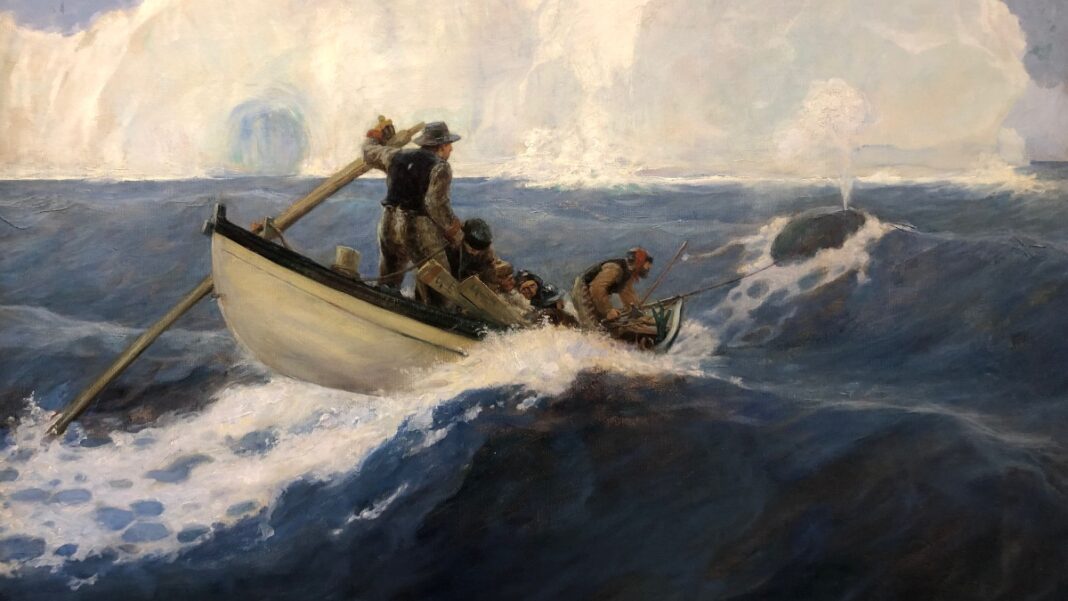
Featured image Clifford Warren Ashley, Public domain, via Wikimedia Commons