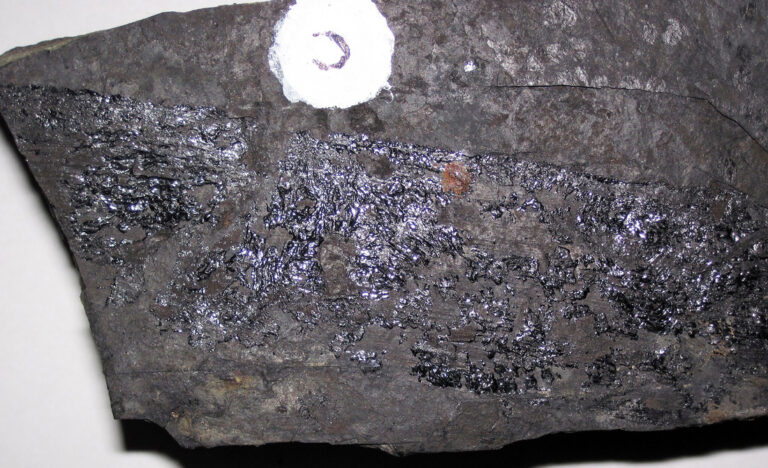
Am I such a romantic to believe that the coaling of the furnace was a job my parents enjoyed sharing before it was exchanged for oil? They seemed to have a rhythmic shoveling knew the coal hours burn-time took turns descending to the dank basement. My mother didn’t want me to spend time there in the dark musty dirty depth of the house, would come check on me if she thought I’d stayed down too long. What was I doing in this mysterious area lit only with a dangling bulb? Mom wanted to protect my curiosity from harm. I wanted to unravel the secrets of boxed memories. Loving warm coals cooled to remembered embers.
Clean Canvas
My house has interactive art. Pieces that I have placed change arrangement every two weeks. She re-moves the boredom of the job she has to do the job I don’t want to do, now don’t have to do
I hope she notices that I keep her creativity until her next visit when she is inspired to move the paint brushes to a new order the rocks in the bathroom to other rocking positions the knit bag of sage jumps up top the quartz splash the towel postures itself on the right this time
dining baskets, basil, and squash in a row on the table Italian sculpture and tins balanced on the server painting abstract pictures with her duster. She has an eye.
Dianne L Knox is a poet who lives in the Pacific Northwest on the Olympic Peninsula in the small town of Sequim (skwim). Dianne is a marketinggraduate of the University of Iowa, worked for a defense communications corporation in Business Development, owned a small business, practices and taught Tai Chi, and is a rabid reader, listener, observer. Knox has been published in several anthologies, Cirque Literary Review, Tidepools Literary Magazine, Port Angeles Fine Arts Center Poetry in the Park, Poetry Corners Bainbridge Island Press, Avalanches in Poetry III, Inspired by Art, Blue Whole Gallery, and her book, Red Hot Pepper.
The world was dark. Very dark. Political tensions were high. He thought maybe a star. A very bright star. Could end the violence
at the border. It would have to be very particular. Like recruiting dancers of DNA. Yet, universal as grief’s bulldozer burying hearts in heaven.
The need for intervention was clear. My offer to help accepted. History was introduced to my lover, Lord Belt. A perfectly pierced
serpent of leather. Friendly enough to plan the reveal of beautiful inches of ecstasy Yet, easily converts to a wrist accessory.
If holy submission transforms the bed. Into a manger scene. Mary becomes Queen of the Prom. Making me a wise man with gifts.
Flooded By Fictions of Rescue
If you get this close to the edge of drowning floating may seem like a dream to you rising from beneath the sawtooth waves where fear is just my breath god said, helping the body stay cool and calm before your future’s phallic vessel arrives with screaming animals.
Fast forward to the desperately needed tsunami in your frigid pool of affection where lightning’s slow-motion burn can cause serious marine life arousal, can make thunder’s bad-ass biblical mouths into back-up singers for Noah’s last song, Flooded by Fictions of Rescue.
Daniel Edward Moore lives in Washington on Whidbey Island. His work has appeared in Southern Humanities Review, North American Review and others. His work is forthcoming in The Stillwater Review, Verse-Virtual, and Action Spectacle Magazine. His book, Waxing the Dents, is from Brick Road Poetry Press.
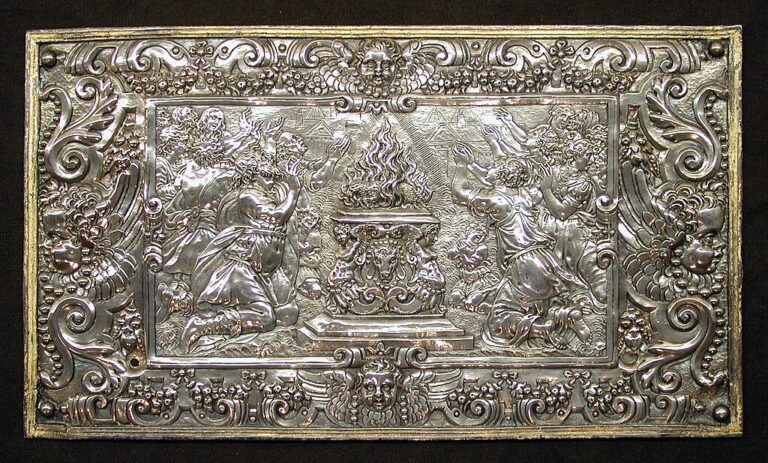
Image: “The Sacrifice of Noah,” Metropolitan Museum of Art, CC0, via Wikimedia Commons
I must grow leaner With thought and age: from wine to Water, beef to broth.
Between here and there, Should a man of decline choose Prayer over repair?
When my final choice Is finally made, one more Comes around again.
Oldness (triple haiku)
I’m old, and yet grand – Of fables that raise a name And remain. . .I claim.
I’m old and better For it: less guess and excess; Less conquest and rue.
I’m old, but able To seize the last refuge of Weakness for satire.
When (triple haiku)
In the shadow of Contrasts, the older I get, The simpler I mean.
I grew tired growing Older, so I decided To lie low instead.
It is not enough To know how the world works – we Should also know when.
In excess of 50 poetry journals, plus numerous newspapers, have published J. Chester Johnson’s poems. Outlets/venues include: The New York Times, Literary Matters, Best American Poetry Blog, Poets House, Harvard College, Trinity Church Wall Street, Troubadour (London), and the BBC, among others. Recent poetry books by Johnson are St. Paul’s Chapel & Selected Shorter Poems (2010) and Now And Then: Selected Longer Poems (2017).
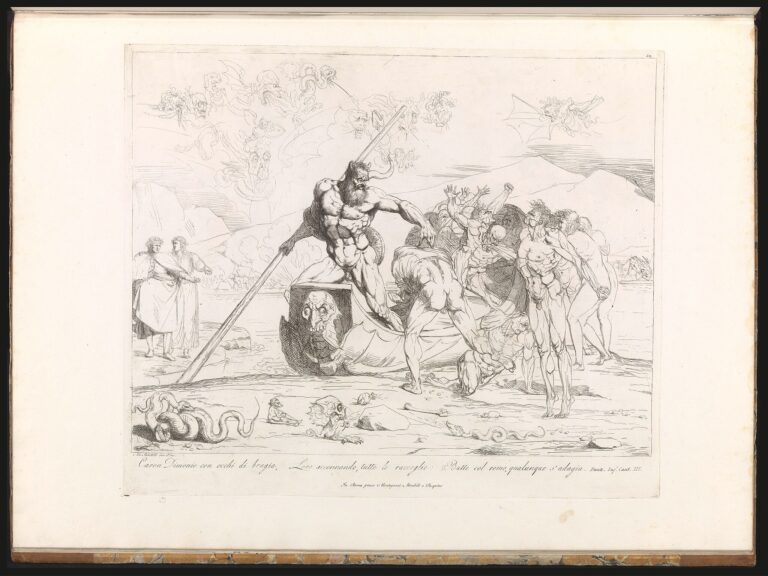
“Charon, the ferryman of the dead, his hand on the boat-pole, calls me now: ‘Why are you tarrying? Make haste, you hinder my going!’ He speaks impatiently, urging me on with these words.” Alcestis (255) Euripides
Inside, your heart weakly beating, rigors rising, wounds weeping – they are sad, too, overwhelmed, out of options – and you are at the end of your bones. Outside, it is late in the yellowed afternoon. Beyond windows and walls, beyond buildings and borders, in the gray misery of the river, is the skull-adorned bony spine of the boat we all know. As your first-born, and, now, your guide down this particular path, I am also out of options, with nowhere else to go.
I should have money to lend, extra funds of any kind. You suggested I save, but I didn’t listen, so I have no coins for your journey. Let’s not pay Charon anyway! We can just say we are lost and blame my bad map skills. Or proclaim we are on the outs: we won’t join queues, follow his rules. Still, you seem resigned, ready for the river, on your way to slip through. Don’t give in to him! Stay with us on this side; don’t make the grim choice to cross forever.
So let’s not pay Charon! I don’t mind being haunted if you don’t mind a hundred years wandering around down and out on the riverbed. We love purgatories, right? So many cautionary tales come from crowded limbos: those delicious, treacherous spaces. Perhaps you met Charon before, were introduced, briefly, so you know when it is your time to cross the river it won’t include me. Charon isn’t confused by my presence; he knows this is our first nodding acquaintance.
In the late afternoon, they come in and prepare you. In the late afternoon, comes sullen Charon in his precarious boat. Expecting his tip. But I won’t let him touch your bones. Would never let him touch your bones.
If you get in, in there, in his makeshift boat, you will never be out here, on the outside, again.
Please don’t say you’ll pay Charon! He’s ugly and surly and nobody likes him. Don’t look at him or meet his knowing gaze. Go no contact! I’ll be all about keeping Charon’s chaos under control, organize the future within an inch of our lives because organization insists on more time. If you get in, you will be beyond the realm of my vision. If you get in, he will whisk you away! And I know why you won’t let me dip in a testing toe or two: I wasn’t raised to be charming; I have nothing to barter or trade.
In the late afternoon, comes churlish Charon in his flat, low boat. You pull your eyes open, so you can see me, one last time, keenly, bright, in the artificial light. Sometimes night comes early. Soon it will be too dark to see. I am here, outside, where I will keep an eye on the world for you. Oh, but inside is my own heart, my own organs, my own bones! For now, they are still ripe and whole. You board the boat; Charon has lost all patience, and it is time to go.
At the End of My Bones
Who were these bones for if not for you. Watch me and wait for the wearing away. Slim, long, thin on the scan: hairline fractures everywhere. You’ll slice your fingers open following the patterns, so don’t trace my splits at the neck, the thighs, the hips. Sharp points at the turned-up collar. Bonds broken between bumps and bones. Shocks in back. Small breaks in spaces. Sudden collapse. This won’t end well. Neither surgery nor medicine will fix this mess.
Who was this body for if not for you. I wait my turn while you watch and wait for the wearing away. Stay with me. Our uneasy relationship with memory. Still, imagine us the way we were. Everything in its place then. Pulling its own weight then. Those whole dull-edged bones, covered top to bottom with smooth skin. So soft, so lovely. Watch and wait for what happens next and when. We won’t wait long for it to set in. Watch me wearing away.
Naomi Bess Leimsider’s poetry book, Wild Evolution, was published by Cathexis Northwest Press in June 2023. In addition, she has a poetry chapbook forthcoming from Finishing Line Press in Winter 2026. She has published poems, flash fiction, and short stories in numerous journals. She has been afinalist for the Acacia Fiction Prize, the Saguaro Poetry Prize, and the Tiny Fork Chapbook Contest. In 2022, she received a Pushcart Prize nomination for fiction.
From construction paper layered in pipe cleaners, uncooked noodles and cotton balls;
to cardstock trimmed for business cards, in neat stacks or sweaty palms;
to printer paper taken from the office for a pile of resumes fed on home ink—
our shell grows thin.
Soon, I’ll be as flimsy as onion-peel falling from my fingers, translucent as parchment paper baking in the oven, growing loose in skin and fucks to give.
Culinary science
sand-crumb constellations wash away in pearly tips as sea lice leap on a bed of beached carrot-peel seaweed stretched beside mushroom-slime kelp baking in LED sun— sea foam blows like tumbleweeds across the frothy shoreline which blubbery seals chase in their floppy gallops while slippery fish slide down black holes of hungry whale throats, teeth like tines, but it’s the prehistoric, noodle-legged jellyfish who keep all in line.
Felicia Clark is a literary fiction and creative memoir writer, poet, and author of her debut book AWAKE: Poetry for the Healing. Her work has also appeared in literary magazines, newspapers, blogs, and multi-authored books. Felicia lives as a nomad in a house on wheels with a home base in the heart of Wisconsin, where she was born and raised. Follow her at FeliciaClarkAuthor.com or @measurelifeinbookmarks.
Featured image in this post is, “Santa Monica sunset and ferris wheel” by Peer Lawther, licensed via creative commons 2.0 via Wikimedia Commons.