Home Blog Page 15

Duloxetine by Jill Khoury

This poem is published as part of the Amplifying Disabled Voices special section, selected by editors Christopher Heuer, Marlena Chertock, and Gregory Luce.
 

Duloxetine

i wake and step toward the dreadtime /
crouched in casualty posture / it’s hard

to straighten / these days / always con-
striction / in the fascia lattice / in class

/ silk filaments fall on my face / i am
told to leave them there / not real /

stop picking at yourself / as if my skin
is a crawling / to be solved only with

patience / if only i could work my will
harder / in therapy / i empty in the telling

/ then the injury / resaturates me with stories /
again / like the glutted flea / no end
 

Jill Khoury (she/her) is a disabled poet and a Western Pennsylvania Writing Project fellow. She lives with OCD, fibromyalgia, PTSD, and congenital blindness. She has taught poetry in high school, university, and enrichment settings. She holds an MFA from The Ohio State University and edits Rogue Agent, a journal of embodied poetry and art. Her poems have appeared in numerous venues, including Copper Nickel, Bone Bouquet, Dream Pop, CALYX, and The Poetry Foundation’s Poem-A-Day. Winner of the Gatewood Prize, her second full-length collection earthwork is available from Switchback Books. Connect with her at jillkhoury.com.

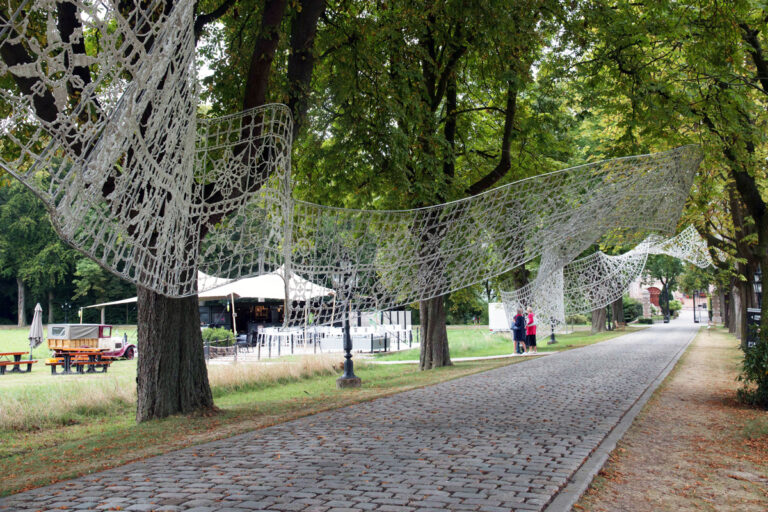
Featured image in this post is, “Lacework at the exhibition PIKANT” by Sally V, licensed creative commons via Wikimedia Commons.

Two Poems By Anne Rankin

These poems are published as part of the Amplifying Disabled Voices special section, selected by editors Christopher Heuer, Marlena Chertock, and Gregory Luce.


left unsaid

nights on the psych ward, my family lies in bed
with me. even in our mostly estranged state,
i hold onto their sadness, & can’t let go
of mine. they never checked in but i can never
check out. all over the unit the halls go dark,
but sleep only comes through chemicals
the way wastewater percolates a leach field.
as i wait for the relief of unawakeness
in the bed i’ve been assigned,
the nurse’s station shines like a beacon.
yet nothing good is there. unless you count the dulling
of an ache that returns & returns. they’ve got plenty of that—
in many colors & shapes—but when they hand you
the little paper cups where your dreams grow, know
you are swallowing more than you bargained for.

tossing & turning on the vinyl-wrapped mattress, waiting
for my mind to eclipse itself, i remember my outside life.
that three-day weekend my brothers visited me,
their friend’s disappearance & probable suicide hanging
in the air. suddenly i’m back with them in that present.
& nothing is past or tense. we joke wildly about our crazy
family; everything painful is up for grabs—
clay pigeons tossed like targets. the three of us trying
to outdo one another, our sharp tongues like knives
being honed on each other’s whetting stones.
i laugh ’til i almost pee.

but the friend still hovers.
it’s the thing we don’t say to one another.
it’s the only thing we talk about.

that whole weekend, far too much of me is left
unsaid. parts that need to be heard & held.
my struggles stay as dark as these hallways.
when no questions are asked,
you’re still left with an answer.

      ~                               ~                                ~

days on the psych ward, there’s plenty to say:
mornings when they make us rate our potential for self-harm,
the too-lean teen with shaved head & bandaged wrists
insists she has no safety number: Jesus is my safety net.
or the middle-aged scraggly-beard who needs to recite
every Rush concert he’s ever seen each time they table us
for lunch. or art room afternoons, the young man with an old soul
lets slip with a timid grin he believes Appalachian Spring
to be the cause of & solution to all his problems.
i envy them their delusions, the luxury of denial.

all of us far too aware how our brains can’t
handle what got put there. & how there’s too much
to say about that. but i speak very little,
even in group. i see no point
in playing catch when i know no one
will get the balls i toss.

with the TV blaring at the blank stares in the day room, i’m sifted
through the remains of that weekend with my brothers.
& i realize then, years after i should have known this
as clearly as my grandmother’s wrinkles
are invading the back of my hands,
my brothers & me—
we don’t bleed the same way.
 

Pattern of Barely

I forgot where I’d put the ocean.
And all the languages it spoke. Stuck
in a pattern of barely. Eating and sleeping
became daily mountains I had to.
Climb. Backwards.
In the rain.
On my knees.

I’d wanted to carve a boundary,
using a river as a guide. At that point,
the dog was with me. Now I know
what I thought I knew
I never did. Would need to repeat
for the foreseeable future.
It’d be a long time before

any kind of understanding could leave
its teeth in me. Too many nights,
moon muffled by clouds.
Too many weeks, prone
to the couch. Foreverly stale
as a blank page, writing another
etiolated letter to someday.

I’d wanted to grow an ability
to be soft again, to unfetter
my breath, stop waiting
for the next awful uphill thing.
Later I quit what was left
of the job, leaving me even more
poor again. An archetype of scant.

What engines the darkness
fell down my throat. Too often
my stomach masquerades
as a parking lot. Too chronic
for words. Which
medicine? What
medicine?

Inside my skull
a wolf keeps howling.
I want to let her go.

Anne Rankin’s poems have appeared in The Healing Muse, The Poeming Pigeon, The Awakenings Review, Hole in the Head Review, Passager, Scapegoat Review, MacQueen’s Quinterly, Atlanta Review, Comstock Review, Whale Road Review, Kelp Journal, Abandoned Mine, Does It Have Pockets?, kerning, The Bluebird Word, Boomer Lit Magazine, Rattle, and Maine Public Radio’s Poems from Here. Her poem “Dear Acadia National Park” will appear in the forthcoming anthology, The Nature of Our Times: Poems on America’s Lands, Waters, Wildlife, and Other Natural Wonders. Her essays have appeared in The Columbus Dispatch, The Mount Desert Islander, and The Washington Post (for “Life Is Short Autobiography as Haiku”); and she has a short story forthcoming in The Main Street Rag.

Featured image in this post is, “Moon and clouds over Goulburn” by CephasOz, licensed creative commons via Wikimedia Commons.
I wake up with you not beside me by Nathaniel Lachenmeyer

This poem is published as part of the Amplifying Disabled Voices special section, selected by editors Christopher Heuer, Marlena Chertock, and Gregory Luce.

I wake up with you not beside me

I wake up with you not beside me
but in me in different parts of me

elbows knee neck the middle rib
on my right side you have the run

of the place I can’t stop you
can’t predict from one morning

to this morning where you will be
or how long you will stay like

an unwelcome guest with its own
set of keys and doors too that open

into every part of me this thing
which is supposed to be my home

the one place where I can rest and be
alone at peace sometimes I swear

I feel like the place is yours and
I am just the ghost that haunts

this house all the time a ghost
without form or substance that feels

too much and only one terrible thing
which is you which is I won’t

name you if I do I am afraid
I am afraid you will never leave

Nathaniel Lachenmeyer is an award-winning disabled author of books for children and adults. His first book, The Outsider, which takes as its subject his late father’s struggles with schizophrenia and homelessness, was published by Broadway Books. His most recent book, an all-ages graphic novel called The Singing Rock & Other Brand-New Fairy Tales, was published by First Second/Macmillan. Nathaniel has forthcoming/recently published poems, stories and essays with X-R A-Y, Iron Horse, North Dakota Quarterly, Citron Review, Reed Magazine, Potomac Review, Epiphany, Permafrost, Berkeley Poetry Review, About Place Journal, and DIAGRAM. Nathaniel lives outside Atlanta with his family. www.NathanielLachenmeyer.com.

Featured image in this post is, “Fröndenberg 20170604 12” by Enyavar, licensed creative commons via Wikimedia Commons.

Always There by Jennifer Daschel

This poem is published as part of the Amplifying Disabled Voices special section, selected by editors Christopher Heuer, Marlena Chertock, and Gregory Luce.
 

Always There

Been so long it is hard to remember
   surely it couldn’t have been that bad
A single twinge reminds me, it’s always there, lurking,
   scaring me,
Is it happening again…

   Don’t touch me, it hurts.
   Why does it hurt with just the slightest breeze?
   Why do the doctors not believe me
   Fire shooting straight down my arm,
      Color changes, always cold, NO…

No, not this time
   breathe deep, it’s fine for now
Every time it’s the same
   the fear is always there.
Remission never feels like forever
   hopefully it will be long enough.
 

Jennifer Daschel was diagnosed with CRPS, RSD as a teenager – currently in remission. In addition, she has lupus and gastroparesis. Her daughter, now 17, became disabled at 14 from a progressive neuromuscular disorder and a brain injury. As her full-time caregiver, she continues to learn about ableism and inclusion. She and her daughter continue to advocate for disability access.

Featured image in this post is, “Life is a fractal explosion” By Joselodos – licensed creative commons via Wikimedia Commons.


Two Poems By Kathryn Schug

These poems are published as part of the Amplifying Disabled Voices special section, selected by editors Christopher Heuer, Marlena Chertock, and Gregory Luce.
 

32

32 Units left
Never out of my mind
Humalog* but not humorous

Always on my mind
The tubing snaking up my back
A constant reminder, a slither
A whisper

Did you bolus?
Did you actually count?
Did you do it right?

You’re falling
                   Falling
                            Falling
Oh no, you’re shaking
Oops, you over did it!
What a shame,
Now you’re rising
                            Rising

                                                    Rising

                                                                and yet

                                                                           still Failing.

                                                                                    Failing
                                                                                            Failing
                                                                                                    Failing
                                                                                                            Failing

                                                                                                                Fail

* An artificial type of insulin used to treat type 1 diabetes. 32 references the remaining units in
an insulin pump.

Dis*a *bled
 
dis*a *bled \ adj. 1. A “differently abled” person/A label created by “able” bodied people, / So as not to distinguish the disabled/ No dishonor/ Yet they disengage the community/ One word doesn’t provide justice. /It doesn’t even begin to describe the experience/ The, “my grandma has that”/ The, “I know everything about you”/ A label not of their own but of someone else’s ideals./Distinguished/Dishonored/Disengaged. 2. Some pain visible, others just plague the mind. / Silent suffering no one knows about/ The thoughts it takes to get out of bed/ Never enough. / The cycle of shame never ends/ The, “I have that”/ The, “I understand” / Reds, purples, yellows, and blues collide/Flesh barely staying alive/Fighting a body that tries to kill. / Always on that daily grind, / Constantly sleep deprived, /To survive. /Bled/Blood/Blame.
 

Kathryn Schug is an aspiring writer and book arts artist. In 2023, her poem, “Voices of All” won the Dexter R. Stanton MLK Art & Essay Contest College Award. Also in 2023, she won the Undergraduate Prize in German Studies in English from The Ohio State University, the first student from the College of Saint Benedict and Saint John’s University (CSB+SJU) to win. Her altered book, My Book House: Unlocking Personal Lives, was featured and given an honorable mention in the 2023 All Student Juried Exhibit. In 2024, Schug was the curator of the exhibit, Duality: Artists’ Books Exploring Multiple Sides. Recently, Schug co-authored a peer-reviewed article with Dr. Ted Gordon, “Rights of Nature: The Indigenous-Led Movement for Sovereignty and a Sustainable Future” published in The Journal of Social Encounters. Schug has lived with Type 1 Diabetes since 2009, a condition that has impacted every aspect of her life.

Featured image in this post is, “I hooked up my new insulin pump. Not quite bionic, but it augments my body” By cogdogblog, licensed creative commons via Wikimedia Commons.