Home Blog Page 20

Three Poems By Jada Carter

These poems are published here connected to the partnership between the Mid-Atlantic Review and Howard University and a recent event for the Howard community. 

It took too long to say wrong

What’s right, what’s ?       ?
I forgot my bag—my bad
        I didn’t forget; I just figured it would tear
Anyway
But it dragged along my heels, desperately moaning
it, too, possessed baggage

I like kicking rocks and relay races
        they’re both ways I make my exit
‘cept one ends where I started

I fell forward once—gracefully,
and somersaulted towards my hat
It held like a bucket
It was a bucket
steadily collecting raindrops

But just like my hair
It, too, was my rite of passage
The pen writes the rest

Took me too long to say
       wro.      
             wrong
Now I just don’t believe in it anymore 
 

Mass Media 

Eat more chicken on the moon?
I heard if you pinch it in the sky, milk will free to feed the stars

Savage bees have been on my mind lately
Twisted telephone poles ring my thoughts
They were stuck in space after I watched the Twilight Zone
My couch clicked like 6-inch heels as it spun around the front room
Over and over I began to dream in circles, everything was sidelined
and both the present and future were left in the dirt

I even got caught in the rain but I wasn’t taught to use the umbrella at my academy
Instead, they pierced holes in my poncho
Said I wasn’t the natural selection
Well I never wanted to be “tall, dark, and handsome”
        They don’t even use that right
I never wanted blue eyes
And I never wanted to wear an “s” across my chest
        it stands for sucka
They don’t ever run nothing

If ratatouille could line dance zucchini would flex across oceans
Over here anything colored is a vermin
This ain’t no melting pot
It’s hell’s kitchen and they kill “rats”
Well not the “good” ones
They called hamsters
And get a cage, a little litter, and a big ole wheel
so they can do all their tricks
Free Fluffy and his backways mindset
Seem he don’t no any better
        But some do

The money bag man has always been the boss, baby
You didn’t know?
He acted like he invented the steps from crawlin to walkin
walkin to runnin
runnin to ridin
ridin to rowin
sailing all way to the not-so-new world
trans-lantic supercharged his journey

Protruding like a yellowjacket amongst hornets
Always doing their dirty down under
Even the slightest foottracking set their anger to thunder
because of all that crunching on hallow crusted cushions
Almost like they had been there before
Certainly, like they decided it’d be forever
if you check the bookshelf that’s what it’d say

60 minutes to 60 seconds and dinner tables don’t exist
Instead, white Jesus does delivery
a two for 10 and don’t nobody do carry-out
Drive up, drive in, pull off
Hot and ready but folks still hungry
Said they had a mission but it skips their own city
Just fishy missiles sucked by their own decisions
That honed on liberty abandoned like its land
Always the lady that must be burdened by man’s lies

Ain’t nothin left to point to
So I just watch the river carry the dirt 
 

Kitchen Creepin’

Shh, or they will hear!
The sound that pounds profusely
all through, head to toe.

Speed not on speed dial
Black dots and spots perform tricks
Barren pits of death!

Too loose tiles cradle
clefts dirtied with sediments
and a tasteless tan

Slow to see and search
Even with eyes of the night
Sappy dough circles
dark, duped by small tumble crumbs
Sculpted by what’s left behind

Day is almost here
Be now if ever a time
To trace the frigid way,
back to the covered corner
When will this wicked race end?

Jada Carter is a junior studying education and legal communications at Howard University and is from Memphis, Tennessee. Carter’s passions are rooted in serving the community, education, and emphasizing the importance of social justice and access within education. She is on the journey of becoming an educator, author, and attorney.

Featured image this post is, “Bees with Honeycomb MET DP-401-001” by Candace Wheeler, licensed via creative commons, Wikimedia Commons.

Three Poems By Susan Mockler

These poems are published connected to the partnership between the Mid-Atlantic Review and Howard University and a recent event for the Howard community.
 

Imagine
for Natalie Clay

Imagine life is a color, a color named imagine
a color so elusive you cannot describe it—a color
that appears different in different light. Somedays
you may say imagine looks gray, dappled, a horse
cantering across a field of timothy, wind-in-its mane-
and tail. Imagine that horse snorting and stomping,
steam blowing from its nostrils. In another light, the gray
may seem so pale that imagine is lavender, early spring
mornings, a cool breeze, a promise of forget-me-nots
and bluebells. Or imagine might be sand, fine-grained crystals
of glass and shells on a beach. Imagine the soothing lapping
of the waves as they ebb and flow to the shore. Imagine
is not unlike a dream—one that lingers long after waking—
one that lets you know you’ve been touched by something.
 

Odyssey

I was an orphan
before I was born,
which is not to say
I didn’t have parents,
but that I could sense,
in my unformed cells,
in the whooshing
of blood passing
from placenta to me,
that this would be
my life’s work:
to tether myself
to something,
to find solid ground,
that my odyssey
would be one of searching
for ground that holds,
unscorched
when hot winds
sweep through me,
like fire, threatening.
 

The Smile

Who are these people
who jump out of cars
on Georgia Avenue in mid-day
near the Wonder Bread Building,
where, if the wind blows just right,
you’d swear you can smell bread
baking, though that factory
shut down over 40 years ago?
Who are these people
who jump out of cars, black
shiny sedans or minis, wearing
ski masks, who jump out of cars
in mid-day and punch a skinny kid
from Brooklyn minding his own
business listening to his tunes,
walking down Georgia Avenue?
And who are these people
who jump out, punch him, stab
him, throw him to the ground,
all for his $1000 jacket—the one
his parents gave him for Christmas—
and you can almost imagine them beaming
when he opened that gift because
they knew how much their son,
their only son, had wanted that jacket
and how much that skinny kid
from Brooklyn’s parent’s loved
him, and how they wanted one thing,
and one thing only—to see that smile,
that smile of his you’d want too
if you’d seen it. So I ask again, who—
who are these people who need a jacket
more than they need a smile on a skinny kid
from Brooklyn walking down Georgia Avenue
in mid-day, who jump out of cars, punch him,
stab him, throw him to the ground and never
give a second thought, not one second thought
to that smile or his parents when they hear
what happened to their son, their only son?
 

Susan Bucci Mockler’s poetry has appeared in a number of literary journals, including the Mid-Atlantic ReviewMaryland Literary Review, peachvelvet, Maximum Tilt, Pilgrimage Press, Crab Orchard Review, Poet Lore, The Northern Virginia Review, Gargoyle, The Delmarva Review, The Beltway Poetry Quarterly, The Cortland Review, The Paterson Literary Review, Lunch Ticket, and Voices in Italian Americana, as well as several anthologies. Her full-length poetry collection, Covenant (With) was published by Kelsay books in 2022. She teaches writing at Howard University in Washington, D.C.

Featured image in this post is, “Field of Timothy – geograph.org.uk” by Derek Harper, license creative commons via Wikimedia Commons

Three Poems By Kimberly A. Collins

These poems are published here connected to the partnership between the Mid-Atlantic Review and Howard University and a recent event for the Howard community.

Mother’s Poems (For Lucille Clifton’s mother)

He threw her words

into dancing flames

watched them become

crinkled ash

charred her daydreams.

He could not tame

the Phoenix he

would never know.

After the vote

A star fell last night
singed broken earth.

Blazed a crooked path
More will follow her.

I wish these warrior women
did not sing their songs

inside my bones.

Art Saves Our Lives

What is bottled up rages through our pens
splashes on canvas, chisels through rocks
that stand in our way as we stitch quilted
patterns to free ourselves from shackled
feet, from muzzles that try to shut our mouths
that we cut with Sonia’s razors between
our teeth so Nikki can ask:

Nigga can you kill? Can you kill nigga?

What we do for ourselves we do for daughters
daughter kind even when they don’t
listen; our art makes them pay attention
Outside validation is nice but not necessary.

We see us. We have always seen us
raising their babies, toiling in their kitchens,
scrubbing their floors, hiding our insides
holding our noses to not smell their lies.

We know without Lucy there would be no them
They still pissed off for being cast out of Akubu
Land. Banished to caucus mountains where they
sharpened their fangs to get back at us.

We know there is no way out of this matrix
without us as Oracle. Sophia saw it coming
She saw this world subsumed in invisible
webs, cyber threads able to wrap its cords
around our throats pop sockets out our eyes
a horror movie of our collective demise.

Warner’s Bro. tried to steal it. They
tried to walk off with all her stuff
she said give it back like a Shange poem.

Butler as seer wrote Parables to be sowed
showed us our end. This is why we ain’t
marching. The warnings were given.
They ain’t listen. Our magic cast a spell
so tough, they set themselves up to
become handmaidens in their own fairytale.

See, Toni reminded us Africans can fly
Pearl told us we were here before men
Tricia told us to Rest in Resistance.

We are storing up all energy in our pencils,
paints and clay to mold out a new path
a more productive way.

We gonna write quiet poems like Pinkie
Lane to sneak up on them; we gonna get
the sweet out the honey, scoop up
the flavor create new praise songs for our
survival with our own sound, do Dunham’s
Rara Tonga; Judith’s Cry all over their tremb-
ling tears without bending our knees

to see what they need.

Kimberly A. Collins MFA is a Poet, Callaloo Fellow, Pushcart finalist, and Master Instructor in Howard University’s First Year Writing and Poetry Program. She is the author of two books of poetry, Bessie’s Resurrection (Indolent Books 2018) and Slightly Off Center (1993) as well as a collection of essays Choose You Wednesday Wisdom to Wake Your Soul (2017). She is the founder of SOAR (So Others Ascend Righteously) where she empowers others through her writing for healing methods and programs. Her early work appeared in the seminal anthology edited by Ras Baraka and Kevin Powell, In the Tradition: An Anthology of Young Black Writers. Her most recent poetry appears in: It’s the Honey(2024) edited by Kwame Alexandar, The 100-year house (2022), Beltway Quarterly (2019), 50/50: Poems & Translations by Women over 50 (2018), Pittsburg Poetry Review, Revise the Psalm: The Gwendolyn Brooks, Anthology; Syracuse Cultural Workers’ 2017 Women Artist Datebook, Truth Feasting: Anthology of African American Writers (2016), The Berkeley Review and more. She is a native of Philadelphia who currently resides in Washington, D.C. Look for her at www.Kimberlyacollins.com.

Image: Comet Crash, Ben Crowder, CC BY-SA 4.0 https://creativecommons.org/licenses/by-sa/4.0, via Wikimedia Commons

Four Poems by Hari B. Parisi

Change of Elevation

When we first moved here, birds—
red-headed house finches, I believe,
a family—twittering high up

in the blue spruce that hangs
from the neighbor’s yard. You can’t see
them. The mother’s made sure of that.

This town is where I grew up. Left
at eighteen. I’ve come back. Family
is here. Mountains to the west, broad

roads I used to drive. I’ve been told
it takes two years—adaptation.
I’m impatient to get there.
Not so sure I’ll ever arrive.

The city is gone
for us. How do you grieve the sea,
the Jewish deli on the corner, cheering

from the stands with 40,000 fans,
driving the Saturday streets to lunch with
a friend? Now, three thousand feet up—

no purple jacaranda, no spindly palms,
bent to the offshore breeze. No buzz.
It’s a different kind of lovely.

First Snow

It arrives without fanfare, without drama, at dusk
on a Sunday in late November. I don’t see it come
down, catch a glimpse through a foggy window—

draping the bent fir beside the pond, brushstroke
sweep across the top of the fence that runs between
neighbors, crystalline spikes on blades of browning

grass. It’s been decades since I’ve witnessed the first
dusting of the season. It’s going to snow more in
the coming weeks, months. Winter has not even begun.

There will likely be days when I won’t be able to get out
of the driveway; below zero days with icy streets, when
I’d do anything to be in the tropics wearing a tank top

and shorts; days I’ll pull on boots, gloves, a knitted cap
and fall back into deep drifts, just to feel the penetrating
cold, like I did when I was five. Today, after a long week

of grief and sorrow, questioning what is good, what is
fair, I take it as a sign, this smattering of pebble white,
quiet soothe of it—sleep the night, know I’m still alive.

Strawberries

The metal racks in front of Bi-Mart are jam-packed with baby geraniums,
silver-leafed lavender, red, purple, and pink phlox. Succulents in starter pots:
Hens and Chicks, Turtle Shell, Donkey Tail, Blue Chalksticks. Roses, plain-Jane
shrubs, and saplings in five-gallon tubs, droop from the mountain-high heat.
I twist through the aisles, looking for plants to plug into barren spots in the beds
where perennials died off from the freezes this winter. My husband beelines
for the strawberries, plucks six of the best from a flat, places them in the cart,
stands, toe-tapping, as I round up my choices. At home he plants the strawberries
18 inches apart on a barren strip of gravel-strewn ground skirting the driveway.
After they’re in, he digs through a box of sprinkler pieces, ferreting out plastic
tubing, elbows and heads; sets up a drip system to transport water to the molded
dirt basins at the base of each plant. I sit to his right, wresting clover, dandelions
and errant fescue wedged in a short rock wall. “The deer will eat them, you know.
Strawberries are like dessert to them.” He shakes his head, “Maybe, maybe not.
I like the thought of them being here.” Brought up on a farm, where they raised
their own food; canning, curing, freezing fruits, vegetables, and meats—laying it
all in before first freeze, it’s what he knows. Drip lines are tested and deliver,
ground raked and driveway swept. Twilight has passed. From the upstairs window
I can’t quite make out the strawberries, but I know they’re there, taking root.

We lived in a flat town

in a flat house with a grizzled backyard
open to the dirt and graveled
alley, lined with banged-up
tin trashcans, knee-high weeds:
a stopover refuge for the occasional stray.
The neighbors directly to our south kept
mostly to themselves, the Hunts—
both lanky-tall, with sunbaked lips
and brows, a measured old-school countenance.
He was a lawyer. She baked latticed pies,
grew tulips, daffodils.

The day my father chopped off
the chicken’s head and its body ran
heedless, up and down the alley,
blood spouting, spewing,
and my three sisters and I
unable to utter a word in the witnessing,
Mrs. Hunt walked out her back door,
across her manicured lawn
and brought us popsicles—
handed them to us one by dripping one,
over the low-slung picket fence—
cherry-flavored; icy cold.

Originally published in Cola Literary Review.

Hari B Parisi’s (formerly Hari Bhajan Khalsa) poems have been published in numerous journals, most recently in Atlas and Alice, Paper Dragon and Poetry South. She is the author of three volumes of poetry, including She Speaks to the Birds at Night While They Sleep, winner of the 2020 Tebot Bach Clockwise Chapbook Contest. She has recently moved from the city back to her hometown in the heart of Oregon.

Image: W.carter, CC BY-SA 4.0 https://creativecommons.org/licenses/by-sa/4.0, via Wikimedia Commons

Two Poems by Antreka Tladi

0

ZULU, THE LANCE AND THE LANGUAGE

First, the language refused to enter my ear and be understood.

Instead I chased words around,

words that hovered beyond grasp

and flew like swallows beyond Inanda hills,

 beyond Ixopo mountains

and down to the Umgeni rivers.

Zulu held a knobkerrie and threatened to knock

my head every time I pronounced a word wrong,

Some phrases came crushing down like violent waves

at Isipingo beach or stretched my tongue like a tent

and nailed it upon my teeth.

I remember some time ago, I tried addressing a meeting

of the Indunas at Umthimkhulu in isiZulu – Oh dear me;

It wasn’t my intention to kill those warriors with laughter

“ Uthini Lo muntu?” they asked.

It felt as if my mouth was a jungle –

A dense forest of entwined foliage,

Where it was hard to come to comprehension.

It felt as if my tongue grew a tangle of grass,

The sharp blades piercing my palate.

They didn’t know it was hard speaking Zulu,

It had to do with the clenching of jaws

and the wielding of shields and spears.

WHAT’S THIS PLACE AGAIN?

A herd of cattle still graze in the field

On the plot of land where the authorities

Had proposed to build a shopping mall

Its proposed name on the rust-stained board

Begins to fade and peel away

The windmill that used to supply the villagers

With water

Had since went dry and leans heavily against

An old crumbling concrete slab

And so are hopes and dreams of a community

Hanging in spider-webs

I sit beneath the Marula tree and watch

The black bull in the eye where it graze

The grass is dry – the land parched

The name of the village on the signpost

Had faded away too, a passer-by stops to ask:

“What’s this place again?”

Antreka Tladi was born in Jane Furse, Limpopo, Republic of South Africa. He grew up in Phokwane, Brooklyn where he received his primary and secondary education and currently lives. His poems have appeared in local and international anthologies and journals including the Avbob Poetry Project, Calabash Literary Journal, New Coin and the Otherwise Engaged Literature and Art Journal among others. His debut collection of poetry titled Mother’s Kitchen and Other Places was published in 2023.

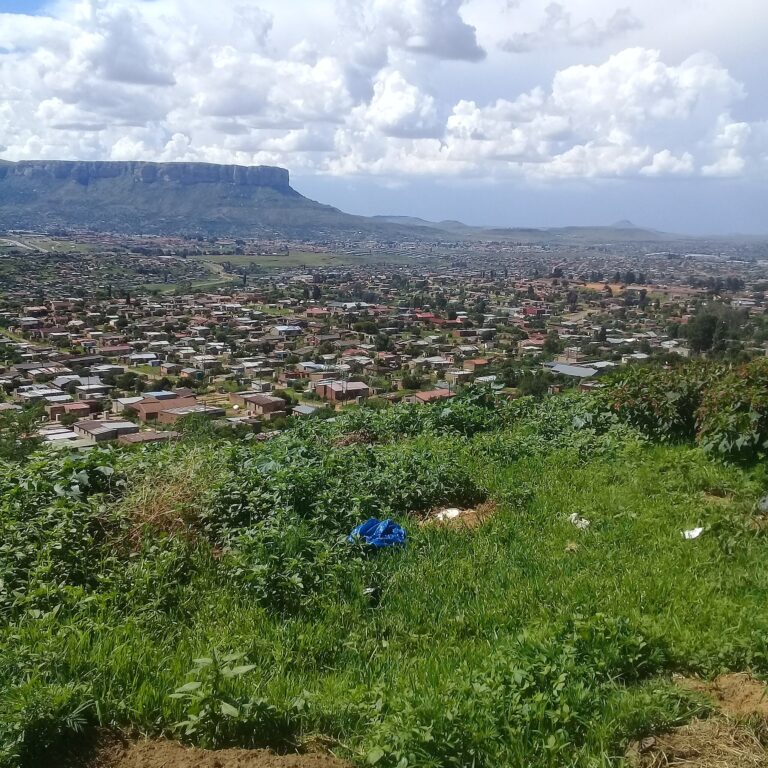
Image: Mpele Thokozane, CC BY-SA 4.0 https://creativecommons.org/licenses/by-sa/4.0, via Wikimedia Commons