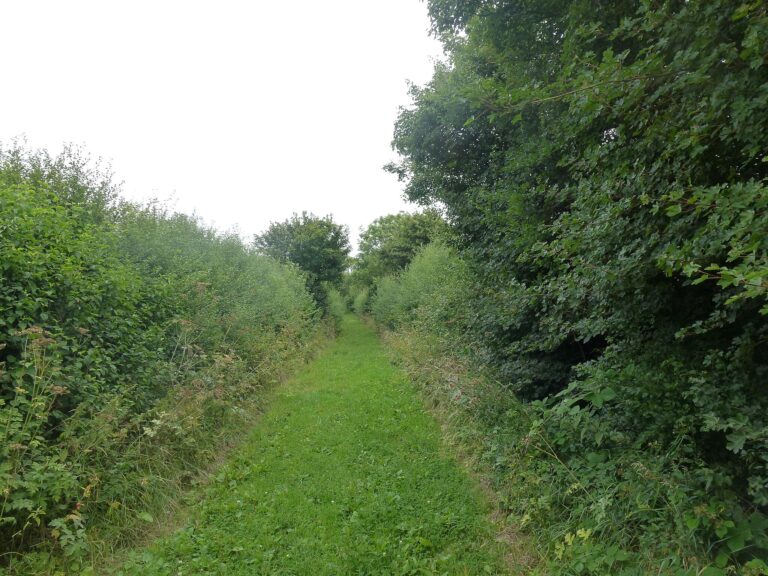
Only the forest remembers and us. The sturdy, low boughs held us in our youth as we climbed. The upper twigs swayed and bent in the wind. From the tops, through leaves and clouds, the sailboats shined on silver waters. Waters running from Chicago to Alpena, Detroit to Montreal. The waters follow that highway of sorrow and forgetfulness, Mackinac to Mobile, Timbuktu to Shangri-La.
Only the forest remembers the broken shale. Knee deep shards lined the gulch carved by ancient ice and snow. When the glaciers receded and the Pleiades fell to sandy shoreline solitude, when sumac burned crimson, vermillion, jasper before November’s gale, before Friday nights at Curtis Field, water and wind worked their magic and the Devonian hexagons bleached in the drought of August.
Only the forest remembers and those warm midnight stars. We found Sagittarius in the eastern sky and The Dipper’s double glow. Ptolemy knew the archer was thirsty. Ptolemy knew when the hunt was lost. And with that J. C. Penny telescope, we knew the lunar mountains. Shadows cast ‘cross craters and across benighted minds of childhood’s fancy. With astral projection, we never looked back.
Only the forest remembers those long days spent as mountain men, trappers, and Allied soldiers slinking across enemy lines to blow ammo dumps and liberate France. Each broken branch a Winchester or an M1 Garand. Each of us, Lee Marvin or John Wayne. “Say your prayers, you Gerry bastards!” we called wading through trout lilies and barberry thorns. “We have you in our sights!”
Only the forest remembers and us. Those long, lazy afternoons biking through the trees. Catching air off exposed roots, we soared like harriers. Rounding embankments with no hands. “Look ma!” we called to no avail. Parents weren’t watching. Our summers remained unsupervised, remained free. They’d call us for dinner; we’d run home for tacos or hamburgs and hotdids before returning to the woods to live out grandiose lives until bedtime called to us again.
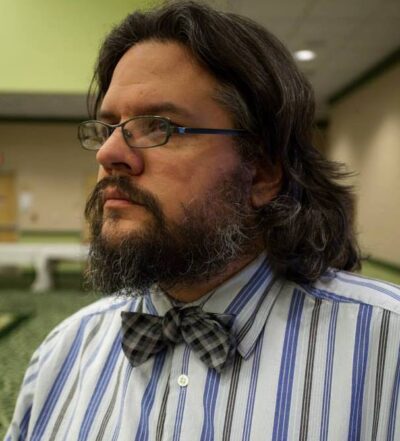
Andre F. Peltier (he/him) is a Pushcart and two time Best of the Net nominated poet and a Lecturer III at Eastern Michigan University where he teaches literature and writing. He lives in Ypsilanti, MI, with his wife and children. His poetry has recently appeared in various publications both online and in print. His poetry collections Poplandia and Ambassador Bridge are available from Alien Buddha, and his collection Trouble on the Escarpment is available from Back Room Poetry. He has another collection forthcoming in 2024: Petoskey Stones from Finishing Line Press. In his free time, he obsesses over soccer and comic books. www.andrefpeltier.com Twitter: @aandrefpeltier
for a massacre. It won’t make any difference if I read their names or examine the brief biographies. They’re children. They did the things children do. If their parents fall on each other, unable to hold their tears, the TV audience shakes their heads. How heavy the heads feel. If you set them on pikes around the rim of the city, the heads would bend and sway over travelers, who find the customs puzzling.
do what everybody is
There’s an admonishment I hear as I bundle my mornings together – glacial lace for the winter.
Why can’t I be someone’s regular dog, quiet at the end of the leash, underwritten by faith? I have an ear for a whistle, a tooth for your eye.
Cats in the rain
I unrestable, I pur my hands on the table, I chap my elbows at you, I tape my toes together so they don’t go off on their own. I doll-faced with a new day’s makeup, a parcel wrinkled at the corners, paper torn, but in my dreams we dream together the same deprivations – music at the bottom of an empty soup bowl, the scrape and bang.
Fly away, the train gnarling in front of us, my sweaty grip on the plastic handle of the suitcase. We are going somewhere with beer soda and ice cream, raight under the plane trees, the freckles of bark littering, a slap to the museum of snow.
Musical figures: church supper
1. A rattle of folding chairs 2. A smacking of coffee cups 3. Gum tocked as punctuation 4. Laughter banging over grief 5. Lint in pockets rolled 6. Lipstick patched over dry lips 7. Smells of mildew and wax on choir robes as the robes jostle 8. The solitary washer of dishes tipping saucers into the sink.
Samn Stockwell has published extensively. Her new book, Musical Figures, is published by Thirty West Publishing House. Previous books won the National Poetry Series and the Editor’s Prize at Elixir. Recent poems are in Ploughshares, Pleiades, and others.
One afternoon, I found a snow- white barred owl lying prostrate at the base of a pine tree. She was the most solemn, most beautiful creature I have ever seen. Even in death she was holy.
I asked if I could bury her, only for men to laugh at me. I was to bag her up, throw her away. I could not bear it. I left this task to someone else as the wind called down in mourning from the highest peaks of the mountains. It was one of those days when the new-green of the forest is so bright, it makes you want to cry for the effort the world puts in to rebuilding itself right when winter starts to feel like the end of every thing.
I should have stayed with her. Seen her off. But the world
knows better, even if I do not: I am older now, and she is growing into new life, still. Slowly.
What men disregard, nature tends to with time.
blue jay
Turning the corner a line of dark blue feathers with tufts of white are strewn across the ground. Never ending,
the violence of this end stuns me to stillness: how the air cradled this small soul then the roar of an engine, the blinding beam of the headlight: the final fall, tumbling down from grace. Rolling over and over, like a child down a hill.
What is a bird descending, ascending but the sound of a human heart taking flight?
I always mourn these lost birds I walk past on the sidewalk, their last sight so far from home.
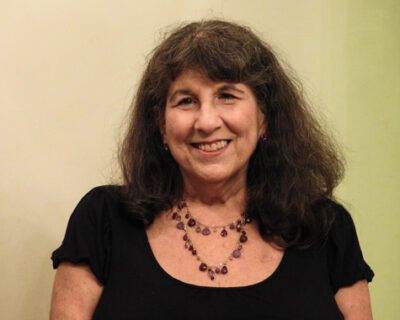
Faith Cotter is originally from Pittsburgh, PA but now travels the world as a U.S. Foreign Service spouse. She is the recipient of a 2010 Society of Professional Journalists National Mark of Excellence Award, among other regional and local awards for journalism. Her poems have appeared in the Pittsburgh Poetry Journal, Time and Singing magazine, ZO Magazine, and the Madwomen in the Attic’s Voices from the Attic anthology. She has an MA in Professional Writing from Chatham University, and has lived in London, DC (where she currently resides), and (very soon!) Amman, Jordan.
1. The buzz comes again this morning, too familiar, a tingling in my buttocks and back, my middle, my ribs. Bees inhabit my body.
A poet I know says you don’t feel anxiety in your butt but I do. Every morning. As if my nerves were plugged into my iPhone,
programmed to go off at 6 a.m. Get up, they say and buzzing begins. I cover my head with the sheet. Dread sours my mouth and bees swarm.
2. Before I was ever stung I loved the small yellow pillows with wings that hovered over clover. Now bees are stealing away from us.
And have ladybugs obeyed the rhyme and flown? The mantis, almost never seen now in our yard, with his long delicate arms,
is he, too, gone? Please, I pray at night, unbeliever that I am, driven to this last resort. In the morning, bees buzz.
I would harbor them all if I could. The swarmers and the borers. The summer gorgers and the winter bugs who creep into our house at night.
3. When Becky was small she stood in our yard, and caught the inchworms that fell into her hands. It wasn’t that long ago. A river of caterpillars
flowed down Highview Avenue every spring. Miner bees nested in the lawn. Tiny Andrena, pollinator of violets, azaleas, and wild plums
The smallest North American bee who does not bite or sting. Still, they spoiled the grass and frightened the kids.
So we poisoned them. Every spring when the girls were small. Please, I say at night. In the morning, I buzz.
Dance in Twenty Moves
Robin on the deck takes flight but gains no height.
My plan—keep all the body parts I was born with but that plan has no legs. How I kicked at four months. Swimmer in a capsule of flesh. Doctor Goral shows me my femur alight with inflammation— the whole head of the bone flattening.
I’m at a holiday party and Lucy (who I just met) chatters. about an old woman whose hip completely collapsed. I feel myself wincing as she talks. The pain so bad they rush her to the hospital. They do an emergency replacement. If your hip collapses does your leg fall off?
My Becky gives me a cane for Christmas— wood, with the handle carved to look like a dove. Remember running, one leg pushes the ground away, the other, the other. One bead short of flying.
O broken necklace whose charms puddle on the floor, O dragon’s tooth, O fire needle, O open flame. When your right hip sears from your butt to your knee— turn to your left. When your left hip burns down your thigh— turn over again. Repeat 500 times.
I drop the dove cane and the tip of the beak breaks off. Pain, your bloom stinks like the carrion blossom. I will never make peace with you. I find the robin’s body with its broken wing still in place— something has already chewed it.
what dreams may come
my brother calls my name the day he’s committed i hear him from my bed 3 thousand miles away
ellen ellen ellen wayne says
who set the tape to loop? the moment repeating
wayne in the squad car the stink of rancid french fries cracked vinyl white stuffing spilling out
my mother babbles how they hated to how they had to who they called
when we were small my arm always draped around wayne’s shoulders
little mother father calls me
i see his ghost in the supermarket turning the corner at the end of an aisle
what happens when the dreamer dies?
will I remember how he came to me between the meats and frozen peas
i mother everyone wayne and baby sharon caterpillars I lift off the driveway
two yellow sunfish i catch and keep in a green glass bowl how their bodies drifted to the surface
i dream of them every night
Through the Hole in the Hedge
I find a child swaddled in the fine tasseled grass here where wild mint blooms on the verge here where the path twists down to the swale
his head a globe of silver fluff airy as any dandelion clock he has no weight
I hold his face close to my own and hear how he hums a sound like the buzz of an infant bee
his face a star with a pointed chin he smells of gardenia and wild wood rose I nest him gently against my chest
wrap him close and follow the trail where red fruit hangs like a thousand suns and moonflower vines garland the trees
here a pallet of rue and pennyroyal blooms I nibble a sprig and festoon my hair heat needles my mouth and disquiets my womb
I lay him down and gather the drupe Cherries that taste of rubies and wine stain my fingers the color of new-made blood
shivers jitter my back to the top of my spine branches clack and the woods begin to chime
and where is my star child my infant my dear? I scrabble through leaves but no one is there
Luna
I yearn for her, but she doesn’t return my regard. I write odes, she refuses to hear. She is Mother, Sister. My own cannot undo their dying. More faithful than they, Moon lounges in her starry bower, returns to me again.
I must have her. I snatch her out of the sky, wrestle her under my shirt. She wriggles so fiercely I drop her in a box, seal the top. It presses itself against the front door. I lock her in the bathroom, barricade the door. She bounces from sink to tub, jumps about like a yearling doe trapped in a cage.
I try to sleep, but in the darkest hour I hear her wail. A person cannot bear it when the moon shudders with sorrow. I fling open the door, hold her in the hollow between chin and chest, cradle her the way I held my daughter when she hurt. Moon lies on my shoulder and weeps. I stroke her, croon, Luna, Luna.
But I err. A straight path lies from here to the window. She bashes my cheek, bolts— punches through glass, leaps back to sky. My chest buzzes and my cheek burns from her blow, but my happiness cannot be eclipsed for tonight I held the moon in my arms.
Ellen Aronofsky Cole is an actor, puppeteer, teaching artist, and poet. Her books include her full-length collection, Notes from the Dry Country, (Mayapple Press, 2019) and Prognosis, (Finishing Line Press, 2011.) Her poems have appeared in Bellevue Literary Review, Gargoyle,Little Patuxent Review, Potomac Review, Innisfree Poetry Journal, Beltway Poetry Quarterly,Fledgling Rag, The Washington Post, New Verse News, and elsewhere. She lives in Silver Spring, Maryland, with her husband Brian, and a small, feisty parrot named Haiku.
Even as you’re trying to decide where to break this line I’m right here guiding this morning’s coffee down the twisting tubes of your long digestive tract. Even as you’re still working on the title I’m blinking your two eyes keeping them always watered even as you gaze into your screen with furrowed brow and scrunched up face. Even in meditation counting breaths here I am again actually making you breathe so you can indulge your front lobe fantasy of total loss of self. Even later when you go out there reading this aloud before a room full of neocortex thinkers wildly looking at watches and rustling in chairs and otherwise trying to understand what’s going on there I’ll be with all the other silent brains working to keep everyone at a steady 37 centigrade degrees. And even now as you wonder how this poem will be received and wondering if you’ll get it published and dare say dreaming of a possible Pushcart here I am as always ready to give your lower abdomen a little squeeze just to let you know it’s time to pee.
Henry Crawford is the author of two collections of poetry, American Software (CW Books, 2017), and the Binary Planet (Word Works, 2020). A third collection, Screens, is forthcoming from Broadstone Books. His poem, The Fruits of Famine, won first prize in the 2019 World Food Poetry Competition. His work has been published in Boulevard, Copper Nickel, Rattle, the Southern Humanities Review, and many others. He Writes on Substack at https://everydaypoet.substack.com/. He serves as co-host for the Café Muse online poetry series produced by The Word Works.