
Home Blog Page 189

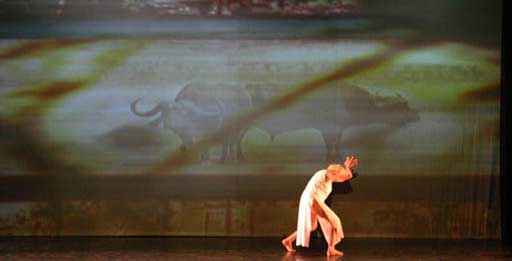
Maida Withers on Training

1

As the funeral procession passed the red brick home on the way to the Salem Cemetery, the child, standing and watching from the porch, broke into a mournful improvised song laced with primal movement that was appropriate for the raw howling of a third- grader. The youthful erotic late-night theatrical improvisations with neighborhood girls (‘Dances to the Moon’ – a possible biblical reference to the moon turning to blood in the last days) was another strong indication that what we now call a preteen was searching for some outlet. The tap-dance improvisations in the nightclubs for conventioneers by an eighteen-year old needing a little extra cash for college in the 1950s was a sure sign of a dancer in the making?

Dancer… maybe. Artist…maybe not! At that time, art was a word greatly revered, a word reserved for the highest forms of expression. How does one move from these earliest stirrings to that lofty place? Continuing…

Of course there were the weekend classes with LaVaun Turner (LaVaun Turner School of Dance – fifteen minutes each of acrobatics, ballet, jazz, and tap dance.) It was just three years of dancing before the dancer was teaching. Initially children as young as three years old – ‘I can do, I can do, yes I can do the boogie woogie woo!” At first the dances were repetitions of dances taught by Ms. Turner or pulled from a manual/card index, but soon, it was easier for me to make up dances at that moment with the children as collaborators, dances that more truly reflected the creative potential of the children than did cute dances for girls with adult sexual innuendoes. Collaboration was not a word in use at the time…. That would come later as a process of artistic interaction with other artists who were as interested in experimentation and innovation as I was.

As with many modern dancers who come from places other than New York City and the major cities of America my training as a modern dancer (perhaps more accurately a postmodern dancer) had begun, and a point of view of dance as an art was being developed/exercised. At that time, many who were determined to dance began dancing in such simple, yet fulfilling, circumstances. The expansion in America of modern dance and other forms of dance had not yet taken place.

Conventional wisdom dictates that ‘training” for dance is connected to an unquenchable need to move, a trait shared with fine athletes. It is true that this need drives most of us who insist on dancing, regardless of the general public’s disinterest and/or disdain for such insistence. Love of moving, love of expressing my life with all its intellectual and emotional journeys, and love of art are the driving forces.

Our first priority is to take class, then rehearse. This was true then and is true today if we add Pilates, yoga, jogging, and other workouts. Our second, and perhaps more important, priority is a full engagement with life. That way, there is truly something to dance about. How else could a dancer like me persist in a desire and love of dancing for over sixty years? The answer to this frequently asked question is “by dancing every day.”
Jane Jerardi on “Efficiency”

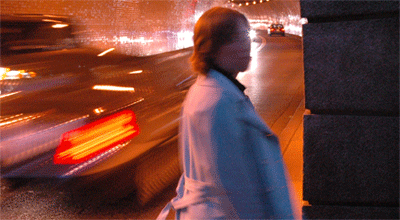
So, I’m creating this new piece about efficiency, making more with less. (Story of an artist’s life, right?) I’m trying hard to find that elusive bit of free time. Maybe I will create this dance between going from one day job to another, running across town to teach, talking through the production details of a different show this weekend, remembering to go to the post office to send a press packet, writing an article in my head that’s due later this week, talking through a monologue, and forgetting to balance my checkbook. And now, I’m wandering…

…taking a walk and even through I’m going in a particular direction, I return for a bit: an edge of a window of a church with particular metal details, the trees billowing, the sound of cars racing down the park below, sandbags lying on a construction sign tipped over on the sidewalk, a jogger rushing past, and then, walking by a Lexus ad on the bus stop (Euphoria, start, stop). Too bad euphoria has to end. (They didn’t mention the traffic part.)

So, in the studio and over dinner, we’ve been talking a lot about time – how do we know what time it is, and what it feels like to be in “no time” time, body time – and also about everyday regulation – commutes, consistency, and rhythm. We’re making phrases from maps – maps of our own commutes and following the City Paper’s map of how to avoid DC’s red light cameras. We’re trying to make the movement more economical…funny thing is, it looks more relaxed, less manic, or driven. How come it doesn’t normally feel that way? How come when we’re pushing hard, we think we’re getting further?

On Friday, I had an iChat date with the composer (he’s in London) and we figured out how to pass off digital files to one another in the internet universe. The next day, I found an mp3 present on my doorstep; I left him a stream of poor quality moving images. I told him about counting: how I count to myself when I’m walking up steps on a flight of stairs, and how sometimes Nicholette counts backwards when she’s waiting for the train.

It is running out, after all. Better to enjoy it while it lasts. Making a dance is wonderfully inefficient. If I remember, I’ll let you know where I get to.

Jane Jerardi is a performer, choreographer, and artist. She has created work for a variety of contexts –- from theaters and galleries to record store listening booths, public subway escalators and projected videos –- creating work that often moves fluidly between media. A recipient of the DC Commission on the Arts and Humanities’ Artist Fellowship and a three-time recipient of its Young Emerging Artist award, her work has been presented throughout the metropolitan DC area — including at Transformer, The Warehouse, Dance Place, and the Kennedy Center.

Elam on Misnomer

Last week I finished the NYC season for my company, Misnomer Dance Theater. A fantastic run for Misnomer, followed this month by a show in Providence, a project in Ireland, a TV pilot for VH-1, and a short dance film. It is a fruitful time to be making art.

My most recent piece is called “Toes of a Snail”, and was born out of a two-month project in Cuba, during which I choreographed on Marianella Boan’s DanzAbierta, Cuba’s leading state-sponsored modern dance company. Upon my return to NYC, Misnomer spent five months developing the piece through a process of training and rehearsal.

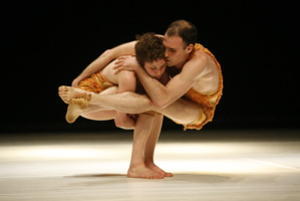
For me, “Toes of a Snail” looks at the connections formed between people, ranging in texture from pleasing to disruptive, as they pursue their lives in a way that remains true to them. In the “Toes” community, efforts are made, flight becomes possible, and grounding looms. The piece draws from my exchanges in Havana, where I was struck by the earnest efforts and creativity of people negotiating their lives despite exceptional and often-changing circumstances.

While riding across Cuba on a bus, I was shown a surreal state-sponsored film which repeatedly presented images of snails sliding across the streets of Havana, with people bending down to examine them closely. Reflecting on the film, I imagined the toes of a snail, an impossible detail that comes into existence only in the moment that you envision it, and then vanishes upon the realization of their improbability. Likewise, the dance conjures improbable and exceptional circumstances with minute details that become intensely real for the performers in the moment, only to dissolve and reform in the next.

Next week, my new piece “Heavy Train” premiers, and then I start work on “Throw People.” Please visit and enjoy my website: www.misnomer.org.

Chris Elam, (Artistic Director and Choreographer) graduated from Brown University and received his MFA in dance from NYU Tisch. He has been on faculty at Brown University and The State Conservatory for the Arts in Turkey, and has served as guest choreographer at eight universities. Mr. Elam’s study of traditional dances informs the technical and conceptual complexity of his contemporary choreography. In 1999 Chris spent seven months with a Topeng dance master in Indonesia, training and performing in temple ceremonies. Misnomer accompanied him to Brazil in 2001 to perform and teach. The following year, Chris taught for six months at the Conservatory in Turkey; and in 2004 he spent three months in Havana choreographing on DanzAbierta, a national dance company of Cuba. In 2005 he performed in Ireland on a European Cultural City Commission, which led to a commission in Holland in 2006 with the interactive technology group Blue Noise Dept.