What could she change to make mistakes never stain?
Here was she wrapped in a box as a doll With a bow With no voice With a dress Without a flaw
Why did they think she could fit if nothing was made for her?
Child
Inside it stays with us, We may grow but Behind the suits and The smiles sits A child
It sees every frown and It cries while we laugh, Slowly withering for us to Be polite
With makeup we hide in elegance, With money in power, With tears, in the Warmth of our crib where We belong
Maybe a tree holds It’s roots deepest where there is room to grow, But we don’t grow up, We grow over
My name is Ally and I am in 11th grade. I don’t usually share my poems but I felt that these two might inspire someone and ultimately send a broader message that can only be conveyed in poetry.
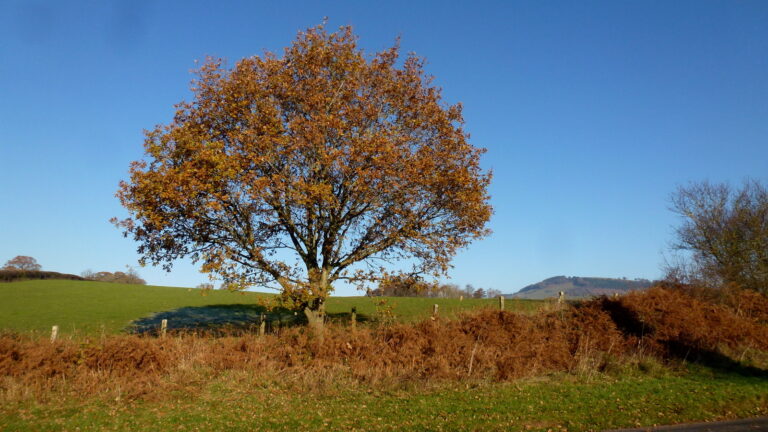
Young oak tree by Jonathan Billinger, CC BY-SA 2.0 <https://creativecommons.org/licenses/by-sa/2.0>, via Wikimedia Commons
Depression is not always darkness. Sometimes it’s padded-room whiteness the brightness of claustrophobic conversations indivisibly linked, infinite shards and chips, an overwhelming push toward cleavers of polite.
Why don’t you ask me how I’m feeling again? my extended pinky finger invites maybe I can project sensible this time – contrite lines, propriety’s scripture, at the very least, I can try.
I should be happy. I know.
There are people who love me. Most days, I scoop thankfulness from my pockets, wiping away any stray fiber or bits of clay, scattering windowsills lightly to keep their kindnesses fed, but lately the sills, swollen tight, refuse to lift; half-starved, necessity’s thrust frees flight.
Alone behind the window’s pane, ingratitude’s guilt turns blighted pages, and I spend time forcing appreciation between each line, handwriting attributes, connecting them to directional signs. They go right there.
I should be thankful. I know.
If I just work harder, I can make it all right – pinching my dry clay, crumbling bits fall. Sponging and kneading and soaking, I try, I try, I mismeasure quantities added by sight, starting over before the end. Forgetting.
What is it, again, I begin?
A blind oversight, gritty and overripe, the spine of everything that’s wrong with me — I do not wish to have more. I wish to be more — futility gnaws each weeping rind.
I should be better. I know.
Practicality whispers denials from the firing room, metamorphosed slurry slips down my upraised hands like batter. I never thought it would be easy, but I thought it would be possible.
There isn’t any wheel. And the kiln has grown cold.
And nothing is as it should be.
Countermelody
And on the worst days, the voices I hear are both chromatic and discordant. Aloud, I wonder how long it will take to feel better; but hearing no replies, despondency unrolls a dampened fugue, dropping minor tones, transposing dull, brave light.
On the worst days, the echoing coil tightens, trilling in concentric rounds, spiraling their measures as quakes of doubt, my parched tongue – shrunken and turned inward – lashes infant thoughts as they hatch, fluttering between my ribs like notes to a staff, silent and aching – packed, frictional shackles sweating with want.
I still know what it looks like to be happy. In remembrances, joy lures light to its center where it crescendos enough to slake every thirst.
On the best days, I remember, warmth thrums in braided adagio, scaffolding freedom until it can hold its own footing; emboldened, it begins to climb, seeking timid tones hiding beneath higher leaves. . Yearning to climb Freedom’s scale, I, too, turn over leaves, one by one, glancing, sidewise, for treasures underneath.
I remember what it looks like to be happy; building the coda as if it were stone, readied for the weight it will be required to hold, I step onto branching chords, the meter quickening, expelling my shackled thoughts, winging them, in ribbons of song, skyward.
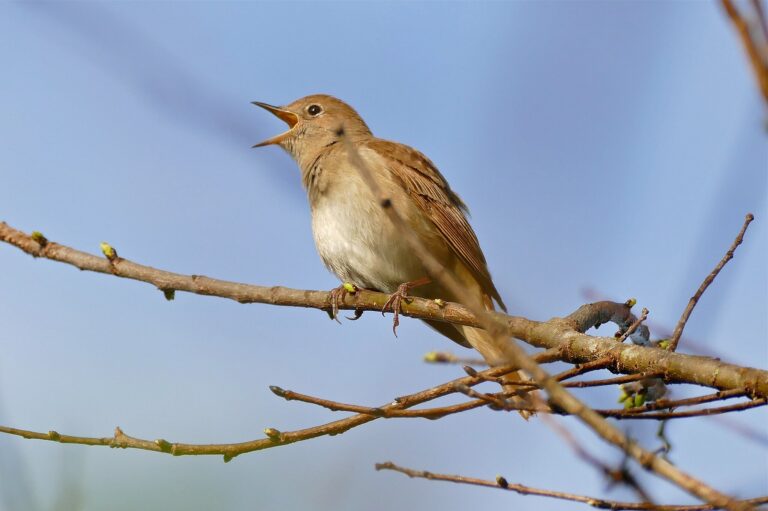
Drunk with their improvised madrigal, I forget everything I thought I once remembered, until, with reckless curiosity, I declare, “I want to see the bird which makes that sound!”
Lavender
More than the old roses, hypnotic angels of seduction unwinding heady perfumes in spirals glowing pinks,
more than the orchids, reaching like ghosts pouty lips and ballerina arms soaking in must-haves like prayers,
more than the canna, speckled sunshine deep pitchers showing their open mouths like borrowed laughter loud and spray-canned,
more than the Bolivian gloxinia, busy and alive each morning as word got around bees dipping their drunken toes into bright bells,
more even than the gerbera, lanky-fingered and loyal fuzzy deep-green veins blushing concealing their divisible mounds,
I love the lavender which springs in compact clumps the tiny purple blossoms and the grassy gray-green pods in which they sleep.
Which when pressed, kiss the tips of my fingers wetly, slicking the whorls. I rub it in just so later pressed to my face I can still catch echoes of clean.
Which when plucked, gather in the shallow basin of my palm softly. I fill my pockets like a thief.
I love the lavender which grows from dusty crags between the cared-for places, grows on quiet stalks grows even though no one tends it and makes every single part of itself useful.
Christina Linsin is a poet and teacher in Virginia. Her work examines connections with nature, complexities of mental illness, and difficulties with creating meaningful connections with others amid life’s obstacles. Her poems have been published or are forthcoming in Stone Circle Review, Still: The Journal, Tinderbox Poetry Journal, and Whale Road Review.
Manhattan in the summer, pretty to look at but sweltering up close. My uranium mother keeping all of us in check in streets too small for her giants. Her home, a home of order. Fragile and volatile and entirely unreasonable next to a steely father, comfortable as a metal casing—holding in, reminding us that mutually assured destruction has another name. And it is mother. The bleaching of our pure, sterile atoms are the price we pay for the dust that collection on his frame. From a busy corner looking in you see two kids in rank and file one, jostling in his sphere begging for a pair of scissors/span> some chaos and some war— the other doing all she can to not be the snip that cuts the wrong red wire. Daughter does not dare defy, to deride or fail, son steps on clean ground with mud caked shoes and tells mom to chill. How do you tell a fission filled matriarch to chill when the unspottedness’s need for molecular stability is in jeopardy. We left the city soon after my brother’s accident when the atoms split and he learned what an explosion really looks like. Not awe, but ending not power, but guilt. Nothing would ever be clean enough in the lingering smoke.
Change
Slick blue iceberg breath Pressed up inside a whale Pressed up inside my chest Paper origami swans Frozen on the lake of my lungs I’m lighting a match now To burn it out of me It is not art when I hold my hands over burning wax, Maybe I want to get struck by lightning Maybe I want to freeze in the dawn of my own basalt body Maybe I want to see the swans Open up wide pale wings, and leave
Etymology of Light
As a child, I was convinced the streetlights waltzed together after I fell asleep. Rusty arms intertwined with one another, eyes lighting the steps to a dance they had performed so many nights before. Laced with anxious veins, I’d often wake from a recurring nightmare— one where my house burst into flames, and I could not escape—and, stumble to the window, trying to catch them in their dance. My hope, to witness their safe light, soothing my little body, so unfamiliar with regulating fear. Yet, the rustle of the curtain, call of my cry as I woke always alerted them straight, back to their guard posts. Years later, a doctor would say OCD she’d say preliminary indicators and I’d remember staring at the four corners of my room so I would notice the second I saw orange red blue flames tickle crown molding. I’d remember a childhood of nights spent waiting, holding my breath at the base of a window thinking my stillness convincing. I’d remember that the streetlights never let me catch them.
Taylor Franson-Thiel is a Pushcart nominated poet from Utah, now based in Fairfax, Virginia. She received her Master’s in creative writing from Utah State University and is pursuing an MFA at George Mason University. Her writing frequently centers on the intersections between the female body, religion, and her experiences as a college athlete. You can find her work in places such as Psaltery and Lyre, Quarter Press, The Bangalore Review. Along with writing, she enjoys lifting heavy weights and reading fantastic books.
Each morning begins before night ends. The dog’s nose nudges her insistent hurry hurry! I can not wait! So in the dark, slow
with sleep and still dream-thick, we walk. Sometimes the sky is star bitten, sometimes there is a moon, always, always the houses
are shadowed and shuttered, always the road disappears beneath me, the black tar bleeding into the black ink of night. It is just she and I
in the predawn, the quick click of her nails the only sound – even the birds are burrowed in branches, songless. Mid-trot, she stops.
I look where she looks. Nothing moves under the tall pines and poplar, nothing in the field. Nothing is there. I tug her
leash to remind her: home. But then I see what my dog knows—there are three of us. Against the edge where the woods end,
a shape stands and stares. I watch it and it watches me. The animal stretches his head towards us, screeches his other-worldly
coyote wail. The sound is a shot that sets all of us sprinting straight into the dark, so the road is empty again when a new day
finally decides to break clean open.
Your Magic Wrapped Tight
Everyone told me this would happen. By thirteen, I’d turn more mad-scientist than mother, pin my own child across the page, a butterfly stabbed through with tracks, magnifying glass pressed to my eye, studying the subtle unfurling of the antennae for a message— any message, but the wires tap a code I can not break. The only truth I know for sure is that the wiggle of your wings means you want to be freed.
Shauna Shiff is an English teacher in Virginia, a mother, wife and textiles artist. Her poems and short stories can be found in Stoneboat Literary Journal, Atticus Review, Cold Mountain Review, Green Ink Poetry, Cola and upcoming in others. In 2022, she was nominated for Best of the Net.
Whenever clouds enshroud Orion’s hourglass of stars and the moon stays concealed, I feel a sadness, as if left alone.
Yet how many times have I seen, in Orion’s upper left corner, Betelgeuse, one of the largest stars known? It glows and
shimmers a reddish-orange hue as it nears the end of its life, in maybe no more than a thousand years from now.
* * *
In the half-year my mother was dying, as a salve for sorrow, she phoned each of her friends
to share a remembered past and to confess how much she cherished their affection.
Then she would say goodbye.
* * *
Lights begin to go out for the night as early as eight in my neighborhood and a perceivable silence arises. Once in a while, a Harley interrupts by barreling down the back road.
Yet, even then, there’s a slender slice of quiet as the motorcycle shifts into a higher gear before racing, fast and far away, as if it’s reached escape velocity and steers toward the stars.
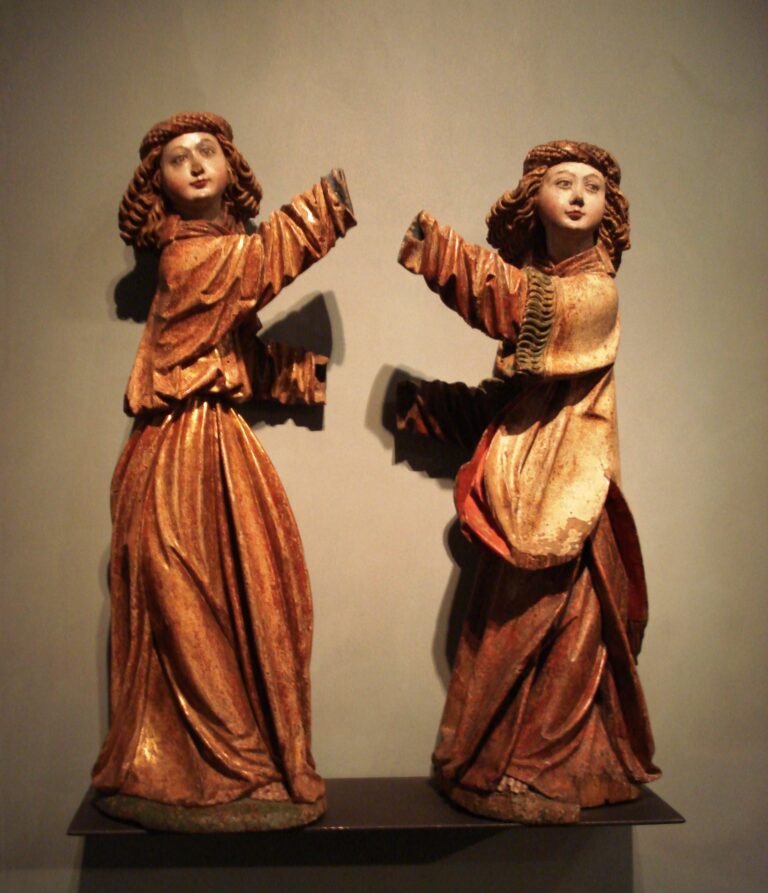
Questions Concerning the Head of a Pin
Not how many, but how do angels do-si-do or polka on the head of a pin? What happens to the six wings Isaiah says each seraph carries (two covering his or her face, two over her feet
and the last pair so he can fly)? No dancing here. Ezekiel is no more enlightening. His angels move on wheels in the middle of wheels, like gyroscopes, but go only straight ahead.
And what if St. Fulgentius of Ruspe is right and evil angels have bodies of air? Would the fallen ones twirl like tornadoes, tearing up the available dance space?
On one pin, perhaps, angels, in queues, moved to macarena, their arms in orchestrated gestures, or else a body of beatific beings belly dancing —which begs the question of bellies and arms.
Is the limbo reserved for unbaptized cherubs and can avenging angels do the saber dance? Do archangels pose in grand arabesques, one arm extended toward the hand of God?
Do angels die, fade coldly, like dwarf stars or dancers in a marathon? And do the new ones know the old steps, take up a spot, vacant briefly, varying the headcount for a nanosecond or two?
And, lastly, does Gabriel blow his golden horn as nimble angels, more than we can count, hully gully, hustle or boot scoot and boogie to the syncopated rhythms of the stars?
Lenny Lianne, born in Washington, DC and spending the next 45 years in Northern Virginia, is the author of five books of poetry, most recently Sunshine Has Its Limits (Kelsay Books). She holds an MFA in Creative Writing (Poetry) from George Mason University and has taught various forms of poetry in workshops on both coasts. A world traveler, she lives in Arizona with her husband and their dog.
Image: Diligent, Public domain, via Wikimedia Commons