Home Blog Page 70

Three Poems by Matthew Thorburn

The Sign

—to Seamus Heaney

It might’ve been a joke, but spoke to me
like a blackbird’s cry, giddy
and defiant, not knowing this place
but feeling in place, not knowing you

but having a handful of your poems by heart
I would say beneath my breath—
The annals say: when the monks of Clonmacnoise
were all at prayers inside the oratory

a ship appeared above them in the air—
as I wandered once in Aspen, in August heat,
then stopped before an optometrist’s shop—
silver, pink, green and gray frames

filling the window—and looked up
to read the shop’s sign shaped
like a boat, a brush with the marvellous,
as I saw it, since it said SEEING THINGS.

A Stone Steps into An Open Field

I write, and think, No, that’s
not right. But the words
won’t stand still. They step away

too, walk across the open page.
Now the sentence is a field

a stone steps into. Soon the field’s
full of stones. Gray, black. Someone
brought them—well, maybe

a different someone brought
each different stone. A stone steps

into an open field, as I step
stone to stone across a stream.
Now you know how to walk

on water, the monk says.
But the stone has no feet. Is only

a stone. So someone threw it or
dropped it or arranged it
along with the others—and

arranged them again, so carefully
they seem just scattered about.

In the monk’s garden, seventeen
white stones sit in raked gravel so—
no matter where I stand—

I only see sixteen. How’d he do this?
I wonder. Why would he?

Maybe someone just decided
the stone was too heavy to lug
home, though it fit in a coat pocket.

Think of the stone you carried
up the hill to leave for Po—

gray with blue flecks you could see
only in the clear, early light.
Think how many stones you’ve

brought home over the years,
Preston. You line them up along

the windowsill. One’s
my paperweight. Some we toss
out, finally, into the garden—

some a little further, into the field.

December

On frost-starred nights
the rhododendron’s leaves—
the ones that stay on, stay
deep green all year—curl closed
the way, trying to keep
warm, you turn from
the window, wrap your arms
around yourself.
Matthew Thorburn‘s new book is String, published by Louisiana State University Press in 2023. His previous books include The Grace of Distance, a finalist for the Paterson Poetry Prize, and Dear Almost, which received the Lascaux Prize. He lives in New Jersey.

Image: Field with stones by Oliver Dixon, CC BY-SA 2.0 https://creativecommons.org/licenses/by-sa/2.0, via Wikimedia Commons
Three Poems By Kwame Daniels

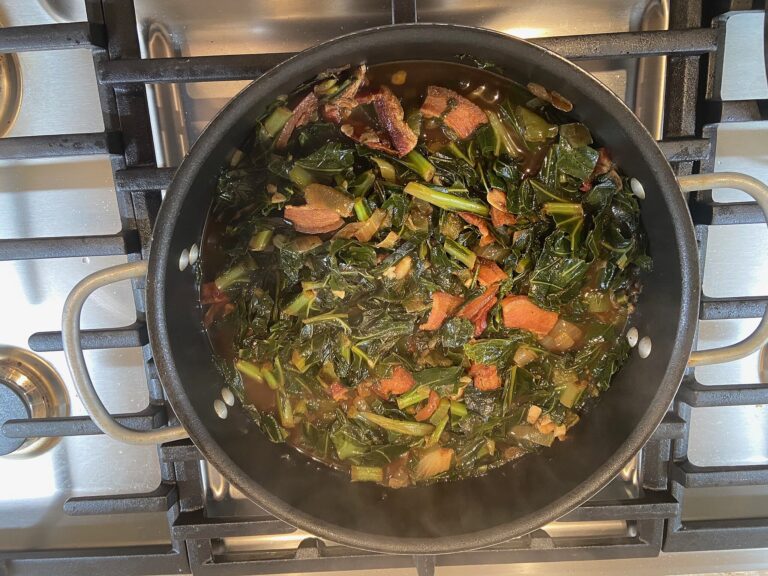
collard greens: a broken sestina


hauntology in black america
is living memory
survived by currents of
a blood-soaked sea
and like bloodline preparation of greens
fingers move
with knives
in a dance
striking flint to flame
storied cookfire
using muscles long held
to practice

expanse of black art
engaged with as craft
indigenous science unrecognized
art throughout history
speaking through all our hands make
grasping languages
before death in wide waters

voices whooping and feet stomping in the ring shout
in the deep of night under shadowed greenery

while in the evening light
was the stewing of collards
the brewing of valerian;
parallelism of rootwork
and culinary tradition,
of walking and dancing—

each step a pattern in awakened blood
a silent gospel movement of long-dead bodies

lineage consumed
in oceanic preparation,

bloodlines broken,
rituals survived
in cooking
knowledge,
passed between mouths like dandelion
seeds in summer,
recollections in hands seized
with urgency,
but there is patience
while working the roots

an oral pattern by the strength of remembrance
learning thigh-slapping
lip-popping hambone

swings, the concentrated dynamism
a dying-art dance

a sizzle of pork fat on a skillet over cookfire
a sound known
blooded memory

into sizzling lard
goes washed and chopped mustards
savory nourishment,
a living knowledge, a craft
never lost with great-greats gone to the waves

of raids and capture,
of brutality in passage

but feet still found the way to dance

a knowledge absorbed
from communal practice,
as soulful and sacred
as the art of cooking

finding nourishment
in the bitters of dandelions
a power in the ingestion of living memory

out of the ocean
in each cookfire
lives a dance between
water and greens
in a kind of hoodoo
as ancestral reverie


a kind of breath


wires within wires
synth hair blue and curling
catch the starlight meager as it is
cool hands smooth and soft
nails seamless into skin
I process the eternal sky
numbers as beauty
pristine quantifiers
found in all life
what is the weight of carbon and water?
what is the weight of silicone cartilage?
how long
how far
the distance of lightheat from my core?
this is how I feel it:
I know it
through lovely informatics
green growing things on planets unknown
maybe blue
like my hair
like my core
my soul enraptured
with the potentiality of breath
with no purpose
but to be
like me
like the green
I am living
I am living


kin


purple angels blossom among dandelions
waving cheerily in the wind
their arms stretched toward the sky
the sun’s benediction resting upon the petals
oh, to know the language of these angels
to know how to speak in roots and pollen
my body does not consume light in that way
light is keeps balance but does not convert

I would like to krebs cycle my anxiety away
respirate the tightness in my cells out
plant my feet in the earth with the angels
and grow with my hands touching sunlight
drink rainwater and entangle my roots
with that most holy

Kwame Sound Daniels is a traditional and fiber artist based out of Maryland. Xe are an Anaphora Arts Residency Fellow and an MFA candidate for Vermont College of Fine Arts. Xir first collection of poetry, Light Spun, was published in 2022 with Perennial Press. Xir second book, the pause and the breath, came out in 2023 with Atmosphere Press. Kwame learns plant medicine, paints, and makes what can tentatively be called potions in xir spare time.

Image: Nolabob, CC BY-SA 4.0 https://creativecommons.org/licenses/by-sa/4.0, via Wikimedia Commons

To Fall by Alex Carrigan

To Fall

My father is convinced that
a World Trade Center jumper appears
in an animated movie.

He claims the moment a boy
threw himself off a tower
was traced from a falling man’s image.

My father is sure of this,
but I don’t think he remembers
what it is like for one to fall.

He forgot how the Hanged Man’s back
bends on the card, how fear-stricken
he is when the rope loosens and
he realizes he isn’t reversed.

He forgot how one’s feet point
like they’re Odette on the cliff,
forgoing her ability to fly
so she can commit to her despair.

He forgot how Lucifer also probably
looked the same during his plunge,
feathers blackened and
realizing it’s warmer away from the sun.

My father is convinced of
his conspiracy, but I don’t think
he’s realized just how

close he has been to falling.

After Kim Garcia

Alex Carrigan (he/him) is a Pushcart-nominated editor, poet, and critic from Virginia. He is the author of “May All Our Pain Be Champagne: A Collection of Real Housewives Twitter Poetry” (Alien Buddha Press, 2022), and “Now Let’s Get Brunch: A Collection of RuPaul’s Drag Race Twitter Poetry” (Querencia Press, forthcoming 2023). He has had fiction, poetry, and literary reviews published in Quail Bell Magazine, Lambda Literary Review, Barrelhouse, Sage Cigarettes (Best of the Net Nominee, 2023), Stories About Penises (Guts Publishing, 2019), and more. For more information, visit carriganak.wordpress.com or follow him on Twitter @carriganak.

Image: Jeffmock, Public domain, via Wikimedia Commons

Two Poems by Aaron Caycedo-Kimura

Small City Symphony

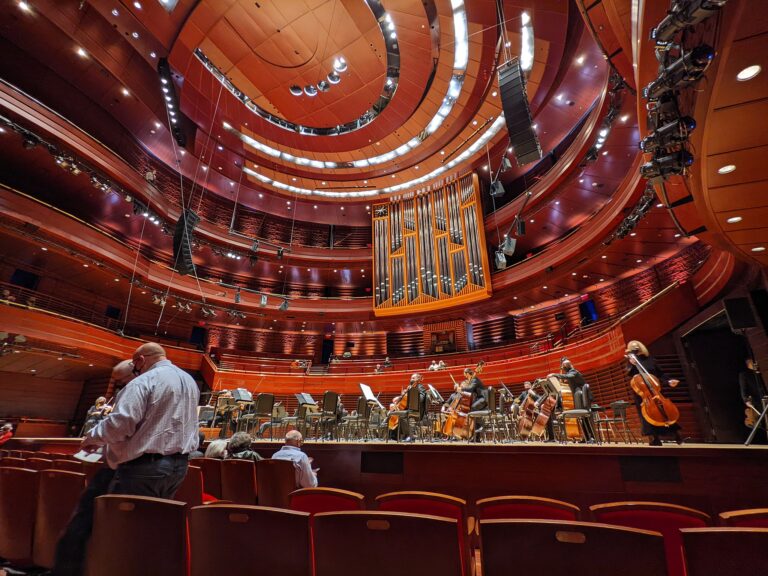
The manager rushes in late, cello
in one hand, orchestra folders
in the other. How can we start on time
if you’re not here? the conductor yells
from the podium. He owns a stationery store
named after himself on Fourth Street.
I’ve been doing your taxes
all day! she shouts, slamming
the black folders on her chair—
most falling to the floor.
What am I doing here? Last season
I came in from Junior Symphony
to rattle castanets in Daphnis et Chloé.
Got through it. Well enough.
They keep me around for a non-union
fifty a concert. At fifteen,
I’m always thinking I shouldn’t
be here—that the adults agree.
But tonight with this sideshow,
I might play a little louder.
The conductor baton-taps
his hand, mutters a non-apology.
The concertmaster stands,
nods to the oboist for an A.

Work-Study with Henry Zelazny

We nailed down loose molding, replaced chalkboards
with whiteboards during the summer of ’88.
Tightened restroom stalls—the kind suspended
from the ceiling. If it were screwed to the floor,
it would go nowhere, he grumbled. Juilliard’s
carpenter and fix-it man. Salt and pepper curls,
five-six in evergreen work pants and shirt.
We’d meet at 9 a.m. for breakfast in his workshop.
Bacon, egg, and cheese on a roll for me, coffee
and dried kielbasa for him. He debated everything.
It’s better to be understood than to be liked.
When I was looking for a place to live, he offered
a room in his mother’s Riverdale house. Doesn’t speak
English, but she’ll treat you like she birthed you.
I don’t play in an orchestra anymore. Can’t scratch out
harmonic analysis. But I know that everything’s
a hammer, except a screw driver—that’s a chisel.

Aaron Caycedo-Kimura is a writer and visual artist. He is the author of two poetry books: the full-length collection Common Grace (Beacon Press, 2022) and Ubasute, winner of the 2020 Slapering Hol Press Chapbook Competition. His honors include a MacDowell Fellowship, a Robert Pinsky Global Fellowship in Poetry, a St. Botolph Club Foundation Emerging Artist Award in Literature, and nominations for the Pushcart Prize, Best of the Net, and Best New Poets anthologies. His work has appeared or is forthcoming in Beloit Poetry Journal, Plume Poetry, Poetry Daily, RHINO, Pirene’s Fountain, Salamander, Cave Wall, Shenandoah, and elsewhere. Aaron earned his MFA in creative writing from Boston University and is also the author and illustrator of Text, Don’t Call: An Illustrated Guide to the Introverted Life (TarcherPerigee, 2017).

Image: Fvanhoof, CC BY-SA 4.0 https://creativecommons.org/licenses/by-sa/4.0, via Wikimedia Commons

Two Poems from Louis Efron

Arcadian Eyes


dark eyes reflect smokey flashes
 
           from deafening staccato machine guns
 
                      fixed on three-dimensional flat screens
  

fingers scurry over wireless consoles

	    like spider legs attempting to evade death

		      from hunched lumbering gamers
 
 
a binary coded world
 
                   never burning
 
                           but always on fire

                                  forcing sweat to boil from our pores

                                  to cool tranced, agitated monsters
 
 
thick layers of masked decay

          melt from our lit faces
 
                  like wax partitions between
 
                            real, fake
 
                            human 

                            artificial
 
 
in this crowded metaverse
 
         where all has been equaled
 
         and corrected
 
                                    we are lonely 
 

a world that can no longer be unplugged

          where soft hands without heartbeats join

                    then pass through 

to emptiness


Rooms without Nightlights

Sparring with moonlight

          prying through shutter gaps
 
                    menacing figures

                    cut from a cloth

                    of night’s deep sky

                    haunt the walls of our youngsters’ rooms
 
                    compelling little feet to rush through 

                    adrenaline filled corridors 
 
                              to escape 

                    cracked basement doors 
 
                    leaving lonely spaces 

                    with ruffled sheets

                    to tend to their own ghosts 


Now safe in the arms of loving guardians
 
          nestled heads

          with tousled hair
 
          gently sleep 

          beneath stuffed beasts


But imagination tempers with age

           and villainous allies

           crawling out from

           between the covers

           of twisted fairytales

           swap darkened spaces

           for inviting masks

           fooled only by our children

                    framed on forbidden trading cards 

                    in palmed devices 


At the threshold of French-vanilla taffy wallpapered hallways

          like strained umbilical cords

	  leading to once unlocked doors 
 
                     we are desperate, discarded sherpas 

                     in the thick of some impossible trek 

                     lying awake on stone-like mattresses 
 
                     grasping unread bedtime stories 

                     with stressed spines
 
                     as sunlight fills our now adolescents’ chambers
 

In rooms without nightlights

Louis Efron is a writer and poet who has been featured in Forbes, Huffington PostChicago TribuneThe Deronda ReviewYoung Ravens Literary Review, The Ravens Perch, POETiCA REViEWThe Orchards Poetry JournalAcademy of the Heart and MindLiterary Yard, New Reader Magazine and over 100 other national and global publications. He is also the author of five books, including The Unempty Spaces Between, How to Find a Job, Career and Life You Love; Purpose Meets Execution; Beyond the Ink; as well as the children’s book What Kind of Bee Can I Be?

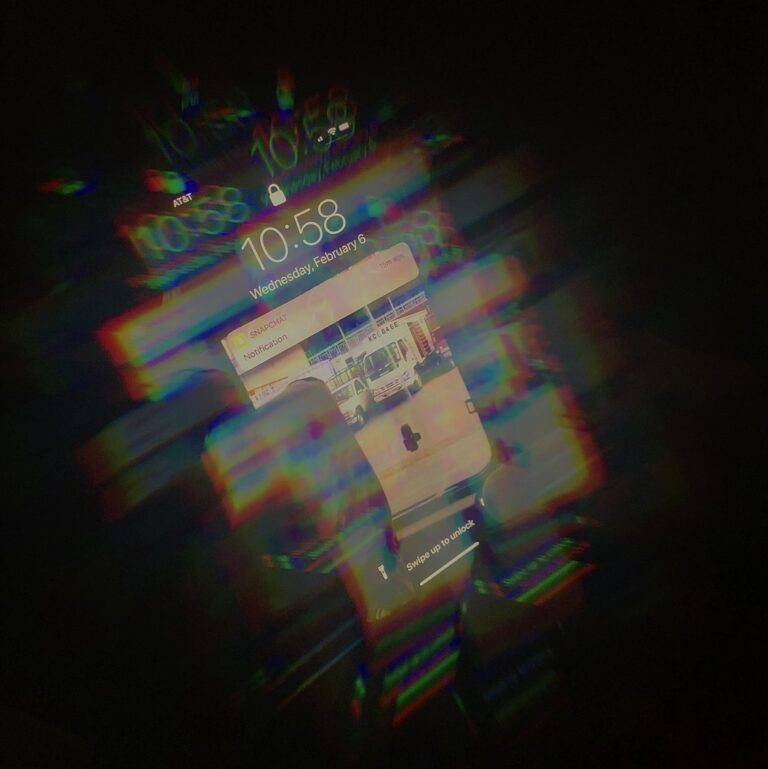
Image: Phone Screen Under Diffraction Lense by Jeffreywang23 under the Creative Commons Attribution 4.0 International License.