A snow drift, the sound of church bells, the scent of a lemon.
Something is always left to cherish once the bombs have exploded.
The heaviness of the quilt, the warmth of your body, the taste of potato soup,
you, me, still, together.
Rick Black is an award-winning book artist and poet. He received a B.A. from NYU and did post-graduate work in Hebrew literature at Hebrew University in Jerusalem. He has studied at both the Center for Book Arts in New York and taught at Pyramid Atlantic Arts Center in Maryland.
His poetry collection, Star of David, won Poetica Magazine’s 2012 poetry chapbook contest and he was named Poet of the Month for April 2012 by Cornell University’s Mann Library. In November 2013, Black did a reading of his work in the Middle Eastern & African Division of the Library of Congress.
For many years, he worked as a journalist, including a three-year stint in the Jerusalem bureau of The New York Times. He left journalism to focus on studying the book arts and poetry. In 2019, he received the 2019 Isaac Anolic Jewish Book Arts Award. His artist books are in the Beinecke Rare Book and Manuscript Library, the Library of Congress Rare Books Division, and the U.S. Holocaust Memorial Museum Library.
His poems and translations have appeared in The Atlanta Review, Midstream, U.S. 1 Worksheets, Frogpond, Cricket, RawNervz, Blithe Spirit, Still, and other journals. You can learn more about his work at www.turtlelightpress.com.
The rabbi told the gossip to rip open a pillow and release the feathers to the wind.
“Now bring them back,” the rabbi ordered. “Every single one.”
Scattered everywhere, the fluffy white wisps couldn’t be caught just like what she said can’t be gathered up and sewn back inside a cotton case.
Yet you ask me to forgive.
To imagine how light I would feel if I let her words fly like feathers in that folktale never to return.
Acquired Skills
Before you learned how.
You paddled in panic,
feeling your body sink.
You couldn’t lean back
stretch your arms like a starfish,
gaze at the clouds.
You couldn’t imagine
how buoyant your body could be,
if you let the water support
your weight, suspend the fear
of being submerged.
Before you learned how.
Swimming was an acquired skill.
Something other people did,
like meditation or yoga or prayer.
Remember that
the next time your heart pounds
and you feel as if your lungs
are filling with water, not air.
The Advantage of a Fairy Godmother
Running away at midnight,
Cinderella lost her glass slipper.
A key item in the final act
when the mistreated girl
sheds her cinders,
reveals her beauty,
and takes the hand
of the handsome prince.
Patience and courage
finally rewarded
while evil stepsisters
writhe and whine.
A story of triumph
told around the world,
promising fortune
to the downtrodden soul
lucky enough to be blessed
with a fairy godmother
who provides a new gown
and glass slippers.
Angels
I’ve felt them.
Warning me.
To get that spot on my nose checked.
To pause at the corner. To grab the baby
before she rolled off the bed.
And most notably,
that Saturday night by the hotel pool,
when I was as calm as the beach ball
floating beneath the flood lights.
Leaning back in the blue-webbed recliner,
I had a memory of my mother’s fingers
back when I was small, patiently untangling
my freshly washed curls.
Moments later, my cell rang
with the news from the nurse.
“Unexpected,” she said.
“Your mom was fine at dinner.”
Angels.
I’ve felt them.
Like the sensation of hands
stroking my hair.
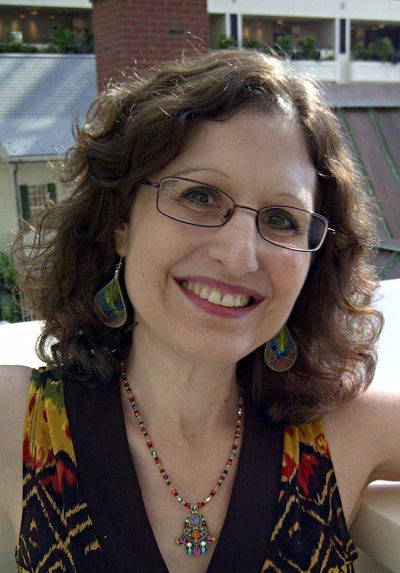
Jacqueline Jules is the author of Manna in the Morning (Kelsay Books, 2021) and Itzhak Perlman’s Broken String, 2016 winner of the Helen Kay Chapbook Prize by Evening Street Press. Her work has appeared in over 100 publications including Bourgeon, The Paterson Literary Review, Potomac Review, Hospital Drive, and Imitation Fruit. She is also the author of 50 books for young readers including Tag Your Dreams: Poems of Play and Persistence (Albert Whitman, 2020). Visit her online at https://metaphoricaltruths.blogspot.com/
By Flickr.com user “brokenchopstick” – https://www.flickr.com/photos/brokenchopstick/290244138/, CC BY 2.0, https://commons.wikimedia.org/w/index.php?curid=1379936
Some sweet morning I can’t say when The sun’s gonna melt my days away And I’ll flow beside the knowing river Till the rushing waters take me down.
One of these evenings In the blue black hour I’ll wane with the moon until I’m dust But please don’t let me be forgotten I’m just going back to where I’m from.
I was a good girl That’s what they called me Pretty in my way if I do tell All I did was what momma told me All I knew is what my momma said.
Tell the children the kind of girl I was I could dance a step and sing my songs I was brown and round and my hair was long And I’ll still love ‘em even when I’m gone
I had a voice A rare contralto The deepest tones of the female range Some thought it special, some thought it fine But an ordinary colored girl Didn’t have a chance.
I gave my love To one man only A hard working man, that was the prize Side by side we made a family No mean doing in the days I seen.
All my babies Pretty as pansies Black-eyed, washed, fed and loved Singing and playing, learning and knowing Praise god from whom the blessings flow.
So tell the children the kind of girl I was I could dance a step and sing my songs I was brown and round and my hair was long And I’ll still love ‘em even when I’m gone
My children call me Blessed mother I loved their dreams more than my own Bury my body next to their dear father But let the rushing river take my soul.
Some may see me Plain and common Some may find me small and low I’ve lived my life with quiet purpose I’m satisfied whatever comes.
I can’t say When I’ll have to leave you I’m telling my story before he calls I tried to love despite the troubles I tried to live the best I know.
Just please don’t let me be forgotten I could dance a step and sing my songs I was brown and round and my hair was long And I’ll still love you even when I’m gone
I’ll still love you when I’m gone
A Praise Poem to the Women
All praise to the women
who made me brown
my grand moms Daisy
and Elizabeth Grace
one black coffee
one café au lait
my caramel hue is a tribute to you.
To the women
who gave me form
small on top
not so small on the bottom
with hips and thighs
that take me where I need to go
those Hayes and Johnson sisters
who whispered mercy in my ear
and dropped dreams in my pocket.
To the women
who saw me coming
before I even got here
spirit women, vision women
who made a way for me
out of no way at all
women of unbowed head
and untied tongue.
A praise poem to the women
who made me sing
every Sunday in the choir
first row, second alto
Mama Alice, Auntie Mel
Aunties Vera and Sweet Lorraine
singing sisters of the highest order
may Jesus keep you near the cross!
To the women
who made me dance
Baby Alice and Sister Lin
listening to Shirley and the Shirelles
on the AM dial
cha cha steps in the kitchen
when we should have been doing the dishes
this is dedicated to the ones I love.
All praise to the women
who made me black
to the sudden soul sisters
from the class of ‘69
who washed their hair one day
and saw that it was good
Africa in our faces
worlds in our eyes
our overnight afros
still live in my mind.
To the women
who made me smart
who expected me
to grow up and be somebody
my great Aunt Roberta
the only one who went to college
and my teacher Miss Drew
who never did marry
but took me to the theater
and showed me how to dream.
Praise and power to the women
who made me strong
10-speeding with the boys
‘round Montrose street way
to my girlfriend Clara
who beat me in the 50-yard dash
and Miss Geraldine Woods
who went swimming at the YW
and wasn’t afraid to get her hair wet.
This is to the women
who made me evil
when I need to be evil
like my Aunt Betty
who put a woman in the hospital
for not minding her own business
but was a sweet as pie
as long as you didn’t cross her.
To the women
who made me crazy.
sure ‘nough stone crazy women
sure ‘nough my kin
on whom I blame
all my unexplainable behavior
and the women who made me sane
every Thursday in a circle
at four o’clock
for three years.
To the women
who made me love men
who knew all the delicious secrets
long before I did
and the women
who made me love women
who understood the mystery
and power of the feminine
long before I did.
This is dedicated to the women
who made me write
Charyn and Kathleen,
Lucille, Anne, and Michelle
who laid the wordy road
out before me
and bid me walk.
And to the women
who made me whole
marrow and bone
from all the trouble
and the wonder
some have spread
their angel wings and flown away
some are still waiting
for that trumpet call.
All praise to the women
who let me know
that I did not make myself.
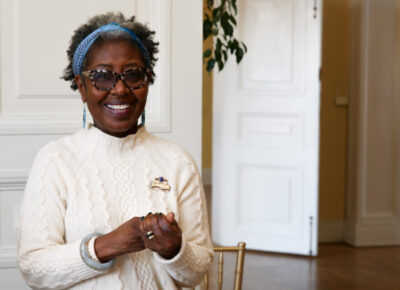
Prior to taking a serious interest in poetry, Bernardine (Dine) Watson worked as a social policy writer for major foundations, nonprofits, and media organizations. She has written for The Washington Post, The Ford Foundation, Annie E. Casey Foundation and Stoneleigh Foundation. Dine’s poetry has been published in the Beltway Poetry Quarterly, Indian River Review, by Darkhouse Books, and by the Painted Bride Art Center. She was a member of 2015-16 class of The DC Commission on the Arts and Human-ities’ the Poet in Progress Program, and the 2017 and 2018 classes of the Hurston Wright Foundation’s Summer Writers Week. Dine serves on DC’s Ward 4 Arts and Humanities Committee and on the selection committee for the Takoma Park Third Thursday poetry reading series. She’s read her poetry in venues throughout the DC metropolitan area with More Than A Drum Percussion Ensemble. Dine is a current member of DC Women Writers of Color.
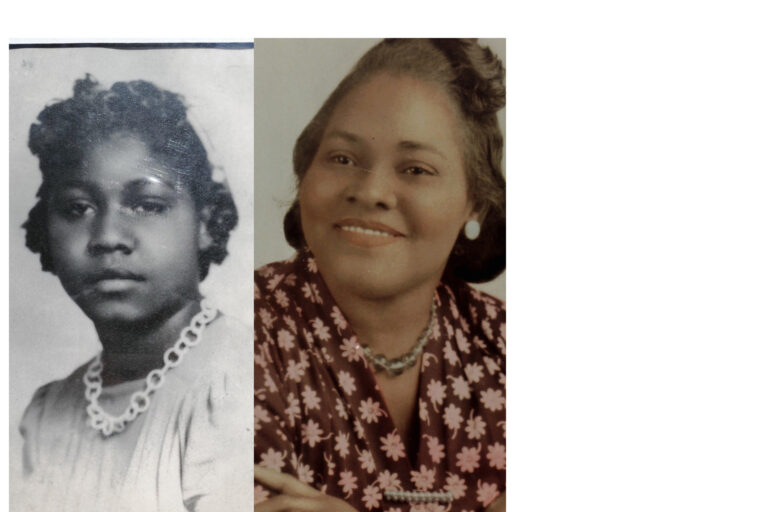
Images: Alice Hortense (l), Grandmother Elizabeth Grace (r), courtesy of the author.
Dig your many trenches of attrition where you must. The inside job comes right from the gut and nowhere else.
Happiness is when what you need to do and what you want to do become one in the same.
A sudden collision of ideas, opportunity and confidence.
The dream world brought to life. Your greatest success.
The Children of Long Division
The invisible man lives forever, forever in the eyes that search for him.
He lives forever because he is never seen and by consequence, always sought.
Journeyman
the cars are parked, some on the street and some in the winding stone drive, I can hear the laughter from inside, a party, someone coughing up a real throaty rejoinder, and later by the rod iron cemetery it is cold and quiet, the flowerless dead no longer able to play with their hair, with various extramarital lovers; the surrounding buildings all with lights that keep going out so that I find myself down by a ravine watching the smooth erosion rocks peak over the surface of rushing water; a few hundred bats squeaking their way through the buzzing winged-insect tumult above.
Ryan Quinn Flanagan is a Canadian-born author residing in Elliot Lake, Ontario, Canada with his wife and many bears that rifle through his garbage. His work can be found both in print and online in such places as: Evergreen Review, The New York Quarterly, Bourgeon, TheSongIs.., Cultural Weekly, Red Fez, and The Oklahoma Review.
I know that you do
In the afternoon
Under a warm blanket
Sun on the couch.
I feel it
Honey in my vertebrae
Pulled out of my flesh
Into ghost arms.
Ghost desire
Lights me.
I know that you do
In the afternoon
Alone, always.
I feel it
Chernobyl in my spine
Pulled away by ghost fingers.
Ghost mouth
Lights me.
Please don’t, please don’t,
If it is only this,
Only alone.
Love is a Sickness Flowing
Love is a sickness flowing a river filled with women, filth, smiling children a holy rite, once crossing the lip, spares you no fever diphtheria, typhoid, cholera the illness of the water wending past distended bellies, combs of fingers, fragile lanterns floating, candles adrift, mouths that open for ashes, silt, refuse laughing splashing cartwheels in the air and then crash! Love is the Ganges, the Yamuna, the Jordan, like milk, you thirst for only this, and only this waits for you, beautiful and poisoned.
Smoke and Scotch
I thought of you first.
I wonder if you know that,
years ago, your melancholy
fedora, cigarettes wreathing
the rim of your hat
a traveler stopping at stones,
roses for strangers,
something I understand.
I thought of you before
embers caught my name
and took me dancing
burned the bones
and left me hollow,
I watched you at the crossroads
leaving smoke and scotch
something I observed quietly.
Like a cat watching a house
deciding if she wants to come in.
I think of you still
silver hair and silent
the man in the hat
at two roads that cross
but once and never again,
praying the words
outlast the smoke,
something I understand.
Silver Webb is the editrix of the Santa Barbara Literary Journal. She is a food writer for Food & Home and various Websites. Her poetry and fiction have been featured in Peregrine, Hurricanes & Swan Songs, Delirium Corridor, Still Arts Quarterly, Danse Macabre, and is forthcoming in The Tertiary Lodger, Underwood, and Running Wild Anthology of Stories, Vol. 5. www.silverwebb.com