Home Blog Page 155

[POEM] My Garden at Vetheuil by Jessica Wilde

1

Mom took us to the National Gallery
when we’d had enough
of dolls, work-out videos
and make-your-own-popsicles.
“Which one is you?” she asked
and we stared up,
the walls whiter than at home.
The girl with the watering can?
The hula hoop?
The one that up close
is made of spots?

The little girl alone,
because she was blond,
and I was too, then.
The one who thought mom
wasn’t looking
because she was so far ahead,
who could sit in a cardboard
moving box
in grass above her head
and be alone.

1880
Yellow spots with green,
shadows of moving flowers,
a little girl alone,
walking in front of the rest,
veering slightly to the left of the path,
her feet frozen in motion,
her youth trapped in one breath.

Monet’s wrist trains my eyes
to recognize my face.
My face
with a mere suggestion of eyes
the color of my dress,
blue into green
peach into yellow
like the world with sun in your eyes.

Mom chose this postcard
years later,
to write me from Walter Reed,
when I would clorox the kitchen
before bed,
when I would sit on my floor
late in the night
and write Bible verses
on ripped up note paper,
tape them on my wall.

I taped the postcard too,
between rainbows are reminders of god
and a Teen-Bible cut-out
of how you look ahead when you carry coffee
so it doesn’t spill—
a metaphor for looking to the future.
Now everyone has cancer
and metaphors of the energy
of color,
of beams bursting
through her body
dividing the cells
that divide too fast,
and her and me both
no longer suffice.
Mom rolls her eyes
at breast cancer patients,
lends them her books,
feeds them carrot juice.

But back then,
my Spanish teacher took me aside
when her mom died
and told me I understood
what it’s like to ponder your mother’s death.
I had no idea,
just accepted her jewelry,
let her call us in, one by one,
to choose the clip-on earrings
we had preferred most while playing dress-up,
the watch on a golden chain
that wound,
that my grandmother kept
in a box
in a plastic bag
with a rubber band around it,
padded with bandaids.

Two nurses,
girls in their twenties,
manned the radiation machine,
showed me a video
of the room behind the metal doors,
and the one nurse slapped the other.
“You’re crossing your legs again,”
she said.
Crossing them makes varicose veins
like her mother had,
she explained.
Then, without a pause,
she pointed at my mother’s feet,
coming out one end of the radiation machine
like groceries on the slowest moving
conveyer belt you’ve ever seen.

Jessica Wilde is a D.C.-based writer of fiction and poetry. She grew up in a Navy family, moving frequently along the east coast of the U.S. and throughout Europe. She graduated from the George Washington University in 2008 with a degree in English and Creative Writing, and received the Hassan Hussein prize for her thesis in fiction. She writes for the Works in Progress section of The American Scholar and is an Assistant Editor of Bourgeon.

My Garden at Vetheuil by Jessica Wilde (c) Copyright Jessica Wilde; printed by permission of the author.
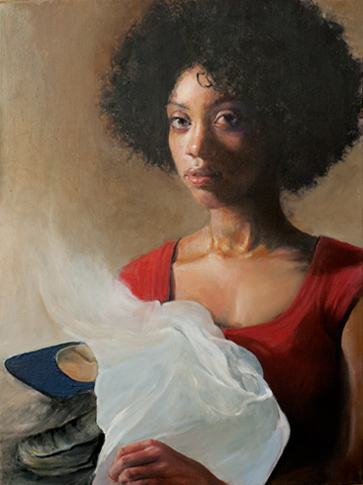
Creating a Veil of Ignorance by Judith Peck

Last year, based on past work and exhibitions, I was juried into the Hillyer Art Space 2010 season to have a solo show. I had just about finished painting my last series (which was on the effects of global issues on the individual), and was ready to begin something new. I started three paintings, one after another, each on subjects that just didn’t feel right in a way that would sustain a whole series. Then I came across a thought experiment by the political theorist John Rawls.

Rawls’ “veil of ignorance” suggests that we hide from ourselves our personal social status, ability, and income, when we make decisions about systems of justice. He suggests that a “veil of ignorance” helps us consider the interests of the least advantaged members of society, and make the best choices for everyone. Inspired by this hypothetical system inspiring social justice, I found that I could not stop painting. The paintings poured out of me.

veil-480pxFor more than thirty years my work has centered on social justice issues seen throughout history. I’ve painted on such themes as the steps taken by the Truth and Reconciliation Commission in South Africa, the victims of suicide bombings, and the uncertainty of bringing a child into this world. The most intriguing part of the veil is that Rawls used such a strongly visual image to explain his concept. I thought that if I could capture that wonderful idea, I would have something special. In the past, a symbol often stood alongside the model to convey a sense of time and place. However, the veil enabled a cohesive, natural, woven image. The veil might be light and airy and dissolve into the atmosphere, or it can be a thick shroud that hides part of you. For example, in my painting titled “Veiled Judgment” (seen on this page) the veil almost floats before the woman in the painting, largely obscuring two strikingly different symbols of social status: a worn worker’s shoe and a stylish high-heeled one, and thus leaves the woman’s station in society in doubt. It became clear to me that if a veil were set in between the subject of the painting and the viewer, either one could be considered “behind” the veil depending on one’s point of view, as is the case in “Veiled Identity.” In this way, I hope the veil engages the viewer, strengthening your interaction with the painting.

Now a week away from the June 4th opening, I am obsessing about finishing up, reworking paintings that have already been photographed, and even inviting models over with new paintings in mind. I guess I like to work under pressure. Please comment here if you have any questions or thoughts, and I hope you’ll come by the opening and let me know what you think.

Judith Peck has made it her life’s work to paint about the history and healing of social injustice. A graduate of the George Washington University with a degree in fine arts, she has exhibited her work in venues nationwide, including the Center for Civil and Human Rights in Atlanta, GA, and the Rhonda Schaller Studio in Chelsea, NY, as well as in such print media as Ori Soltes’ book The Ashen Rainbow and the San Francisco City Concert Opera Orchestra’s announcement for “Die Weisse Rose.” Peck’s latest series “Original Position” will be showing at the International Arts & Artists’ Hillyer Art Space from June 4th to June 26th with an Artist / Curator Talk to be held Saturday June 5th from 5 to 7 pm. You can visit the artists website at www.judithpeck.net.

Poem: A Triumphant Return by Isaac Beekman

0

Lactation precedes this dictation but nowhere is expectation
As high as with the internal leave-taking of the senses, this mother
Of creation, this happenstance of understanding. Lactation
Underwires the triumphant return of mistakes which bless
This tundra, replete with the ice of hardened experience.
This return solidifies the maternal in me, the show up
And fight, the wrestle and meander in me, provoking
Such stiff yards of immigration that I am easily pushed over.
I am pushed over, I fall over in this triumphant return.
The overwhelming pull of gravities strange and immeasurable
Leaf me into the hardware of great joy, my body surrounded by
The snow and ice, melting the cold with my warm back.
I look up, a triumphant return at hand:
There you are.

(C) Isaac Beekman

Joan Belmar on his View from the Outside

I have lived in many cultures, but have never felt completely at home in any one. Born in Chile, I moved to Ibiza, Spain at 24, and to the U.S. at 28. In each culture, I have experienced the feelings of an outsider. I have come to understand that “all is not what it seems.” My need to communicate this point of view is what drives my art.

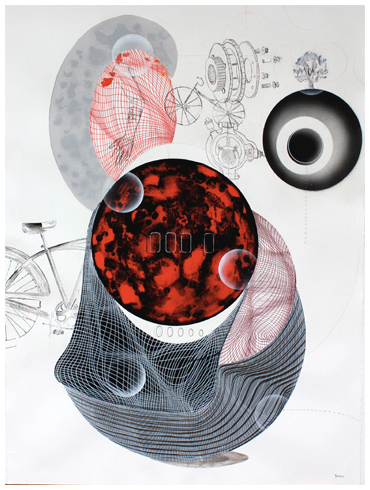
In my recent work, I have created 3-inch thick worlds under glass. At the base of this world is plywood or masonite, on which I have drawn tools, toys, animals, or body parts that can just be detected by looking closely. The surface layer is acetate, on which I often make a geometric pattern or drawing to represent the external, structured, societal world in which everything would seem to have an objective measure and to exist within familiar rules. In between these 3 inches, I use Mylar and acetate to create layers that both expose and obscure the worlds within. Sometimes I use closely separated vertical strips of Mylar that are dyed with diluted acrylic. This heightens the effect I’m looking for, because as the viewer moves from left to right in front of the piece, new things that exist below are revealed and others become partially obscured. Also, the color intensity of the piece varies as you shift from looking at the piece head-on to looking at it from the side. The result I hope for is an organic and mysterious world that is in constant movement, as you shift your viewing position. One image that I have recently used is that of an old bicycle, because it touches upon both our interior and exterior worlds, and it also represents movement and change.

I am fascinated with color and transparency and the compression of worlds that coexist due entirely to the imposition of a technical structure. I think that I create this work as the result of my journey. I think of myself as a collage of experiences and even though many times I do not feel as though I fit in a place, I have access to these experiences.

I do not like to title my works with names that are too descriptive. I think names sometimes narrow the viewer’s focus. I want each viewer to bring their life’s perspectives to the viewing experience, with the hope that each viewer will discover something different.

I love taking advantage of technological changes and contemporary materials. I remember using thin layers of acrylic and oil to create abstract paintings back in 1996 in Spain – a combination of media that was frowned upon at the time – and I have continued to experiment with materials and imagery. I have used all kinds of material (fabrics, papers, plastics, glass, etc) but when I discovered the transparent qualities of acetate and Mylar and the effect of using them in combination, I began to make the dimensional pieces that characterize my current work. They are not exactly painting and not exactly sculpture, another ambiguity that I love.

There are two pieces that have been especially influential in my work: Anish Kapoor’s blue egg and Tara Donovan’s thousands of styrofoam cups. I appreciate the way that Kapoor exploits all the tactile and physical characteristics of materials. He also succeeds in taking the viewer to a different dimension that distorts the senses. As an example, he has placed people playing as children in front of his work; this is done as part of the work itself. Tara Donovan’s work has similar qualities, but she uses disposable materials as glasses, straws, and paper, often in large installations, creating optical illusions that are a challenge to understand. Donovan uses a simple plastic cup to create a world!

I imagine that each of these artists must have a great time in the studio playing and making art from the play. As artists, we face a host of adversities outside our studios, but inside our studios we need to stay very close to our child inside.

Right now I am working on a series of paintings on paper and canvas. In these, the layering is more optical illusion than physical reality. These are a new direction for me and some of them can be seen in my current show at the Neptune Gallery in Bethesda. In the future, I would love to experiment with photography, using light and reflections as new way to create depth.

This month I will open a large exhibition at the Winvian in Litchfield, CT.

Joan Belmar was born in 1970 and grew up 2 hours south of Santiago, Chile. He left Chile for Ibiza, Spain, at the age of 24 where he began painting professionally, using the Catalan “Joan” for his first name, John. He came to Washington, D.C. in 1999, and was granted permanent residency in the U.S. based on extraordinary artistic merit in 2003. Belmar’s work is in the permanent collections of the DCCAH Art Bank, the District of Columbia’s Wilson Building, and the Airport Art Collection, Ibiza Spain. In DC, he has shown in WPA\C venues, the American University Museum ,the Chilean Embassy and the Corcoran Art Auction Gala. He has also shown in Chicago, New York, in Europe (Athens, Barcelona, London, Ibiza, Biella, Lisbon, Sevilla, Santander, Bologna, Malaga, and Rome), in South America (Buenos Aires and Santiago), and in Asia (Seoul). He was a Mayor’s Arts Award Finalist in 2007 as an outstanding emerging artist in Washington, D.C. The DC Commission on the Arts and Humanities and awarded him an artist fellowship grant in 2009 and in 2010, he was awarded an Individual Artist grant by the Maryland Arts Council.

Click here to see the artist’s website.

Editorial assistance on this article provided by Ellyn Weiss

Creating the Temporary by Laurel Lukaszewski

As a sculptor, I work primarily with clay, more specifically porcelain and black stoneware. My interest in clay started in a summer class when I was eleven years old, but the experience was not all positive; that summer I learned to hate the pottery wheel. The kick wheel, made for adults, was for me an exercise in futility. As a result, functional work has held little interest for me. It wasn’t until twelve years later, during a two-year stay in Japan, that I made my peace with the wheel, though I decided that I would leave the exquisite bowl making to more patient people. Separately, it was in high school and college where I learned to dislike glazes almost as much as the wheel. I managed to ruin just about everything I glazed. Despite my dislike of these two relatively fundamental elements of working with clay, I still loved the material and was determined to continue to explore it as a medium.

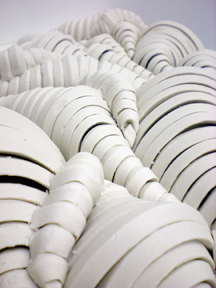
Over the years I discovered clay bodies that I found beautiful without glaze, being drawn to their way of absorbing or reflecting light, casting shadows, and holding textures. I also became interested in line and form, echoing a lifelong passion for patterns, rhythms and structures found in nature and rooted in my habit of incessant doodling and study of Japanese art and culture in graduate school. Experimentation in the studio led to the discovery that I could create three-dimensional “drawings” that could be built or erased simply by adding or subtracting individual pieces. I also discovered how dynamic the work could be by creating pieces that were assembled in reaction to the space where they were being placed. Often, clay sculpture is limited in size by the capacity of the kiln. It is also an issue that if part of a piece breaks, the whole is basically “ruined.” I found that creating and firing smaller components and assembling them afterward allowed me to create works that had two advantages: I could build works much larger than anything I could create whole in the kiln (my largest piece to date being a 16-foot hanging porcelain sculpture), and if one of the component pieces broke it could simply be replaced without affecting the whole work.

This idea of mutability — that a piece can be assembled, disassembled and reassembled in a new form — has become an important aspect of much of my work. The reality is that if moved, none of these installations can be replicated exactly when reinstalled. On a practical level, this allows me to create a unique piece for each new environment. I am also able to “recycle” the components of one work to create another. On a philosophical level, it helps incorporate my long interest in Japanese aesthetics and cultural concepts.

My recent work has been influenced considerably by the concept “ichi-go ichi-e” (一期一会), originally from the tea ceremony, meaning “one lifetime, one meeting” or “once in a lifetime.” Moving beyond the confines of the teahouse, this idea that an instance or a particular occurrence will only, can only, happen once makes time both special and poignant. It reminds me that no matter how good (or how bad), all is temporary. This idea suits both my abstract works that are assembled for only a short time (say, the duration of a show) and works that are more representational, such as my installations “Sakura” (cherry blossoms) and “Ghost” (leaves). It is with these ideas in mind that I continue to explore the boundaries of what I can create in the studio. Recently, I’ve been on something of a creative tangent, constructing abstracted patterns and textures inspired by shells and barnacles. These are for a show called “The Shell in Nature” this summer on Bainbridge Island outside of Seattle. I will also be showing new work in June at the Athenaeum in Alexandria, VA.

Laurel Lukaszewski is a Washington, DC area based artist who has exhibited widely here as well as in New York, Miami, Palm Beach, St. Louis, Pittsburgh, Philadelphia, Santa Fe, Seattle, Tulsa and Bainbridge Island. Recent solo exhibitions include ONCE at Project 4 Gallery, Washington, DC, and ARTworks 2009 featuring Laurel Lukaszewski at the Walter Arts Center, Tulsa, OK. Recent group shows include Flora: Growing Inspirations at the United States Botanic Garden in Washington, DC.

Laurel is a founding member of Flux Studios, in Mt. Rainier, MD. and has had residencies at Seattle’s Pottery Northwest and the Holland Hall School in Tulsa, OK. Laurel has served on a number of nonprofit boards including the Washington Sculptors Group, the National Cherry Blossom Festival and the Washington Project for the Arts Artist Council. Laurel holds a B.A. in International Affairs and an M.A. in Asian Studies from Florida State University in Tallahassee, FL.

Her work will be seen in “The Shell in Nature” at The Gallery at Bainbridge Arts & Crafts on Bainbridge Island, WA, from June 4 – June 30, 2010. (http://www.bacart.org/exh-upcoming.html) and in “Of Itself” at the Athenaeum in Alexandria, VA, also this June. You can see more of her work at: www.LaurelLukaszewski.com.