Home Blog Page 29

Three Poems by Elizabeth Cohen

0

The Museum of 3:00 am

This is when they visit you
all the gathered pieces
of everything.

They come rushing in
in groups, in squads,
in platoons, in cliques.

And the occasional
straggler, too, some guy
wearing an interesting cap.

They have a lot they want
to discuss with you, about
the future of the oceans,
the way things turn sideways
before they fall, how you
are still afraid of the high dive
(and what that says about you).
Why you are alone.

You ask them to back off
please, to give you some space
but then they come back with
“space is the place” quoting
Sun Ra, and “Space, the final
Frontier,” quoting Star Trek.

“Please, please, already,” you say,
“I need rest.” But they are
adamant visitors, not just drop ins;
they’re carrying picnic baskets
and to do lists that scroll down
like Rapunzel hair.

“Order those opera tickets,”
they command, “Eat more fruit!”

And you, poor soul, listen up
until, finally, sleep pops up
and grabs you by the pajama lapel.
“Come this way,” it whispers,

“I know a secret exit ramp
from the museum.”

It’s a slide and you climb
on and let yourself go
slowly down, then faster,
into your pillow, into some
little snip of abstraction,
a not-annoying dream,
and then tomorrow.

L’esprit de L’escalier

what was not said
can become a shadow
ghosting around
like a small curse,
an underbreath mutter

some words, the lazy
things, just wait around
until it’s too late,
missing the train
of the moment,
missing the party.
missing the curtain call
and the audition

that time a woman told me
I could not take off work
for pre-natal care; that time
a man told me I need to
somehow, expensively,
fix my teeth, that time
a colleague said I should
let him take my daughter
on a canoe trip; that time
someone smashed my car,
took my dog, dropped me
off alone, in snow, far
from home.
Those times I was put on hold
when calling help lines
the time we waited hours
in an ER, bleeding, expiring,
holding onto vanishing hope

and all the other times
when I should have located
those sentences, and spoken
up, but didn’t

when all the right words
slunk away, went into hibernation
and would not re-appear

now I am carrying them
around like extra clothes
I’ll never wear, in the small
satchel of my life

I still see them, hear them
calling me out, wasted bastards,
waiting for the past to circle
back so they can have their
moment, rush out into the air
and do that important dance
they missed out on
which I am pretty sure will
never happen

yet here they are with all the others,
the I’m sorrys and what the fucks
and you sucks
and the elaborate ones
which quote some
version of Baldwin:
“be careful what you set
your heart upon”; “it is easier
to cry than change”;
“fires can’t be made
with dead embers”;
“it is expensive to be poor”;
“love is growing up”

Cloud Mountain

watch the sun climb
down the cloud mountain
step by step, slowly
navigating the gauzy terrain
as if it is the first time it
ever traveled this route,
as if it’s nervous it might
trip and tumble into some
cloud ravine, or cloud crevasse,

don’t worry sun, you’ve
got this, you might think,
or you are the sun, for god’s sake,

but watching there, that
tentative pull through
scattershot mist, through
the almost liquid, the puff
and tangle pulling down.
like blinds, a semi-dark,
it becomes clear:

no matter how often a journey
is traveled, every step contains
some new kind of effort,
a tender center moment of risk.

There is always that fear
when climbing, of going sideways,
stepping off the train into the gap,
twisting, breaking, falling,
losing your way in the world.

Elizabeth Cohen‘s poems have been published in Patterson Review, Kalliope, Hawaii Review, Yale Review, Blue Mesa, San Antonio Review and other literary venues. She is the author of five books of poetry, most recently, Mermaids of Albuquerque. She lives in New Mexico, with her dog, Layla.

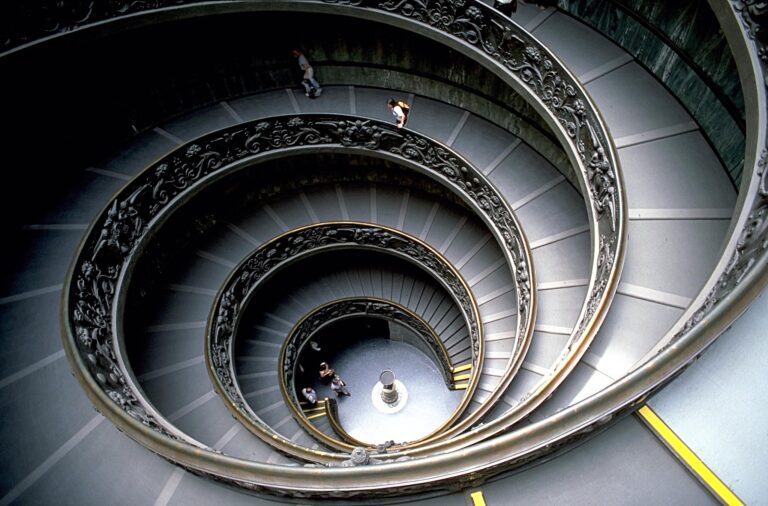
Image: Vatican Museums, CC BY-SA 4.0 https://creativecommons.org/licenses/by-sa/4.0, via Wikimedia Commons
Four Poems by Lora Berg

0

Globe-Spinning

To make my own book about a voyage to Japan
when I was nine, I clipped color pictures
from a travel magazine, pretending
I’d set sail, arrived in Osaka
and traveled overland by train
on the JR Tokaido line
to Kyoto.

Onto the burlap cover
stiffened with shirt cardboard
from Father’s clean shirt,
I stitched an origami crane.

Will I ever visit Kyoto
and its temple Kinkaku-ji,
where a golden phoenix
prances on the roof
to the pulse of gazes?

Will I see kingfishers skim
over the temple’s reflecting pond,
beaks embroidering its silken surface?

Will I stand before the topiary ship
shaped from a centuries-old white pine,
layers of sails puffing above,
the scent of pinesap in air
throbbing like shamisen strings?

May my spirit climb
up through those branches
and high into the fascicles.

Train Hopping

I heard a fiddler play where the candied ducks hung from wrung necks
beaks glazed shut in a market in Shanghai—and I could have asked why
he fiddled there, but instead, I wondered where those ducks once floated.

I heard, one Sunday night at a fiesta in Guanajuato, church bells bawling
their sorrows, and I could have wondered why they sighed so—but
instead, I donned a tiara of plastic flowers and danced into the crowd.

I heard the March wind promising a sweetie as it blew along the tracks
and I could have asked, how can the wind make a promise? But instead,
I tried to catch it, swinging aboard a train.

I, Lora, hear the jinn, one I try to ignore whispering in my right ear: stay—
the other who hisses in my left ear: go—wrapped in promises and puffery,
the screech of wheels, evasions, what could be, what might have been.

Cerrado por vacaciones

Why insert myself into this kiln of August, when
sensible Granadinos are away, splashing in the sea?
Even the man who sells fresh chips has closed shop.
Yes, the golondrinas have flown and I am lonely,
retracing steps down to the Darro, a spirited river
without water below the Sierra Nevada without snow
and gazing up at the Alhambra one seeks in Granada
in August, ghosts inviting one to recline and sip
honeyed tea, reciting in Hebrew, Spanish, Ladino
and courtly Arabic, poems. Lend me your past, Granada—
to run through my fingers like a subha, memories
to nestle like threads dyed in marigold petals
and nettles and wound on an olivewood shuttle.
I’ve never been here before, and still I remember.

Mint Tea (Atay Bi Nana)

He pours hot tea
from a great height
so it cools as it tumbles
from swan neck
over gold rim
and into the stout glass
stuffed with mint
that glints like pine needles.
Lofty in his fez,
eyes kindling above
a pyramid mustache,
he pours as if to say
you are welcome,
or isn’t this mint luscious
or will she tip enough
to cover mama’s medicine
or that fly is back on the cup
or we are all in god’s hands
or what are the chances of
surviving the crossing by sea—
but what do I know
since his life may be excellent
and just as he wishes
as he sails to the next table,
and I nod in thanks
for this healing infusion
regretful I won’t ask
what his gestures really mean
as I am timid, a gatherer
of shreds from
what I sense or read,
and prefer to imagine,
tilting my face
into the steam.


Author of The Mermaid Wakes (Macmillan Caribbean) with Grenadian visual artist Canute Caliste, Lora Berg writes with a light touch from her home in Maryland. Her poems have appeared in Shenandoah, Colorado Review, and other journals. She served abroad for many years at U.S. Embassies as cultural attaché. With an MFA from Johns Hopkins, she worked as poet-in-residence at Saint Albans School. Lora participated in the 2022-23 Poetry Collective at Lighthouse Writers Workshop. She is a proud grandma in a vibrant multicultural family.  

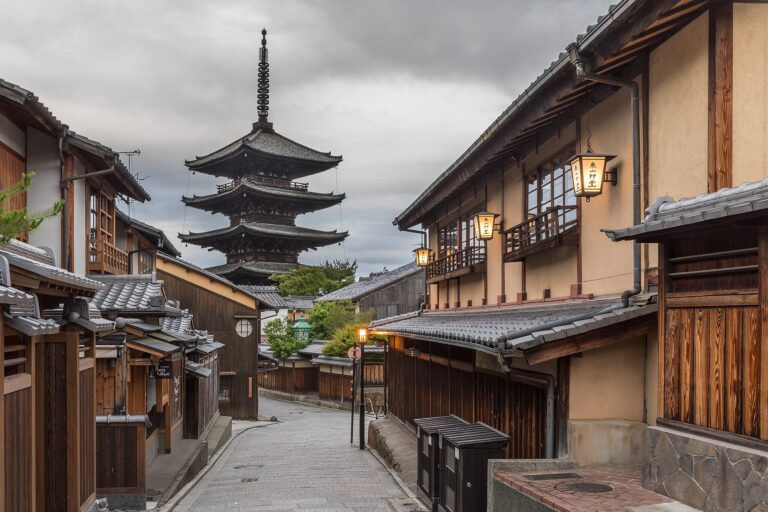
Image: Martin Falbisoner, CC BY-SA 4.0 https://creativecommons.org/licenses/by-sa/4.0, via Wikimedia Commons
Two Poems by Nicholas Pagano

0

Red Tower

At this height, it looks less
like defeated, more withstood.
Summer’s hottest days
in dwindle, retreating
until the same
as any other battle fought
and survived. I believe
in victory, like acceptance.
More and more a fading
scent of lemon on the wind.
Here, where dusk, the horses,
who come to these hills
to graze in the relative
quiet, the rippling blue
muscle of the herds crossing,
seems so far away.

Medieval Architecture

That was when to lock away
the body came to mean holiness. Then, fear

as a world denied for
forever would shine how stained

glass shines. In many colors. Broken
to be remade. I’m sorry,

I can’t trust a cloister’s quiet
heart. No matter how strong or artfully built

its walls. The kind muddled by trees,
leafless branches that, even today,

could be surrender or just
too early for buds.

The wind dances through the colonnade
all the same. A hidden tapestry,

in which cardinals dart through copse bushes,
and, held for once steady,

the breath is a single gold thread, unfurling
even when we try to look away.

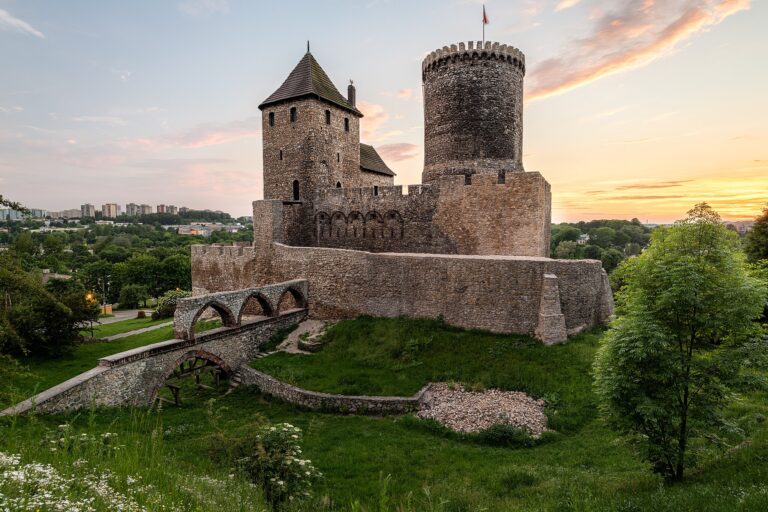
Nicholas Pagano has previously been published in Chronogram, Field Guide, Stone Circle Review, The Windward Review, and elsewhere. He lives and writes in New York.

Image: GrzegorzImielowski, CC BY-SA 4.0 https://creativecommons.org/licenses/by-sa/4.0, via Wikimedia Commons

Funland by David Fallick

0

Funland

I stole her away, I did.
I stole her away.
I went into her restaurant
And stole her away.

She has a Chinese restaurant
She ran it with her husband.
I fell in love with her
The first time I ordered steamed vegetable dumplings.

Of course, I couldn’t do anything.
Since she was married.
But I think
One time
When I ordered extra rice
Our eyes met
They did!
Our eyes met. I melted.
She… She turned toward the back
And yelled, “Jah Fahn”, or “More rice” in Chinese.
Then she turned back toward me and said
“It’ll be right here, sir.”
“Sir”. She called me “Sir”. With tenderness and kindness
And reassurance that
My rice would come
The next day, I came back
She smiled, with eyes so soft, asking me
“Steamed vegetable dumplings?”
I knew then that we would be together
From that point on
I came back
Every Tuesday
For weeks.
Sometimes it was an extra fortune cookie
Or extra rice on the house
Sometimes, her fingertips gently
Caressed my hand as she gave me my change

One day, she told me
How she felt about me
Not directly of course
But through a tofu and vegetable entrée
She didn’t charge me for
When I finished the last piece of tofu and the last piece of vegetable
I opened up my fortune cookie
There was a note inside
“You’ll meet a Chinese woman
Who left her husband months ago
The guy in the back is my brother.”

Staring at the note
My mouth agape
I managed to stand and hold myself up.
I walked slowly to the counter
Where she stood taking orders over the phone
And where it had all started.
I looked into her eyes
“Put down the phone”, I said.
And I took her hand
And stole her away.

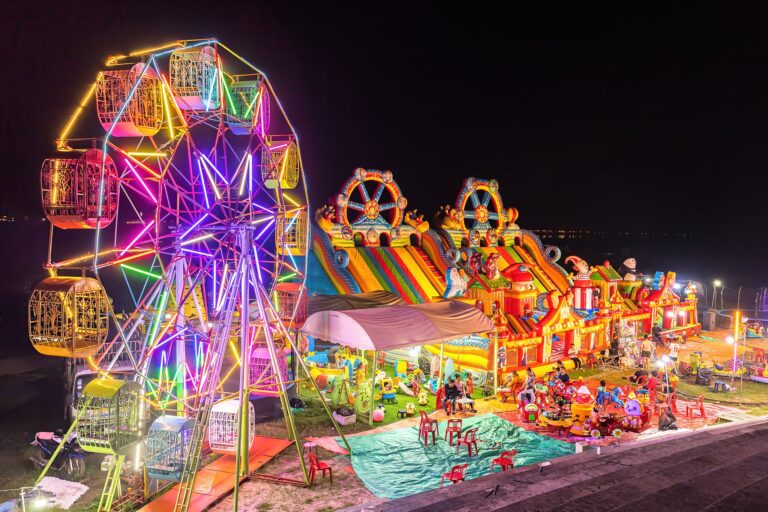
David Fallick lives in Rockville, Maryland. “Funland” is his first published creative writing in English. Previous published creative writing is in Yiddish.

Image: Basile Morin, CC BY-SA 4.0 https://creativecommons.org/licenses/by-sa/4.0, via Wikimedia Commons
Three Poems by Summer Hardinge

0
Aperture
with thanks to Ikkyu Sojun


And I said, the moon is a house.

It was the eclipse and we lay outside on the chaise lounge

while the sun turned from a thumbnail sketch to a mouth’s

swooping smile then to sliver, and we wondered

where we’d be twenty-one years from now. Whether we’d see

another one. Shadows from the garden chairs cast

diamond patterns on the slate, and clouds drifted.

For a few moments, a bit of darkness. We had expected

no movement from spectators; yet bees came to the blue phlox.

A group of ants edged along the rock wall,

and a school bus made its way down

the sloping hill. We wondered if they knew

our trajectory when we lay completely inert

and let the Sun take over.


The horses are whickering

and they stand spattered,
even eyelids covered in mud

the barn’s floor a river,
we do not know their names.

The donkeys stamp and bray
thinking it could be their turn,

then decide they know more
in silence.

Paddock in hillocks,
and we pull all manner of field

from hooves. Ice crystals pool off
whiskers and when I hold

the beautiful animal close to my chest,
something passes through me

and the present with the past
seem a continuum.

With coats dark with sheen, we sense
how good our lust for wonder

that we exist at all.


Abundance

When sour cherries ripen
full in the orchard

on Sugarland Road, I take
all morning among

heavy branches, filling
my buckets, thinking

this will be the last one, sliding
handfuls of tart flesh

into my mouth; my shirt
stains pink, a talisman. In wet

fields and dark rivers, under
trees, the life there is, moves.
white woman with blond shoulder length hair, smiling in a aqua blue blouse

Summer Hardinge lives near the Potomac River in Maryland. She is the first place winner of the 2024 Ron Rash Poetry Contest for “Contents of Lincoln’s Pockets,” published in Broad River Review. Her work appears in Stonecoast ReviewBeltway Poetry Quarterly, Literary Mama, and elsewhere. Summer received the 2019 First Place in the Poetry Contest sponsored by Bethesda Urban Partnership. A former high school English teacher, she leads Amherst Writers and Artists workshops in the Washington D.C. area. Visit her website.

Featured Image: “Aperture in a lens” by Gaurav Dhwaj Khadka under the Creative Commons Attribution-Share Alike 4.0 International license.