Home Blog Page 46

Two Poems by Jim Smith

Eating the Sun

At the Alburgh VT eclipse festival, children sit at a picnic table drawing the sun with black crayons. A dragonfly brushes my cheek. It’s time I checked the astronomical charts. At breakfast a man curses hell. My grandfather’s dying, he promised to wait. It’s a ten-hour drive. A friendly snake circles my ankle. Sorry, I’m only passing through. Even the air smells like maple syrup. On the playground the kids swing so high they might hit their heads on the moon. Grandfather feels a chill, needs a coat. The darkness crawling once again as in those pesky nightmares. Unfazed by fireworks, the dragon snaps. I take one last look around. In Vermont, the children stay up late playing hide and seek in the dark.

This Page Intentionally Blank

Flip the switch that disconnects the machinery of your senses till the mind goes blank and the lake appears under summer skies while you glide your canoe celebrating the silence with no sea shanty sailors or talkative guides then you find a mirror cove the clouds seem to drift underneath as the slish of swirling water curlicues off your paddle like the curl of a girl underwater floating in flowing medieval gown with a blank stare singing how should I your true love know now you want to embrace her stay in the scene till you see a specter approaching nearer neither submarine nor welcome party for he is the keeper of possibility whose thwack of his tail sends you retreating to town where you search for revelations on a blank wall.

After moving to Silver Spring in 1993 for a position in the US Government, Jim Smith became involved in the DC poetry scene – taking classes, attending readings, and even performing now and then. Now retired, he is trying to get his first collection published.

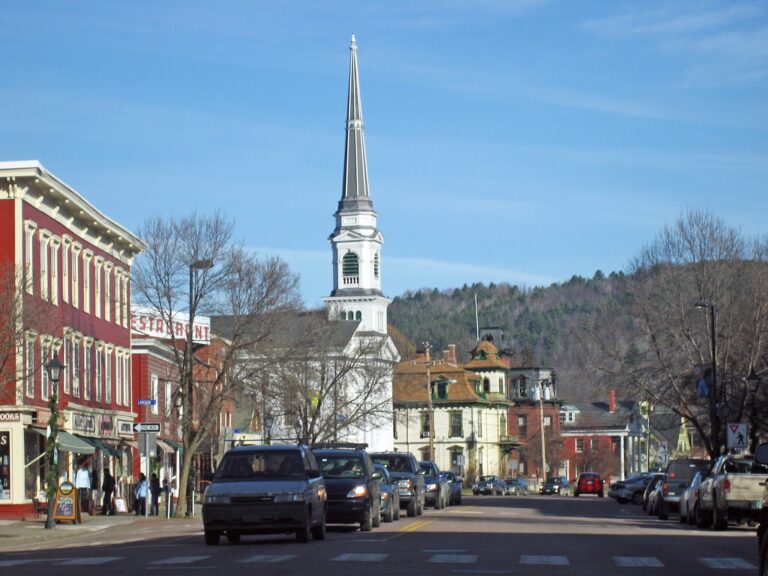
Image: GearedBull, CC BY 3.0 https://creativecommons.org/licenses/by/3.0, via Wikimedia Commons
Two Poems by Mark Thalman

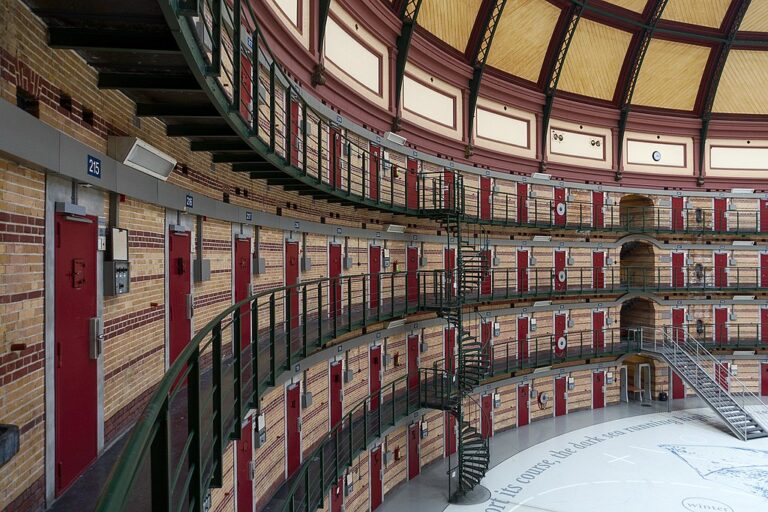
At the State Maximum Security Prison

There are no elevators.
They can’t be secured.
To get to classrooms on the third floor,
everyone takes the stairs.

Before class and during breaks,
it is a status symbol for inmates
to talk to someone from the outside.
For a few moments, they get to experience
what it feels to be “normal.”

While teaching MacBeth,
the witches foretell the future
and nothing is normal.

Then there is a knock, knock, knock
from the other side of the wall
where there isn’t supposed to be
anyone, unless you’re Spiderman
crawling up a blank facade.

Everyone freezes and stares at me,
waiting to see what I will do.

I walk to the board
and knock back three times,
returning the signal, if it is a signal,
and nonchalantly continue where I left off
as if nothing happened.


Accidental Coincidences

"There are only two ways to live your life.
One is as though nothing is a miracle.
The other is as though everything is a miracle.”
-Albert Einstein

If my father had not fumbled the handoff
from his father when they were building
a stone wall, I would not have been born.
The doctors did not want to operate
on his foot, until he stopped growing,
as not to stunt the growth.

When he was drafted during W.W. II,
he couldn’t finish long hikes, because
his big toe wouldn’t bend
due to calcium deposits
solidified like concrete.

My father was given an honorable discharge
and entered the university, a paradise.
Women outnumbered men six to one.

On their first date, my parents attended a dance.
Half way through the evening,
Dad said he’d be right back.
That’s when he walked on stage,
and prearranged with the drummer,
a longtime friend, switched places
and played In the Mood.

My parents only wanted two children.
If my mother had not had a miscarriage,
before having my sister, there would not be
any “To be or not to be” for me.

It’s no wonder that the ancient Greek’s
believed in Fate. If I turn left and she turns right
the encounter evaporates into oblivion . . .

never to find out we share the same birthday,
enjoy solving murder mysteries,
and love the French Impressionists.

Now, after thirty-three years of marriage,
I wake up to this happy accident that is us,
and together we have another day on this earth.
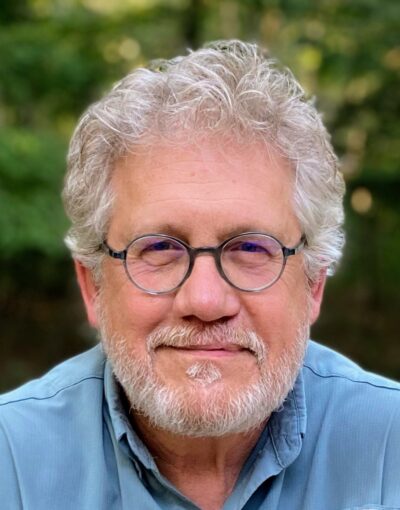
white man with receding hairline, fray hair, rimless glasses and blue button up shirt

Mark Thalman is the author of Stronger Than the Current, The Peasant Dance, and Catching the Limit. His work has been widely published for five decades. His poems have appeared in the Paterson Review, The MacGuffin, Pedestal Magazine, and Valparaiso Review, among many others. He has an MFA in Creative Writing from the University of Oregon. Thalman retired from the public schools after teaching English and Creative Writing for 35 years. Besides writing, he enjoys painting landscapes and wildlife art. He lives with his wife and their Shetland Sheep Dog in Forest Grove, Oregon.  Please visit markthalman.com.

Feature Image: “Allround” Koepelgevangenis (Panipticon-style prison), Arnhem, The Netherlands, from Rob Oo from NL licensed under the Creative Commons Attribution 2.0 Generic license.

Two Poems by Le Hinton

The Rainy Season

We report the discovery of the Labord’s chameleon, with a posthatching life span of just 4–5 months.
— PNAS abstract: “Unique life history among tetrapods”

I think of dying every day… At a certain age, you should be prepared to go at any time.
— August Wilson

What if you get only four
months to live? From an egg-
breaking birth until your palm
tree death-fall. Just the brief weeks
of a rainy season in Madagascar.

What if the sole purpose of your existence
is to find the love-of-your-lizard-life
and sire a clutch of new eggs, never
bothering to even eat that whole time. Never
getting the chance to hug your little ones later.
How compelling is that memoir?

Would you ponder your own mortality or wonder
if you’ll be reborn into a higher realm?
Maybe you’d worry that you’ve not done enough
in your rainforested life to earn your angel
wings, fly up to some reptile heaven.

You don’t have enough time to do it all. To listen to Shorter
through black, Bose speakers or watch old film clips
of Clemente being brilliant. You won’t study Carlsen’s cunning
when playing the Scotch Opening or experience Clifton reading at Dodge.
There is no time to dream or hope inside your chameleon brain.

So, tell me, how do I spend the next
three months after a blood test hints
that the cancer is undetectable this time?

What do I do with
these 90 days

until the next test?
These 90 days

until the next scan.
These 90 days

before the lease comes up for renewal?

My heart is misty, and I am lost, tiny friend.
So, tell me again, how do we dream
in this season of rain?

Karkinos

éna
This isn’t a constant battle. Sometimes he loses
interest or moves on to someone else for a while.
Attention deficit perhaps. Eventually, he’ll get back to me.

dío
Maybe I should move the emergency
money to the joint checking account
so that she doesn’t have to do it later.

tría
The Buddhist in me focuses on the present, like
the silence in Kind of Blue. The ghosts of those
seven souls never change keys.

tésera
There are less-depressing methods to increase
your vocabulary. You can learn metastatic
and malignant without personal examples.

pénde
The doctors ask, How are you? Do you have any
pain? Can you quantify it for me? But I’m not
a math major. Can I write a poem instead?

éxi
What should I do with my subscriptions?
Renew, cancel. Cancel, renew. I wonder if the gods
are pondering the same decision about me.

eptá
Once upon a summer, I took a two-week course
in conversational Greek. I don’t recall much.
Just enough to say andío.

Poet and publisher, Le Hinton, is the author of seven collections including, most recently, Elegies for an Empire (2023) and Sing Silence (2018), both from Iris G. Press. His work has been widely published and can be found in The Best American Poetry 2014, the Baltimore Review, the Skinny Poetry Journal, the Progressive Magazine, Little Patuxent Review, Pleiades, the Summerset Review, and elsewhere. His poems have received multiple nominations for the Pushcart Prize and have been nominated for Best of the Net. His poem, “Epidemic,” won the Baltimore Review’s 2013 Winter Writers Contest. In 2014 it was honored by The Pennsylvania Center for the Book, and in 2021 it was featured on the WPSU program, “Poetry Moment.” His poem, “Our Ballpark,” can be found outside Clipper Magazine Stadium in Lancaster, Pennsylvania, incorporated into Derek Parker’s sculpture Common Thread.

Image by King of Hearts, CC BY-SA 4.0 https://creativecommons.org/licenses/by-sa/4.0, via Wikimedia Commons

Two Poems by D. R. James

I Don’t Know the Biochemistry
of a Hummingbird

I can only wonder
at this blurred
whir of evidence, clouded
in the blue fan
of a thousand
wings. I want
to feel
their million beats
per second on my beard
and lashes,
reel
from each swig,
the dozen
manic intervals,
stomach a zoom
to the forsythia, whose
scream of tender yellow
faded and fell
last week.
How
can mere filaments
in tiny shoulders
flex
and reflex so fast?
How
can miniscule
sipping, the sucking
through a needle beak,
fuel a miniature tyrant’s
relentless burn?
Then,
in the resting,
which is not even
a breath,
how rapid
the saturation
of liquid sugar
into blood, into
wing muscle, into
instinctual motive
for a horizontal
life? And how
rapid the
depletion?

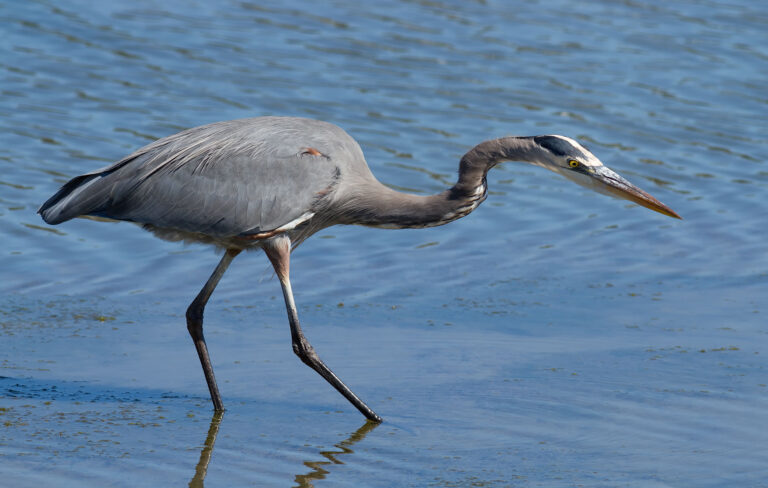
Great Blue Heron

Look, I want to love this world
as though it’s the last chance I’m ever going to get
to be alive
and know it.
—Mary Oliver, “October”

Busy inhabiting my world—
blazing car, radio blather,
coffee buzz that wouldn’t last—

I somehow caught a left-hand glimpse,
so quick I didn’t see you flinch,
yet so outstanding, you could’ve been

a plastic cousin to the prank flamingos
that another morning
enthralled my neighbor’s lawn.

Stark still, ankle-deep
in that transitory water,
only the one side, one-eyed,

wide as disbelief, you looked
just like you looked, posed
in the Natural History Museum,

1963: for again,
all those slender angles,
the spear of your bill,

that deathless intensity
marking your stick-form way, only
now in a mid-May puddle poised

between the intersecting rushes
eastbound, 196, southbound, 31.
And you, still doing

what you’ve never known
you do, still finding your life
wherever you find yourself—

while I, still fixated as always
on finding myself,
as if that were to find a life,

saw again how wildly
I am alive—
how I always want to know it.

D. R. James, retired from nearly 40 years of teaching college writing, literature, and peace studies, lives with his psychotherapist wife in the woods near Saugatuck, Michigan. His latest of ten collections are Mobius Trip and Flip Requiem (Dos Madres Press, 2021, 2020), and his work has appeared internationally in a wide variety of anthologies and journals. https://www.amazon.com/author/drjamesauthorpage

Image © Frank Schulenburg

Two Poems by Nathan Scheer

“Lost”
-For NAC

Is it possible to grieve
for someone who still breathes?
To mourn someone who still walks
and works and talks to you?
You’re no longer the same to them,
and them to you,
because of a decision they made,
something they said.
There’s nothing you can do
except cry
and miss them.
You never let your melancholy manifest itself
above the surface. You bury it
with a sprinkling of soil
and the occasional thump
of a pebble.
You host a shiva
just for you, entertaining distractions.
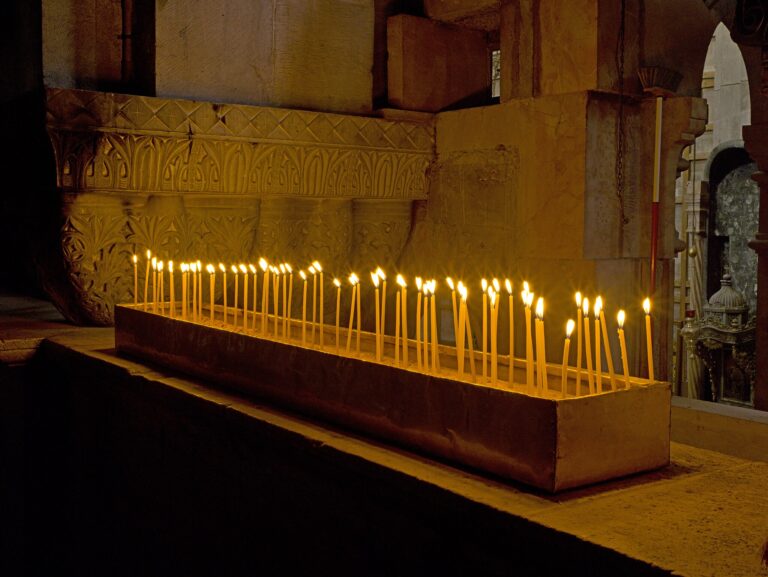
You light a candle, a solitary vigil,
hidden from all who poke and prod
and pry and try to peel away
the layer you’ve thrown over yourself,
the shroud over your love,
the veil over your face.
Is it possible to grieve
for someone who still breathes?
You know where they are,
but you’ve lost them,
and you’re lost too.

“Proclaim”


I cry soul and fire into the air.
I denounce fate and expectation.
I banish all hope but my own.
I wrap my arms around love and the
future I see reflected in their face.
I sing myself a home into existence,
for it’s only a home if I am in it.
I sit truth down in a chair and give it
a cup of tea to make it feel more
comfortable.
I give my nerves a slap before hitting
it behind the knees so it stumbles, just
for a minute.
I lock memory in a closet so
it can’t sneak up on me.
I let creation rest proudly on the
countertop, for anyone to see as
they walk in.
I keep fantasy hung on the wall, so
I can sneak a glimpse every now and
again as I pass.
I wipe frustration on the mat by the
door, and still leave some on the bottoms of
my boots.
I dance with melancholy, counting out
the steps to prevent him from crushing my
toes like last time.
I take uncertainty by the hand and
we stroll down the wooded path, together.
white man with brown hair and cream and black shirt

Nathan Scheer is an emerging poet from Northern New Jersey primarily active in the New York City poetry workshop and open mic scene. The subjects of his work include everyday life in and around New York as well as Jewish and queer experience.

Feature Image: “Jerusalem-Church of the Holy Sepulchre-Candles” by Andrew Shiva under the Creative Commons Attribution-Share Alike 4.0 International license.