Home Blog Page 119

Two Poems by Maria Teresa Ogliastri

0

Bourgeon continues its celebration of Women in Translation Month.

Rationing

In the line a woman shouts
there’s flour

I think of warm biscuits

Soon I hear
only rice is left
but my happiness is futile

They’re bringing sugar
Oh! miracle
I will wait
I hear words ricochet
the sugar is gone

The line begins to disperse

I persist
eventually they will bring something
finally a hand offers me a chicken
I leave with my treasure

In a bookstore nearby
a friend has the nerve to read me a long poem
the poet doesn’t know why I flee
such an ordinary goodbye fills me with guilt

You must live in a country with hunger
to understand how a poem’s symmetry
can be broken
by the slow drip of guts and blood

Translated by Yvette Neisser. Originally published in The Brooklyn Rail’s InTranslation series.


Racionamiento

En la fila una mujer grita
llegó harina

Pienso en panecillos horneados

Poco después oigo
solo queda arroz
pero mi alegría es vana

Van a sacar azúcar
¡oh! Milagro
esperaré
escucho palabras en rebote
se acabó la azúcar

La cola comienza a deshacerse

Persisto
algo van a sacar más tarde
al final una mano me entrega un pollo
salgo de allí con mi tesoro

En una librería cercana
un amigo se atreve a leerme un poema largo
el poeta no sabe por qué me despido
lo prosaico de mi huida me hace sentir culpable

Hay que vivir en un país con hambre
para entender cómo se puede romper
la simetría de un poema
por un ligero goteo de vísceras y sangre

Lark Please Look at Me

I know Newton’s Laws produce birdsongs
hence the tenacity of the lark
how it carries its song through the air
holding and releasing its river voice

the hanging feeder is replete with fruit
and the cage set in gold
I can’t understand what impedes her

outside the birdseed now ice

other birds come to peck the fruit
she crashes into the snow

twig by twig she builds a nest

though I try to sing like the lark
I am a woman imprisoned

unable to modulate
without the vibrato of another throat

I find myself at the throne of death

lark please look at me
and death shall have no dominion
because a lark can revoke the sentence
if a dying person meets its eye

From the book Del diario de la Señora Mao (From the Diary of Madame Mao), this poem is written in the voice of Jiang Qing, widow of Mao Zedong, at the end of her life.

Translated by Yvette Neisser and Patricia Bejarano Fisher.

Que me vea una alondra

Sé que las Leyes de Newton producen cantos
de allí la tenacidad de la alondra
la forma como sostiene su canto en el aire
conteniendo y soltando su voz de arroyo

el comedero colgante está provisto de fruta
y la jaula engastada en oro
pero no entiendo el impedimento del pájaro

afuera el alpiste de hielo

otras aves se acercan a picotear la fruta
ella se estrella en la nieve

ramita a ramita construye un nido

aunque imite el cantar de la alondra
soy una mujer cautiva

para modular
necesito el vibrato de otra garganta

me hallo en el trono de la muerte

necesito que me vea una alondra
y la muerte perderá su dominio
porque una alondra puede revocar la sentencia
si un moribundo encuentra sus ojos
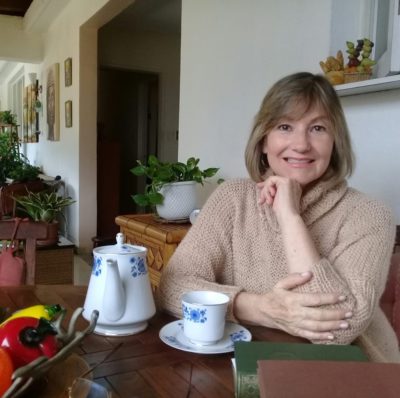
Maria Teresa Ogliastri was born in Los Teques, Venezuela, and lives in Caracas. She is the author of six collections of poems, including Alambique (“Distiller,” Editorial El Taller Blanco, 2019) and Polo Sur (2008)which was published in English as South Pole/Polo Sur (Settlement House, 2011). Ogliastri has been featured at poetry festivals in Latin America and the US, and her poems appear in several anthologies of contemporary Venezuelan poetry. She is currently a professor in the School of Philosophy at the Universidad Central de Venezuela.
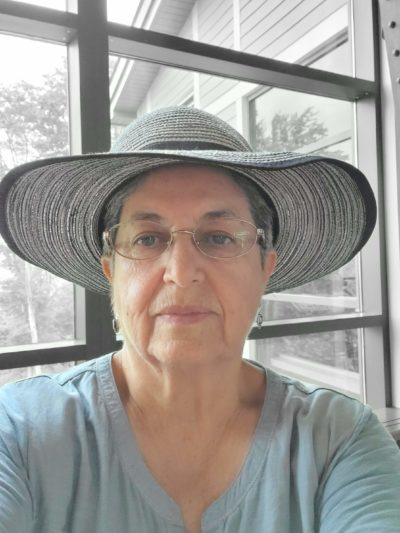
Patricia Bejarano Fisher, originally from Colombia, is a multidisciplinary language professional who has worked as a translator, teacher, and developer of learning materials. She is co-translator of Maria Teresa Ogliastri’s South Pole/Polo Sur (Settlement House, 2011) and From the Diary of Madame Mao (unpublished). Her translations have appeared in literary journals, as well as in Laura Shovan’s The Last Fifth Grade of Emerson Elementary (Random House Children’s Books, 2016), and in Danuta E. Kosk-Kosicka (Ed.) Szklana góra/Glass Mountain (2017). 
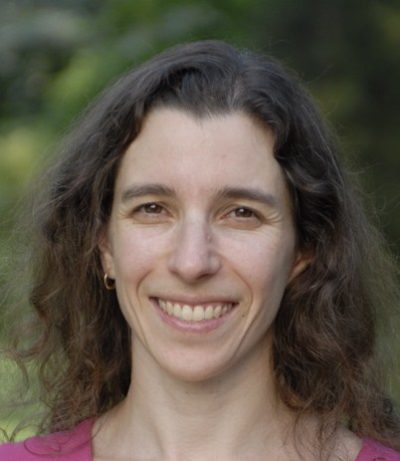
Yvette Neisser is the author of Grip, winner of the 2011 Gival Press Poetry Award. Her translations from Spanish include South Pole by María Teresa Ogliastri and Difficult Beauty: Selected Poems by Luis Alberto Ambroggio. Her poems, translations, essays, and reviews have appeared in such publications as Foreign Policy in FocusVirginia Quarterly Review, and the Bloomsbury Anthology of Contemporary Jewish American Poetry. She is a founding Board Member of the DC-Area Literary Translators Network (DC-ALT) and has taught writing at George Washington University and The Writer’s Center. By day, she is a writer for an international development firm.

Image by RASECZENITRAM [CC BY-SA 3.0 (https://creativecommons.org/licenses/by-sa/3.0)]
Two Poems by Lê Phạm Lê

0

co-translated from the Vietnamese by Nancy Arbuthnot and Lê Phạm Lê

Editor’s note: August is Women in Translation Month. Bourgeon is celebrating by offering the work of four distinguished poets from several countries. Arlington Poet Laureate Emerita, Katherine E. Young, introduces the series:

August is Women in Translation Month, an international event held every August since 2014. Why? Here in the U.S., fewer than 800 books in translation (that number covers all literary genres!) are published in any given year. Of those 800 books, fewer than one third are works written by women. Clearly, we are not hearing enough women’s voices from around the world – not even from those languages where their work is originally published as frequently as the work of men.

Women in Translation Month is the brainchild of Meytal Radzinski, an Israeli scientist and book lover who noticed how few women she was reading in translation. Radzinski had two goals in mind when she founded the event: to increase dialogue and discussion about women writers in translation, and to encourage people to read more books by women in translation. Her advocacy has been eagerly seconded by booksellers, literary programmers (including the Café Muse reading series here in the DC area), and online supporters. If you enjoy these poems, I urge you to support women authors, their translators, their publishers, and the booksellers who carry their work: go buy a book (or two!) by a woman in translation!

Overseas Journey (In memory of PTM)

by Lê Phạm Lê
co-translated by Nancy Arbuthnot and Lê Phạm Lê

Your name, Mai: a yellow blossom.
Your smile, a sparkling in your eyes.
In the chaos, you dreamed.
In waves beyond waves, you risked
Your dream. Before reaching shore
You disappeared in the ocean.
Now, regret following regret,
I burn incense for your soul.

Trên Đường Vượt Biển (Khóc Bạn PTM)

Mai vàng: cánh lụa mong manh.
Nhớ đôi mắt phượng long lanh nét cười.
Đảo điên thế sự trêu ngươi.
Bên bờ sinh-tử, quyết liều ra khơi.
Đại dương bão tố tơi bời.
Giữa dòng nước cuốn, nửa đời mạng vong!
Tiếc thương, xao xuyến tấc lòng.
Tâm hương thắp giữa trầm luân kiếp người.

Memory River 

by Lê Phạm Lê
co-translated by Nancy Arbuthnot and Lê Phạm Lê

Childhood friends, that ancient village,
Purple reeds swaying by the bridge.
Đa Nhim River still flows in memory
And the lost calf moos, nghé ngọ …

Dòng Sông Tuổi Nhỏ

Quê nghèo, bạn cũ, phố xưa
Có hàng lau tím đong đưa bên cầu.
Sông sâu*, nước chảy về đâu?
Tiếng bê nghé ngọ…, nỗi đau lạc bầy!

*Đa nhim River running through the author’s hometown, Đơn dương

Born in Vietnam, poet Lê Phạm Lê is the author of two bilingual collections of poems (translated into English with Nancy Arbuthnot): From Where the Wind Blows, Waves Beyond Waves, and three children’s books written in English: Magical Voice in the Forest, Guava Hill, and Baby Sparrow Song. Her poems have been published in several poetry anthologies and periodicals including World Literature Today, Nimrod International Literary Journal, and Source, among others. After working at Los Medanos Community College for 22 years, Lê is retired and currently working on a play, Bequest of Wings, in collaboration with Nancy Arbuthnot.

Nancy Arbuthnot is professor emerita of English at the United States Naval Academy (USNA), author of Spirit Hovering: Poems, and co-translator with Le Pham Le of two books of her Vietnamese poems, From Where the Wind Blows and Waves Beyond Waves. She is currently seeking a publisher for her poems about growing up Navy and teaching at USNA. 


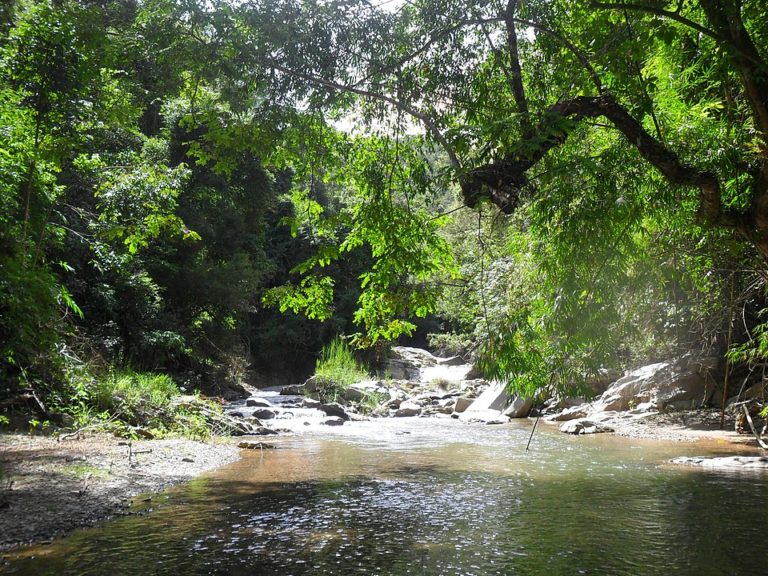
Image by Violetbonmua – Own work, CC BY-SA 3.0, https://commons.wikimedia.org/w/index.php?curid=15698587

Three Poems by Alison Palmer

0

Hunger

This morning is sickening— 
                                  the photograph on my desk from before
            the day the birds quit
                                                circling, you
a pair of silent eyes—


And how
            often can I write beauty
                                    into pain—

I want you
to know again the stunning curves of your calves, the
                        invitations from the bend in your arms
to come, dance—

But these are merely waking dreams. I begin
                                               as any cloud—
            will I be made of ice or water,
                                   will it be a low-lying day—

Our faces, fringes
                       on a sun-stiff background—
                                               I wish to unspool
       you down to bone where
                   no heart can be—

We Are Not Tied to Our Body’s Weight on Earth

So I lift you.

You are breath in my cupped hands.

You are less than air.

The flowers miss you.

I’ve become how they can’t blossom.

This time last year maybe laughter.

I think, how sorrowful is sorrow’s life?

I think, falling is instant loss.

You’re always somewhere behind my eyes.

How I wish they were blue like yours.

I look in the mirror to own a piece of you.

My mouth speaks your name and closes.

A Cartographer’s Confusion

The sun at Polaris.

Between the moon and the Pleiades.

Angles our hips destroy, one pressed on the other.

And east of our bed, vased-tulips, a card
with animals on the front that reads:

            Meant for each otter 

How closely I let my lips pull to yours
                                    as you fall asleep at a forty-five
                       arms splayed, and I have you, starfish.

If you’re an intercardinal direction, then
            southwest (SW). I lie
between the letters, the “x” degree, down

                        by your bare feet now, curling the map.

So, the sextant,
                       compass, quadrant. I turn the telescope
                                   on you.

You’re a space observatory.

You’re a weatherman.

You’re a spy.

Alison Palmer is the author of the poetry chapbook, The Need for Hiding (Dancing Girl Press, 2018). To read an in-depth interview with The Poet’s Billow visit www.thepoetsbillow.org. Alison’s work appears in FIELD, Bear Review, River Styx, Glass, Cimarron, Cincinnati Review, LAR and elsewhere. Nominated for a Pushcart Prize, Best New Poets, and a finalist for Eyewear Publishing’s Sexton Prize, Alison lives and writes outside Washington, D.C.


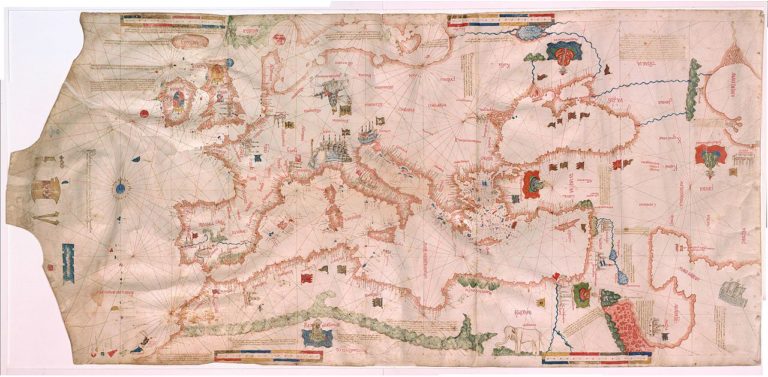
Image by Bartolomeo Pareto (1455) – http://www.smoliy.ru/
img/anticuemaps/bartolomeo_pareto_1455.jpeg, Public Domain, https://commons.wikimedia.org/w/index.php?curid=58376634

Three Poems by Yvette Neisser

HUSBAND

A hand
that reaches out

mooring me
from a night of wind-tossed dreams

luring me back to port
this bed our terra firma

the heat of his palm
the only thing that holds me here

like the weight that keeps a tarp
from flying into the storm

WHAT YOU LEFT BEHIND

A closet full of tools
I cannot name.
An industrial-strength vacuum.
Receipts from 2005.
Books you never read.

A 40-foot ladder.
Empty, crusted paint cans.

Years of dust in the corners
we never swept.
Cracked windowsills and peeling paint.
Curtains hung crookedly.
Others never hung.

The bed we bought together.
And the sheets we slept on.
How many years.

Dreams where I sense you
lying next to me
and wake up
saying no, no, no.

Your last name
on every document I own.
The hollow of its vowels.

YVETTE

This name derived from the yew tree
and given to me in 1973
for my mother’s love of French
and a Boricua girl with black braids,
my father’s favorite student
when he taught second grade
in the South Bronx, his refuge
from the draft, a time
when they lived in one room
and a hamper served as his desk.

A name that has passed through languages,
from Germanic into French,
linking me in a chain from Saint Yves
to the girl with Spanish twined in her braids,
to my own brown curls
and a childhood of English.

Yvette, written with a Y
that sounds like an E,
mispronounced all my life,
its first syllable a mystery vowel
on the tongues of friends and teachers.

This name I carry with me, reminder
of a time when lives were defined by war,
when my mother dreamed in francais
and my father taught arithmetic to children,
a time long forgotten in the annals
of our American family
where English came to dominate
pushing Yiddish and German
into the eaves, into the distant sphere
of grandparents. Who knew
that the language of the braids
would find its way back,
that one day I would find Neruda
and grow into Spanish.
It is in me. I contain it.

Yvette Neisser is the author of Grip, winner of the 2011 Gival Press Poetry Award. Her translations from Spanish include South Pole by María Teresa Ogliastri and Difficult Beauty: Selected Poems by Luis Alberto Ambroggio. Her poems, translations, essays, and reviews have appeared in such publications as Foreign Policy in FocusVirginia Quarterly Review, Split This Rock’s The Quarry, and the Bloomsbury Anthology of Contemporary Jewish American Poetry. She is a founding Board Member of the DC-Area Literary Translators Network (DC-ALT) and has taught writing at George Washington University and The Writer’s Center. By day, she is a writer for an international development firm.

Image by Jay Wennington jaywennington – https://unsplash.com/photos/OLIcAFggdZEImage at the Wayback Machine (archived on 8 May 2017) Gallery at the Wayback Machine (archived on 4 May 2017), CC0, https://commons.wikimedia.org/w/index.php?curid=62335393

Three Poems by Marianne Szlyk

Fishing Poem

The grandfather I never knew fished for hornpout
in a pond I heard about but never saw.

There my mother’s family spent summers,
less than a half-hour’s drive from the city.

Unless they fished in clear water,
hornpout tastes like mud, which not even

Gram’s hand-cranked peach ice cream
or Grandpa’s Lucky Strike Greens could disguise. 

I Google Ashburnham to see the pond
not quite sparkle under a brilliant sky.

The surface hides mud, weeds, a murder victim.
No one fishes now, and the houses for sale

are far grander than that summer-time shack
without electricity, without running water.

The trees are smaller than they would have been
before the hurricane, the year my mother turned twelve,

the year she stopped fishing.


Flying into Warsaw in Another Life

In this life, the eastbound airplane
simply hangs above the toy landscape:
cotton ball clouds; tiny, nameless trees:
the ocean, a smooth, dark sheet
without trash or fish or shipwrecks.

Tomorrow morning I land in Poland,
my grandfather’s country, country of trees
with yellowed leaves and peeling bark,
of cobblestones coated with cigarette smoke,
of lumbering oxen and steam trains,
of people who look like me
but swish and swallow vinegary consonants
that burn going down an American’s throat.

In this life, I don’t know
that Grampy never lived in Poland.
In his own village, near Vilnius,
his words, a foreign language, swirled
like wood smoke in morning air.

The Indoor Sculpture Garden

                  After Sara Parent-Ramos’ exhibit However Because

Objects from the sea
surface above
sea-level. Vibrant blues
shimmer, form
patterns, speak in code.

At this party,
humans are mingling with
ceramics. 
Some know each other. 
Most don’t.  I clutch,

my phone, dancing in and
out of this
game in which we guess
the other’s names.

Speechless, objects glisten,
 
the vanished
artist’s nameless children, 
hidden from our 
winter world of mud and 
pelting rain.

Marianne Szlyk is a professor of English and Reading at Montgomery College.  She also edits The Song Is… a blog-zine for poetry and prose inspired by music (especially jazz). Her book, On the Other Side of the Window, is now available on Amazon. In July 2019, she was part of Tupelo Press’ 30/30 Project.  Her poems have also appeared in of/with, bird’s thumb, Loch Raven Review, Solidago, Sycorax Review, Red Bird Chapbook’s Weekly Read, Young Ravens Literary Review, Music of the Aztecs, and Resurrection of a Sunflower, an anthology of work responding to Vincent Van Gogh’s art. She invites you to stop by her blog-zine and perhaps even submit some poems:  
http://thesongis.blogspot.com 

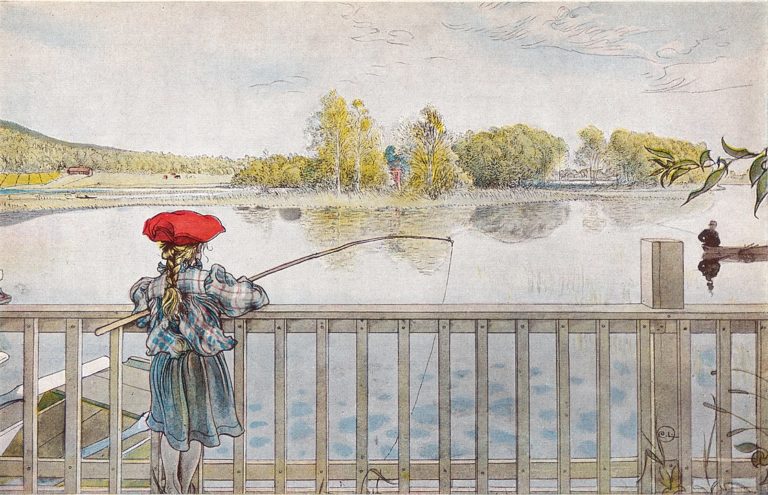
Image by Carl Larsson – Carl Larsson. “Ett hem åt solsidan”, page 62, Stockholm: Bonniers 1955. ISBN 9915140770, Public Domain, https://commons.wikimedia.org/w/index.php?curid=63051