In this shrinking house, I am still growing,
my wrist gripped between window and sill,
one toe pinched in neat joists.
Our mother’s footsteps echo far away.
In this dollhouse, animals and plates die
under glass, a frozen china cabinet phalanx.
The wedding cake couple will keep on waving
to no one forever, through dust.
At midnight, I creep into the bathroom.
I focus my stare into the mirror, whisper
my own name three times, and wonder
why I still can’t see my face.
True Story Metaphor for Parenting
The father’s oatmeal-colored apartment
absorbed all who entered:
his masked daughters, their mute boyfriends.
It swallowed even the mother’s twilight gifts
appearing by the door: a smashed chair,
torn photos tucked inside letters.
In the night, as rain pattered the windshield,
the father said to one daughter, Bridge Ices before Road. Do you know why?
when there’s a bridge, the earth can’t heat the road so the road stays warm and the cold bridge ices faster than well ha faster than anything else.
She looked at his red plastic cup
with melting ice and wanted to be
the road ahead instead of the bridge.
Diana Smith Bolton is the founding editor of District Lit. Her work has recently appeared or is forthcoming in Cider Press Review, Coldnoon, concīs, The Fem, Gargoyle, The Northern Virginia Review, The Pedestal, The Pinch, and elsewhere. She lives in Arlington, Virginia.
Most of the time when I’m making music I’m holding mallets or sticks.
My first instrument was my older brother John’s drum set. When I was about ten I started to listen and try to play to all the great Rock music of the late 60’s and ‘70s. Then early in high school I discovered marimba when our school bought one for the band program. I was in love! What a sound!
Late in high school I found jazz and more free forms of improvisation but I majored in classical percussion (at Catholic University here in D.C.) and through that studied and played the great composers – Stravinsky, Bartok, Cage, Crumb, ….. Bach! Playing good music is thrilling to me, whether it involves months of preparation to get every note correct, or when created on the spot.
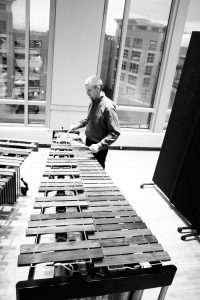
Rich O’Meara performing on Marimba; image courtesy the author
I’m currently working on a piece including both composition and improvisation that will premiere in the Capital Fringe Festival on July 9, 2016. I‘ll perform live in the show to support a story written and performed by my good friend, David Kessler. The one-person play, called “One Mutual Happiness,” is directed by Jennifer Knight with technical assistance from Momo Nakamura and Joe Musumeci, and artwork by Adelaide Waldrop. Team Happiness!
I was drawn to this project by the opportunity to work with David. His son was a classmate of my daughter’s and we met at a parent’s meeting years ago and became fast friends. David is the author of several novels, and his play “Wombat Drool” was a hit at last year’s Capital Fringe festival. (“Wombat Drool” is a fictionalized account of his career as a biologist at the National Zoo.) For “One Mutual Happiness” David asked that I create music to help tell the story, but that would also be an integral part of the experience.
To begin the process I studied the script, listened to him read it, and then recorded him performing it. Once I had the recording I divided the script/recording into sections and subsection (scenes) to work on individually.
We both wanted marimba to play a major role but knew we were constrained by the fact that this is Fringe we’re talking about. There would be next to no time for set up at the performances and we may end up with a very cramped venue. I decided to use MainStage (an Apple performance program) and my MacBook Pro in the performance. I’ll use those tools to trigger recorded passages during the show and will also play sampled instruments from a small keyboard, and some live percussion instruments.
Although I won’t be playing my marimba in the show, marimba is still central to the score. The sound world I created for this includes marimba, vibraphone, glockenspiel, harp, ukulele, synth textures, cello and percussion.
The score has a recurring theme associated with David’s father that makes many appearances with variations. By altering the density, color and tempo, the same basic thematic material conveys optimism, sadness, pain or light-hearted fun. There are several moments of uplifting and surprising joy and I help portray them with Ukelele. Those are some of my favorite parts of the score.
The show includes flashbacks to wedding ceremonies, funerals, hospital visits and life events indoors and out. To help transport the audience to those particular environments I’ve added ambient sound recordings, and most I recorded myself.
As we developed this work through the winter and on into spring I got feedback from David and our wonderful director, Jennifer Knight. One challenge for me was adapting the score as the script changed and scenes expanded or contracted. A lot of time was spent editing recorded material to fit the new scene structures.
In all I trigger about 35 playback cues during the show. That density allows me to stay flexible, so I can flow with David from scene to scene. Each performance changes somewhat depending on the energy coming from the audience or how David improvises his lines. I’m constantly finding new things to play within the structure I’ve built. David and Jennifer have created some places where I interact with David during the show and hopefully I’ll be relaxed enough to make the audience feel our connection.
I’ve really enjoyed this entire experience and I’m excited as opening night approaches. Hope to see some of you in July!
Rich O’Meara is best known for his compositions for marimba that are performed throughout the world. His work has been featured on the NPR program “New Sounds”, the PBS documentary “The Music Instinct, Science and Song” and can be heard on the Audite, Cybele, Animato, Codamusic, and Koch Discover International record labels. He gave a master class and concert of his works at the Eighth International Festival of Percussion in Patagonia, Argentina and has received four ASCAP Plus awards.
Since 1999 he has been a member of Silent Orchestra; a collaboration with composer/ keyboardist Carlos Garza to develop and perform new scores for classic silent films. Recent performances include the Smithsonian Museum, the National Gallery of Art, the National Museum of Women in the Arts, the Virginia Film Festival, the Savannah Film Festival and the Percussive Arts Society International Convention. Silent Orchestra scores for “Nosferatu” (1922) and “Salome” (1923) are available on DVD from Image Entertainment.
O’Meara has performed with Kwo’m Percussion, Sandbox Percussion, One Earth Percussion Theatre, the Contemporary Music Forum, the National Symphony, and as a soloist with the Kitchener-Waterloo Symphony. Along with the members of So Percussion and his son, Kevin O’Meara, he has played with the Dan Deacon Ensemble and appears on Dan’s albums “Bromst” and “America”. As an active member of the improv/experimental scene in the DC area, he has played with Colla Parte, Trio O, Large Glass Bead Game and the Subtle Body Transmission Orchestra.
“One Mutual Happiness” will be performed as part of the Capital Fringe Festival at at Mead Theater Lab at Flashpoint, 916 G St. NW on the following dates:
Saturday July 9th, 4:15 pm
Thursday July14th, 6:30 pm
Saturday July 16th, 8:15 pm
Sunday July 17th, 8:15 pm
Tuesday July19th, 6:30 pm
Saturday July 23rd, 3:00 pm
the slide at each other before one finally explained
that they had asked the kids, earlier, what sort
of pet was their favorite. My daughter had said
she wanted a dog. When they asked what
its name should be, she’d said, “Lucifer.” They went
quiet to see my reaction. I laughed and explained
that the name came from Disney’s Cinderella. Forced,
relieved chuckles followed. “That must be it,” one
said. I corralled my daughter, making sure to have
her say goodbye to the teachers, and tried not to remember
being labelled a Devil Worshiper when I grew up
in the Bible Belt, how that meant ostracization,
police harassment. She ran ahead to the tiny bench
by the school door, sat, and asked me to sit beside her.
“I’m too big,” I said. “But I’ll watch you.” And she turned
her face to the sun and smiled out at the world.
(Originally appeared in SubtleTea.)
CL Bledsoe is the author of thirteen books, most recently the poetry collections Riceland and King of Loneliness, and the novel Man of Clay. He lives in Northern Virginia with his daughter.
Image: By Unknown – Livre de la Vigne nostre Seigneur; fol. 067v France ca. 1450-1470, Public Domain, https://commons.wikimedia.org/w/index.php?curid=39892182
Donald Illichhas published poetry in journals such as The Iowa Review, Nimrod, Passages North, and Sixth Finch. His chapbook, which will be published by Finishing Line Press, is “The Art of Dissolving.” He lives in Rockville, Maryland. His blog is The Art of Dissolving. The link to his chapbook to pre-order is here at Finishing Line Press.
I started playing drums when I was 12, joined my first band at 14, and played in bands consistently for more than two decades. But when I moved to DC a few years ago from Cleveland it wasn’t easy to find a space where I could hit things with sticks and be loud on a regular basis. I didn’t live in a house where I could play, and a practice space was out of my budget. It was frustrating, having come from a city where it was easy to find warehouse space to do whatever you wanted.
Being an artist in DC can be tough, especially if you play a loud instrument. Because I needed to stay musically active and creative, I started working with tape. While I continue to play drums in live settings, tape has been my recent focus in composition and studio experimentation.
Click to listen to MATTER by Nate Scheible
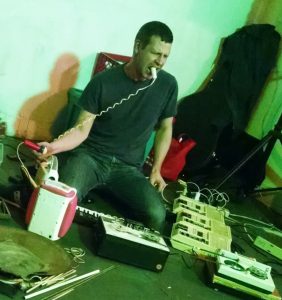
My most recent cassette, “Matter”, was released in October, 2015 on Power Moves Library. It’s my first release to focus solely on the exploration of tape manipulation and sampling. I have experience working with tape from making recordings as a drummer and band member. Most of my early musical recordings were done on a four track and I used to engineer at a studio that utilized a 16 track ½ inch machine. A couple years ago my friend and collaborator Pat Cain starting getting into creating cassette loops – something that I hadn’t done for quite some time. Once he mentioned it I felt motivated to get back into exploring the capabilities of tape. And as soon as I started playing around with it, I realized how much I missed the physicality that comes with tape and analog equipment, especially in comparison to recording onto a hard drive. Getting out the razor blade again (to cut and loop tape) felt like a cure for not being able to play drums on the regular.
I very quickly became fascinated by the element of chance associated with creating tape loops. Most of my previous writing involved improvising, settling on distinct parts, revising them, refining them, and using them as the basis on which to build other ideas/parts/layers. Making tape loops removed a lot of these conscious choices.
To make “Matter” I scoured thrift stores for old New Age cassettes. The more artificial, lifeless, and generic, the better. My favorites were those that relied solely on digital keyboards, lacked any trace of acoustic instruments, and didn’t employ drums. A lot of that was an aesthetic choice, but I found that it oftentimes resulted in more consistently interesting loops and samples. I began by creating some mixtapes of the best parts I found on these cassettes. Once I completed a tape, I would cut it up to create loops, and keep making batches until all the tape on that mix was used up. I might end up with 100 cassette loops per mixtape. Periodically I’d listen to some of the loops from each batch. Most were generally garbage but once in a while something would be so good that I could just let it play endlessly. It was a Zen-like process- cutting hundreds of loops just to hear what would happen and selecting the 5% of them that “worked” musically.
What most excites me about this process is that I end up with something I could never have come up with on purpose. Creating a digital music .WAV file and chopping it up into loops within an audio program would be a lot easier. But the loops from cut tapes produce unique sounds. There is usually some weird effect that results from where the loop was cut – maybe a bit of a warble, or weird panning effect, or just some damaged sound that could never have occurred within a digital environment.
Some of the first projects I did with cut tape resulted in sound installations. I’d find 10 loops cut from similar sources and play them all together on cassette players placed around the perimeter of a room to create an immersive experience for the listener. Things got more interesting when I started collecting machines with pitch shifters. That gave me the capacity to take loops from multiple sources and adjust the pitch of each cassette individually to be in the same key (or out of the same key, for that matter.) I eventually took this process into the “studio” to create a finished composition with layers of manipulated loops. I enjoyed that process but it ended up feeling stagnant so I started looking into other treatments for the tape loops.
A 1/4 inch tape machine, similar to the one used by the author.
I had bought a really nice ¼ inch machine from my fellow drum pal Ian McColm that I wasn’t using as much as I should have and I began sampling the cassette loops to ¼ tape and using chance operations to generate really damaged sounds. Most of this experimentation involved sampling audio to reels of tape that had undergone some kind of treatment. I would crumple up the audio tape, cover it with duct tape and then pull the tape off, run tape through a pasta machine, cut out sections with an exacto knife, and demagnetizing it in random places. In some cases these changes would be very subtle but in other instances they could be very dramatic, with original source material completely obliterated and something new taking its place.
I was honestly surprised with how the tracks for “Matter” turned out. A lot of the fun was spending hours creating a layer that might consist of 20 loops in varying states of degradation, only to bounce it down, fuck with it more, and have it end up as just a faint addition to a larger piece.
While I’m personally excited about the work I’m doing, I’m not naïve enough to imply that this is innovative or without precedent. William Basinski and Ian William Craig are probably the most noteworthy reference points I know for this kind of stuff. And my choice of source material is arguably influenced by vaporwave. But, who knows. I try not to think about these things too much. It’s kind of like fielding the dreaded “What does your band sound like?” question. I leave it up to others to decide what it sounds like, if they see fit.
Nate Scheible is a DC based drummer/composer who has performed and recorded in a variety of bands and ensembles spanning multiple genres. Recent collaborators include Layne Garrett, Luke Stewart, Phong Tran, Sarah Schaffer, Nancy Havlik, Patrick Cain, and Gary Rouzer. His most recent releases include “New Year’s Eve, 1969” a series of drum duos with Ian McColm, and the solo recording “Matter” on Power Moves Library, which can be found at natescheible.bandcamp.com.
 Diana Smith Bolton is the founding editor of District Lit. Her work has recently appeared or is forthcoming in Cider Press Review, Coldnoon, concīs, The Fem, Gargoyle, The Northern Virginia Review, The Pedestal, The Pinch, and elsewhere. She lives in Arlington, Virginia.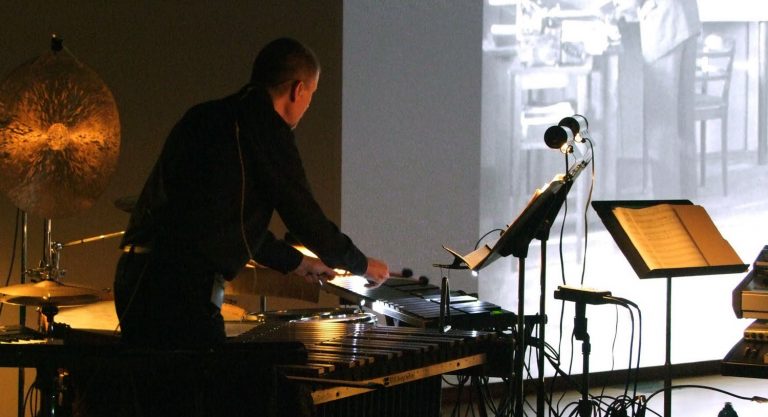
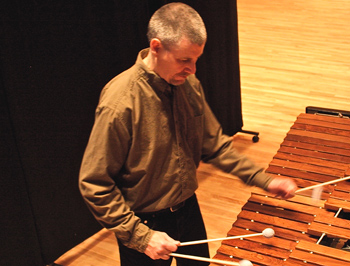 Rich O’Meara is best known for his compositions for marimba that are performed throughout the world. His work has been featured on the NPR program “New Sounds”, the PBS documentary “The Music Instinct, Science and Song” and can be heard on the Audite, Cybele, Animato, Codamusic, and Koch Discover International record labels. He gave a master class and concert of his works at the Eighth International Festival of Percussion in Patagonia, Argentina and has received four ASCAP Plus awards.
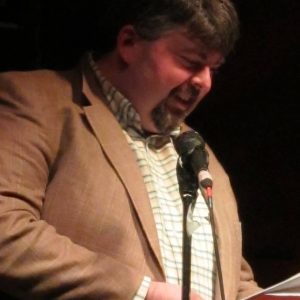
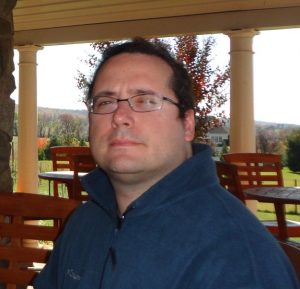 Donald Illich has published poetry in journals such as The Iowa Review, Nimrod, Passages North, and Sixth Finch. His chapbook, which will be published by Finishing Line Press, is “The Art of Dissolving.” He lives in Rockville, Maryland. His blog is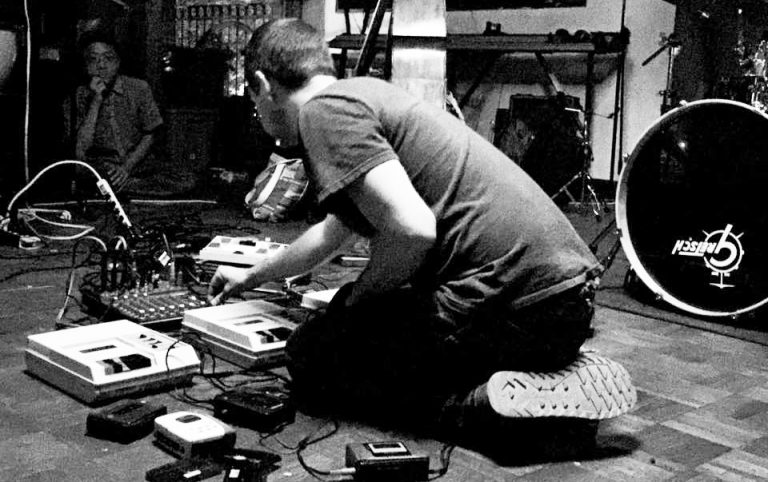

 Nate Scheible is a DC based drummer/composer who has performed and recorded in a variety of bands and ensembles spanning multiple genres. Recent collaborators include Layne Garrett, Luke Stewart, Phong Tran, Sarah Schaffer, Nancy Havlik, Patrick Cain, and Gary Rouzer. His most recent releases include “New Year’s Eve, 1969” a series of drum duos with Ian McColm, and the solo recording “Matter” on Power Moves Library, which can be found at