Home Blog Page 179

Cathy Elliot on Light Design for Dance

I was recently at an event where two women asked what I do as a dance lighting designer. I fumbled with my usual two- part response, which always includes: light can create an atmosphere or a context for a dance, and lighting design is created from four basic elements – color, angle, intensity and time.  The women listened politely and when I was done. One woman commented “Essentially you hope to reveal the intent of the dance.” Her friend added “ At best you can clarify how people experience the movement.”  Yes. Exactly.

The ‘hope to reveal the intent of the dance’ is what keeps lighting work interesting.  I prefer to work collaboratively, so my first job is to gather as much information as possible. When I watch a dance piece, I see the lighting design play out in my head fully realized like a movie. I then work backwards, deconstructing the movie in my head, while communicating to the choreographers and accommodating what can actually be done with the resources at hand. From past experiences I have learned to ask some really important, basic questions. How does the dance end? Are there any dogs, children, or fiery torches in this piece? Does anyone become naked or throw knives – especially at me?

‘At best you can clarify how people experience the movement’ is the inherent challenge to creating a lighting design for dance.  I was fortunate to come to lighting design with a degree in dance from Connecticut College and many years of art school. I think lighting can be understood like a well-constructed painting.  Good lighting can help guide the attention of an audience member to a specific space in a given moment, or toward the sense of relationship among the dancers.

In creating a design it is crucial to consider the space or theater where the dance will be presented.  I have been fortunate to create designs in theaters with lots of electricity and lighting instruments.  I have also lit dances in converted spaces, where we had to run around the building and turn off coffeepots in order to run the show.     Finding the magical elements of each space, and how they can be used to accentuate the dance, is the challenge.  I once lit a show in the atrium of the Corcoran Gallery of Art.  The evening had gone perfectly and as the dancers stood for a second bow, one by one all the fuses in the dimmer packs failed. It was a beautiful effect, as each light slowly dimmed.  More than I would like to admit, much of my work is based on equals parts luck and prayer.

Cathy Elliot has won numerous awards for her light design in and out of Washington, D.C.

Maida Withers on “Thresholds Crossed”

Thresholds Crossed, an evening-length multimedia dance work about Russia and America, premiered in Washington, D.C. at Lisner Auditorium, April 21, 2006.    The project, a kinetic fusion of East and West, explores the events, ideology and humanistic issues that link the U.S. with the former Soviet Union and contemporary Russia.

Thresholds Crossed began in 1997 when I attended a dance conference in Volgograd, the city on the Volga River that rebuffed Hitler’s army.   It was my first visit to the former Soviet Union. Contemporary dance was very new in Russia at that time since it had essentially begun following the dissolution of the Soviet Union, in 1991.  Since 1997 I have visited frequently – teaching, performing and creating work.  Each time I returned to the United States I wrote about my experiences.  This was all done without intention.

For many of us, our awareness of Russia began when we, as children, were taught to hide under our desks in preparation for an nuclear attack.  I always knew a Russian child was hiding under a similar desk fearing the same fate.  Before I started spending time in Russia, the cold war was still be the frame that surrounded my views.  With the passage of time, as doors opened and propaganda diminished for me, a new Russia emerged.

I discovered that Russians and Americans share deeply held values inherent in honor and patriotism, values often won through struggles associated with conflicts and war, both historic and current.   I started to think about what dance piece could be made exploring these issues.  I asked, “What remains of the long history of fear and distrust between Russia and America?  Whom can we trust and who can trust us?   Who will lead, and who must follow?   How do we reconcile our need for privacy and the government’s need for surveillance and security?  What about displacement of values – the value of displacement?  How do we surrender to the will of the majority while protecting the voice of one?  How are propaganda art and political slogans in Russia and America, often couched in humor, used to persuade?   How do we express our loss and move on?  What is the future for world superpowers?

On July 4, 2005 (American Independence Day) an open-call audition was held in Moscow for Thresholds Crossed.   Over forty dancers showed up.   Perhaps it would have been easier to collaborate with one Russian dance company.  Considering the political nature of the work, it seemed important to begin with a democratic process by opening the audition to any Russian able to get to Moscow for the audition.  Dan Joyce, Jennifer Stone, and Megan Thompson, American dancers working with the Dance Construction Company, assisted in selecting the dancers – six Russians and one Ukrainian.  An air of skepticism was present during the audition, and why not?  The dancers selected were expected to rehearse in the capital cities of Russia for one month, five hours a day, six days a week, and then in the USA, similarly, for one month.   Obtaining a visa to America for most Russians is almost impossible, and for young, low-income dancers, a pipe dream.  Each dancer was interviewed by my son, Marc Withers, who lives in Moscow, to ascertain the feasibility of his/her involvement in the project.  The Russian portion of the project was co-hosted by TSEH, a national dance agency in Russia, and the Dance Construction Company.  At the conclusion of the three-week residency, we presented Part I as a work in progress to students and faculty of TSEH International Summer School.  The fall of 2005 in Washington, DC was devoted to the creation of Part III and segments of Part IV with the American dancers who had gone to Russia, and an additional American dancer (Rob Bettmann.)

Five international artists were eventually approved for visas to the United States, sponsored by the Dance Construction Company and hosted by The George Washington University in Washington, DC.  When the foreigners arrived, the material from the residency in Russia, nine months earlier, was reconstructed and the international dancers were integrated into the unison section of Part III.  There was a decided difference in the openness of both the Russians and Americans.  Perhaps this was due to the absence of skepticism about the American residency.  Whatever, the change was palpable. For the last two months of rehearsals, Steve Hilmy (composer, musician), Audrey Chen (musician), and Linda Lewett (videographer), joined in rehearsals.  The addition of the live musicians brought energy to our practice.  In addition, I regularly invited friends to come watch rehearsals.  These additional eyes enhanced the creative energy and focus of our work.

To assist in promoting the dance I looked for partnerships with organizations that work on the issues presented in Thresholds Crossed.  In the end, George Washington University’s prestigious Elliott School for International Affairs’ Institute of European, Russian and Eurasian Studies, sponsored a forum on the topic: “How Young Russian Artists View Their Recent History.”  The Russians were very confident in the presentation, but not comfortable with the idea of making “politically” motivated work. Nikolai Schetnev, assisted by the other dancers, led a contact improvisation session for the Washington, DC contact improv jam, which was hosted by George Washington University at the time.

With only six days to opening night, we began to create Part IV – the grand finale – about contemporary Russia and America, where orbiting groups of USA and Russian dancers collide and intersect. It was satisfying to be working on choreography lighter in content. The international dancers were so disciplined and strong emotionally that the work fell into place quickly with the help of the Americans who had previously refined movements from the choreography. Russian dancers contributed solo materials as statements about contemporary dance in Russia.

In Thresholds Crossed, the visual installation (a video projection across the entire back of the stage) carries the historical perspective while the dance tells the human story.  The music was the bridge between these two worlds. The presence of the Russians and Americans on the stage created a tension and a drama that carried the work.  The audience was fascinated and captivated by the Russian artists, revealing American’s ongoing curiosity about Russians and especially Russian dancers. Thresholds Crossed will be performed during a four-city tour to Moscow, Arkhangelsk, Yekaterinburg, and Krasnoyarsk, Russia, April 17 – May 3, 2007.  The tour is supported, in part, by The Trust for Mutual Understanding, the U.S. Embassy in Russia, TSEH, the Ford Foundation in Russia, The Dance Construction Company and individual donors.

Part I references the period from 1930 to 1990 – from the forced labor camps of the Soviet Era through the Cold War years.  Nikolai Shchetnev collapses and recovers stability in a symbolic statement of bearing the weight of military power while wearing a World War II Russian military coat.  Upstage, Russian and American dancers in groups of two and three, dressed in maroon briefs and white undershirts, begin pushing a lead dancer downstage until the structure collapses. Returning to upstage, the pushing segment repeats with a new resistant leader.  Several duets express physical violence. Betrayal is often a theme. Projected images include historic video footage from Red Square, the inside of gulag prisons, and propaganda art posters.  Original music by Steve Hilmy features electronic music and impassioned Russian war songs supported by the extreme music of vocalist/cellist, Audrey Chen.

For Part II, Maida Withers and Anthony Gongora, dancers, and Audrey Chen, vocals and cello, perform a dramatic trio that examines the tragic events in Abu Ghraib prison. The formal attire of the dress tie and silk handkerchief become a leash, head covering and blindfold. The projected visual installation animates photographs from Abu Ghraib with images of steel sculptures by Frank Williams, a contemporary Russian sculptor.

Part III expresses the human experience of loss and grief. Two men and two women dancers wearing black dresses and suits reveal responses to the loss of faith, the loss of love, and the grief associated with war.  In the finale of Part III, international dancers join the quartet in a unison statement contrasting hope and despair.  The visual installation features video of Arlington Cemetery, the Tomb of the Unknown Soldier, photographs of sculptures at the World War II memorial on Mameyev Hill in Volgograd, Russia, and related imagery.  The music has a complex melodic pattern.

Part IV is a fast-paced, running, finale depicting Russians and Americans in two orbits where dancers intersect and exchange roles.  The feeling is upbeat and driven.  It is a hopeful conclusion.  Referencing contemporary Russian rock and roll, the music supports the race for dominance while having a very good time along the way.  The visual installation features video of contemporary urban life in Moscow and the USA coupled with images of the national flags, currency, and other icons of today.
Jane Franklin on “Found”

When I started to think about a project for 2007, I rolled around to my typical routes of discovery and development. Sometimes I find an artful contributor –  musicians, composers, poets, visual artists or multi-media – and let that artist’s process inspire my own. This has taken me into some great territory that I never would have reached in any other way.  It has also led to some wonderful people, unexpected results and a unique journey I certainly could never have planned.

After viewing and thinking about art by Robert Rauschenberg, and by other visual artists, I began to consider the collaborative process for choreography. Rauschenberg often cites works by others in his pieces, and I began to think about what that process could be like choreographically.  What would the lonely journey of choreographer be like if I had some company?

Dance is a very public way of making art, at least so says a poet friend who is amazed by that risk-taking. Unlike a writer – who works alone until ‘ready’ for the editor – choreographers most frequently do not choreograph without another body, a human subject, from the get go.  Ideas are being observed and evaluated by your dancers, in front of your own public as it were, even as they are being created.  This very public process of choreography is complexly filled with the demands of personalities, negotiation, emotion, availability, finance and just about every other tricky kink that exists in human interaction.

As a choreographer, you do maintain a position as the lead instigator, suggesting or demanding the fulfillment of your own criteria, spoken or internal.  With a choreography collaboration what would happen to the lead?  Can actual movement materials be shared, swapped, interchanged and in the long run built into something that reflects the artistic position of each contributor?

“In the gap between art and life” is a phrase that Robert Rauschenberg coined for his pieces, also known as ‘combines,’ that merge objects you come across day to day in unexpected relationships.  The unusual relationship I was looking for in “Found” was a choreographer who would be willing to work with the company for a few rehearsals, certainly not composing a whole dance, but willing to evoke movement materials that might be disassembled.  To start, the choreographers would bring an idea or movement inspired by a found object.  An object that could have gone to, or come from the scrap heap would be thought of in a new light, and similarly the dance ideas would be recycled as well.

Margot Greenlee came to us with all her experience plus seven years with the Liz Lerman Dance Exchange.  With Margot we experimented with a core of group improvisations, boiled down to individual inventions from personal dialogues, and then back again to a group dynamic.  Words worked as a catalyst, an underlying element that was never spoken, yet nevertheless resonant.  This way of thinking in words was a quality of negotiation I understood from my daily life, including conversation with self, words that linger after being spoken, and just plain working on the next grant application.

With Laura Schandelmeier and Stephen Clapp the clustering and disbursing of joining up and letting go was an experience of work in tandem.  Stephen and Laura brought in ideas of portals, doorways, rites of passage.  I saw birds flocking and the way time can’t be captured.  We explored moments of completion and stillness, complexities of mechanics in supports and partnering, and tiny compromises in order to reach a group result.

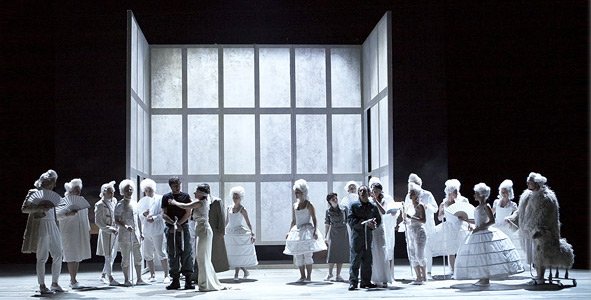
We made a side trip while on the way from performance in North Carolina to work with Danah Bella, of Radford University. Danah explained the cultural differences between her native Southern California and southwestern Virginia, a South very unlike the South in Southern California.  From a roadside landmark not clearly seen, Danah’s found object was something hanging, perhaps broken.  Working in increments, Danah started with a simple but daring amount of weight. Dancers learned the movement in unison trying unexpected impacts, dependently aware of the others though never touching. The idea of a desperate hanging on, a ball and chain tango came up when I reconstituted the movement as a kind of cloying dependence. Using a piece by a young Italian composer played for us by musicians Kristen Benoit and Allan von Schenkel, the tongue in cheek anti-romance of the dance partnerships had to be balanced with making the timing of the music work.

As a seamstress would stitch together, I’m looking for threads of content that I can transition through a very non-linear work.  My own found object is a bird I videotaped last summer.  Enviably free, it couldn’t be caught but was purposeful in the way that each breath is its own breath but connected to the one before and the one after.  As a way to connect myself to the whole, after several years of not dancing in my choreography, I joined in the rehearsals with a true sense of purpose. Being visual, I missed watching the unfolding, but did enjoy experiencing someone else’s process.

Now, as I continue this work, I do think that my visual impulse will take a strong step.  My captive collaborator, my thirteen year old son, creates origami birds that the dancers can fly. I stroll down to look at the creek nearby. I see birds there while I listen to myself think in words.

Jane Franklin is a dance educator and choreographer.  She directs Jane Franklin Dance which is celebrating its 10th Anniversary Season.

Cheles Rhynes: What is Dance?

0

Dance is a form in which a choreographer tells a story or expresses thoughts/feelings through movement, not words. Dance can move you in ways that you cannot define. Everyone from birth reacts to music and uses body language to communicate. Dance builds on this. There may be different forms, styles and interpretations but all of it has a background and something to communicate.   –  Cheles Rhynes

Interview with Constantin Cacourakas

August 27th, 2006 New York City

Rob Bettmann- Costas, I’ve been told that you were Balanchine’s favorite photographer. You were there for the creation, performance, and response to the majority of his work. You have documented the work of scores of companies, choreographers, and dancers. You have provided images for a number of books, not to mention your own book of Balanchine dance imagery. Would you be willing – for today – to cite a single experience as your favorite experience?

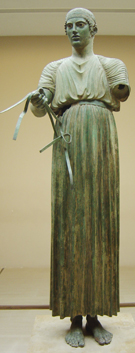
Delphi_charioteer_headCostas – You know, Balanchine’s Don Quixote with the Ballet Russe was not a great success. And it lasted for a few years and then they were going to bury it. And the last season they were doing it, just before they were doing it, he was saying something, and I wanted to hear the rest of what he was saying so I got in the elevator – I wanted to hear the rest of what he was saying – so I just followed him. We went upstairs to the fifth floor studio, and he started choreographing a pas de deux. And it was a pas de deux to the ballet Don Quixote. And I said to myself – he wasn’t satisfied with the one that existed– and I said to myself, ‘Here is a ballet that is going to die in a couple of weeks, because that was going to be the last time that they were going to do it. Ever. They had sold the scenery so that way they could be sure they were going to not do it. Why is he choreographing a new pas de deux for a ballet that is going to die? Dissapear? I was at a loss. I did not understand.

A few years later, I was doing a book on Greek myths. “Gods, Masters, and Heroes.” And the writer and I were in Delphi. And there is the famous statue of The Charioteer. You know it. But this charioteer was in a chariot which no longer exists. The chariot has disintegrated. But the charioteer is holding his reins to the horse, and when you would see him in ancient times he was in his chariot, so you couldn’t really see his feet. Yet when you look at the statue now, everything was done perfectly. Achilles tendon, and everything. And I said to myself – well, those feet have never been seen by anybody at that time, because of the chariot. Why did the sculptor make it so perfect? And then I connected that with Balanchine and Don Quixote. Because everything had to be perfect, even if it was never going to be seen.