Home Blog Page 181

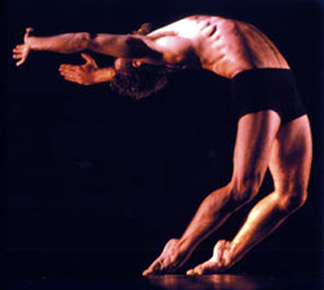
Interview with Jason Hartley

July 27th, 2006

Rob Bettmann: Jason Hartley, you attended the North Carolina School for the Arts, and from there went to Ballet Met, then Ballet Austin, then American Repertory Ballet. You have now been a member of the Washington Ballet for seven years, performing lead roles in classical and contemporary works. You were awarded the Princess Grace Award, and have also been the winner of the Kennedy Center Commissioning Project Award. Now at the ripe old age of 29 I was wondering – in all of the experiences, can you tell me what your single individual favorite experience has been?

JH: A number of my favorite experiences in dance have to do with that dance is a live performance. Thing can go wrong. I remember being a rat in this nutcracker. And at the end of one scene, the tree had to grow. Had to go up. But there was a present stuck to the tree. And it was keeping it from going up. And we can’t go on to the next scene until the tree goes up. In that version of the nutcracker the rats had been battling with these gigantic forks and knives. And so I took one of these gigantic forks and just swung at the tree like a giant piñata. (laughs.) I was able to knock the present loose, the tree rose, and we went on to the next scene.

I’ve always enjoyed thinking about ways to get through a problem scenario, or watching others find their way through. I’ve always found that, with live art, when things go wrong people tend to go on with the art. And with those live moments, those emergencies, you can start seeing personality come through in the dance in a way that sometimes it doesn’t when everything goes as planned.

RB – How old were you when you knocked that present off the non-growing tree?

JH- I think eighteen.

Interview with Jon Madof

July 18th, 2006

Rob Bettmann – So Jon, you’ve been a musican for a number of years, and have had the opportunity to tour the united states and Europe.

In all your experiences as an artist, and training as an artist prior, I’m wondering if you could tell me about one of your favorite experiences as an artist.

JM – As a musician?

RB – yes, your favorite experience as a musician. If there was one time, whether it was one show, making on record, one encounter having to do with music, related to your music making… whatever your favorite experience was.

JM – The first thing that comes to mind is a festival I participated in that John Zorn organized for his fiftieth birthday. I did a few shows for the festival; one was myself and Marc Ribot both playing solo and as a duo. I felt confident that I had the music together , but I was still really nervous about it. I don’t really play solo guitar and I was doing Zorn’s repertory and he was in the audience. I played the show and thankfully it went really well. But that actually wasn’t my favorite experience. My favorite experience was two days later when I did another show with my band Rashanim as part of the festival.

Each night, Zorn would do two sets of his music and then at midnight he would have another band play, one that was associated with him. I got there early and saw Masada play – with Joey Baron on drums – I just loved it. And then most of the people left. There were maybe twenty or thirty people left for our show at midnight. I had felt so much pressure earlier in the week to play his music right that I just didn’t care. I was tired, there weren’t so many people in the audience. I felt completely free of any worry or anxiety; I didn’t care. My bass player and my drummer were about to leave for a while, so it was our last gig before they left. And we had the most fun we’ve ever had. The only reason why we were there was to have a good time and play. And I really felt like how it was as a kid. I didn’t feel any pressure to be good. I didn’t feel any pressure for the music to be good. I really didn’t care. Unfortunately maybe it’s cause the pendulum had swung back from this incredibly stressful experience. I felt totally that there were no consequences. It was just about being in the moment and playing. It was great. And I think the music sounded really, great.  I don’t have a recording, but subjectively, it was what I always want music to be.

Interview with David Pleasant

Rob Bettmann– David Pleasant, you were born into a musical tradition that thrives in the Gullah/Geechee culture of Georgia and the South Carolina Sea Islands. In years as an instrumentalist/percussionist you have had the opportunity to work with a number of significant artists, including Wynton Marsalis, Paul Simon, Erykah Badu, Urban Bush Women, Audra McDonald, Graciela Daniel, Ron Brown. You also research and teach as a Fulbright Senior Specialist. I was wondering if you could answer the question what is your favorite experiences as an artist?

DP- Well it would be difficult to pick one. But one of my most extraordinary experiences as an artist, and I carry it with me still, was on Igbo Landing in St. Simon’s Island, Georgia, where I went to do research on Gullah culture. And I went to meditate, but I went to this particular site, which is off Dunbar Creek, and it’s a place where, the place where a great group of Igbo people had jumped off a slave ship, to avoid being made slaves. And it’s the place where the song “Oh Freedom” came from. “Freedom over me. Before I’d be a slave I’d be buried in my grave and go home to my lord and be saved.” And they jumped off the boat rather than be slaves. They jumped off with their chains on. And the myth is that they walked back to Africa in the water, on the water, under the water, but they made it back.

And when I went to this place I had this really interesting, strange experience that’s kind of directed me in this positive direction, and it was so affirming. I came in to the place where this was – it doesn’t have a marker or anything, even though it’s a famous site from 1801 – and it’s so cause they weren’t supposed to bring Africans from Africa to Georgia at that particular time. But they were smuggling them in, and that’s where this particular group of people came from. I went through a gate. And the guy who let me in – it’s where the treatment plant for the city is – he let me through this gate where the site was. And he closed the gate after, and put the latch on it. And it was thundering.

And I stood up on this big rock, and I was meditating and praying and thinking, “what am I supposed to do?” Knowing the stuff I know, and playing the music I play, and having the life experiences I’ve had – growing up on Sapelo Island, and in Darien /McIntosh county – what am I supposed to do? I was praying to god to show me. And at that moment a fish jumped out of the water right in front of me, and when the fish jumped out I thought it was very strange. And then I jumped off the rock, and as I jumped off the rock there was this big clap of lightning that hit. And I was like “wow, what is going on?” It stunned me. And then I heard this creeking sound, this, “eeeehhhr.” And I turned and the gate slowly opened. Behind me. Before that I’d been praying and asking what to do – do I go out and show this message and do this? – or whatever. And I have this experience. The gate opened slow… I’ve never had an experience like that [laughs] of such synchronized action. And that was one that has really had a major effect on my psyche in turns of what I am supposed to be doing as an artist, why I am supposed to be doing it. How relevant it is in terms of my personal spirituality, and spirituality in general. How close for me what I’m doing as an artist is to my God sense, and my ability to carry on and be self-determining. And put forth this art form. And know it comes from someplace much greater, and grander, and transcendent, than any entertainment or quote ‘art industry’ could possibly be. And it is the great message, or parable, of my life.

RB- How many years ago was it?

DP –seventeen years.
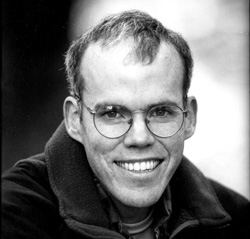
Interview with Bill McKibben

0

May 27th, 2006

REB – Mr. McKibben you’ve been a writer for a long time, and are both publicly and critically acclaimed.  Like all of the arts, it’s a difficult thing to make a living as a writer.  You’ve done it successfully.  And I know you’ve also done it joyfully.  And I was wondering if I could ask you what your favorite experience as a writer was, or is.

BM – Well that is a very difficult question, cause as you say, this is pretty much what I’ve been doing with my life since I was, I don’t know, fourteen or fifteen or something like that.  And so I can answer it in many different ways.

One of the things about being a writer is that it’s a solitary occupation.  One of the great pleasures of my life was the few times when I’ve been it and done it with other people.  The most intense version of that was the four years I spent at Harvard working on The Crimson, the newspaper.  And that was really all I did when I was at Harvard.  It was a six day a week newspaper and I was working there ten or twelve hours a day.  For four years.  With an extraordinarily tightly knit group of friends with whom I spent even the times I wasn’t working there.  And that was remarkable, for me.

And the central experience of working there at The Crimson was that every Sunday night they’d have editorial meetings where the entire staff, including the people who sold ads – everybody – would come and debate the editorials that would be in the paper the next week.  What stands we were going to take on various issues.  And everybody had a single vote, and anybody could write one, and argue it out, and amend them, and change lines, and on and on and on.  And writing in that group like that was in some sense, frustrating, because you didn’t get to say exactly what you wanted all the time, but it was enormous fun.  There was great pleasure in that.

I’ve gone on in my life.  You know, as a writer one has to mostly work on one’s own.  And in a sense most of my collaborations have become far less formal.  Everybody writes for a sort of small audience of people – the people they know or have in mind, that kind of thing – and I’ve had great luck to work largely in an area – “the environment” sort of largely construed – where I’ve had continued companionship from a sort of crew of people many of who are writing about some of the same things, many of whom have become great friends.  Terry Tempest Williams, Rick Bass, Wendell Berry, Barry Lopez, Gary Snyder.  So we don’t write together, obviously, and they’re all better writers than I am in many ways, but we all inform each other in some ongoing conversation that I very much enjoy.

Laura Schandelmeier: What is Dance?

0

What is Dance? Dance is the constant query of what it is. What is Dance? = What is Dance?

Laura Schandelmeier is a choreographer, performer, Director of The Field/DC, Master Teaching Artist with Wolf Trap’s Early Learning Through the Arts Education Program and lives with her collaborator and life-partner, Stephen Clapp and 10 year old Holly Rae.