Home Blog Page 185

What is Dance? by Lou Antonini

0

Dance is exploring where you go, how you go, and what when you’re not.

Lou Antonini, choreographer and founder of Dance Antonini, has been involved in the Washington Dance scene since 1986 creating Dance Theater and teaching in the style of Modern Dance.

What is Dance? by Diana Dinerman

0

A little hegemony, a little resistance.

Diana Dinerman is a Washington-DC based writer.

What is Dance? by Brian Buck

What is dance? Well that depends on how one defines dance. The existence of this journal is a reflection of the fact that we all have different ideas. Even Webster’s dictionary provides two definitions broken into five smaller refinements. Any one of those explanations can be reduced into a tighter definition or expanded to cover other possibilities. “To move quickly up and down or about” is a reasonable definition, but leaves a great deal of ambiguity. A piece of paper drifting through the wind can “move quickly up and down or about.” If one accepts this definition, what about and extension: does the poet dance when writing of such visions using words of such actions? Someone walking down the street could be moving quickly about from one place to the other. Walking could be a dance. In sports the Super Bowl is considered a dance; the entire major league of baseball is considered “the dance.” In school students attend dances. These latter statements change the word “dance:” from a verb to a noun. All these euphemisms and metaphors leave me wondering if everything is dance. Could life itself be a Dance? Are mankind and nature in a kind of ballroom dance of their own? At the very least the planet is whirling through space in an interplanetary dance through the universe. To define is to put walls around something. If one’s definition of dance is that dance is everything, is it really a valid definition?
Many a dance piece has been created to imitate nature. Nature is life. Could life itself be a dance? I have witnessed many a dance created to imitate nature -none as beautiful as nature itself. I would contend that a tree growing out of the earth is dancing just as much as the dancer on “stage” is dancing or dancers in the ballroom are
The way tree branches reach and weave through space and time is similar in nature to both the way a modern or ballet dancers carve a stage. And ballroom dancers reach and weave across the floor with grace and dignity similar to a red oak growing from the mountain side. The space, time, and even gestures may be different but the principle is the same. An entity, be it a tree or a person, grows through movement toward a greater good.

The ideology works for both people and nature. Beside, beauty is as the cliché goes, “in the eye of the beholder.” In the winter roots of trees reach for water through the dirt. Through dirt that most of society believes is dirty. Whether “good” is sunlight for a tree or grace and beauty for the individual is an even grander topic that cannot be addressed in the brevity of this article.

Even at our stillest moments our bodies are always in motion. Our beating hearts and rising lungs keep our bodies constantly in a dance. At the cellular level, electrons are rotating like miniature universes around nuclei creating what Steve Paxton named the “Small Dance.” The cutaneous membrane – the skin – is where our bodies congeal to meet the world. It is where our nerves sense the environment around us, every instant sending messages to our brains which inform how we reach for the sunlight and guide our own dance of life. Movement is constant on both the micro and the macro levels. Like change, it is inevitable.

I am not here to define “dance”, but rather am trying to demonstrate that like life, dance can be anything. Defining dance would be a crime in and of itself. It would be like trying to contain oxygen (which when contained is highly explosive and dangerous.) “Dance” is meant to be free and wild and ever evolving with the times as they change, as movement and gestures of people, places and things evolve. One can define dance in anyway one might like to. One can look at the entire Universe and see one gigantic dance or one can look at a tree and appreciate the uniqueness of the arches, twists and turns that it offers to shape itself in this world. One can see a gas station, clouds, an old dog, a ballet, and the same tree again and see all of this dance.

Brian Buck dances.

Casey Maliszewski on Leaving Dance

My mother swears I came out of the womb dancing. Obviously, I don’t remember that exactly, but I do remember that I have always had a certain passion for moving with the music. My mother enrolled me in dance lessons at age four in order to let out some of my persistent energy. From that point forward, I lived, breathed, and slept dance, developing what may be called the dancer identity.

Twenty happy years go by, and I suddenly begin to question the identity that I had worked so hard to develop as I was growing up. Maybe it was the constant battle against my weight. Maybe it was the ever-persistent ankle injury. I just got weary of it all. I’m not really sure how it happened, but one day I woke up and I realized that dancing isn’t what I wanted to do anymore. Questions began running through my head: What will I do? What kind of person will I become? Will I be labeled as just another dancing failure? Who am I, and who will I be now that I am not a dancer?

Leaving the dance world is not easy. It is a complicated matter to walk away from a life that one has spent the past twenty years bleeding, sweating, and crying for. I felt bewildered and confused. I felt that I was left with no identity at all; I felt like a blank sheet of paper. The hardest part was I felt that I had truly disappointed those that were behind me while I was dancing: family, friends and teachers, all of whom had bled, sweat, and cried with me along the way. Did they think that I was a failure? Am I a failure?

It’s funny how we think of an identity as a single unit, when in reality it is multi-faceted, pulling together all of the things that make you who you are. I learned this lesson the hard way, yet realizing it made the transition from the dance world just a little bit easier.

The dancer identity has many layers. Some are positive (graceful, strong, beautiful), some negative (poor, insecure, dumb.) Leaving the dance world is easier to bear when you realize that you can hold on to the positive parts of the self formerly labeled under the heading “dancer” while eradicating the negative parts that you never personally identified with anyway. Body stereotyping and an uncertain future were parts I was glad to scurry away from. The disciple I developed over my life through dancing is helping to secure my new future; the one that I know was meant to be.

I will always have been a dancer; it will always be a part of my identity, although I may for now also be identified as a student, a writer, and a part-time waitress. I have no idea where my life will take me, or what parts of my identity remain to be seen. But no matter where I end up, I’ll be smiling on the outside and still dancing on the inside.

Image in this post is of the author as Phi Theta Kappa International President – 2008-2009.

Jonathan Meyer on Khecari

Just as the most complex of human movements are based upon the foundations lain by primitive. Upon this complex is lain language. Upon language our verbal arts. Upon verbal arts our mass communication. We have developed towering edifices of communication; living large in the penthouse we forget the basement pumps supplying our oxygen and heat.

Dance as an art form is the stark meeting of subtle and obvious, primordial and modern, cultured and primitive: a reminder, however unconscious, of our roots, our animal matrix, our pre-civilized selves that skulk too often ignored in our cellars. As both a formalized language and also a pure somatic expression, dance can create this connection. We operate on a daily basis through spoken language or a formalized movement language. Unconscious movement, posture, and expression offer subtlety and power of meaning to those languages. More significantly, movement offers a directness of experience and communication the loss of which we suffer in our quest for clarity. Behind all conversations and arguments, poems and paintings, lies a longing for touch, a desire to push, or pull, or slap, or embrace.
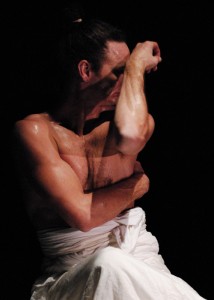
wkabhideOur popular culture, and even our art, is increasingly spoon-feed to us. The joke is explained before the punch line delivered: we are told not only what we are viewing, but what to think of it, how to feel, how to respond. In reaction, we have developed a cult of surprise that presents surprise for surprises sake. The upsetting of expectation is too often obvious, creating too immediately its own expectations, shutting off dialogue or open viewing, limiting instead of expanding options. As a choreographer, I seek a subtler play. This can be as simple as following a repetitive pattern through the rhythm of expectations: expecting more repetition, expecting change, again expecting more repetition, again expecting change, getting annoyed or bored, getting lulled or mesmerized, pulling back out from this lull, perhaps, maybe finally reaching a place of expectationless appreciation. As artists, let us offer choices to an audience we respect enough to trust with choice.

What all of this holds in common is an interest in expanding possibilities. Any tool: a carving implement, a computer, a meditation practice, a dance technique, the surprising of expectations can serve either to limit or to expand possibilities. Tools serve to focus attention and energy on something other a sculpture, an essay, a spiritual state, a bodily expression, a sense of new possibility yet we too often glory in our ability to create and use tools, and focus on the tool instead of the task. If we are truly creatures unable to avoid creating meaning where only being existed, then let us be conscious and creative in this task. We are remarkably able to adapt: though generally loath to, when we do enter an unfamiliar world, a world of dreams or an otherworldly dance performance, a world at odds with that which we believe we inhabit, this new world becomes ours, if only for a night or a performance. In so entering and inhabiting, we find beauty in places we would not have expected: beauty in this new world where there was ugliness in another. And we carry new skills at finding meaning and finding beauty back to the world of our daily life: a world which desperately needs meaning and beauty.
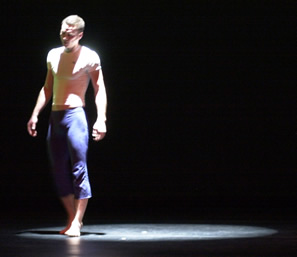
jonobioJonathan Meyer began dancing at Oberlin College in 1990 and graduated with a BA in dance from the University of North Carolina at Greensboro in 1996. In addition to modern and post-modern techniques, he has studied ballet, capoeira, butoh, and other movement forms. All find their way into an eclectic choreography unified by an understanding of chaos as the primal creative font, reflected by the name “khecari,” a Sanskrit word for creation that translates “moving in the void” or “dancing in the abyss.” Meyer has danced professionally in the United States, Canada, Europe, and South America. He founded Khecari Dance Theatre in January 2002 and serves as Artistic Director.