Home Blog Page 22

Two Poems by Giulia DeLuca

0

“Don’t Lose Sleep Over It”

I dislike it when people say,

“Don’t lose sleep over it.”
Chances are, I probably will.

No matter how miniscule the item in question.

Tossing and turning
Thinking about:
The conversation,
The worry,
The undone task,
The future,
The thing I did wrong
Or really right.
That battle in my head I wish I’d won,
That week’s current event,
That excites me
Or makes me anxious.

The event that will bring me closer towards my authentic liberation.
That will bring the country and world closer towards their shared liberation.
Freedom of mind and body in shared community and space.

Thinking about:
The thoughts or words
I need to write down.
The connectedness of all issues
and solutions.
The laws, the bylaws.
The bombs and budgets of the West.

Thoughts and emotions reeling,
Looking towards the next day.
Even when the sun is asleep.
While I should be asleep.

Heart beating fast,
Waiting for news.
Mouth drying waiting to speak,
Body restless,
Waiting to strike.

They say rest is radical and crucial.
And I agree.
But how do you sleep,
in a country that’s mostly asleep?

How do you sleep
When billionaires and boys start a coup
and establishment leaders play by the rules?

How do you sleep
When leaders create double standards,
Ignoring the cries of their people,
Cracking down on protesters and the working class,
Waving colors of Blue, white, red, green, and black?

How do you sleep,
With a mind that’s awake
And a body that’s moved to act?

A Frozen Fire Melts Ice

For so long, I’ve sat in a costume.
Waiting for something.
And as autumn passed and mid-winter sat,
my mouth grew dry.
As I stood and listened.
Too nice to be angry,
but not kind enough
to address a problem.
Ready to please whoever walked my path.

Worry kept me still,
My jaw clenched,
frozen and ready to tell a lie.
Just to make everything fine.

After years of living in a freeze state,
two people happened upon my path:
One was my friend and
One was my younger self.

They placed a glass bottle near my face.
As soon as the Olive Oil touched my lips,
I felt like it was safe to begin unfreezing.
Like the Tin Man, I could finally move my jaw.
Up and down, left to right.
And I found my voice.

I found that I had a lot to say.
I was angry, more so than I knew.
I didn’t know what I was searching for,
words or actions.
But I knew I had been holding me back.

My friend looked taken aback.
But they pulled out a compact of their pocket.
They opened it and it reflected.

I saw my face and felt it.
Soft and cold to the touch.
I saw my eyes, fire sign.
Flames ablaze.

This fire melted the remaining ice.
This fire lit up someone the ice had hidden.

Someone ready to speak.
Someone ready to act.
Someone ready to be in community.
Someone ready to support others unfreeze.

Giulia DeLuca is a writer living in Washington, DC. In her work, she combines current events, the complexities of navigating the human experience, and the need for shared action and liberation.

Image: Ted.ns, CC BY-SA 4.0 https://creativecommons.org/licenses/by-sa/4.0, via Wikimedia Commons

The Vision of Meribah by Matthew Ratz

The Vision of Meribah

I Meribah,
granddaughter of Amenemhat,
beloved of Ishmael,
recite my ancestors’ lessons
so that you, my child, may teach them to your own.

It is through our mothers
that we enliven our people’s stories,
and teach the generations
from Vulture to Basin.

Our grandfathers’ names are precious
they reveal the deepest truths.

Abram, father of Ishamel,
whose name meant “turn around”,
was elevated to Abraham
“The Father of the Feminine”
whose seed was sown about the world
for he sowed the words of God
in the mouths of his children and grandchildren.

His son,
your father,
was named “He Who Hears God”
his legacy pronounced to Heaven.

My mother’s father,
Amenemhat,
whose name means
“Who Believed in Her,”
planted within our family the mother’s task.

We are the grandchildren of Eden.
Ours is the legacy of the unbroken word
of the Heavenly Chorus–
deities sprung from the Endless Beginning.
They that constructed all that you see,
hear, smell, taste, touch, and perceive.
They are the building blocks
communicated to you and to me
as we sat at our grandfathers’ knees.

In the Beginning,
as the End and the Infinity
swirled within the Void,
A Ha! A universe burst forth,
struck as lightning,
illuminating effervesces of iteration.

Down a manifold path this force erupted,
through Severity and Mercy,
awakening each universal paradigm.
Constructs echoed across the
chasms of aquatic nothingness,
vibrations formed the undercurrent of our universe.

These cosmic bounces birthed logic,
constructed the very matter of our heavens
Swirling, pulling, pulsating,
contracting into the very stuff of planets
whose reverberations and tremors
awakened the fabric of our existence.

We are an emergence of this Divine reverberance,
a mere microcosm of the Infinite Endless logic
blazing across the two-score paths
that unite us with our Creator.

We are, each of us, breathing
the very breath of this cosmic logic,
We exist for a single multifaceted purpose
To reenact love that brings peace to all things.
As the breath of Everything rippled across the inky vastness
animating us in Its image; therefore
to oscillate our creations into perfection.
But how?

This is the secret of all creation:
the love each of us must radiate
should be as a weighted blanket,
a swaddling cloth for our precious children.
Our love must be the warm,
tender and unfailing arms
of a mother holding her most beloved.

All things long for peace,
contentment and equilibrium
a weighted blanket and loving embrace.
As instruments of the Infinite
our task is to exemplify
the very feeling that started
this whole wild experiment.

When we can love as perfectly
as that perfection which formed us,
we will have finally mastered
our reason for being.

Rabbi Matthew Ratz is the Executive Director of Passion for Learning, Inc., a nonprofit focused on closing opportunity gaps for low-income students in STEM and college readiness. He also teaches English at Montgomery College, has authored several books, and has appeared in poetry anthologies. A recognized speaker and poet, his TEDx talk is available on YouTube and TED.com. Matthew channels his extensive experience and unwavering commitment to inclusivity and equity to make a positive impact on the world.

Image: Diego Delso, CC BY-SA 4.0 https://creativecommons.org/licenses/by-sa/4.0, via Wikimedia Commons

Hollywood, Paris, Covid by Brenton Booth

0

Hollywood, Paris, Covid

We both had positive Covid tests after
celebrating New Year’s Eve a few days
earlier. Her ex sent her a text saying he
wasn’t vaccinating their ten-year-old son.
She is surprised he got back to her at
all. She’s worried about her sons
attention deficit disorder. When she
had full custody of him she tried her
hardest to get him into one of the best
private schools. They all turned him
down. Too difficult to teach, they
all said, without actually saying it. I
tell her he is a beautiful kid. Looks
just like a young Marlon Brando.
“Yes!” she immediately responded,
vigorously pirouetting around the
entire room. “I think he must have
had attention deficit disorder also.
Look what he did with it though:
he was amazing! My son could be
amazing too, don’t you think?” “Sure,”
I said, “even better than Marlon Brando!”
Her voice instantly quivered. Tears
streaming down her naked yellow cheeks.
“I will put away everything I possibly
can. When my boy becomes an adult,
I will definitely send him to Hollywood,
if he has any interest.” Her ex that badly
abused her for years and normally
completely ignores her texts sent
several photos of drawings their son
recently did at school. She sat on the
lounge studying them an extended
period. “Forget about Hollywood,”
she enthusiastically declared, following
a long thoughtful silence, “I will be
sending my son to Paris!” she repeated
the rest of the night, along with a
luminous smile, more golden than Klimt.

Brenton Booth lives in Sydney, Australia. Poetry of his has appeared in Gargoyle, New York Quarterly, North Dakota Quarterly, Chiron Review, Main Street Rag, Naugatuck River Review, Heavy Feather Review, Big Hammer and Nerve Cowboy. He has two full length collections available from Epic Rites Press. brentonbooth.weebly.com

Image: Michael E. Arth, CC BY-SA 4.0 https://creativecommons.org/licenses/by-sa/4.0, via Wikimedia Commons

Three Poems by Patricia Gray

0

A Three-Day Love Affair

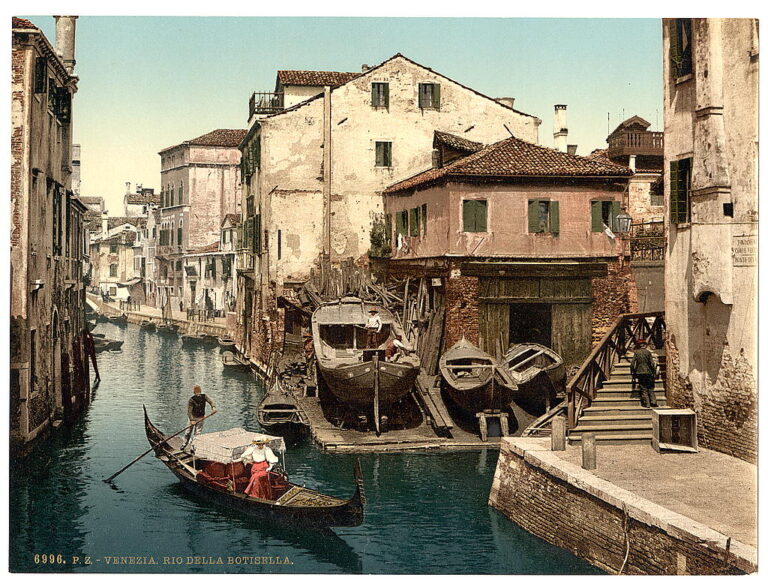
I fell for you fast, Venice,
the moment I stepped from the vaporetto
and onto your floating welcome.
Waif-thin as I was, you took me in,
transported me in time. I hunted
the greats who haunted your tearoom—
Byron and Proust, Dickens, Rousseau—
and sat in seats like theirs at the Florian,
sampling biscuits and delicacies, then
walked among pigeons clucking
and scolding as they mobbed
St. Mark’s Square.

That early December was cool.
The canal smelled of fish at night.
In the sinister twists of your streets,
Venezia, every shop hung
with plague-doctor masks.
I was in love with a gay man then—
a short-lived crush. My fingers sought
your handmade papers and journals,
your quill pens and ink…

I fell for you, Venice,
as I have fallen in love with men—
and was beyond lucky. You gave me
a transgressive show—that Balthus exhibit
of awkward erotic girls, a Dobyns’ poem
accompanying each painting—
then Rilke’s early journal with his drawings—
waiting in the Grassi Museum.

I knew you were magic and heathen
when I was swallowed by a costume shop,
six hands outfitting me for Carnevale in red
velvet and gold, too heavy to wear or buy.

I loved even your hawkers, Venice,
touting their fish as fresh, when my nose
said old by three days. Squid ink
stained my lips like a Goth diva’s and
remained till I was back in the States.
That’s how I wanted to be marked.
Some things you don’t want to forget.

Dark, Soft Curve

Writing a poem is like developing a photo
in the darkroom
in the old days. By bathing the photo-paper
in a chemical bath,
the imprint would emerge slowly through
a wavy liquid. You’d think,
ah, there’s her shoulder now and that dark,
soft curve of scarf
and you’d pause remembering the day and
place the picture was taken.

Lifting the photo from its bath, you use
the warmth
of your breath and hands on the paper to hasten
development and
make visible the details all but lost by a too-bright
flash. In this one moment
you can amend your mistakes, use your body
as heater and healer—
as we do in life, often in the darkest of rooms.

Crossing the Blue Ridge

Driving over the mountain and into the valley, I hear a rolling sound
like waves coming across fields that once held the fodder shocks
of ancestors’ labors, a feeling the soul misses—

remembering that the Iroquois Nation tilled these fields and moved
their farming in answer to the weather’s instructions, and even
the deep history when our planet was one big ocean,

and the mountains I love erupted in the Earth’s raw turnings,
and the valley pulled away from the foothills,
where the blue mountain stretches out in the distance.

The Blue Ridge is like my parents. It blends
Dad’s muscular caring with Mom’s mind and pillowy
curves, as if she were lying on her side on the horizon.

Patricia, you know you’re romanticizing, don’t you, pretending
the landscape is human? Admit it. You miss your parents, now
that you’re all grown up and too old to be called an orphan.

Patricia Gray’s poem, “The Taste of a Girl’s Knee” is in The MacGuffin, Vol. 40.1. Four other poems were in the Mediterranean Review. In 2023, she was awarded an Artist Fellowship in Poetry by the DC Commission on the Arts and Humanities and was a finalist for the 55th Millennium Writing Award for her poem, “Morning of Wilderness and Wind.” She lives in Washington, D.C.

Image: The Library of Congress from Washington, DC, United States

Ha Vay’s Baby I’m the Wolf is a call to the wild you’re gonna wanna answer by Hailey Wharram

0

This article is the winner of the 2024 DC College Student Arts Journalism Competition. Learn more about the 2024 competition on our website here.

In “Venus in the Sea,” the blushing lead single from Ha Vay’s 2023 EP Avalanches and Unfamiliar Ways to Die, the singer-songwriter wails “enraptured in the bluest dark, I captured your beating heart.” Just over a year later on her debut album Baby I’m The Wolf (2024), Ha Vay enraptures us all over again. Here, Ha Vay plucks Venus out of the sea and drops her into the bleeding heart of the forest, extending a hand to us so that we may follow her down the rabbit hole. Enriched with crystalline, caterwauling vocals and enchanting, literary-infused lyrics, to step through the portal into Ha Vay’s musical world is to be transported to a glistening, fern-canopied grove where feminine wiles and feminine wild collide.

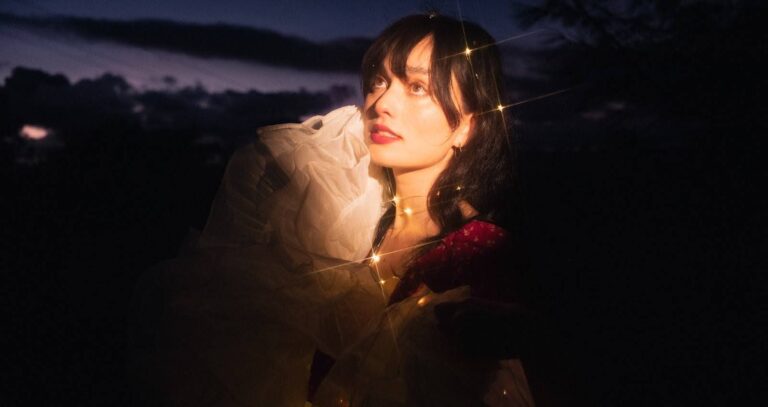
Released at the tail end of June, Baby I’m The Wolf is a gossamer love letter to female ferocity—look no further than the album cover which sees Ha Vay screaming towards the sky in a berry-stained white frock for proof. Despite the deceptive docility of her delicate, cobweb-spun cadence—equal parts pillowy and entrancing—Ha Vay sings of howling at the moon and unleashing the powerful, unbridled spirit churning within her. The result of this sonic and lyrical contrast? A recognizable yet refreshing portrait of the ongoing struggle between external expression and internal repression that many women know all too well.

“This album is my experience of girlhood,” Ha Vay said in an interview with the Voice. “For me, a lot of that is sort of being someone who presents very soft and feminine. I don’t even think I realized that I did until a couple of years ago when I started making music. I was like ‘oh, I guess I have kind of a very feminine persona,’ because in my head I feel really wild and adventurous and crazy and all kinds of things. I think for me girlhood is kind of a journey of reconciling those two sides and trying to figure out how to be who I am and still feel accepted.”

In Baby I’m The Wolf’s sparkling opener “Ophelia,” Ha Vay makes it clear that “soft” and “strong” can coexist harmoniously—a thematic current which cascades throughout the rest of the record. While Shakespeare’s original Ophelia is primarily defined by her sorrow and her relationships with men, Ha Vay reimagines Hamlet’s leading lady as a starry-eyed yet self-sufficient daydreamer. “Ophelia at the window, pining for that first snow / she’s twirling like a ballerina, never caring how you see her,” she sings in the echoey first verse.

“Ophelia is really special to me,” Ha Vay said. “I’m really proud of the writing in that one and it just kind of flowed through me in a way that was really special.”

While much of the LP embraces both the mild and the wild, the title track sees Ha Vay, exhausted by being misunderstood as one-dimensional, finding solace in unabashed ferality. After a breathy, celestial beginning, the bridge roars to life with a galloping drum beat as Ha Vay repeats the song’s central mantra: “You think you’ve caught a lamb, but baby, I’m the wolf.” In conversation, Ha Vay elects “self love and self discovery” as the two core themes of the project, making this feisty anthem of redefinition and reclamation a perfect choice to represent the album as a whole.

“Ophelia” is not the only song on the record which harkens back to Shakespeare. According to the songstress, Queen Titania and King Oberon—the fae royalty of A Midsummer Night’s Dream—were similar sources of visual and thematic inspiration for this album. Likewise, “Angel! Wild! Superstar!” follows a pair of star-crossed lovers “on the hunt for a violent delight” à la Romeo and Juliet. Besides the Bard, the record also references a famous quotation from Jane Austen’s Pride and Prejudice in the sultry “Pretty Baby”: “I bewitch him, body and soul.” Ha Vay also takes ample cues from the world of cinema, citing Maya Deren’s surrealist short film Meshes of the Afternoon (1943) and a number of A24 horror films—namely X (2022), Pearl (2022), Midsommar (2019), and The VVitch (2015)—as inspirations of hers.

Above all other media, however, Virginia Woolf’s Orlando is the piece of art that consumes Ha Vay’s headspace most wholeheartedly. “I’ll never get over Orlando,” Ha Vay said. “I think everything I make is somehow adjacent to that book, and I’ve read it so many times. I read it for the first time when I was seventeen, and I feel like it hit me at just the right time to change my whole brain.”

Baby I’m The Wolf’s penultimate track “Nature’s Bride” gets its name from a pivotal passage in Woolf’s illustrious novel in which her eponymous protagonist declares “I have found my mate…It is the moor. I am nature’s bride.” A sweet surrender to the gentle grandeur of the natural world, this ode to the untamable climaxes with the protagonist breathily pleading for the earth to “entwine these vines ’round my fingers.” Underpinning the delicate piano melody, the swift and swishy muted acoustic guitar strums capture the heart-thumping euphoria of running with the wolves.

“I’ve been trying to write that song for years, and I’m really happy with how it came together,”  Ha Vay said. “I consider that to be kind of the pinnacle or the thesis of the album.”

Though “Nature’s Bride” has been trying to clamor its way out into the world for quite a while, typically Ha Vay’s songwriting process is much more intuitive and quick-moving.

“I really never spend more than like 30 or 45 minutes writing a song,” Ha Vay said. “If it doesn’t happen easily, I tend to think that, for me, it’s probably not right. It might mean that sort of the same concept comes back reincarnated in another song form at another time, but I feel like, to me, if I’m battling a song while I’m writing it, I feel like the audience can feel that battle, so it has to come naturally and as nonjudgmentally as possible.”

The fearlessness and fluidity which characterize Ha Vay’s creative process shines through all ten tracks on Baby I’m The Wolf. Ha Vay’s prioritization of “not forcing it”’ pays off in spades—each song feels thoughtful yet easy-going all at once. Likewise, in its steadfast exploration of multi-faceted womanhood, the album cleverly balances sonic and thematic cohesion with the concoction of a distinct tracklist. While all the songs are bound by a folksy pop flavor tailor-fit for the forest, melodies never feel one-note. The album staunchly side-steps monotony, ensuring each tune still feels uniquely momentous in its own right.

Against a confident chorus of electric guitars and swinging drums, “Fragile” sees our narrator as anything but; “I’m phenomenal, try me and then you’ll see.” The eerie, operatic “Vampires” features a shivering, phantasmic piano melody perfect for the Halloween season. “The Huntress” and “Moon Girl” are back-to-back, silky-smooth-talking tracks anchored by swampy basslines and bashful seduction. The latter is a particular gem, with Ha Vay masterfully locking the listener in her orbit thanks to twinkling, silver strings and howling vocals. On the eclectic, electrifying Baby I’m The Wolf, lightning does in fact strike the same place twice—actually, make that ten times.

The clarity of creative vision found across Ha Vay’s work is particularly impressive considering her greenness. Though she has been making music her entire life, Ha Vay officially began working on releasing music as a solo artist under her stage name—a name which pays homage to her Chinese heritage—during the pandemic, thanks in large part to the encouragement of her former bandmate turned producer Elliott “Woodbridge” Jacobs. You’d never know it just by listening to the polished debut record itself, but the singer is very candid about the small-scale, low-budget nature of her production endeavors.

“I don’t know how clear this is or isn’t, but the album and all of the videos and everything, it is all an extremely DIY operation,” Ha Vay said. “It’s pretty much just like three people—though sometimes more people join in—but I’m so grateful for the people who have worked on this with me and have brought this to life. In the loveliest way possible, everything is kind of duct-taped together, and it was such a team effort to really move mountains and make something out of nothing, so I just want everyone to know that—that it’s been such a journey to do it and that it still is.”

As of the release of her latest video for “He Wants The Rain,” seven out of the ten songs from Baby I’m The Wolf currently have music videos; the three remaining include “Fragile,” “Vampires,” and “The Huntress.” However, according to Ha Vay, not only will all ten tracks have videos by the end of the album cycle—all ten will combine with supplemental narrative scenes to create a short film to accompany the album. Tentatively, Ha Vay plans to release this project on Sept. 1.

These videos are largely the manifestation of a creative collaboration between Ha Vay and Emily Oreste, her best friend since first grade. Though Ha Vay is somewhat self-deprecating when she refers to her videos as “duct-taped together,” in actuality the grainy, found-footage-style visuals are endlessly charming and intimate. Each video feels like a precious peek into a clandestine life lived entirely on the protagonist’s own terms. Girls in flowy white dresses and flower crowns frolic in fields; Ha Vay explores a gothic, candle-lit house, applies rouge in a dusty mirror, prances through the snow, and spins in the starlight; Lovers come and go, but her coven proves everlasting. Ha Vay presents us with a peculiar yet alluring little world we are eager to lose ourselves in.

“We’re shooting on my producer’s Dad’s 1999 camcorder that we found rummaging around—like we didn’t have a camera or anything,” Ha Vay said. “Most of the props and so many of the costumes are handmade. So many friends dedicated so much time—like my friend Nicole designed dresses for some of the videos. People worked so hard for no money, just dedicating their time and their talents to making the music videos come to life which was just so special to me, because for me, every song is not complete without a video.”

In addition to the upcoming movie, Ha Vay is opening for fellow singer-songwriter Sarah Kinsley on tour this fall. The pair will be coming to Washington D.C. at Union Stage on Oct. 6.

“I’ve been a big fan of Sarah’s for a while, and I don’t even have a booking agent, so I guess she just had her management email me and I was so excited,” Ha Vay said. “I’ve never been on a big tour like that, so it’s a little bit daunting but very exciting, and I couldn’t be more excited that it’s with someone whose music I admire so much. I think it’s gonna be a whole new chapter. I’ve only really met listeners from California because that’s where I’ve played, so it’s gonna be amazing to meet more people. I might try out some new material as well, so it’s gonna be really, really fun.”

Rooted in delectably dreamy production and a strong sense of self, Ha Vay’s Baby I’m The Wolf is a once-in-a-blue-moon debut. For indie pop lovers looking to take a walk on the wild side, this bewitching, transcendent record is a must-listen.

Hailey Wharram is a senior at Georgetown University from Richmond, Virginia. She is majoring in English with minors in journalism and film and media studies. Hailey is an Associate Editor at The Georgetowner and also writes for The Georgetown Voice.