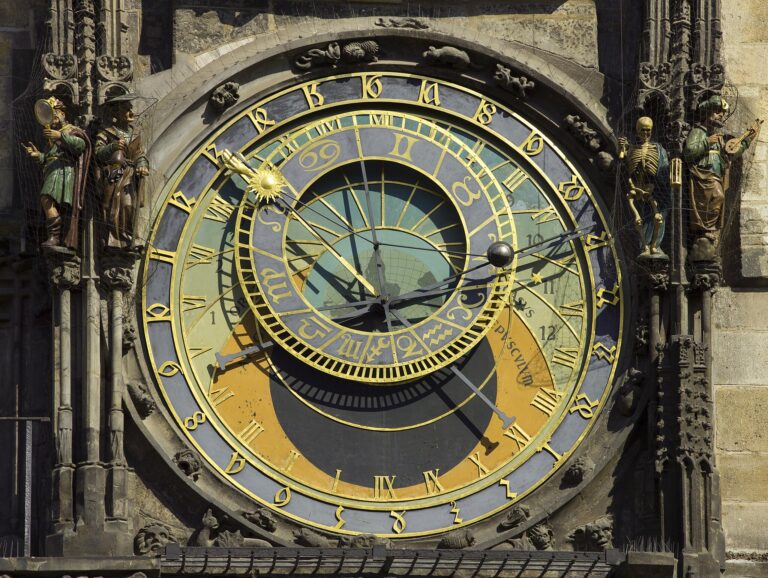
Like the penetrating ticking of a tightly wound clock
Is the knowing.
Knowing we shall not be,
Knowing, though I close the door
It will not cease,
Despite my gasp,
“No more.”
Faith Bueltmann Stern, poet, writer, and musician, has taught at colleges in Maryland and the Midwest. Her poetry and prose can be read in Preview, New Writer’s Journal, Fodderwing, Grub Street Writer, Gunpowder Review, Chesapeake, and the St. Louis Genealogical Society Quarterly. She is the author of Getting There with Faith: Adventures of a Travel Addict from Bielizna Press. Born in California, she lived near Kalorama Circle before moving to Takoma Park, MD.
Featured Image for this post: The Prague astronomical clock (in Old Town Square) was installed in 1410 by clock-makers Mikuláš of Kadaň and Jan Šindel, and is the oldest functioning Astronomical clock in the world from Andrew Shiva / Wikipedia / CC BY-SA 4.0
a depression left in the grass, a shallow bowl, or profound,
a gap in the hedge the hog trespassed, in other words, not the animal
but the space through which it moved, a river, the water having graved
out the dirt and stone, cast a place for itself to run, helter-skelter
*
or the imprint of the Buddha’s butt on a mountainside,
the Virgin Mary on toast, Christ in a snowbank,
in other words, like pareidolia, Greek for “beyond the image,”
or call it magical thinking, air-castle, desperation, need
*
from the Middle French for “hiding place” so, also, the inside shelf above the closet door, invisible if you didn’t
look straight up upon opening, where I stashed myself so that I was always the last one found,
nestled there, I loved listening to the sound of seeking—pounding feet, muffled shrieks, and, at last, sighs—
their pretense of giving up on me, as if I hadn’t performed this trick a thousand times
*
or how you can also hide in time, like staying in bed and pretending to sleep
to avoid saying goodbye to someone leaving for another continent
their laughter on the other side of the wall, leaving impressions like a hand’s sweaty stain
* the handprint of a beloved in cement, finger furrows into which you—or anyone—
can try to place your own, palm against where-another-palm- once-was, so trace
of a pilgrimage, of an ephemeral immanence, mark of hoof, of claw, of ball or heel
Meuse II
Pron.: /ˈmjuz/
Panther Hollow, part of a park in Pittsburgh,
a valley, or “holler,” past home of the now locally extinct wild cats,
pooled with water in the deep dip between the trees and long, steep stairs
but which I understood as hollow panther, hungry,
or lonely, its belly translucent as an Xray
or a sonogram of a nonviable blastula
which my mother witnessed four times in her life
the hollow panther of her own body on a screen,
the ultra-sound of soon-to-be emptiness, and so, my sister and I became
DES babies, the impression diethylstilbestrol [Pron. / dī-ĕth′əl-stĭl-bĕs′trôl′ /]
or, to speak more plainly, synthetic estrogen, left on us:
the risk of clear cell adenocarcinoma, and that’s a lot to swallow
*
What was the cure for panthers like my mother?
What is it still? You guessed it. An evacuation.
A scouring, a raking, leaving a hollow to be filled another day—or not—
*
We played in the woods by the hollow. Raced on the stairs.
Dared to swim. Pretended to fish. Dug for loose change
in the muck. Rubbed sticks into fire, or tried to. Kept watch for a sleek form
to move through the shadows. Later, a girl I knew in high school
was stalked in the hollow while running. Caught, pinned, and filled against her will.
Meuse III
Pron.: /ˈmjuz/
that scarred cleft under the cliff
of your chin, where the swing
swung back that pore
turned pit after the oil
slicked your face, that ghost
forest, after fire or flood, ghost
apple, after pre- mature frost, ghost
wolf after near extinction, now
coiled into coyote DNA,
that way a grudge
makes a home circling and
circling, mulish and mean
it’s in the cup of my hands
even as I try for grace
Meuse IV
Pron.: /ˈmjuz/
metaphor for memory, not the
surface dive of the short term
but the hippo- campus-driven
journey to the epi- sodic, risking
the bends upon return
to the Present. Hippocampus, Greek
for “horse” plus “sea-monster,”
or its gentle cousin, “seahorse.”
Named concretely for the shape
of the organ, like the dress I remember
wearing to my father’s second wedding,
printed with purple hippos, rippling
when I moved, a zoetrope
on my body, or the red slap
of my mother’s hand on my face, or,
the grenade thrown at someone
by my own voice years later.
Rise carefully after you go there.
And if you return too quickly
to the present, your head spinning
round like an anima- tronic figure in
a haunted house, bend back
over, and try again, find that
bowl of cream you learned
to whip into sweet sweet soft butter
Meuse V
Pron.: /ˈmjuz/
metaphor for a hole in the heart that is, in the wall between
the ventricles, the prime pumping chambers, considered congenital but caused,
most likely, by toxins ingested by the host to save its own life
while pregnant, or a hole in the pipes in the body of a city, its prime pumping
station subject to corrosion, corruption, then everything
sneaks in, the decaying tunnels seeping their own lead into themselves
perhaps you’ve read my friends from Flint who write about Flint
perhaps, like me, you’ve booked a flight to L.A. and haven’t yet read
that the water won’t be safe to drink after the wildfires—you’re used
to only worrying about water in Mexico—perhaps we will meet in L.A., bottles un-capped,
clink them together in a dull plastic smack of sound—
even lead asks us to appreciate the impression it leaves, the half-life it once had,
how it dares to trespass. I’m reminded of the way I leak into myself
in the best and worst ways— it takes all I’ve got to decide which is which
Virginia Bell is the author of the poetry collection Lifting Child from the Ground, Turning Around (Glass Lyre Press 2025) and From the Belly (Sibling Rivalry Press 2012), Virginia Bell won NELLE Magazine’s Nonfiction Prize in 2020 for the personal essay, “Chicken,” and her poetry won Honorable Mention in the 2019 RiverSedge Poetry Prize, judged by José Antonio Rodríguez. Her work has appeared in New City Magazine, Five Points, Denver Quarterly, SWWIM, EAP: The Magazine, Hypertext,The Night Heron Barks, Kettle Blue Review,Fifth Wednesday Journal, Rogue Agent, Gargoyle, Cider Press Review, Spoon River Poetry Review, Poet Lore, The Nervous Breakdown, The Keats Letters Project, Blue Fifth Review, Voltage Poetry, and other journals and anthologies. Bell is Co-Editor of RHINO Poetry and teaches at Loyola University Chicago and DePaul University. Please visit www.virginia-bell.com
Image: Detroit Publishing Company, Public domain, via Wikimedia Commons
There is a hurt that runs so deep within the marrow of my bones,
Twisted lies
Deceiving smile
Words dipped in scalding tar meant for ill filled gain
The smell of burnt flesh fills the air
As my beauty is stripped, one scar upon another.
You used me to carry out a facade
Bricks and mortar you built
Inhabited by shallow desire of things to fill your bowl of status
Hardwood floors
Gold knobs for kitchen cabinetry
Floor to ceiling bookshelves
Four post beds and classic highboy
Silver encased dinnerware and sunlit porches
Tick-tock went the grandfather clock
People come and go
Your chest swell with pride
Ooo-awww!
Puff it up some more.
Hiding behind smoke and mirrors
Proclaiming a marriage beyond reproach
All the while shattered glass under your feet
causing mine to bleed.
Your insecurities shadowed my smile, turning it upside down
Your imperfections I inherited
My heart singed black by your poison
Seeping into the marrow of my bones.
Buried alive, choking on your shit
I would have suffocated were not for
The marrow of my bones
That rejected the transfusion
Synaptic gaps flush red
Arms stretch wide, take a deep breath
And the breath dug deep down into the marrow of my bones
I am born again
Inhale – oxygen
Exhale – push, push, push
Push out a new life – Without you.
Letter to My Son(s)
LIS–(T)E–NNN
Baby Boy Some look at you and say that you have a gift. They’re wrong. Buried underneath the violence against your hue Stop and frisk for a headlight does not necessitate handcuffs Cut your locs because hiring managers shun you Refuse to see the spirit in you
Yet your intimacy with words Flavored in lyricism Seasoned from joy and pain Your words, your rhythm marinades in the marrow of the bones
Your vibe leaves us salivating Our souls stirred by your offering The musicality beyond doubt The production credits undeniable You don’t have a gift, you are the gift.
My boyz, Do not vibe with the pressure that crushes you, Vibrate on the level of your solution Your creativity is your identity It is your essence
Though they plant you as if in the ground Recall another if you will another time When hidden in darkness In your mother’s womb You emerged into the light of a new day
Today and henceforth, Go after the sun/ son (or go get your blessing) You don’t have a gift, you are the gift.
Ann-Marie Maloney is an educator with a diverse background in arts integration, speaking, and writing. She is part of the University of Maryland Writing Project (UMdWP), a chapter of the National Writing Project which focuses on teachers teaching teachers. Her curated lessons are on The Reginald F. Lewis Museum website and she was a featured poet at The National Portrait Gallery. As a facilitator, Ann-Marie designed impactful workshops for teens and launched the “About This Life” podcast along with the “Becoming Enough” online community. With a Masters in Curriculum & Instruction and National Board Certification, Ann-Marie mentors both students and educators, fostering creativity and resilience through arts integration. Ann-Marie is dedicated to promoting healing through poetry, supporting individuals in overcoming life challenges, and helping them find their voice.
You reveled in flaws. You turned an opaque hobnail to the sun,
You cracked open to reveal cloud after shimmering cloud.
I was your pewter daughter.
I was a crocheted blanket.
I was a camouflaged nest.
I gained as I protected, worked, concealed.
I never showed my need, my dropped stitch.
I would have held you in my arms, not precious but sturdy, lasting, forever.
We were both broken by the brutal,
oyster-hard storm. The thunder-head
battered and blasted without end.
I asked you to swim.
You learned to swim by drowning and then relearning breath.
I should have known.
Roots of trees reveal the mirrored light of transcendence.
1944 Bible
A book of images, not answers.
Not births, not deaths. No family tree.
Writing on the wall, but not on the pages.
A gentle rectangle around “whom God hath joined” is the only notation.
Photos and papers burst the spine.
Ex-boyfriends, poems from the daughter,
Father’s World War I service record. Asterisk: Silver Star.
My mother opens it and remembers.
She closes it and all fades like a silvered mirror.
As if the foot is dry before and after you dip in the river.
Maggie Rosen (she/her), writes about the intersection between truth and myth, history and family legacy. She has won numerous awards and recognition for her work, including the Moving Words Competition, the Enoch Pratt/Little Patuxent Review Poetry Contest, and the Bethesda Urban Partnership Prize. Her poetry and hybrid work has been nominated twice for Best of the Net. A poetry chapbook, The Deliberate Speed of Ghosts, was published in 2016 by Red Bird Chapbooks. Her poems and hybrid works have been published in Marrow,Heron Tree,Harpy Hybrid,Waccamaw, Cider Press Review, and Barely South, among others. She lives in Silver Spring, Maryland. See more at maggierosen.com.
That day you went the cracks of dawn That fractured us like porcelain Ran down my road. You called upon All things but us to start again. That day I stayed the autumn fell Whose ancient, cyclical demise Could not for worlds of red instill October in your August eyes. All told, I’m doing rather well. I have a husband and a home. My baby has your eyes and Hell Is freezing over in my own.
Lorena Axman Freed is a poet living in her native Ohio, and received her MA in English from the University of Rochester. She enjoys gardening, gaming and playing paintball.
Image: Bruno Liljefors, Public domain, via Wikimedia Commons