Home Blog Page 27

Three Poems by Pamela Mathison-Levitt

0

What it feels like to tell your child about the loss of your/their human rights

The day Roe vs. Wade was overturned,
I detached,
a power cord ripped from the outlet, until my charge ran low
and my mechanical movements slowed, my function automated.

Fold the throw blanket. Plump the pillows on the couch. Pick up the laundry. Turn the dial;
close the lid. Pull out the meat for dinner, let it thaw until the juices bleed red on the plate,
oil the pan and let it sizzle. In between everything, double over a kitchen chair, dish towel in hand, tear streaks blotching my face until I cannot hide the pain from the kids running indoors. I modulate my voice, but they hear the cracks, the off-pitch tone and then they want to talk to my face not my back as I keep turning in the other direction because once they see, it will be real.

It will be real that one day, if my child is pregnant and due to our genetic condition
she faces the risk of hemorrhages, she may be forced to bear that child even if she dies
the next minute like I nearly did twice. And I think of their sweet faces and all that another pregnancy would have cost us, would have made me miss about them, the times
they would have reached for me and grasped air, found vacancy, if their father hadn’t agreed
to the vasectomy because I was scared that to be with him meant I would face death a third time.

And yet—vasectomies fail and every day, mothers die in childbirth and now my children must
weigh every choice and the scales are out of balance and how do I tell them, and the meat
is charred in the pan, the washer buzzing, their faces concerned, and the chair wobbles
under my weight, but I stand up and say that Mommy is feeling sad
because they overturned a law today that said a person could have choices to protect themselves or their children if they needed to by having a medical procedure that sometimes is needed when…and I list all the reasons and they ask: why did they do that?

Turning in my Purity Rings: An homage to Nadia Bolz Weber*

In the 1990’s, I felt the fervor,
a pledge not to take a lover.
Instead, to seal my legs with honor,

the Church held out a pen.
It wrangled young people in,
judged their worth and defined their sin.

Then it imparted lessons of shame
to the youth who scratched their name
as though desires are sins to claim.

I, committed to this endeavor,
opted in as I would never
submit but to God, the Father.

Two years later, when my lover
discarded me for another,
ring abandoned on the counter,

I confessed, as if my love was rent;
in my pure heart there was a dent,
a sin for which I must repent,

a bloody sacrifice: my virginity
upon the altar of misogyny,
spoiled because I did not “marry.”

Mary said yes, yet in their obsession
they explain her conception
was immaculate intervention.

This is why no one yells: Oh Mary,
OH MARY, in a moment of ecstasy.
Instead, we submit a plea,

Oh God! We scream on the precipice.
We climb the steps of the edifice;
then are cast out of bed, back to Genesis.

*True Love Waits pledges were employed by Christian and Roman Catholic churches in the 1990’s to promote abstinence, and often involved wearing a purity ring as a reminder of one’s promise. Lutheran minister Nadia Bolz Weber disapproved of the damaging effects of shame within purity culture and requested those who wanted to discard their pledge and ring to turn them in to her whereupon, she and artist Nancy Anderson created a sculpture of a vagina from the rings and presented it to Gloria Steinem.

Forced Birth

Distended belly
swollen with words,
the skin stretched taut,
the words, gnawing.

It is hard to breathe;
they are growing so big,
kicking at other organs,
writhing and twisting at the cord.

The pressure mounts,
the sharp points of each letter pierce.
Watch them ripple as they move,
watch them shudder.

Words were implanted here,
words which must emerge
or be released.
But, they were not meant to be.

If I didn’t consent to speak,
if these words formed against my will,
I need not utter them aloud,
or bring them where they are unwelcome.

Except, you knead the flesh around them.
You cross my legs and
force me to lie with them,
to witness their growth.

These words aren’t meant to be.
I know this.
But you pry open my mouth
and grab my throat, squeezing.

You press your knee down
and the words scream out:
words of generations of words
with nowhere to turn.

I watch you break open
the protective caul.
Words that are not my own
shriek; another set of lungs

filled to the brim.
I never wanted these words.
They developed under duress.
You clamped and wrested them from me.

Now they suckle,
drain out the air and marrow,
and take up space that was meant
for other words to be said.

Pamela Mathison-Levitt is a chronically ill, disabled poet and homeschool mother living in the DMV. Her work often explores themes around her Unitarian Universalist faith, chronic illness, relationships, and mental health. Her work has been published in or is forthcoming in the following publications: Exposed Brick Literary Magazine, Mid-Atlantic Review, Literary Mama blog, Emerald Coast Review, The Anthology for Appalachian Writers, and the Mighty. You can find her work on Insta @pmmlevitt or Facebook at Lines and Branches.

Image: Rlmabie at the English-language Wikipedia, CC BY-SA 3.0 http://creativecommons.org/licenses/by-sa/3.0/, via Wikimedia Commons

Three Poems by Barbara Schwartz

0

Touch

From our family bones make marsh-duff
soil, salt, a kingdom of seedling, stalk—
Drinking purple dawn, we wade in the strange
autumnal songs, swallow sunshine, sweet corn
skin, raze the lawn, rub pollen from our sleeves,
weave dandelion & puzzle-grass & when
night falls we wait for the raccoons,
their noses so close we almost touch—
The woods burn & we rearrange our plots
of marl & clean & drink & hope that some eye
in the sky sifts what we have made from time
& lifts one silken brow before the thunder
returns. From our bones, make tide pools,
blood moons, O of a newborn’s lips—

You Did not Begin With Me

As ash after rain
becomes shelter,
a bird-bath’s hollow,
the shape of a womb;
as dirt becomes humus,
vine, vineyard, pew
of scents, incense,
myth, you did not
begin with me.

You grew
your own heart
as the wind
carves time
into bark,
& blows
new seedlings,
surprise
in the palms
of starved
gardeners—

To cultivate things
unknowingly is easy:
sweat, scars,
ruminations,
faith as overgrown
& golden
as dandelion
crowns, which I
picked from
the lawn
heading into
the hospital
on the day
you were born.

O Has a Mouth

My grandmother loved to roam the forests of her mobile home & drink
the air. When she died, I searched for her everywhere: in the space between
notes of a song, in the caesura, & the dusk, in the wind under an owl’s
wing, how it wheels toward the kill— With one word or look she could
calm me. If she had to, she could drown me with her hands.
Whole-body terror: wave after wave that wrecks, reshapes
whatever it touches— I am remade better: time-capsule: filled & filling.
Beside my son’s bed, the conch, its roar tells the same story:
from its burrow, a snake whirls inside a fish’s mouth,
then winds inside the winding intestines of a shark, around
whose throat is wound a shining wire— Heartflesh sold on a platter. We eat
to remember. How the earth swallowed her whole, will swallow us all,
gleaming mouth of dirt & stone closing our throats. When my son
was born he seemed too meek to resemble her, but when we heard
his violent, desperate cry, we knew— She did not stay in the ground for long.

Barbara Schwartz is the author of three books of poetry, a chapbook Any Thriving Root (dancing girl press, 2017) the collaborative collection Nothing But Light with poet, Krista J.H. Leahy (Circling Rivers, 2022), and the hybrid memoir, What Survives is the Fire, forthcoming from Alternating Current Press in 2024. A finalist for the 1913 Poetry Prize, Barrow Street Book Prize, and Alice James Award, What Survives is the Fire was adapted for the stage and selected for Boomerang Theater’s First Flight New Play Festival in 2018. Barbara has chronic myeloid leukemia and is an advocate for children with disabilities. She lives with her family in Brooklyn, NY.

Image: Ryan Hodnett, CC BY-SA 4.0 https://creativecommons.org/licenses/by-sa/4.0, via Wikimedia Commons

Remembrance by Mariam Ahmed

Remembrance

The sun sleeps
In the dirt, here.
I am less smoke, more steam,
The refreshing kind of bitter.

In the dirt, here,
We’ll plant our feet and leave.
The refreshing kind of bitter
Lives in my coffee now.

A tiny, smiling Death,
The sun sleeps.
I am still here, still now;
I am less smoke, more steam.

We’ll plant our feet and leave.
A tiny, smiling Death
Lives in my coffee now,
I am still here, still now.

Mariam Ahmed is a Californian poet. She has her Bachelor’s degree in English with a minor in Sociology from UC Davis and a Master of Fine Arts degree in Creative Writing with an emphasis in Poetry from San Diego State University. As a Pakistani-born American raised in the Bay Area and Folsom, CA, Mariam is a first generation scholar and the first woman in her family to attend college. She is a certified Poet-Teacher with California Poets in the Schools, and her work has been published by many literary journals and presses, including “Poetry International,” “The Los Angeles Review,” “The Elevation Review,” “Flint Hills Review,” “Progenitor Art and Literary Journal,” “Maintenant: A Journal of Contemporary Dada Art & Poetry,” and elsewhere. In addition to writing and teaching, Mariam enjoys meditating and exploring beaches.

Image: К.Артём.1, CC BY-SA 4.0 https://creativecommons.org/licenses/by-sa/4.0, via Wikimedia Commons

Two Poems by Ince Lachey

observant gravity

a sort of protest
is underway performed
in excellent style by
the superfluity of those who have ever been
beloved by you
who beat with a hoop-stick against the North
Pole hoping
to reduce it materially to
a limp white cravat yet

succeeding only in dislodging
a speck of rust
you
deemed with the elevation of one
eyebrow
not rustworthy

radical nature

he wasn’t himself very often even now when he was
walking shoeless with paper
feet through wet grass
but at the same time sitting in
the shade provided by a cloud of many
insects he wants
to lay hold of to
smear along the walls where
other things of that kind were also
smeared leaning back
in his chair in
which is another man saying all
the while “leave me be”

Ince Lachey is a young astronomer fascinated by distant galaxies and black holes. Working at a renowned observatory in Maryland, he studies the mysteries of the cosmos.

Image: Los Perros pueden Cocinar, CC BY-SA 4.0 https://creativecommons.org/licenses/by-sa/4.0, via Wikimedia Commons

Two Poems by Charleigh Triaga

Phone Call: Grams, On Her Ex-Fiancé

He’d show to work an hour late. Never have any money to go out and go anywhere. I always had to pay. I was workin’ at Bennet’s, I think I started in September and Bill started in November and there was an old carpenter there, and he— I guess Bill, must’ve had his eye on me, and the old carpenter was encouraging him, and Bill said, no, she’s engaged. I don’t want to break up an engagement. One night, I’d given my boyfriend the ring back. I went to work the next morning and the old carpenter seen me without a ring and he run and told Bill, and Bill come over that night, just to see me. Well as it was, I was takin’ my Station Wagon to the garage, and on the corner of Genessee and South Newstead, he was comin’ up to see me and I was goin’ the other way with the wagon. So he followed me over and picked me up, ‘cause I left the car there. And we were just ridin’ around the first night. But then, I think the second night, he asked me if I would move to West Virginia, and I told him yes— but I had no intentions of movin’ to West Virginia. So that was November, we got engaged for New Year’s, and in June, we got married. Yeah, we’ve had a good life. We’ve had our battles. But we all do. A lot of em’ were over the kids. You know, Darla was a little shit. And he was hard on Ronnie. They say you’re always hardest on the first one. I mean for instance, if they were out, snowmobiling, and Ronnie was s’posed to be home by twelve and wasn’t, Papa was up. Then I’d have to get up and intervene. And Jackie was always the favorite, I don’t know why. But she’s still his favorite, and he’s her favorite. So. It’ll be sixty-eight years? Or sixty-nine? We were married in ‘55… this year will be sixty-nine. If we live that long. You never know.

The Biscuit Method

Some separate whites from yolks using the shell it falls from
I use my fingers, spread open and curled so yolk slips by

Eyes dry-tired like someone sieved tears from whites
It’s morning, hours before coffee. Tears welling like ice melting

I cut chunks of butter into flour, coating each frozen cube
Folding flour into fat forms flake, “the biscuit method” in baking

A mother knows her daughter by face
Red streaks give me away when she asks, were you crying?

Pinching crust thumb-to-forefinger against a bent knuckle,
I think, maybe it’s the medicine

The pie crust collapses
I didn’t let it rest, didn’t give it time, wasted mine

Walking past, Mom squeezes my shoulder, a reminder
She is here. But her smile too is a smudge, hardening in concrete

I could buy pie weights. Add stability
I am not sturdy, but still a foundation

It’s just a pie, start over. Get the flour back out
From the cupboard, the oven’s still preheated

Maybe it’s the dosage

When the crusts cool, I lift each disc from plate
Squeezing one in each hand ‘till they crumble

I could use them to top a berry parfait
One doctor tears a script, phones in a new med

I eat the crust pieces with a bowl of peaches
Like pie, deconstructed


From Buffalo, NY, Charleigh Triaga is now based in NY, NY. She writes “homestyle poetry” about domesticity and her multigenerational family. Her work explores the human body and pain processes. She received her MFA from Queens College in May 2024.

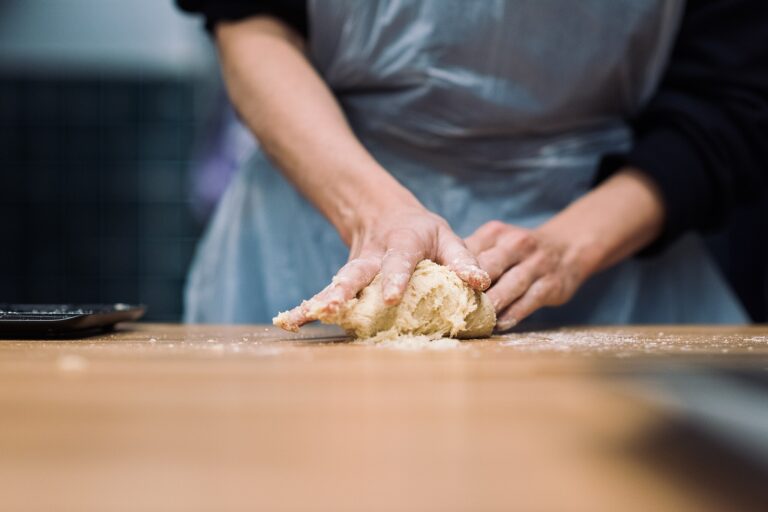
Image: Bread Ahead, CC BY-SA 4.0 https://creativecommons.org/licenses/by-sa/4.0, via Wikimedia Commons