The poems in this post are part of a special section, curated by Ori Z Soltes and Robert Bettmann, The Jewish Experience.
At Night in Jerusalem
I touch your wound and know that the night is long. Sitting beside you in the hospital by the pockmarked walls of the Old City, I keep watch for the first sign of dawn.
The bus was taking us to the other side of the city, to the onion domes of the church of gentleness, to the arched mosque of kindness, to the ark of the synagogue of peace.
Yet we could not escape from this circuitous route of suffering. It took us through all of the city’s neighborhoods, east and west, north and south. And I kept boarding and unboarding the bus like the angels of Jacob’s ladder but not ever reaching top or bottom.
When I awake from my dream, I stir beside you. It has grown lighter outside. A man— is it me or am I still dreaming?— is walking towards the Old City, where he will lean against the Wailing Wall and pray for his friend, who was wounded in the bombing of a bus and whose hand reaches out to be comforted.
Potato Kugel for Rosh HaShannah for my mother
I place the yellowed recipe— the one with her rounded letters and the address of my childhood home— nearby on the kitchen counter, gather six potatoes, an onion, a carrot, two eggs, oil, flour, salt and pepper.
And then begin to grate the potatoes into a large glass bowl. Occasionally, I glance at her familiar handwriting to make sure I’m doing it right.
Preheat the oven, grease a 10” pan and heat it. Meanwhile, I grate the onion and carrot, pour the oil, measure the flour, stir and mix in the other ingredients.
And while the potato kugel bakes, I think of her whose life was measured and meted out in a limited quantity of days.
Rick Black is an award-winning book artist and poet. His poetry collection, Star of David, won an award for contemporary Jewish writing and was named one of the best poetry books in 2013. His haiku collection, Peace and War: A Collection of Haiku from Israel, has been called “a prayer for peace.” Other poems and translations have appeared in The Atlanta Review, Midstream, U.S. 1 Worksheets, Frogpond, Cricket, RawNervz, Blithe Spirit, Still, and other journals.
Featured image in this post: Hanukkah dishes, Ms Jones from California, USA, creative commons via wikimedia commons.
The poems in this post are part of a special section, curated by Ori Z Soltes and Robert Bettmann, The Jewish Experience.
What I Will Remember By Sarah Sassoon
These days in Jerusalem we are swapping horror stories over hot cups of tea the tea brings no comfort
At the party they raped over 200 girls they killed their boyfriends they left the girls alive the terrorist under investigation says so they would remember them
What I will remember that one of the girls was from a religious home was too embarrassed to tell her family what happened to her to go to the hospital the next day to be treated to receive the morning after pill to prevent her pregnancy
What I will remember how the man of a fallen soldier from our neighborhood stepped down from the van and cried Gibor Nafal – a hero has fallen.
What I will remember how I smiled at a stranger because my heart was raw and I was seeking reassurance that there is still love for strangers in this world
What I will remember how there were too many funerals to visit too many houses of mourning to visit
What I will remember how neighborhood high school kids volunteered to dig graves
What I will remember how everyone banded into an army of volunteers to cook for soldiers to help over 200,000 survivors from the South evacuees from the North how we could not do enough
What I will remember the mud from soldiers’ boots in the entrance of the Aroma coffee shop the blessing of two cups of hot chocolate in the rain what becomes holy because it’s so human
What I will remember how people thought we can fight this war with fair metaphors and simple similes rather than cliched truth
What I will remember how I lit candle after candle night after night wishing my grandmother was alive to receive her advice glad she is dead because she would be so sad.
What I will remember the two burnt ribs bent together from a last hug a symbol of what Israel is now an embrace of each other
what it is to love what it is to not let go until the end
The Ash Test By Sarah Sassoon
This is how you check how much fibre is in wheat burn it down to the ground rub your face with it smell note on a scale of one to ten how much it hurts to feel how much you cannot
tell the story of your son
the more you cannot feel the more fibre there is
it’s a special kind of torture to have a soldier son
note what’s burnt between my fingers how history is ridged, razed between thumb and forefinger
is my fingerprint original if it has been burnt through and cut too many times with a knife whilst chopping onions for stew
the first cut is always at birth they say it does not hurt the cutting the mother it is natural the birth
there is ash the size of a cigarette tapped on the side of the street falls by the tree does not ignite the carpet of fallen needles piney with resin with promise
what is bran if not a protective outer coating what if my germ is allowed to germinate
I cannot stop measuring the days of my son
they say the ash content does not affect the quality of the bread they do not know how we Jews measure what’s left
in between hold me tell me what is left after the burning
we live and die by that number
To the God of no name By Sarah Sassoon
i appreciate the God of no name how enormous it is to be a God how small and nameless we name things in order to know them i name the pomegranate’s orange bell’s yellow stigma, night-blooming jasmine, the jay perched in – between pines i do not know how to name this prayer
i call out the name of my son what man’s name does the strong Judean wind carry but i named him and have let him go to war i have named each tear after angels Gabriel Michael Refael i do not know the name of all the tears where they fall from i thought i had more faith i thought my prayers would protect yet i keep praying into the blue and white Czech coffee cup my eyes are on the news when really i should raise my eyes to the impossible mountains I am seeking to an alchemizing prayer how to turn hate to love how to hold on to what can not be named
Sarah Sassoon is an Australian born, Iraqi Jewish writer, poet, and educator. She is the author of the award winning picture book, Shoham’s Bangle and This is Not a Cholent. Her poetry micro chapbook, This is Why We Don’t Look Back was awarded the Harbor Review Jewish Women’s Poetry prize. Her poetry and personal essays have been published in Consequence Forum, Hadassah Magazine, Michigan Quarterly and elsewhere. She is an editorial advisor for Distinctions: A Sephardi and Mizrahi Journal. She is also the co-author of the The In-Between, a female literary dialogue about identity and belonging with an Arab Christian and Austrian-Serbian. She received her MA in English Literature and Creative Writing from Bar Ilan University. She lives in Jerusalem with her husband and four boys. Visit www.sarahsassoon.com
Featured image in this post: NP India burning 41 (6315316978), CIAT, creative commons via wikimedia commons.
The poems in this post are part of a special section, curated by Ori Z Soltes and Robert Bettmann, The Jewish Experience.
DocumentAerie
Hardly anybody can name all eight of their great-grandparents. Can you? Will your children’s grandchildren remember your name? –Robert Pinsky, “The Forgetting”
I perched on a lonely branch of our family tree, hungry for slippery worms of story.
My father gone, my mother asleep, my grandparents’ immigrant clans impenetrable thickets of feud and diaspora, I penciled the causality I knew on scraps: from Isaac and Fanny, Sigmund; from Max and Eva, Margot; from Max and Fanny, Harry; from Herman and Nettie, Pearl. I snatched raw bits of Before America whenever the elders forgot themselves and quavered their own forgetting: blood tides outrun, shields made of visas, homes abandoned, families broken, universes extinct.
As I grew, I trained my eyes on prey: proof of their stories. I found names as they wrote them—Isak Chiel, Fáni, Shaya, Mendel, Fruma, Nechoma—and transliterations of their vanished worlds—Zmigrod, Gulacz, Bochnia—the alien phonemes as warm and guttural in my mouth as fresh kill. I glided over paper meadows and mountains of manifest and marriage certificate and immigration, searching, diving.
With each new fact I found—a line with my line, the black fluff of a ruined shtetl’s name—I built myself a nest of truth, a home. Only here can I feel their lives echo in the rustling wind and feed them to the gaping beaks of my young.
The Ark, 1978
My grandparents wanted to save me from the rising waters of American Christianity.
They paid for my Hebrew school in our exurbian exile, the white clapboard house the only synagogue for miles.
I was one girl amid five boys in a strange ark meant to protect, like the red light glowing above the bimah.
Our teacher taught us to decipher the foreign alphabet, the words for boy and girl, a key distinction.
Because it was school, I loved it; I was quickest to remember the alien sounds, the significance of each squiggle.
But when they heard me leak snatches of “Rudolph,” my grandparents took me to Israel: three weeks
and a sabra guide in the raw sienna landscape—insurance. I saw a waitress with numbers on her arm, as close as I could
swerve towards the black hole that almost swallowed my Berlin-born grandparents. They explained the tattoo, but not
how they escaped, the homes and loves they lost—the Shoah indelibly needled on their lives without a drop of ink.
I stood on Masada with these survivors—my agnostic self— as we each tried to imagine dying for God in our own way.
Was it really better to die than live without Jewishness? I had the American luxury of thinking myself safe from this question;
they saw only their own dammed and diverted lives, could not empathize with those whose land it was before it became our just-in-case homeland.
They bought me a sterling siddur encrusted with turquoise cabochons, a bribe to close the deal. I learned the Sh’ma by heart, thought maybe
it could matter, prayed for beauty and boobs not yet mine. I glimpsed a future in a kibbutz: e pluribus unum manifest, milk and honey, making the desert bloom.
I started to be convinced by Haifa’s golden dome, the King David Hotel, the Chagall windows, the mosaics of Herodium, how I floated
in the Dead Sea, the crash of the Mediterranean in Tel Aviv: suddenly Jewishness was a team I wanted to be on.
After I came home with my notebook proudly filled with new Hebrew words, soon after Bella Abzug led the National Women’s Conference,
the Conservative shul told my mother girls could not bat-mitzvah, so I let myself be pushed from the ark into the flood.
Daiyenu
The smell of lilacs, another Passover. Except for a box of matzoh and Manischewitz macaroons, I have again let it pass over unnoticed. I can’t do it—I can’t do what they did.
My grandparents delivered flawless shows, the years stacked neatly as Grandma’s linens. The iridescent Pesach plate, Grandpa’s burgundy velvet afikomen bag, twilit Maxwell House haggadahs: props in the world’s oldest play.
Without my grandparents, I choke— I freeze before the archaic stage directions: candlelit searches for chametz; where this vegetarian buys lamb shank; how to make haroset; get maror.
Without them, I choke— I can’t say my lines, ask the absurd: Why do we eat reclining? Why do we dip twice? I already know this night is different.
Without them, I choke— I can’t celebrate the final act: death of the firstborns of our enemies; I don’t think I’m part of a chosen people.
My grandparents wore religion like a coat; they put it on only when needed. They were cultured Berliners, searching themselves for what lay beyond the shtetl.
They were comfortable picking at the seams: Grandma, annoyed girls were never taught Hebrew; Grandpa, breaking a chain of generations by refusing the rabbinate.
Daiyenu is the simple song we sang. It would have been enough, it means. I see what they did was enough, but what about what I have done?
The Unitarians showed me how to renovate this ragged theater, drape it in civil rights, feminism, liberation. “The pain of others diminishes my joy,”
they read in their earnest communal seders even my hippie heretic mother called Passover Lite: Passover without the Jews. Isn’t that what I wanted? To not be a member of a chosen people?
The problem is without being chosen I am not sure what to choose. The years run through my empty hands while the matzoh turns to dust in my mouth.
Lori Rottenberg is a writer who lives in Arlington, Virginia. She has shared her poetry and flash non-fiction in many journals, anthologies, and even podcasts, most recently in december, Pleiades, and Viewless Wings. She received Honorable Mention in the 2024 Passager Poetry Contest, one of her poems was picked for the 2021 Arlington Moving Words competition and appeared on county buses, and she served as a visiting poet in Arlington Public Schools for over a decade. Some of her writings about Judaism have appeared in Poetica, Minyan, and the Jewish Writing Project and have been shared nationally on the Unitarian Universalists for Jewish Awareness website, https://uuja.org/resources/. She holds an MFA in Poetry from George Mason University, where she teaches writing to international students and poetry to Honors College students.
Featured image in this post:Jacques Callot, Noah’s Ark, NGA 36913, Jacques Callot, creative commons via wikipedia commons.
The poems in this post are part of a special section, curated by Ori Z Soltes and Robert Bettmann, The Jewish Experience.
My Facebook Feed, October 2023 by Jacqueline Jules
I post pictures of sunsets, fall colors reflected in a pond, boats bobbing on blue water.
Images I visualize to keep my blood pressure in the normal range amidst abnormal times.
I go out daily to find and photograph flowers still strong despite dwindling October light.
My grief glistens in the grass as I press share on yet another picture, posting my hope beauty will someday prevail in a world abruptly turned vile.
The Talmud Says the World Resembles a Glass Jar by Jacqueline Jules
Extremes cannot endure inside a fragile vessel.
Think of glass busted by boiling water or fractured by freezing.
Too much heat or too little produces the same result in a world where Justice and Compassion compete as if we need only one to survive.
An eye for an eye, a tooth for a tooth makes everyone blind and toothless Tevye declares on stage while the fiddler plays a plaintive melody, precariously perched on the roof.
Jacqueline Jules is the author of Manna in the Morning (Kelsay Books, 2021), Itzhak Perlman’s Broken String, winner of the 2016 Helen Kay Chapbook Prize from Evening Street Press, and Smoke at the Pentagon: Poems to Remember (Bushel & Peck, 2023). Her poetry has appeared in over 100 publications. Visit her online at www.jacquelinejules.com
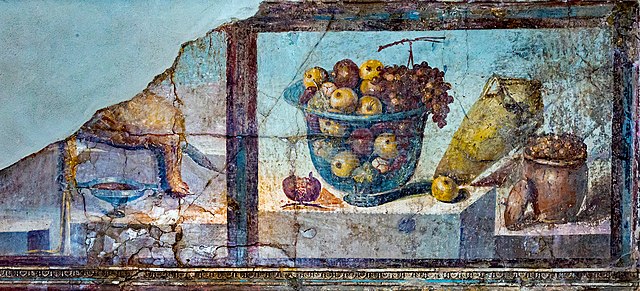
Featured image in this post: Wall painting – still lifes with food – Pompeii (II 4 2-12) – Napoli MAN 8611, unknown author, ArchaiOptix, creative commons via wikimedia commons.
The poems in this post are part of a special section, curated by Ori Z Soltes and Robert Bettmann, The Jewish Experience.
No words By Bruce Black
You want a poem this morning to soothe the ache in your heart, the grief you feel after learning about Hersh’s death and the five other hostages murdered in the Gaza tunnels hours before their bodies were found by the IDF?
Here’s the poem then, but don’t expect it to soothe the ache in your heart. No words can bring Hersh or the others back to life. No prayers helped keep them alive. So let yourself weep, and listen to the words of Hersh’s mother still filled with hope for the future even as she lamented her loss at his funeral yesterday.
Take courage from her example, and remember there are still good people in the world. Find a way to keep hoping so hope can spread and from hope, perhaps, one day your dream of peace will come true.
—
There are no flowers left in Gaza By Bruce Black
There are no flowers left in Gaza no trees, nothing green except for the sea, a turquoise blue reflecting the sky.
I used to think the same color blue was inside my heart, its waves of peace caressing my soul.
If only I could feel at peace again, could see the color blue when I gaze toward the sea.
If only I could see the flowers, the trees, some tiny speck of green, some sign of life.
But my eyes are covered with the dust of the earth shut tight against
the sight of all the rubble, the broken glass, the shattered hearts,
unable to see anything besides the pain of both sides of this war
Palestinians and Israelis feeling the same pain, weeping over what each has lost.
Here we are, each of us living on the edge of the most beautiful sea in the world,
the most beautiful blue, and no one can see it anymore no one can feel the peace it brings,
no one can hear the waves still washing up on shore still whispering—
I am at peace, I am peace— only no one can hear.
—
Bruce Black is editorial director of The Jewish Writing Project. His poetry and personal essays have appeared in numerous publications, including Write-Haus, Soul-Lit, The BeZine, Bearings, Super Poetry Highway, Poetica, Lehrhaus, Atherton Review, Elephant Journal, Tiferet, Hevria,Jewthink, The Jewish Literary Journal, The Reform Jewish Quarterly, Mindbodygreen, and Chicken Soup for the Soul. He lives in Highland Park,IL.
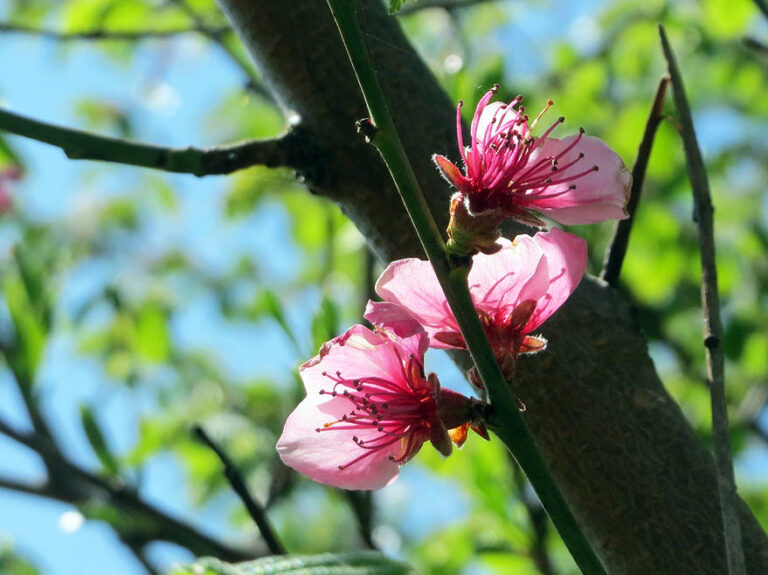
Featured image in this post: Mandelblüte (Prunus dulcis) im Landschaftsdschutzgebiet Hockenheimer Rheinbogen, creative commons via wikipedia commons.