Home Blog Page 40

Two poems by Jane Schapiro

0

The poems in this post are part of a special section, curated by Ori Z Soltes and Robert Bettmann, The Jewish Experience. 

Just In Case
by Jane Schapiro

Even my father, the optimist, harbored a just-in-case.
He never let on, but after his death
my sisters and I found gold coins in his drawer.
We never knew he had a just-in-case,
had inherited the dread of pogroms and camps
from his parents, their parents,
on down the line.
We divided the coins for our own just-in-case:
a source for escape should hatred explode.
Months can pass and I forget the stash,
but last night, after listening to a victim’s account,
how she and her girlfriends, high on drugs,
had been dancing to a D.J. on a Negev field,
just dancing arm-in-arm
in a percussive daze,
boundless, whole

when the sky split
as the sun rose,
and missiles and bullets tore through the dark
and gunmen burst from behind barbed wire
dissolving the ground to a swamp of blood,
how she escaped but not her friend—
when she finished her story, a man raised his hand,
“why were you dancing so close to the line?”—
I counted my coins.

Bleak Jew
by Jane Schapiro

“When talking about 6 million murdered, what can you have other than a bleak Jew,
view, I mean a bleak view.” Holocaust scholar Lawrence Langer

*
Bleak is why I’ve read all his books,
keep them close on a nearby shelf.
Bleak is why I contacted him,
hoped at 92 he could offer a salve.

Love of family, he tells me,
that’s what sustains him.

But love vanished in the camps, I replied,
even maternal love.

Bleak is that fact.

*
A husband and wife are on the news—
he saved his wife from a bobcat.
Film shows the husband
stepping out the door, a cup of coffee in one hand.
Good morning, he greets his neighbor,
puts his coffee on the car hood.
His name is Happy (I kid you not).
I’ve got to wash my car, Happy announces.
Out comes his wife, toting their pet cat in a crate.
A shadow leaps out, claws onto her back.
The wife, shadow, cat are knotted
in a tangle of screams. Happy races over,
grabs the shadow, lifts it over his head,
Oh my god, it’s a bobcat. Oh my god,
throws it on his front lawn, yanks
a pistol from his waistband,
I’m going to shoot that fucker.
The footage ends.

Bleak is the question:
why did Happy wake up that morning and put a gun in his pants?

*
A filmmaker travels the Darién Gap to capture
the horror migrants face and is captured himself.
Polluted waters, poisonous spiders, predatory criminals—
he believed he could weather them all. Off he went,
traversing rocks, mud, soiled diapers,
until men appeared with machetes,
took his camera, threw him in a tent,
called him Gringo, told him not to move.
Hearing screams, he wondered
was he next, unzipped the tent, fled into the night.

Safe at home, he can’t sleep, can’t find his way
to his pre-trauma self, thinks he should have stayed,
rescued someone.

Bleak is his cry:
My brain keeps saying I could have done something.

*
Love of family but what else,
I persisted as the two of us talked.
Can you say you’re thirsty,
trust your neighbors, believe in hope?
How do you emerge from history?
I pressed, harangued, harped until—

I write.

*
Bleak is a word.

Jane Schapiro is a writer living in Northern VA. She has published three volumes of poetry and a book of nonfiction (Inside a Class Action:The Holocaust and the Swiss Banks: Univ. of Wisconsin Press). Most recently, she has had work appear in Sheila-Na-Gig, Innisfree Poetry Journal, Quartet and forthcoming in New York Quarterly. Find more of her writing at www.janeschapiro.com.

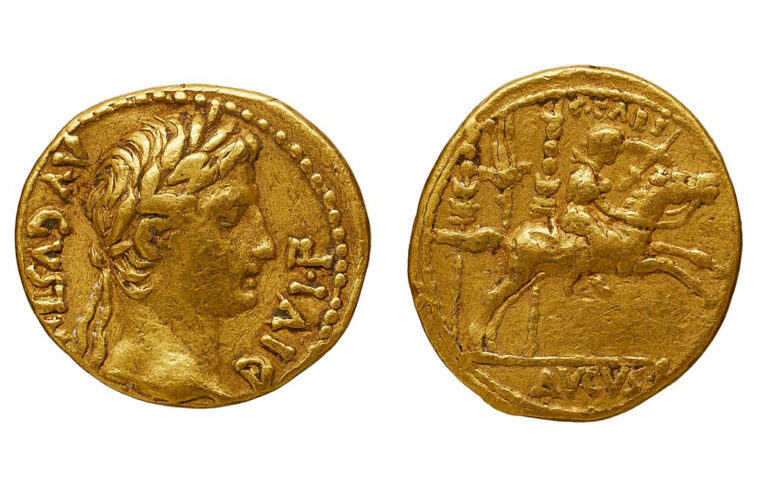
Featured image in this post: Gold coin, Aureus, Auguste, Lyon. 7.90 g., unknown author, French National Library, creative commons via wikimedia commons.

Two Poems by A. Z. Foreman

Historian

A world of vanished nations in your head
You lie tonight without a thought to spare
Anything but the wind that downs the leaves
As fall fells summer air

This

Do I still like America? Yes and no.
The question is a trap. That much I know.
Nice place, from sea to rising sea, which we
Do not know how to love. Land of the fee, 
Hypocrite, hipster and the toil-turned hand,
The heritage we think we understand,
Oh and it’s where I was born. As for races
(Black, white, rat, electoral) the disgraces
Impress more than that song of spacious skies,
Let alone Rushmore’s mountain maladies.
And I have stomached too much hullabaloo
From kneejerk Nothings making much ado
Beneath blue sky in whose light the foul claws
Dig for the carcass of the grey Lost Cause,
Then hearing wind now colder up the hill

Blow like a race-myth looting people’s will.
Where to? To get space from rhetorical muck,
I’ll run my mind here through my town. And look
Here I am. Store. Gazebo. School. Signs. DANGER:
CONSTRUCTION. Where I learned to be a stranger
Is where I’m from. In between sky and earth
Are many berths but never a second birth.
I’m woozy. Best sit down. And then they start,
Those dead dreams once more beating up my heart
Wrapped in that starstruck banner. So it is,
God damn it. Can’t just walk away from this.

Born in DC and raised largely in Maryland, A. Z. Foreman is a literary translator and poet currently working on a doctorate in Near Eastern Languages at the Ohio State University. His translations from Latin, Occitan, Russian, Old Irish and Yiddish have appeared in sundry publications including Metamorphoses, Blue Unicorn, Asymptote, Brazen Head and the Penguin Book of Russian Poetry. He sometimes writes his own poetry if it really comes to that.

Image: Presidio of Monterey, Public domain, via Wikimedia Commons

Darcy’s Pantoum by Kirby Wright

0

DARCY’S PANTOUM

Trained to be invisible yet helpful.
Latchkey kid living beside the tracks.
Console Mom when first marriage flops.
Summer visit Dad’s new family in Maine.

Latchkey kid living beside the tracks.
Help stepmother can and bake cookies.
Summer visit Dad’s new family in Maine.
Cook and waitress at grandma’s parties.

Help stepmother can and bake cookies.
Bars on apartment windows and doors.
Cook and waitress at grandma’s parties.
Ache for a first boyfriend.

Bars on apartment windows and doors.
Scrawl “Hi Phillip” on stepdad’s desk.
Ache for a first boyfriend.
Crush on Mr. Jadwin in English.

Scrawl “Hi Phillip” on stepdad’s desk.
Cheer up Mom during second marriage.
Crush on Mr. Jadwin in English.
Weep when stepdad moves out.

Cheer up Mom during second marriage.
Console Mom when first marriage flops.
Weep when stepdad moves out.
Trained to be invisible yet helpful.

Kirby Michael Wright was born and raised in Hawaii. He earned his MFA in Creative Writing from SFSU.

Image:M&A, CC BY-SA 4.0 https://creativecommons.org/licenses/by-sa/4.0, via Wikimedia Commons

Five poems by Ishanee Chanda

0

These poems were commissioned by Day Eight within a project funded by DC Mayor Muriel Bowser’s Office of AAPI Affairs, directed by Regie Cabico.

first dates
By Ishanee Chanda

what is your favorite food?

(my mother’s keema and rice, spicy.
no peas.
minimal potatoes.
red like kashmiri chili.)

have you lived here all your life?

(i was never here to begin with.
my father still talks about the small,
village hospital where i was born.
the fat nurse, the quick delivery.
the kajol behind my ear to ward away
the evil eye. my mother panting
in the dim light of the early moon.)

are you close to your family?

(how can i be so close to something
yet so far away. they love me
because i am theirs, i love them
but they are someone else’s.
a country’s arms extend beyond
an ocean. my arms extend beyond
a woman, just past my mother’s tears.)

what was your favorite kind of music as a kid?

(i didn’t listen to English music
until i was in sixth grade.
my father still listens to ghazaals
when he is washing the dishes.
my mother hums lata mangeshkar
like a prayer in her sleep.)

i am not sure it’ll work out.
we don’t seem to have much in common.

(just like them,
in this country
i am alone.)

An Ode to Everything Everywhere All at Once
By Ishanee Chanda

mama, how often do you feel like evelyn?
do you wish, too, that your daughter would
come home, a little bit skinnier, holding a
young man’s hand? do you think about what
you and baba could have been without me,
without two children in a house so big you have
to clean it with your bare hands? do you wish
you were in another universe sharing hot dog
fingers with a beautiful blonde-haired woman?
do you want to be an actress sparkling on screen?
i am not joy, mama, but i try to be yours.
to respect my elders and hug my brother and
light a candle for those that we have lost.
i am not jobu but sometimes it just comes out
that way. i am not deirdre but sometimes it
just comes out that way. i am not waymond
but sometimes it comes out that way.
how many dreams have i kept you from, mama?
do we get our happy ending? in every universe,
do you want to be with me? please be with me,
mama. i will be your desert rock under every
baking sun.

Diwali
By Ishanee Chanda

in the ramayana
a lot happens, to be honest –
demons turn into golden deer,
monkeys become sitting gods,
bridges are made from brick on floating water, etc. –

but at the very end,
after all the monsters are gone,
ram, sita, and lakshman are on their way home.

ram was exiled, you see,
sent away with his brother and wife
the darling prince away from his darling kingdom –
it was for many reasons,
i won’t go into them now –

but the important thing to know
is that the people loved him.
so when he started his journey back,
after years away in a labyrinth of shrouded wood,
the people, they lit candles,
and left them on their doorsteps.

a glowing path through the maze
as pinpricks in the darkness of night,
flames flickering softly
in the trees, in the bushes,
in the steps along the roadside.

we call it diwali now
a cause for celebration
good over evil, light over darkness,
love above everything,
a family welcomed home.

/

i am on my way back from the grocery and
my arms are heavy,
macaroni in one bag,
avocados and coke starlight
stuffed into the other.
the sky is yawning blue and the
late summer heat is dripping
like saltwater onto the ground.

on the sidewalk ahead of me
there is a small light,
a lingering flicker in the shrub,
before it disappears.

a lightning bug
floating softly into the long grass.

ahead of it, another one
another
three, six more
twenty, thirty
grazing the cement
in a lopsided line
slow motion.

i follow them, slowly
all the way home
following the shrubbery
until the road leans dark.

each one
leads me
to you.

grief is love with nowhere to go
By Ishanee Chanda

when i dream, i see dadu in
white linen. he is always sitting
on the couch in his home and
he looks happy. the wrinkles are
gone from his forehead. his glasses
are perched gently on the side table.
he looks at me clearly with both eyes
working perfectly. he is always smiling.
it feels like joy. in the background,
there is humming. in the foreground,
there is humming. i reach out to touch him.
he is always holding my hand.

marital bliss
By Ishanee Chanda

quibbling with you over

dishes. the dog. who is taking him out.

it is 10pm and raining. the laundry is stacked

to the top of the hamper. the floor is littered

with crumbs and pieces of cheese the puppy has

yet to find. the recycling is piling up in the kitchen

corner. the trash stinks of fish heads and the last

vestiges of oatmilk curdling slow. this is you and me

making a home for ourselves here, together.

the greatest life i could have imagined for myself.

you are the greatest gift i have ever received.

Ishanee Chanda is a prose writer and poet from Dallas, Texas. She has been published on The Huffington Post, the Eckleberg Project, and ThoughtCatalog. Ishanee is a past winner of the Gordone Award for Creative Writing, and has participated in the Blackbox Writer’s Residency program.

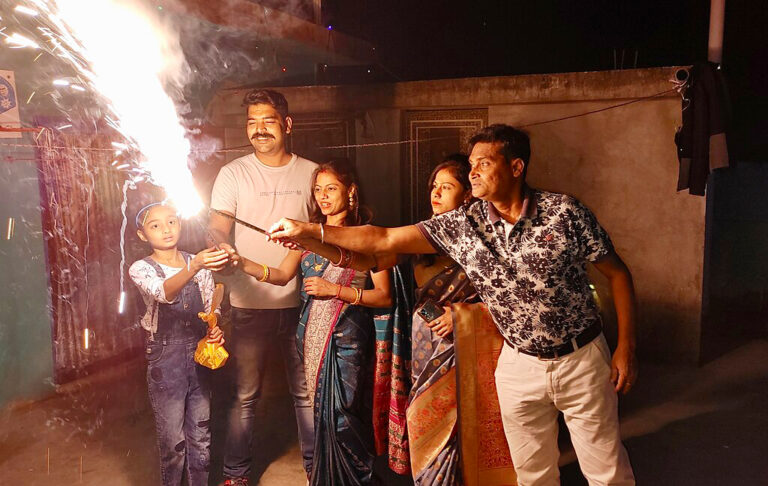
Featured image in this post is: “North Indian family celebrating Diwali – Joy of victory of good over evil” by Maxtroysmith, license via creative commons, wikimedia commons.

Two Poems by Sofia Reyes

0

El Jorobado

I hate talking to a beautiful man.
It’s like trying to talk to the statue of David.
Every inch of him is crafted,
to form a pinnacle of humanity.
To look at him, is to look at just that.

Oh, to every god out there
they really are beautiful.
Faces like that of true fabrication.
Structured yet still soft,
human in its wear over time.

Usually though,
they act like sirens of the sea,
from hymns before our time.
It’s their beauty that pulls you in,
and their anger that plunges you out.

Because oh, they are cruel.
Speaking bluntly with no care,

more harsh than the real truth.
Their manner sharp,
inhumane, and uncouth.

If you aren’t one of them now,
you may never be. I’m not sure if we
undisputedly loathe or lust that nowadays.
At least this club isn’t permanent.
Just like a boat that can’t help but sail,

change can’t help but exist.
If the young become old,
their beauty must not mean everything, always.
Even the remains of the sailing boat
eventually get lost on shore.

With a G

You say so much to me.
I used to not know what it all meant.
But I see you’re an entertainer,
One that must always be entertained.

You always ask the questions
I least want to answer.
Because to answer them,
I’d have to show you the truth.

Show you the truth–
to those wondering eyes.
Confrontationally friendly blue eyes.
I wouldn’t even describe them as just;

They’re deep, like the bottom of the ocean.
Where waves don’t crash anymore.

Or like the marbles kids play with
on the side of the road.
But you know, I do like you.
Even when you make the choices I wouldn’t.

You’re weak when you should be weak,
And you’re funny when you don’t have to be anything.
You’re also the epitome of trouble.
I can’t say I’m not scared of you.

I never gave you the second hand secrets
of mine that you preach.
Chug, challenge, chisme!
Enjoyed and taunted every night.

I will be wary of you.
So will we all.

Sofia Reyes is a full-time student and a part-time healthcare worker based in Northern Virginia. Because she has just so much time, she writes poetry as well! Her work has been published before in Words for the World.

Image: Christian Ferrer, CC BY-SA 3.0 https://creativecommons.org/licenses/by-sa/3.0, via Wikimedia Commons