These poems are part of a special section of the Mid-Atlantic Review, Celebrating Black History, and selected by editors Khadijah Ali-Coleman, Carolivia Herron, and Rebecca Bishophall. To learn more about this series read a blog post on the Day Eight website here.
A note from the poet:
This is a documentary poem, which relies on primary source documents for its creation. Words, phrases, and sentences in quotation marks are direct quotes taken from Jefferson Michie’s military pension file that is housed at the National Archives in Washington, D.C.
Legacy: A Documentary Poem for My Ancestor
by Sherri Mehta
I’m going to tell you a story of how I came to be
one mighty leaf of many on our beautiful family tree.
Come closer…
and let me tell you the story of how I came to be
the 2nd great granddaughter of a soldier
in the 29th United States Colored Infantry.
September 1830,
Baby Jefferson was born enslaved on a Louisa, Virginia plantation.
But in 34 years he’d seize his freedom at “the Battle of Trevilian Station.”
Mother Minia, wife Ann,
children Arie, Florence, and Thomas,
Sister Matilda,
Brothers Minor and Isaac
stayed behind as he departed with one promise:
to return with freedom as the boon of his journey.
June 1864,
Union troops – with poor Cathay Williams in tow –
moved through Louisa dealing the Confederates a disabling blow.
My ancestor, hearing the affray,
knew this was the time to steal away.
So, off he “went … with [General] Sheridan’s [Union] Cavalry.”
Three months later, a private with the 29th USCT,
training down the road in “Arlington at Camp Casey;”
enlists marking an X and leaves service signing Jefferson Michie;
then ended up in Galveston, Texas to witness the reading of General Order #3…
June 19, 1866,
the end of enslavement in our country,
and my 2nd great granddaddy was there to see…
and to witness the collective prayers of his people answered.
“Mustered out in Illinois,” he made his way home to Ole Virginia
back to Ann, Arie, Florence, Thomas, his momma, and brothers Isaac and Minor.
But there was no happy reunion for my ancestor that day.
“Sick in bed when he left,”
“Ann died on Dr. Perkins’ place during the war while Jefferson was away.”
For freedom, this was the heftier price paid;
but he took the change, bought some land, and
stayed…
He married Ella, had eight more children,
a daughter – my grandfather’s mother.
He loved up on his family, had a business, stuck close to his brother.
Worked through the pain, “the rheumatism, effects of war and its scurvy,”
got his pension, and lived his life until his poor body grew weary.
Ella stood up so her husband’s memory would live on after he died,
Made the government make good on its promise as she boldly testified,
“I can’t give the month I was born or the year or the state,
but I was about twenty years old when Lee surrendered, [April 9,]1865” was the date.
And she would testify two more years to get her widow’s pension…
Because I come from strong women, strong men
who took every single small blessing and multiplied that thing times ten,
got knocked down, took that hit, got back up and did it again.
I am not my ancestors’ dream;
I AM my ancestors, and they are ME.
Every part of them was poured into exactly what you see.
Thus, I exist as a leaf- one of many – on our beautiful family tree.
It’s the bark that binds,
the buds of leaves
that grow eternally;
the crooked branch, the bumpy trunk,
the roots in Virginia dirt that birthed the WE.
Our Jefferson’s spirit rejoined the ancestors August 31, 1909.
They sent me here 65 years later – same month, same date, same time…
Damn…a true act of the Divine!
And when I had to decide
what I would research and write for my last degree,
my ancestors saw me worthy and called out to me.
Said find the story of your Jefferson Michie
and of the other 209,000 Black men in the USCT;
of every battle they fought,
of every letter carefully wrought…
Reconnect descendants to their rich and powerful ancestry,
so these brave Black soldiers will never again be a footnote in history.
And moving forward from this day,
you can look in your two sons’ eyes, lean close, and proudly say,
Ah…my babies, come and let me tell the story of how you came to be
part of the legacy of a freedom fighter – your ancestor – Jefferson R. Michie,
a gallant Black man, father, husband, and soldier of the 29th United States Colored Infantry.
 Sherri Mehta is a Maryland-based presenter, writer, homeschooling mom, and wife with over twenty years of English teaching experience . She holds both a Ph.D. and an M.A. in English Literature and a B.A. in Mass MediaArts, and specializes in African American Civil War letters and nineteenth-century African American and American Literature. She has several published articles and encyclopedia entries; has presented at various local,state, and national conferences; and continues to offer workshops and presentations at local museums, research centers, and universities. Her research allowed her the opportunity to serve as a historical consultant on the Grammy Award winning song “Juneteenth” by Fyutch and the Alphabet Rockers. You can find her teaching homeschool literature classes, reading good books, writing some poems, and enjoying her family and close friends.
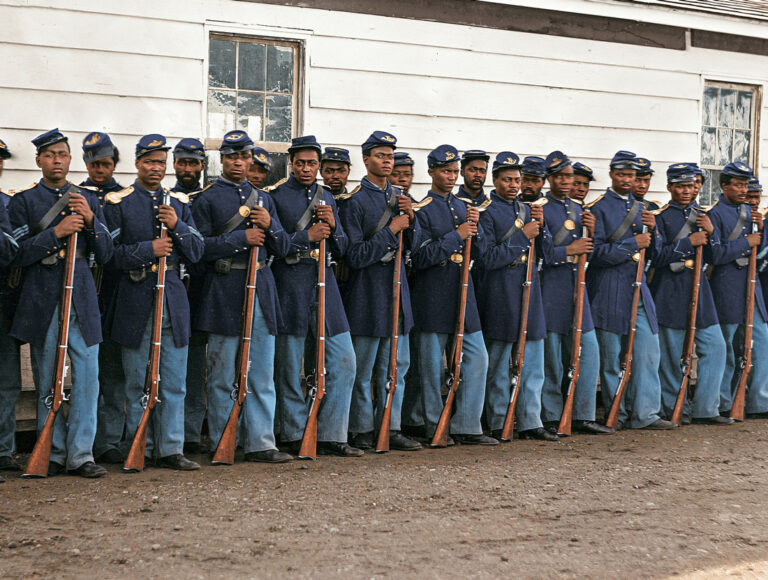
Featured image in this post is: “Company E of the 4th United States “Colored” Infantry Regiment, at Fort Lincoln, Washington, D.C. c. 1864. (50133595056)”, Julius Jääskeläinen, creative commons, via Wikimedia Commons.
 Alfajiri Shah is a budding data scientist and Black studies scholar. Their poetry explores themes of relationship to self and community, along with social and political critique. They recite poetry at the occasional open mic and spend most of their time in various states of dreaming.

 M. Nzadi Keita’s third poetry collection, Migration Letters, published by Beacon Press in April, 2024, centers her upbringing in Black working-class Philadelphia. Her second book, Brief Evidence of Heaven, shed light on free-born, illiterate abolitionist, Anna Murray Douglass, Frederick Douglass’s first wife. Publications including Poet Lore and anthologies such as The Ringing Ear: Black Poets Lean South, have featured Keita’s poems. Her prose publications include the journal About Place, and the volume, Women, Culture, and The Sixties. Keita served as a Professor of English at Ursinus College for 25 years, an adviser to the award-winning film, “BadddDDD Sonia Sanchez,” and a consultant with the Geraldine R. Dodge Poetry Foundation and Mural Arts Philadelphia. She is a member of the Black poetry collective, Cave Canem, and a recipient of grants, awards, and fellowships from the Leeway Foundation and the Pew Center for Arts and Heritage, among others. Keita has presented poetry and scholarship in varied settings, including the Modern Language Association International Conference and the National Caucus of African-American Librarians.
 Atena O. Danner is a cultural worker who imagines Black liberation, engaged in boundless curiosity. Her poems range from kitchen-table specificity to expansive relatability, covering topics including neurodiversity, human connection, and collective liberation. Atena is grateful to have work published online, in ‘understory quarterly’ and Raising Mothers Online, and recently in ‘Fwd: Museums [Redacted].’ She also has work published in anthologies such as Shelter in This Place: Reflections on 2020 and Struggle, Elevate, Celebrate: An Anthology of Women’s Voices, and her own book of poetry, Incantations for Rest: Poems, Meditations & Other Magic. She is a Roots. Wounds. Words. Fellow, and Anaphora Writers Residency Fellow, an alum of the Hurston/Wright Writers Week, and has been a featured reader for The Guild Complex Presents Exhibit B series, Chicago Poetry Center’s Poetry on the Green, and the annual Brooks Day celebration in Chicago. Atena is a founding member of Lifted Voices organizing collective and collaborates as a member of Surviving the Mic, a collective of survivors that hold affirming creative space for survivors of sexual violence. In their home north of Chicago, near the traditional homelands of the people of the Council of Three Fires and of the Menominee, Miami and Ho-Chunk nations, Atena lives with her partner, pets and 2 free Black children. Her first poetry collection, ‘Incantations for Rest’ was released in 2022 and was awarded a Nautilus Silver Award for poetry in 2023.