These poems are part of a special section of the Mid-Atlantic Review, Celebrating Black History, and selected by editors Khadijah Ali-Coleman, Carolivia Herron, and Rebecca Bishophall. To learn more about this series read a blog post on the Day Eight website here.
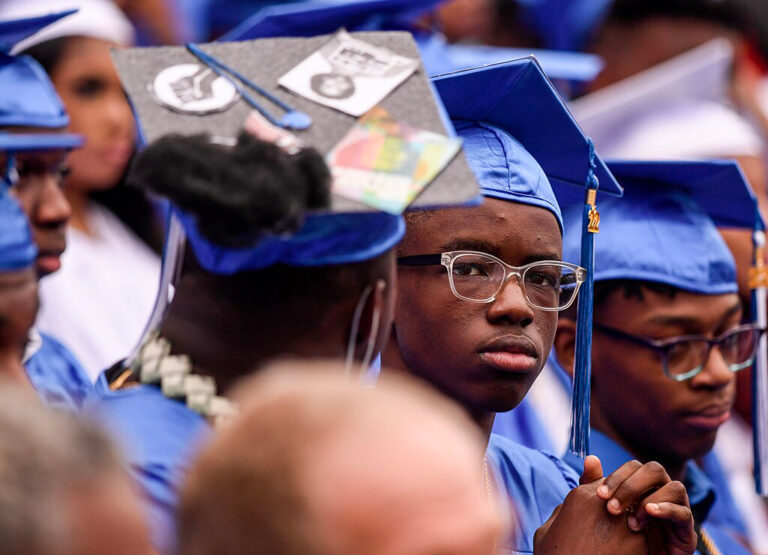
On a Black High School Senior Who Cannot Walk With His Class Because of His Natural Hairstyle
By Synnika Alek-Chizoba Lofton
Inside
this flesh.
Inside
this
skin,
I develop
a method
to protect walls,
soulful interior
of the flesh,
Music
which
represents
tradition
and culture.
This body
is celebrated,
like jazz
in June,
like bright,
Black paintings
by Basquiat,
lighting
up city
blocks with
urban appeal,
with aggressive
Beauty, with
tattered dreams
that still grow.
Around here,
I live
in my purpose,
cornrows showing
the path to freedom,
braids tightened
with hair grease,
momma’s love,
knotty dreadlocks
reaching for scorched
earth, just to keep
it
Cool.
I keep it cool while
they
find ways to put bullets
and knives
through my back.
Living
in America
is dangerous,
if you got
the wrong kind
of hair. Living
in America is
dangerous, if you
got the wrong
type of hair
Flight patterns
represent
progress.
I sign
my name
on tomorrow,
growing success
from
my scalp. Synnika Alek-Chizoba Lofton is an award-winning poet, author, and educator. He is the author of more than 40 poetry collections, and he has recorded more than 170 spoken word albums, Eps, singles, and digital downloads. He earned both a B.A. with a concentration in Creative Writing from Goddard College (2004) and an M.F.A. in Creative Writing (2006). Lofton teaches literature at Chesapeake Bay Academy and Composition and Public Speaking at Norfolk State University.
Featured image in this post is: “Transit Tech CTE High School Graduation (52178830155)”, Metropolitan Transportation Authority of the State of New York from United States of America, creative commons, via Wikimedia Commons.
Was it Miles Davis’ “Kinda Blue” bringing me home to you? Or the musical memories of our mutual histories? Scott Joplin and Jelly Roll laid back and fingering those piano kevs, on an instrument played by Langston Hughes, Bontemps, Zora Neale and Countee Cullen while Black women danced a close sweating two-step with their men in Harlem jook joints?
Were the blues born on sultry evenings under canopies of stars? Come into this world between dark southern thighs while our enslaved ancestors danced to strumming banjos, wailing mouth harps and ancient rhythms of violins, tambourines and drums.
Men and women dancing to words become songs: work songs praise songs kin songs to the blues?
Were the blues born with the birth of “The New Negro?” or “the flowering of Negro literature”? Or were the blues more hidden, ever more subtle in the eyes and on the tongues of Harlem?
In the lyric of Billie Holiday crooning “Strange Fruit” at Café Society? Or the crackle of Louis Armstrong’s voice? or the clarion call of his trumpet? Was it in the unstoppable Trane: a love supreme flowing from his horn? or in a Black child’s first giant step?
Black man, my lover, I held your newborn in my arms wondering just what he would make of this world, a world he gazed on with sad, irreverent yet innocent brown eyes.
Black man, my lover, do not ask me how you will survive without the blues.
The Painter
You sat with brushes in hand and the light flowing above and below, the prayer like paper, the light illumined all our sacred trees. Somehow, we forgot all our raucous and joyous past loves when I asked you to listen for the screen door’s slam and the call to supper as I brought you the evening meal.
And then there was that folio of your recent sketches. so many similar dark faces filled with joy.
I gazed at the rich, brown texture of a watercolor on the page, a man’s tortured face, his beard, his glowing tough bronzed skin. You said it was a portrait of your brother, who died overseas during a rain of fire in the Viet Nam war.
And you put down your brushes to confess we were going to start life all over again without waging the private wars that keep us together.
You painted your dead brother’s face against a background of blue.
Childhood
Music became a halo, a birthmark, the praiseful signifying voice warning me not to live in the past, nourishing my young mind. While rehearsing a sonata on the family piano, I forgot the repetition of finger exercises, the scales, the tempo on an otherwise quiet Sunday evening when no one was listening save my daddy who thought of me as perfect and knew each note to every song by memory.
When I turned twelve a backyard party entertained me with a stack of 45s, rhythm ‘n’ blues, dancing, chilled sodas, and the sizzle of an old-fashioned colored bar-b-que. A time for sprouting breasts, long, lanky legs, and knobby skinned knees. While the Four Tops wailed their sweet soul Motown symphonies on the phonograph, I looked down from my bedroom window on the second floor as fate come a-knockin at my door. It was all so right.
Years later, memories of being twelve returned to me like the ghosts of failure with the sound of unwritten songs in my ears.
And, my father, who once thought I was perfect, forgave me.
Beth Brown Preston is a poet and novelist with two collections of poetry from the Broadside Lotus Press and two chapbooks of poetry, including OXYGEN II (Moonstone Press, 2022). She is a graduate of Bryn Mawr College and the MFA Writing Program at Goddard College. She has been a CBS Fellow in Writing at the University of Pennsylvania; and, a Bread Loaf Scholar. Her work has been recognized by the Hudson Valley Writers Center, the Sarah Lawrence Writing Institute, The Writer’s Center, the Fine Arts Work Center at Provincetown, and by A Public Space. Her work has appeared or is forthcoming in the pages of ADANNA, AFRICAN AMERICAN REVIEW, BIRMINGHAM ARTS JOURNAL, THE BLACK SCHOLAR, CALLALOO, CALYX, CAVE WALL, EVENING STREET REVIEW, FREE STATE REVIEW, HANGING LOOSE, HELIX, ILLUMINATIONS, MUSE, OBSIDIAN, PASSAGER, PATERSON LITERARY REVIEW, PENNSYLVANIA REVIEW, PENSIVE, POTOMAC REVIEW, RAIN TAXI, SINISTER WISDOM, STORM CELLAR, TALKING RIVER REVIEW, THAT LITERARY REVIEW, VOX POPULI, and many other literary and scholarly journals.
The monuments are gone Good riddance I say Talk about losing a battle They lost an entire war
Cold cast iron faces of Lee, Jackson, and Jefferson Davis, Put up back in 1890 twenty years after the death of their cause Not to mention the obscenity of their cause, The lost cause Statues of men, fighters not for freedom, but for oppression Men who deserve to be studied, not gloried
Studied in the same way you’d study history’s other despots and tyrants, just to be sure you’d know how to prevent similar ones from popping up
They were put up during a time of change Put up by people afraid of change Afraid of the people they’d oppressed So they put up images of Civil War generals Thinking that would scare change away Thinking the cold iron faces would be enough But cast iron doesn’t last forever Change eventually came in a year of strife Of death, of anger, almost 130 years later
Monument Avenue A street once stained with mistakes of the past Injustices displayed for Everyone to see, in an otherwise great city now wiped clean
Like a crack in the foundation patched up a step in the right direction On a journey that continues down a long avenue
Josh Young is a poet, writer, and artist from Richmond, VA. Josh Young’s poems primarily focus on social issues, emotions, and city living in general. Josh Young’s poems use rich imagery and complex metaphors to create images in readers minds and range in styles from sonnets to free verse. In addition to written poetry, Josh Young also competes in poetry slams and open mic readings. Josh Young has published in Voices of the Valley magazine.
These poems are part of a special section of the Mid-Atlantic Review, Celebrating Black History, and selected by editors Khadijah Ali-Coleman, Carolivia Herron, and Rebecca Bishophall. To learn more about this series read a blog post on the Day Eight website here.
They Name Not Trauma
I remember Black Women of yesterday years
How they cherished honored life lived breathed life stories with unnamed trauma Their Story not of the trauma. Yet their first foot was to exemplify and expound the greatness on how good God had been
they would rise in church Some in the PTA meeting Or in the midst on streets downtown their first words were “I don’t have a hard luck story to tell, even though I did not come through flowery beds of Ease but all in all God’s been good to me” Their story was not of the trauma Their theme story was not trauma
With renown sophistication, pride, dignity on the second leg of their expounding story; they tell/told of how it may have gotten hard sometimes How they LIVED with meager means but God made a Way out of no Way, their story was absent of the trauma No sing-song of downcast delusions on this eluding journey
This be how it got read into me my mother being the one who had founded the story Same After she blessed all of her children by name each one standing at Her bedside, She blessed her children’s children by name She then came back to the grandchildren/great grands of those who were standing by the bedside
As For me, Mother blessed my oldest son and his wife the children who will come from Her womb. Then she blessed my youngest unmarried son Yet went on to say; ‘May the womb be blessed Of whomever he chooses in marriage Mama’s Story was without trauma But yet of praise-Thanksgiving even at a time of parting going Home For they refused to give way to trauma Instead an Amen giving of Thanks
Upon the last words of my mother; after finishing the blessing and agreeing to wait for my sister in flight from before Going On Blessing her last upon her coming forth The same ritual upon her family and children She sang forth her last lyrical life song: “I am thankful to God Almighty that all of my children know God and are safe in His Arms now I’m ready to go home. I then said; “Mama you going home The doctor said in a few days” she sounded forth most bliskely; “I am not talking about that home Your Daddy built for us in 1939 I’m talking about home with Christ Jesus Whom I now See”
Come the closing moments like our Dad ten years hence Mom Raised her hand for the last goodbye Carrying her works of life before her Leaving to us All the many Her life’s legacy In order we might move forth Victors and Overcomers
They, these mighty Ones left off the trauma syndrome They knew not a trauma definition Their Story not of Trauma
R. Zack Zachary is an inspirational Poet, Storyteller and Visionary. Zack became an activist at age eleven and later met Dr. Martin L. King in his hometown, Anniston, Alabama. From that renown experence, he has continued throughout the years to follow a path of Activism through Poetry/Storytelling. He began writing poetry in the U. S.Army 1971-74. He created and founded The Healing Love Institute and Dialogue Cafe. He is the author of two books of poems: “21 Love Poems” and ‘Behold America, BeWHole’. Zack’s latest book; Forgotten Stories Remembered is due out May-June 2024 by Newman Springs.
Featured image in this post is: “Family Portrait” by Eric Ward, CC BY-SA 2.0, via Wikimedia Commons
These poems are part of a special section of the Mid-Atlantic Review, Celebrating Black History, and selected by editors Khadijah Ali-Coleman, Carolivia Herron, and Rebecca Bishophall. To learn more about this series read a blog post on the Day Eight website here.
Active Well
I am the crude oil from the wells my ancestors dug
how dare I shun the memory of those calloused hands?
Summit
Blackness is my Kilimanjaro. It’s not just some summit. It’s a frigid and breathless climb.
Let the muffled and toothless shout escape me.
This hike is not a race. Have you heard of altitude sickness?
Blackness is a star so celestial we walked the moon or we invented the moonwalk
Blackness is as supreme as the moon with it’s fullness and eclipses of light.
Deaundra Jackson is a 2023 MFA in Writing graduate of Sarah Lawrence College. Her work centers marginalized voices of the past. She was a 2023 Diversities and Diasporas Fellow of the Global Diversity Foundation. She has been published in The Raven’s Perch, Aunt Chloe Literary Magazine, Rising Phoenix Review, and Beyond the Sea: An Eber & Wein Anthology. She lives in Atlanta, Georgia and enjoys hummingbird watching and music festivals.
Featured image in this post is: “Mount_Kilimanjaro, Tanzania (51904885703)” by Ray in Manila, Creative Commons, via Wikimedia Commons
 Synnika Alek-Chizoba Lofton is an award-winning poet, author, and educator. He is the author of more than 40 poetry collections, and he has recorded more than 170 spoken word albums, Eps, singles, and digital downloads. He earned both a B.A. with a concentration in Creative Writing from Goddard College (2004) and an M.F.A. in Creative Writing (2006). Lofton teaches literature at Chesapeake Bay Academy and Composition and Public Speaking at Norfolk State University.