Home Blog Page 84

Three Poems by Rebecca Bishophall

0

Editor’s Note: These poems appear in Breaking the Blank, available from Day Eight: https://bit.ly/3VbR9vL.

Seduction

Seduction…

Drag my finger down
their spine then
breathe them in.

The more pages the better;
read until I’m spent.

Her Breath Matters

Rainbow-swirled spheres she
sculpts with breath made of giggles;
laughter floats on wind

She and I fight…still
hugs and kisses before sleep –
a must for good dreams

She still asks me to
lay with her; breath on my neck
helps me fall asleep

BC

It costs me 10 dollars a month
to remain childless,
but recently,
I’ve been wanting to waive that fee;
even though
10 dollars is such a small
price to pay for sanity.

I become baby crazy
when I forget to take my meds –
BC without the BC
and what I sleep on becomes
more than a bed,
it becomes a vessel for wishes unspoken,
because when he gazes into my eyes,
I want him to just be able to tell.
The air is filled
with my hormones
and I’ve taken to wearing pheromones
so when he smells me
he wants to jump my bones
but won’t know why.

This is not a trap.
It’s just that lately
I’m feeling a little past my prime.
In earlier times,
a woman my age
would have had at least four kids
already,
aged two through nine.
I feel behind
and had taken to crying
in my room, door locked,
my mother thought I was dying.
Had to convince her I was fine.

Last week,
I was thrown out of CVS;
not because of a theft,
but because I had rubbed
baby lotion all over my arms
and was smelling myself.
Told the security guard I wanted
to smell fresh
and Zest
wasn’t cutting it.
I went home and downed
an entire week’s worth of
ortho-tri-cyclen
and it worked…
until I went to the park and saw little babies
tri-cyclin’
and slide climbin’.
I just wanted to take five of them
home with me
but that would be a felony.
Need to get back on the BC
before I’m in the penitentiary
serving twenty to life.

I used to think I had to be someone’s wife
before I became a mother.
I don’t feel that way anymore.
All I want to get is that teething ring.
Funny how such a small thing
can bring such happiness.
I’m anxious to be blessed
with one of my own;
until then I take another pill to the dome
and wait.

Rebecca Bishophall has featured at Spit Dat open mic, the Afrocentric Book Expo, and others, and works in member services for a non-profit organization. She graduated from Trinity University in 2006 with a major in Communications. A loving mother who enjoys rainstorms, ramen and romcoms, she can be found writing, reading fiction novels, and singing along to soft rock.

Image by Lars (Lon) Olsson – Own work, CC BY-SA 3.0, https://commons.wikimedia.org/w/index.php?curid=23486409
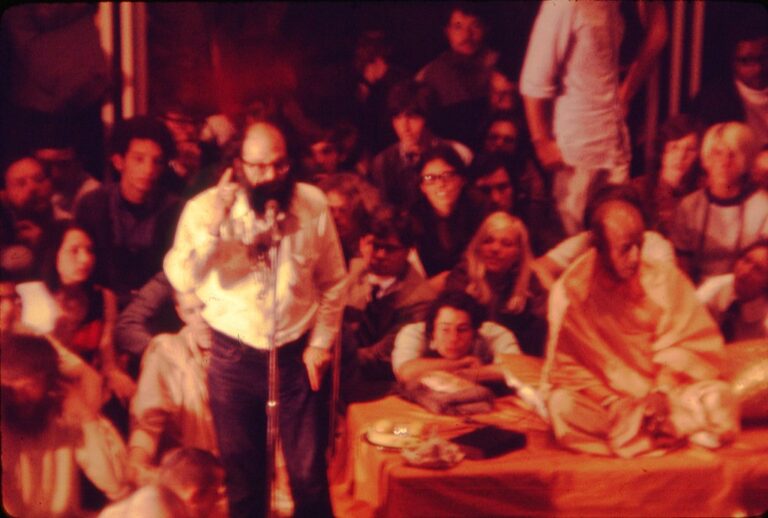

Aleinu by Alan Abrams

0

Aleinu

Dear Allen Ginsberg, no angelheaded hipster am I,
nor have I ever seen those staggering Mohammedan angels–
not in my deepest swirling dreams.
Some life force always drew me back from the brink,
before plunging that angry needle in my arm.

Like you, Allen Ginsberg, Jewish blood pulses in my veins,
and traces of Hebrew prayer linger in my brain.
Aleinu leshabeach la’adon hakol. Our duty to praise.
Yet I am a stranger to the synagog, and bare my head to the sun.

I should mention, too, Allen Ginsberg, that I am straight,
maybe with more authority to say it than most men.
Because when I got in bed with Carl, that night when we were nineteen–
me, with the scene flickering in my mind of handsome Alan Bates
and brawny Oliver Reed, stripped naked, wrestling before the fireplace –
we, too, were naked, Carl and I, shoulder to shoulder, hip to hip—but
I could not get it up for him. What was I thinking?
Sweet Carl, you were my closest friend,
before you were lost to AIDS–still–on our precious night
I could not even touch your hard little penis.

But so what, Allen Ginsberg. You still move me to tears, reading
that poem about you and Jack in that dead gray Frisco rail yard.
You showed me the golden sunflower in the shadows of my tattered heart.
How I want to sing like you, even in my own rusty voice.

Aleinu, my duty to praise.
Which is why I write this for you.

Alan Abrams was born in Washington, DC. Now that his beard is white, he lives a far more sedate life than when he was annoying his neighbors with his loud motorcycles. He ought to write more, but when he does, he produces something akin to poems–a few of which that have been published, apparently by very needy journals. His style–if you could call it that–is simple, direct, and conversational. Sort of like at the pub, sitting next to a blabbermouth whose had a few too many.


Image: Albin Vineyard Shirk, Public domain, via Wikimedia Commons

Two Poems by Marianne Szlyk

0

Monk of the Written Word
For Will Mayo (1960-2022)

Will said he hated the Holy Rollers
of his small-town, backwoods youth.
After death, he wrote, many late nights,
was nothing. No heaven, no hell,
no next life, no do-over.

But he lived like a monk
in his cell, one or two rooms
narrowed by books, leaves as yellow
as October. He never left his home
to walk along the river, watch the sky.

Nowadays, to live like Han Shan,
you need a Ford Truck for the roads,
a generator, some MREs, and guns.
Will had two rooms of books and a cat.
He lived a mile from a quaint downtown,

simulacrum of his birthplace with dusty
bookstores, lunch counters, and junk stores.
It could have been the place I used to live.
It was not the place where I live now,
small city that expressways run through.

The last time that I took the bus
up to Frederick, Will gave me books.
Next time I was going to give him some,
the story of a Brit who swam in lakes and
streams, the story of William Least Heat Moon

who rode the rivers to the West Coast.
Will’s books were old science fiction – the future
we’d never see. Or they were about death,
subject of his morning and midnight meditations,
perhaps his last thought that July evening,

a cloudy day, not a hot day, not even
in that cell, with Velvet, his cat, perhaps
his last thought before whatever came next.

Rue and Rejoice

In the Lithuanian month of linden,
our July, boys and girls from Baltimore
dance in intricate patterns, switch partners, and
skip nimbly in sullen heat. You long for cool
drinks inside. These are not your people. They drove
your family from their country. I am yours here,
not theirs. No matter if my great-grandmother
knew these steps and the touch of young men lifting
her up for less than a moment. No matter
if, like these girls, she wore a crown of rue
to rejoice at the far northern sun’s return.

Marianne Szlyk lives in the DC suburbs with her husband, the wry poet and prose writer Ethan Goffman and their retired cat. Her poems have appeared in the Beltway Poetry Quarterly, Verse-Virtual, the Sligo Poetry Journal, Bourgeon, Sheila-na-gig, MacQueen’s Quinterly, Writing in a Woman’s Voice, Mad Swirl, and Spectrum as well as a few anthologies. Her books Why We Never Visited the Elms, On the Other Side of the Window, and Poetry en Plein Air are available from Amazon and Bookshop.

Image: Kurt Stüber [1], CC BY-SA 3.0 http://creativecommons.org/licenses/by-sa/3.0/, via Wikimedia Commons

Three Poems by Kim Roberts

0

HICKORY TUSSOCK MOTH CATERPILLAR
lophocampa caryae

We are replete with caterpillars this year,
mostly of the woolly bear variety,
but today I saw one covered
in thick white hairs and trimmed
with a rickrack of black dots.

It made such elegant geometry
cresting a blade of grass, each dot
a dorsal tuft rising and falling.
The dead don’t need our forgiveness.
Despite my mother’s elaborate theories

about healing the pieces of their souls,
their fragile bones awaiting
the metamorphosis, she’s dead now too.
The hell with her theories. Here in the woods
the caterpillar does its job, which is eating

the leaves of hardwood trees,
with a miraculous single-mindedness.
The long white hairs poke through
chiton, and if you touch them
a painful rash will erupt on your hands

and any place on your body
where you put your hands. In that way,
the caterpillar reminds you of your pitiful
childhood and all the things you learned
to forgive in exchange for future wings.

THE DEATH-WATCH BEETLE
Xestoblium rufovillosum

Edgar Allen Poe called it
a low, dull quick sound,
such as a watch makes

when enveloped in cotton.
In the rafters of old homes,
it taps its head again, again,

against the oak: tick-tick-tick.
Jonathan Swift wrote:
Then woe be to those

in the house who are sick.
Many a roof
has turned to powder.

The small circles,
entry and exit holes,
are packed with frass,

the residue of hardwood
chewed down to dust.
The beams of Westminster Abbey

were riddled with holes, in danger
of imminent collapse.
The Bodleian Library’s

magnificent ceiling was lost.
In this country too, the beetles live
up to seven years

destroying houses, cathedrals, libraries,
a thousand clocks clicking
all night long,

the vigil of the Grim Reaper
drumming bony fingers,
the insistent teeth of time.

PRAYING MANTIS
Mantis religiosa

Tapered celadon wings
held perfectly still;
the plot does not advance
save for the occasional gnat,

the sporadic spider
held perfectly still
in two praying arms.
I can’t save the occasional gnat

who shares this small square drama,
the sporadic spider
on my window screen.
In two praying arms

held fetal and close,
who shares the small square? Drama
unfolds imperceptibly
on my window screen.

Autumn unrolls. Its sentence
is held fetal and close:
death comes too soon,
unfolds imperceptibly

its tapered celadon wings.
Autumn unrolls this sentence.
The plot barely advances—
and death comes too soon.

Kim Roberts is the editor of the anthology By Broad Potomac’s Shore: Great Poems from the Early Days of our Nation’s Capital (University of Virginia Press, 2020), selected by the East Coast Centers for the Book for the 2021 Route 1 Reads program as the book that “best illuminates important aspects” of the culture of Washington, DC. She is the author of A Literary Guide to Washington, DC: Walking in the Footsteps of American Writers from Francis Scott Key to Zora Neale Hurston (University of Virginia Press, 2018), and five books of poems, most recently The Scientific Method (WordTech Editions, 2017). Her chapbook, Corona/Crown, a cross-disciplinary collaboration with photographer Robert Revere, is forthcoming from WordTech Editions in 2023. http://www.kimroberts.org

Image: Gilles San Martin, CC BY-SA 3.0 https://creativecommons.org/licenses/by-sa/3.0, via Wikimedia Commons

Three Poems by Lora Berg

You Choose

Say you studied hard to understand the body,
so hard that its ailments were no longer a mystery.
Say you kept cures in jars behind the counter
on apothecary shelves with the rarest highest,
plucked from the shores of the River Liao,
Mount Kenya’s pockets, tresses of the Amazon.
Women would line up early, murmuring symptoms;
the men would arrive after sunset, caps pulled low.
After all, it’s a living, you might tell yourself,
selling elixirs for real problems, fertility tonics,
poison for neighbors who won’t respect limits —
like that poor poet who squats by the door
in front of your shop and types with two fingers
on an old Olivetti, wringing problems of the soul.

Finale

The danseur, himself
a glissando
glides toward
the deft display of
made-up grace
that is the coryphée.

He leaps to every key.
Timpani thrum
as he gathers his weight,
propels it in air
and holds there, a fermata
above his own jeté;

I too, hold — my breath,
half a century gone by —
dancers ever young,
but not I, not I, until
he lands, intact
and I let myself exhale

clapping, as he steps
to lift her high in this
mauve and sequined
moment of ballet,
nearing an end which
disbelief suspends

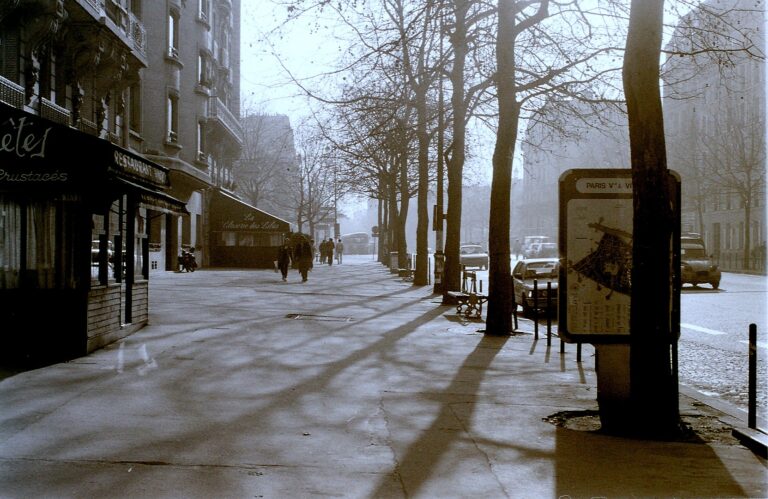
Francophilia

I’m anxious the moment I land in Paris, anxious my visit will end.

In the womb, I must already have missed this Paris one can’t possess,

my father must have whispered je t’aime, cheekbone pressed

against mama’s stretched skin, and I heard him, tawny buildings

of the 16th leaning in and breathing so close to me, gentled lions.

Yes, he must have reminisced as I walked the walls of the womb,

about his first wife, a countess who later married rich, lived in Paris,

had as many shoes as a willow has leaves; he must have played

Debussy’s Réverie as my patient mother leaned against the spinet,

one arm cradled under the baby bump of me, and sighed a sigh

like a cliché puff of smoke in a monochrome print where a student

at the Sorbonne, glasses and bangs obscuring her eyes, reaches

toward her pimpled lover over a café table, her future unfurling.

Lora Berg writes with a light touch, sometimes on difficult topics. She has published a collaborative book with visual artist Canute Caliste, as well as poems in Shenandoah, Colorado Review and The Carolina Quarterly, etc. She served as a Poet-in-Residence at the Saint Albans School and holds an MFA from Johns Hopkins. Among hats, Lora has served as Cultural Attaché at U.S. Embassies abroad and lived in several countries. Lora is a proud mom and grandma.

Image:bex73, CC BY-SA 4.0 https://creativecommons.org/licenses/by-sa/4.0, via Wikimedia Commons