Home Blog Page 98

AU alum Ismah Khan tackles tough topics in her short film ‘Disturbed’ by Olivia Kozlevcar

This article was a finalist and winner of the 2021 DC Student Arts Journalism Competition. Click here to learn more about the competition.

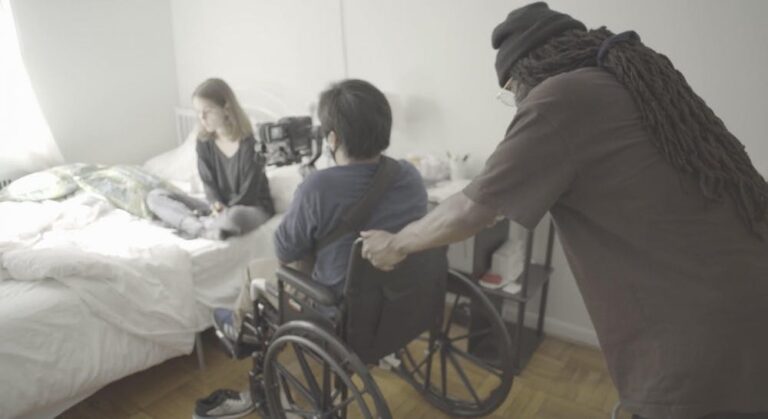
“Disturbed,” a new short film created by American University alumna Ismah Khan, is a brief look at the short-term troubles — and long-term effects — of living with mental illness. Unsettling and remarkably modern, the film makes right on a subject that has so long been misrepresented by Hollywood. The short follows protagonist Monica (Christina Coulter) as she battles insomnia caused by her mental illness — both of which are misunderstood by her friends. She carries the burden of her affliction while being further weighed down by the distrust and disappointment cast on her by the other individuals in her life.

Inspired by filmmaking icons Ari Aster, known most for “Hereditary” and “Midsommar,” and Darren Aronofsky — known for “Pi” and “The Fountain” — the crowd-funded horror movie lives fundamentally in tones of blue, with the only source of warm coloring radiating from medication that Monica takes. And while the audience follows along directly with Monica’s journey, they are forced to confront whether they believe her lived experience or the judgement placed on her situation by other characters.

The viewers must also evaluate the source of the monster (Keon Jones) following Monica: is the figure real or fake? A figment of the imagination or a true demon? Khan makes it a point to leave the answer to these questions up to the interpretation of those watching. “I wanted it to be about the fact that we don’t really listen to people when they have pleas that are quite serious regarding how they feel,” Khan said. “I wanted [to have] these deeper conversations about how we participate in the conversation of mental illness, or how we perceive
mental illness.”

For Khan, who has bipolar disorder, this project is an important one that has been in the making for over a year. Her personal relationship to the subject matter is particularly crucial when considering the tumultuous relationship that the filmmaking industry has historically had with accurately depicting mental illness and those impacted by it.

“One of the problems I came across — especially because I was on medication — was thinking: what role is medication going to play in this film? Is it going to be the typical ‘medicine makes this person crazy?’ I really didn’t want that, because that’s such an unhealthy narrative to put out there,” Khan said. “In fact, [medication] can do the opposite in a lot of cases.”

During the creation process, Khan said she wanted to make it clear that the medication being taken did nothing to impact the manifestation or resilience of the monster. It is another important step away from the Hollywood obsession with medication and the tendency it has to vilify it.

“It is medication: it works for what it’s intended for,” Khan said. “It’s not what causes the monster, it’s not what makes these nightmares happen. And I wanted to be very intentional about that.”

As for the technical side of production, Khan is not the only AU alum on the film: actor Valarie McFatter and tech members Fernando Rocha and Reignon Prillman all graduated from AU. The crew of the film is also predominantly BIPOC, a decision that Khan takes great pride in. “I feel like as a filmmaker and creator that it’s my duty to raise other BIPOC individuals with me,” Khan said. “Anything I do in terms of my career is always connected to people of color and making sure that we’re creating a network within ourselves.” Khan said she knows that “Disturbed” is just the beginning of the hard-hitting work she intends to create. “I would love to keep making films, and keep getting better, and tell more poignant stories,” Khan said. “I think ‘Disturbed’ is just right at the surface of all the things I want to say.”

Olivia Kozlevcar is a junior at American University studying Literature and Journalism with a minor in Legal Studies. She is in her third semester of working with the University’s award-winning newspaper “The Eagle” and second semester of functioning as the Arts & Entertainment editor. You can follow her writing on The Eagle and catch up with her on social media (@OliviaKozlevcar) to be alerted of all her adventures, writing or otherwise. 
Beyond the Lights sits at the intersection of commentary and theatre by Ajani Jones

This article is a finalist in the 2021 DC Student Arts Journalism Competition. Click here to learn more about the competition.

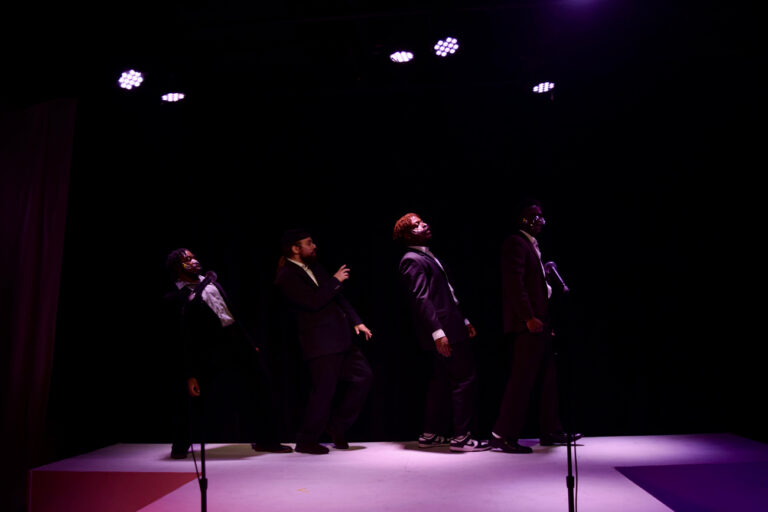
It’s five minutes to show time on the opening night of Beyond the Lights, and nobody knows exactly what to expect. The air buzzes, electric with barely contained enthusiasm and anticipation. The audience’s excited chatter drums into a final cheer going off backstage as the cast finishes its last minute preparations. Then it’s time. Following a blessing for a spectacular performance from co-producer Jada Snyder (COL ’23), the lights dim and the show begins. 

A commentary on the Black experience in America, Beyond the Lights: A Night of Black Musical Scenes is an hour of non-stop heart and energy that had its audience hooked within minutes. Its collection of timeless classics highlight the show’s commitment to paying homage to the long and vibrant history of Black musical theatre. 

Georgetown’s Black Theatre Ensemble (BTE), in collaboration with Mask & Bauble Dramatic Society (M&B), produced this insightful intersection of director Samuel Oni’s (MSB ‘22) original story and Black theatre’s most iconic staples—songs from Dreamgirls to Sister Act II to The Wiz. The show is an interactive experience through use of comedic conversations and vibrant call-and-response with the audience. The sheer charisma of its cast, excellent use of lighting, and powerful renditions of musical classics also made the show particularly engaging. Simultaneously, the production prudently comments on topical issues such as racism and what it means to be “Black enough.” 

The play opens with two friends, Rebecca and Sophia—played by Karen Samy (SFS ‘23) and Winnie Ho (COL ‘25), respectively—having a back and forth over their favorite movie musicals. When it is revealed that Rebecca has never seen Dreamgirls, the undoubtedly iconic 2006 musical, Sophia berates her and questions the legitimacy of Rebecca’s Black identity. This early exchange excellently centers questions about racial belonging into the play’s narrative. Despite the potentially good intention of sharing the cultural masterpiece of Dreamgirls with her friend, Ho’s character perpetuates the idea that one must meet a quota of experiences in order to identify with their own community. 

Samy highlighted the show’s desire to address the idea that we should not gatekeep the identities of others simply because they have not taken part in a certain experience. “That’s kind of the message we were going for. There’s not one way to be one race or ethnicity,” Samy said. 

Beyond the Lights goes on to carefully address several other current issues facing the Black community, many of which pull from Oni’s own experiences. From racial prejudice in the classroom to dangerous stereotypes of the Black community, Oni’s script sheds light upon institutional problems that plague our society. The choice to tell these stories through music was

deliberate—Oni recognizes not only the importance of music in Black pop culture, but also its utility. “I think music is a great way to tell stories,” Oni said. 

Through song choices like “Blackout” (In the Heights) and “And I Am Telling You” (Dreamgirls), Oni is able to maintain the serious subject matter of his production while seamlessly integrating both themes of hardship and triumph. As such, the music of Beyond the Lights helps to emphasize Oni’s story and add a layer of depth. 

In addition to its exceptional representation of issues faced by the Black community, Beyond the Lights does an outstanding job of keeping its audience entertained. “This show does a good job of being entertaining and also informative,” Shakeer Hood (COL ‘24), a member of the cast and the show’s assistant stage manager, said. 

The show’s duality is balanced through its scenes. In the second act, the cast recreates a Black church service with an energetic rendition of “Oh Happy Days” (Sister Act II). The number kept the audience laughing with its perfect integration of interactive and situational humor and also served as a narrative tool through the subversion of dangerous stereotypes. 

While allowing its audience to be fully immersed in the story it wants to tell and the issues it wants to address, the show also engages them with the lively and joyful side of Black musical theatre that often goes underappreciated. In choosing songs, Oni shared that while he wanted to ensure that key stories were being told, he also felt obligated to do justice to more than one facet of the Black experience. 

“I definitely want the audience to take away the contributions Black people and people of color have made to Broadway—the aspects of our experience that often go unheard from an actor, director, casting perspective,” he said. 

One of the possible downfalls of live performance is, of course, its susceptibility to error. Despite the narrative and directoral strengths of the show, it suffered several shortcomings—moments of brief technical failures and some hiccups with choreography and lines. The production’s setbacks can likely be attributed to time constraints and other unfortunate complications—including a directoral switch halfway into the show’s production—that occurred behind the scenes during the production. 

Cast members also highlighted the challenges that arose in making the show interactive and engaging while also complying with COVID-19 protocols. “It’s weird because we can’t even touch each other technically, so having a show that’s so focused on integrating the audience was a bit worrisome,” Cameren Evans (COL ‘24), a cast member, said. “There have been a few difficulties in, ‘How far can we go? How far can we push the envelope?’ but also staying within COVID protocols.” 

In spite of health restrictions, the cast powered through each scene, delivering every line and lyric with unwavering spirit and unquestionable passion. The final number of the show—Evans’s rendition of “And I Am Telling You”—was utterly show-stopping. Her execution of this famously difficult classic was especially moving due to the sheer power of her voice and the palpable emotion she put behind this performance. 

Ultimately, Beyond the Lights perfectly balances serious subject matter with charismatic performances and excellent renditions of musical classics. Despite its short run from November 19-21, Beyond the Lights was a welcome breath of fresh air in the theatrical space and a perfect segue into future stories to be told. Excitingly, BTE has shared plans for a slew of upcoming performances in the Spring that already show promise of the ensemble’s commitment to theatrical excellence.

Ajani Jones, born and raised in Jamaica, Ajani is currently a college freshman who has a deep fascination with the intricacies of language and linguistics. Through this love for language, Ajani hopes to explore the intersection of journalism and the arts.


Sometimes stupid cool shit is all that matters by Sarah Watson

Content Warning: This article references self-harm and eating disorders.  

This article is a finalist in the 2021 DC Student Arts Journalism Competition. Click here to learn more about the competition.

In the Colorado mountain town where I lived, tattoos were just part of the culture. Whenever things lagged at work, a circle of 30-somethings would trade tales and roll up sleeves to reveal panoramas of ink. Some shared moving stories of mental health struggles or the death of a loved one, others simply said, “Idk, I just thought it was beautiful.” 

It was an electric and freeing environment that never took itself too seriously— yes, tattoos can be deeply meaningful, but they’re also just objectively cool. They are uniquely expressive and aesthetically alluring, with a hint of badass. They can’t be contained within their original meaning or lines, but stretch and move with their individual canvas.  

“It’s not only something on a page or a wall, it’s a living, breathing thing that changes over the years,” Egan Barnitt (NHS ’22) said. “It takes on many different meanings and many different forms, it’s like pretty much the most interactive art form that you can really make.” 

When I got my first tattoo, the artist cleaned the blood off my skin with the words, “Welcome to the inked community.” Colorado’s tattoo-embracing culture is worlds different from the stuffy professional atmosphere of Georgetown, but a small and diverse group of students make up a community of the decorated and proud.  

Barnitt comes from the perspective of both the inked and the inker. She began her tattoo business in a New South dorm room her first year at Georgetown, giving stick-and-poke tattoos to fellow students. Over the years, she developed her talent, now offering hand-poked tattoos that look the equivalent of machine done artwork.  “Being able to do tattoos has been such a confidence boost to know that people trust me and like my art enough to want it on them forever,” she said. “What more validation could you get than somebody being like, ‘I want it for the rest of my life?’”

For artists like Barnitt, tattooing offers artistic experimentation in movement, style, and color. While American style (think stereotypical biker tattoos) has emerged as a contemporary form, tattoo art has deep cultural origins and significance in Polynesia, South East Asia, and Indigenous North American societies, each of which have distinctive artistic elements. With skin and ink as the essential materials, modern artists can integrate history with new technology and play with styles, from the delicate to the abstract to the cartoonish.  

For Barnitt, the act of tattooing itself is “meditative.” Tattooing can be a vulnerable process, so she strives to create a safe space for women and nonbinary people where their choices are respected. “That’s what really matters the most to me—being able to make sure that people feel safe while they’re making such large steps to become the person that they want to be,” Barnitt said.

Tattooing can offer people a renewed sense of agency over their bodies, and an ability to celebrate them in a unique format. “The best part about your body being your body is that it’s yours,” Ace Frazier (MSB ’23) said. “You can do anything you want whenever you want and that’s just so freeing and amazing.” Frazier is relatively spontaneous with tattoos, creating stick-and-pokes on their body whenever the inspiration for a design hits. 

I empathize with the freedom tattooing can bring to your body. I entered 2020 with a long list of fears, and over the year, began intentionally facing each one (within reason). Getting inked commemorated the personal growth I’d made over my irrational thoughts and worries, and also marked the first time I’d ever felt confident in my body—not because of its appearance, but its strength. They can also act as reminders of personal growth. Akanksha Sinha (SFS ’23) began getting tattoos at the age of 16, and has gotten at least one every year as bookmarks of who she is then. “All my tattoos have meaning to them,” she said. “My first one was commemorating me being clean from self-harm for a year, so that was a really big deal.”  

Since her first tattoo, Sinha uses her annual tattoos as a reminder of how far she’s come. “Every time I would feel the urge or anything I can look at that and be like, well I did it for so long, so I can do it for longer.” 

For Barnitt, who has over 20 tattoos, tattooing has been a healthy way to have a say on her body’s appearance while recovering from an eating disorder. “I think being able to sort of reclaim your personhood in a visual way is really helpful.” 

Last summer, Barnitt got a belly tattoo that she describes as one of her most empowering. “I thought, ‘I am over this. This tattoo is gonna look sick,’” she said. “I’m wearing crop tops all the time, because I want to show this off, you know, like I fucking love it.” 

But part of the freedom of tattoos is that while they can have deep meaning, they’re also just freakin’ cool. As Barnitt said, “Sometimes stupid cool shit is really all that matters.” While there is pressure to get a tattoo with deep significance, every inked person I talked to unequivocally considered this mentality a misconception.  

“There doesn’t need to be philosophy about you making a decision about your body or you making a decision in general,” Frazier said. “I really like that about tattoos.” 

There is an often-cited worry about regretting tattoos, but Sinha knows that she won’t love all of her tattoos in every period of her life. And that’s okay. “People can get paralyzed by that idea of something being on your body forever,” she said. 

Sinha sees her tattoos as time capsules, telling the story of who she was at different stages. “It’s okay if, 10 years down the line, they don’t mean the same thing to me, because there is still a reminder of what it meant to me then.” 

If a tattoo is representative of who I am, then to me, its physical permanence isn’t a big deal. Just like our bodies, tattoos don’t need to be perfect. Permanent changes to our bodies will come whether we want them or not. Stretch marks from aging, crinkles from laughter, wrinkles from worry. Tattoos are selected snapshots in time of the people we were and the places we came from. And there’s something very honest and beautiful about that. 

“I really like the idea that I’ll be able to look back on this one tattoo that maybe doesn’t mean much to me anymore, but to know that it meant enough to me at one point in my life to get it put on me permanently forever,” Barnitt said. “It’s just such an ode to all the people that I have been.”  

Barnitt is a former cover editor of the Voice.

Sarah Watson is the Editor-in-Chief of The Georgetown VoiceGeorgetown’s premier newsmagazine. She is a junior in Georgetown’s School of Foreign Service studying Regional and Comparative Studies. When she is not writing, she likes to be exploring the outdoors. 

Bridgerton proves that color-conscious casting alone is not good enough by Kulsum Gulamhusein

This article is a finalist in the 2021 DC Student Arts Journalism Competition. Click here to learn more about the competition.

When I first saw the trailer for Bridgerton, I could hardly wait for Christmas Day. As a dedicated fan of Scandal, Jane Austen, and Gossip Girl, Bridgerton seemed like the perfect amalgamation of my favorite genres. Trailers promised a regency era drama following the scandals of London’s elite, narrated by a mysterious observer through her gossip column. More exciting than the storyline was the inclusion of a diverse cast; a shock compared to most historical dramas available. Undeniably, I did enjoy Bridgerton—it was a great distraction for the two days following Christmas. But as I learned more about the show and its creation, I realized there were several problematic aspects I had missed in my festive turkey-induced haze. 

Bridgerton has been criticized for many things: a scene involving dubious consent, a lack of historical accuracy in costumes, and a lack of true diversity. I want to focus on the diversity issue, specifically the way the show was cast, and how it reflects changing diversity standards in the media industry. When interviewed, series creator Chris Van Dusen claimed to have used “color conscious” casting to fill roles in the show. Color-conscious casting acknowledges the dimensions that race can bring to a story, and in most cases, embraces them. It is an increasingly popular alternative to color-blind casting, which asks us to suspend reality and imagine a world where race is not important. Color-blind casting was initially introduced as a way to bring more actors of color on screen. As discussions about the effects of race on everyday life have become more mainstream, color-conscious casting has become more present. There is a growing debate as to which casting approach is more appropriate, and it’s important to consider the ways we incorporate diverse casts into period dramas where racial diversity is not historically accurate. 

Period dramas can generally be divided into two categories: those with the goal of telling a historically accurate story, and those that prioritize the drama and plot. Shows that intend to be more historically accurate tend to be less diverse. Think Downton Abbey, which follows the lives of the aristocratic Crawley family in early 20th century Yorkshire, England. When asked about the lack of diversity in his shows, the creator stated that “you must create something that is believable” and that the settings of his shows were not historically racially diverse, therefore, in the interest of historical accuracy, the cast could not be racially diverse either. 

For shows that are less concerned with historical accuracy, and wish to include racial diversity, there exists a spectrum ranging from color-blind to color-conscious casting. When casting Hamilton—the hit historical musical— the producers put out a call for non-white actors. Having a racially diverse cast tell the stories of the founding fathers—white slave owners—adds another depth of contemplation to the way we remember American history. In contrast, the inclusion of actors of color has no effect on the story being told in The Personal History of David Copperfield (2019), an adaptation of Charles Dickens’s David Copperfield. Instead, the producers used color-blind casting to show that people from diverse backgrounds can have the same opportunities to be involved in historical dramas. 

Bridgerton sits somewhere in the middle of the spectrum, not really committed to color-conscious casting, but not color-blind either. The way that race fits into the storyline seems to have been an afterthought. Race was addressed once—in the fourth episode of the show—during a conversation between two Black characters, Lady Danbury and the Duke of Hastings. The conversation, which attributed the diversity of the society to love conquering prejudice, was so shallow that I wish they hadn’t included it. It certainly didn’t change or add meaning to the plot. The conversation seemed serious, but the topic was never addressed by any white characters, therefore implying that race is only important to POC, and not society as a whole. A truly color-conscious production would have woven the experience of being Black in a newly integrated society into the plot—or at least addressed it in more than one conversation. Such a shallow observation glides over the important and difficult conversations a conscientious show should be having about racial integration and equality. Since the explanation was so unsatisfactory, I would have preferred the show not include an explanation about why there were POC present. That way, I could have pretended that the showrunners had simply realized how talented actors of color are, and how absurd it is to leave them out of interesting narratives. The way that the showrunners chose to address racial diversity in the show made it seem forced, and as though the impact of having POC in a historical drama should only be felt by the actors or characters of color. 

There is, of course, criticism of both color-blind and color-conscious casting. Critics claim that color-blind casting either removes race from the equation or reduces POC to just their race. It also benefits white actors more than POC, because there are so few roles written with POC in mind. Color-blind casting has also been said to let Hollywood “off the hook” for creating stories about POC because they are being inserted into white stories. Additionally, as Angelica Jade Bastién wrote for The Atlantic, it perpetuates the idea that race is only important in stories that explicitly tackle it, rather than something that is ingrained into society. 

Once upon a time, color-blind casting was a great way to introduce POC into mainstream media, but it’s no longer good enough. Color-conscious casting is certainly a better alternative since it takes into account the way that race changes a character’s story, but we need to move beyond inserting POC into narratives that aren’t created for them. In order for color-conscious casting to be effective, conversations and plotlines about race need to be woven into the narrative, rather than shoehorned in and only addressed by characters of color, as was the case in Bridgerton. 

I would argue that shows that choose a racially diverse historical setting do the best job of thoughtfully including POC in historical narratives. Many shows become increasingly diverse over time to reflect the integration of society; this is especially true of shows set in the 1950s and 60s. Call the Midwife, a show set in what would have been a predominantly white neighbourhood in London introduces more cast members of color as the setting of the show becomes more diverse with time. The show’s many supporting cast members become increasingly diverse as the show progresses, and in the seventh season, a Black midwife is introduced to the main cast, to reflect the influx of immigrants from the West Indies. By choosing to write a narrative that integrates the stories of people of color in a historically accurate way, shows like Call the Midwife do a much better job of promoting diversity in TV than shows where POC are fit into roles written for white characters. They provide opportunities for actors of color to be involved in shows that value historical accuracy and are centered around white characters, without pretending that race isn’t an important factor. Rather than finding ways to add actors of color into white history, producers should be working to amplify diverse historical narratives that provide opportunities for POC to be involved in the film industry and share their rich histories. 

The lack of diverse narratives in TV and film is appalling. After the success of movies such as Crazy Rich Asians or Ma Rainey’s Black Bottom, there is no reason to believe that a production centered around POC cannot be successful. If we are really going to tackle the lack of diversity in the film industry, we need to start by creating equal opportunities for actors of color, and that involves writing more diverse narratives. Not only is there a lack of roles for POC, there is also a lack of POC writers and producers in the industry. Both Hamilton and Crazy Rich Asians were created by people of the same race and similar cultural backgrounds to the actors, and the tone of both productions is incredibly different to that of productions where white showrunners have tried to practice color-blind or color-conscious casting. The very nature of race and race relations in the western world and film industry means that a white producer will never truly be able to understand the context of being a person of color, and how that will affect a character’s story—whether the intention is to address race or not. 

There needs to be greater racial diversity throughout the entire film industry, and we definitely need to move away from the idea that every character is white unless otherwise specified, or every period drama is set in England. POC are every bit as talented and deserving of a wide array of roles as white actors, and their history is just as interesting and screenworthy. We need to start providing POC with the same opportunities as white actors to be successful in any genre on screen. 

Kulsum Gulamhusein is a junior at Georgetown University where she is majoring in government, and minoring in Arabic and Public Health. She is an Assistant Editor for the opinion section of The Voice where she also enjoys writing about politics, popular culture, and campus issues. Kulsum feels that her view on life is strongly impacted by her international background, and this carries into her writing. In her free time, she enjoys exploring this brand new reality that is living in the U.S.

This article originally appeared in The Voice, a Georgetown student publication, and was edited by the author to fit the word length of this competition.

C’mon C’mon is a heart-wrenching portrayal of the fleeting nature of childhood by Thais Carron

This article is a finalist in the 2021 DC Student Arts Journalism Competition. Click here to learn more about the competition.

By Thais Carrion 

Director Mike Mills (“20th Century Women”) gives viewers another profound examination of the fragile relationships between children and adults in this month’s new release, “C’mon C’mon.” 

The film follows radio journalist Johnny (Joaquin Phoenix) and his Nephew Jesse (Woody Norman) as they are forced together, navigating the awkwardness of getting to know and trusting one another while Jesse’s mother Viv (Gaby Hoffman) is called to tend to Jesse’s father, who is in the midst of a manic episode. What was supposed to last one week quickly turns into many and Johnny finds himself bringing Jesse along on a cross-country trip as he interviews children of immigrants in urban cities about their expectations of the future. Equal parts heart-warming and heart-wrenching, we watch as Jesse and Johnny form an unlikely bond and wrestle with each other’s fraught emotions and vastly different perspectives on the situations that unfold before them. 

Despite the fantastical nature of the time spent out of school and traveling with his uncle, Jesse’s erratic emotions are at the forefront of the story. His frustration with the lack of agency in problems so closely involving him is palpable and no doubt resonates with the confusion of childhood at the whims of adults. 

The black and white medium combined with the radio-journaling subplot of “C’mon C’mon” gives way to an experience rich with sound and texture unlike any contemporary color-filled movie out today. Putting his recording equipment in the hands of Jesse, Johnny unknowingly creates a whole avenue of expression where through things often overlooked; the rolling sounds of skateboards at a skatepark, the rumbling of a train thundering forward on tracks or the overwhelming sounds of a city during rush hour all come to life through Jesse’s handling of the microphone. These sounds set against an emotive sound track of powerful orchestral compositions all come together to set the mood of the trip: an exciting, fragile and fleeting moment in the lives of both Johnny and Jesse. 

While the relationship between an endlessly curious child and a contrastingly jaded adult comprises the core of this film, many other themes like past and future perspectives, the difficult role of mothers in patriarchal systems and the ways in which society is increasingly placing responsibility on the shoulders of younger generations to “fix” the mistakes of generations past all make an appearance throughout. Viv’s role as a mother is captivating and well-conveyed, as she is tasked with shouldering the burdens of all those around her with no respite or time for selfishness. 

The integration of Johnny’s work project into the main storyline fell flat in a way that nearly turned the film as a whole into a socially insensitive version of a “white savior” storyline. The decision to have Johnny (a white cis-gender heterosexual adult male) give voice to diverse perspectives is a troubling one that distracts from the significance what he records. Furthermore, the fascinating ideas of these children of American immigrants included through Johnny’s interviews are organized around Jesse’s storyline. The overall effect is a disappointing tokenization of the important diverse perspectives included throughout the movie, subjecting them to a supporting role in what is a primarily white narrative. 

One of the most enjoyable facets of the movie, along with the use of rich sound and visual texture used throughout, is the varying references to contemporary works of literature to set the emotional scene and signal a shift in theme. Quotes from a wide range of books provide short interludes and give the audience something to ponder through the events unfolding on screen. In the final moments of the film, one particularly intimate scene between Johnny and Jesse quotes “Star Child” by Claire A. Nivola, encompassing the fleeting sense of the beautiful yet painful chaos that is the experience of growing up: 

“To visit planet earth, you will have to be born as a human child… There will be so much for you to learn, and so much for you to feel: Sadness, joy, disappointment, and wonder. Over the years you will try to make sense of that happy, sad, full, always shifting life you were in, and when the time comes to return to your star, it may be hard to say goodbye to that strangely beautiful world.” 

Mills gives audiences a culmination of beautiful camera work and intricate audio detail, treating the transitory nature of childhood with the utmost care and respect. As the movie winds down and Jesse and Johnny’s time together comes to a close, both must come to terms with the intangible nature of the memories made. The audience is similarly forced to come to terms with the inevitability that Jesse will soon grow up and forget these memories despite his best efforts to remember them, while Johnny is left watching from a distance. Ultimately, “C’mon C’mon” is a work of art. 

Thais Carron is a contributor on the Life section of American University’s The Eagle and is editing at John Cabot University’s paper, The Matthew, during her semester abroad in Rome. She has published 5 articles on The Eagle Online since September 2021 in both English and Spanish and has had the opportunity to interview filmmakers and museum curators both local to DC and internationally. Throughout her time studying International Relations and Art History in DC, Thais has developed a deep interest in Art History and Literature and greatly enjoys writing book reviews and museum pieces.