Home Blog Page 108

Words I Write by Fran Abrams

Words I Write

are words you read.
Do my words bring you warmth
like sun on shoulders? Exhilaration
like riding a motor bike fast?
Laughing children
who make you laugh?

Poems I write
are scenes you see.
Do my poems show you vines
where green grapes ripen to purple?
Places on the coast
you have never seen?
Someone who loves you
arriving on a train?

I write other poems
for no one to read.
Poems that sound
like my inner doubts.
Words meant only for myself
until someone who
cares for me
understands them
though I never
made them visible.

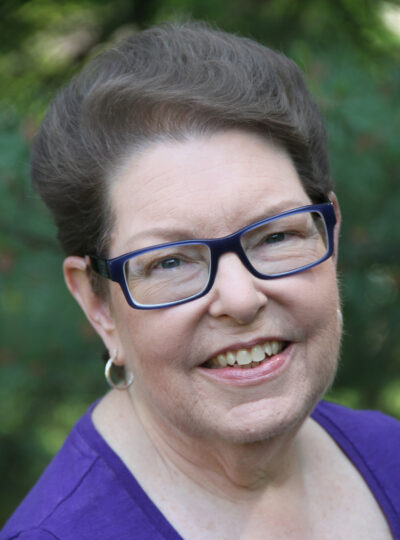
Fran Abrams began writing poetry in 2017. She has had poems published in print and online, including in Work Literary Magazine and in the Winter 2021 Bulletin of Alan Squire Publishing. Her poems appear in eight forthcoming and published anthologies, including This is What America Looks Like from Washington Writers Publishing House. In 2019, she was a juried poet at Houston Poetry Fest and a featured reader at DiVerse Gaithersburg (MD) Poetry Reading Series. Visit franabramspoetry.com.


Image by Jiří Sedláček (Frettie), CC BY 3.0 <https://creativecommons.org/licenses/by/3.0>, via Wikimedia Commons

Indian River by Stephen Roddewig

Indian River

I had no idea
when I threw the mangrove seed,
wishing for brighter days,
clouds prowled over the mainland.

Perhaps my offering failed,
perhaps nothing could be done.
But the guilt that I carry
betrays the lingering love.

After I threw my farewell
spiraling into the silver-rimmed waves,
the real pain crept up.
When nothing more could be done.

After the prayers,
after lives are replanted,
then comes the limbo.
Too late to cry,
too early to laugh.

Months later, I returned
to shores warmed by memories.
I had no idea
what awaited me.

As my blistered feet
walked along the seawall,
dead sea grass
turned the air to salted mildew.

The mangrove my brother had planted
so many sunburns ago,
sprouting alone beside the dock,
had shriveled and blackened.

Only the cicadas remained,
appraising the pale man below,
before droning their scratching song.
But above the malaise
rose the sharpened chirps.

And I watched
as the black wings of the osprey
flew guard over a second seed
and the memories

Stephen A. Roddewig is a marketing content writer living in northern Virginia. His work has previously been published in two separate Virginia’s Best Emerging Poets anthologies as well as the literary magazines ArtAscent and Gardy Loo. In addition, Stephen is now contracted to publish his first short story “Land’s End Light” in Abyss and Apex on January 1, 2022. When not writing, he enjoys collecting records and running races.


Image: CC BY-SA 3.0 <http://creativecommons.org/licenses/by-sa/3.0/>, via Wikimedia Commons

She Kills Monsters by Ceoli Jacoby

This article was a finalist in the 2020 DC Student Arts Journalism Competition. Click here to learn more about the competition.

In many ways, Thursday night’s performance of “She Kills Monsters” was like any other live performance. The cast and crew listened to their directors deliver the pre-show announcement, anxious to begin the play. The actors donned elaborate costumes, delivered their lines in front of sets their media designer had put together and executed scene changes set to live music.

However, it was also the first of its kind. The actors entered from the Zoom waiting room instead of from the wings. The lighting designers sat idle, trusting the cast to make corrections on their own. And the audience, about 5,000 strong at its peak, tuned in from the comfort of their own homes.

The road to putting on a full-length production via livestream was a rocky one. When the cast list was finalized, no one expected that the University of Maryland would soon send students packing as a result of the coronavirus pandemic.

“We’d all pretty much come to the conclusion that it wasn’t happening,” said junior theatre performance major Ren Alberg. “But then the week after our spring break, we got an email that we were going to attempt to stage the play through Zoom. It was very preliminary, we didn’t know how it was gonna happen, we just knew that our director said we had a plan and we were like, ‘cool!’”

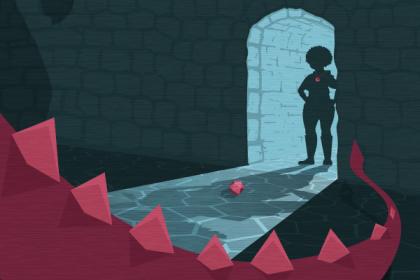
“She Kills Monsters” follows protagonist Agnes Evans’ discovery of her late younger sister Tilly’s identity through a Dungeons and Dragons module she left behind. It explores themes of queerness, wish-fulfillment and self-forgiveness, all while providing a very real picture of the sometimes rough, mostly rewarding existence that is sisterhood.

The play “She Kills Monsters” is a technical challenge even in its original format. But translating all of its necessary elements (which included – among other things – a gelatinous blob, a five-headed dragon and a flock of fairies) onto a livestream seemed near-impossible. The cast and crew faced challenges every step of the way. From learning to work through laggy video to positioning actors in such a way that the Zoom backgrounds would neither engulf them nor disappear into their home environments, there was a steep learning curve.

“Our primary job [as actors] is to bring the character to life and to do a lot of the character development,” explained junior theatre performance major Elijah Williams. “But now that we’re not on campus anymore, we don’t have as many resources as we usually do … so now we have to be our costume designer, we have to be our lighting designer, we have to be our own director in a way.”

The actors, though, were up to the task.

“[We had to] figure out how we were going to make it look like we were going to make it look like we were interacting with the people we weren’t really there with by figuring out how to manipulate the locations of our boxes on Zoom or change filters on Snap Camera to make it look like we were different characters,” Alberg said.

The script that the actors used was a combination of playwright Qui Nguyen’s original dialogue and the Zoom adaptation, which was based on the show’s Young Adventurers Edition and produced in collaboration with director Jared Mezzocchi.

Mezzocchi and co-director Lisa Nathans considered the production an experiment which sought to answer three essential questions.

“During a COVID-19 world, can live theatre still exist in a real way?,” asked Nathans.

“Can the human essence truly be captured in pixels?,” added Mezzocchi. “Can a community come together in their own isolated space to have one communal experience?”

In the end, the answers were clear: yes, yes and yes.

“The tears that were leaving people’s eyes [after the show] said it all. We were incredibly proud of each other and we came a long way. We struggled with a lot of things, a lot of different adjustments and we were just really proud. We were very excited to share that with everybody,” said Williams.

The cast and crew agreed that they had created a blueprint for what live theatre might look like in these uncertain times.

“I think now the whole country knows because of us that this is even possible,” said Williams.

The students also recognized that there may even be some benefits to going virtual. For example, the reach of a virtual show is much broader than that of an in-person one.

“I think it’s a great thing that it was online because everybody who has a computer or a phone and access to the link can be engaged … some of my family doesn’t get to come out and see me perform as often as I would like, and now there’s no excuses,” said Williams.

Alberg touched on the increased accessibility of virtual shows, which can be enhanced by closed captioning and accessed by those whose special needs may otherwise prevent them from physically sitting in an audience.

“Especially now that so many theatre professionals are out of work, we know now that it doesn’t have to be the end of [full-fledged performance] … If we can keep working towards this, it could become something really cool in the future especially for accessibility needs,” added Alberg. “It was something that started out as a stressful ‘I don’t know if we’re gonna be able to do this’ thing that turned into ‘maybe this could be the beginning of changing performance in the future even after this pandemic is over and we can go back to interacting with human beings in public again.”

The show, like any other live performance, was not perfect. At times, the volume of the music overpowered the actors’ voices. The Snapchat lenses would occasionally disappear from an actor’s face when they turned to the side, only to reappear when they faced forward. But the show was a reminder of why the students of the School of Theatre, Dance, and Performance Studies chose the career path they did.

Performance art has the ability to awe, to expose audiences to new perspectives and to transport people into a different reality. But it exists chiefly as a means of bringing people together. And this is exactly what the cast and crew of “She Kills Monsters” accomplished – thousands of people all over the world, experiencing one of the most trying events in recent memory, sharing an hour of respite from their seclusion and supporting the next generation of artists in the process.

Ceoli Jacoby is a sophomore in the University of Maryland’s Philip Merrill College of Journalism. On campus, she is a features writer for Stories Beneath the Shell and a section editor at Unwind Magazine. She is also a member of Mezumenet, UMD’s all-female Jewish a cappella group. During the Fall 2020 semester, she was an intern at Mid-Atlantic Media, where she contributed to both Washington FAMILY Magazine and Montgomery Magazine.

Local Artists Beautify by Hannah Shows

This article was a finalist in the 2020 DC Student Arts Journalism Competition. Click here to learn more about the competition.

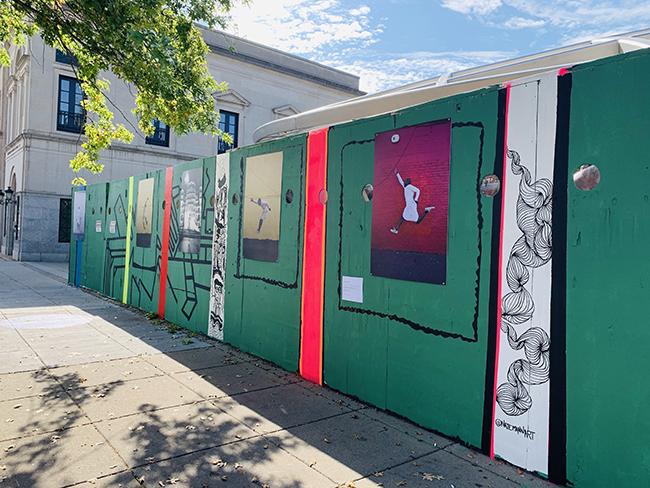
Two local artists decorated construction barricades at the Dupont Circle Metro station to beautify the neighborhood, even though the exhibit is only temporary.

Construction is underway for a new overhead canopy to protect riders entering and exiting the escalator at the north entrance of the Dupont Circle Metro station. Temporary construction barricades surround the project to shield messy construction work from public view and to protect pedestrians from any debris or potential worksite accidents.

Local artists Timoteo Murphy and Ravi Raman worked in partnership with the Dupont Circle Business Improvement District and the Washington Metropolitan Area Transit Authority Art in Transit program to paint the temporary barricades.

“WMATA is aware that the construction canopy may not be the most visually appealing thing to look at every day,” said Laurent Odde, the program manager for the WMATA Art in Transit program.

To remedy this eyesore, Murphy and Raman covered the bright green barricades with their artwork.

“This project is ephemeral,” said Anne Delaney, the project coordinator for the WMATA Art in Transit program. “It’s on a temporary structure. I think there is an appeal that people will enjoy it, remember it, miss it. It’s a real mystery. That’s part of the experience.”

Dupont Circle is one of the busiest Metro stations. Before the pandemic, it served an average of nearly 17,000 people per weekday, according to WMATA’s ridership data. As of this August, the average weekday ridership at the Dupont Circle station is down 92 percent when compared to August 2019.

“The installation, it’s really … enlivening this corner,” said Colleen Hawkinson, the executive director of the Dupont Circle BID. “The station, it’s high foot traffic. It’s high vehicle traffic. It’s at the intersection of a major bike route as well, so there’s a lot of visibility.”

In addition to its aesthetic beauty, the art serves a practical purpose. Hawkinson said that the public responded positively to a similar initiative in June 2019. The previous initiative also commissioned Murphy and Raman to paint murals on temporary construction barricades in Dupont Circle.

“We did find that people were taking pictures of themselves in front of the artwork,” Hawkinson said. “This also prevented graffiti from being applied.”

Raman, the local contemporary artist behind the “Love in Six Lines” paintings featured at the Dupont Circle Metro station, created the series to toe the line, literally, between complexity and simplicity.

“The original analogy that I was trying to make is that something that looks very simple can also be complicated,” Raman said. “Love is kind of the same way. With everything being so polarized, I thought it would be nice to have a message that completely flies in the face of all that anger and puts a smile on someone’s face.”

The series’ simplicity and message contrasts with Washington’s politicized art scene.

“The town tends to have political messages, or messages that people can be diametrically opposed to, whereas my message is way more simple, and it’s pretty universal,” Raman said.  “Who can argue with love?”

Murphy’s “Jump 4 Da Life” series, featured on the barricades adjacent to Raman’s artwork, is a photo collaboration between Murphy and conceptual artist Maps Glover to visually represent lives lost to fatal police force. Murphy photographed Glover jumping over 300 times in one day, with each jump representing a life lost.

“My project is not saying, ‘Black Lives Matter,’” Murphy said. “My project represents the life that was taken, any life. It’s not about Black or white.”

As an Afro-Latino man, Murphy understands the lived reality of Black men in 2020. Murphy said he hopes that passersby can see in his artwork how he, as an “artist in the community, is affected by politics.”

During his art installation at Dupont Circle, police approached and confronted Murphy twice. At one point, two Metro transit officers and three Metropolitan police officers arrived and lingered around Murphy.

“They stopped me for a total of six hours during two days of work,” Murphy said. “I showed the police my texts and emails verifying that I could do this work at the Metro, but the license wouldn’t load on my phone.”

When Murphy contacted the Dupont Circle BID to provide Metro transit police a copy of their signed agreement, he was then permitted to resume work, Kayla Brown, the marketing and events associate for the Dupont Circle BID, explained in an email.

“Every contractor is required to have documentation on hand for their activities while conducting work on Metro property,” said WMATA Spokesperson Ian Jannetta. “Metro employees and MTPD are instructed to identify such workers on the job site, and that’s what happened here.”

“It kind of kicked the air out of me,” Murphy said. “The project was already taking a lot more effort than I anticipated.

Despite the setbacks, Murphy persisted, and the installation is now complete. Murphy and Raman’s artwork will be available until the temporary barricades are removed in late 2021, Hawkinson said.

“Transit is not just about moving people,” Odde said. “The Art in Transit program is trying to give you an experience beyond just taking the bus or going down to the Metro. It’s about the whole traveling experience.”

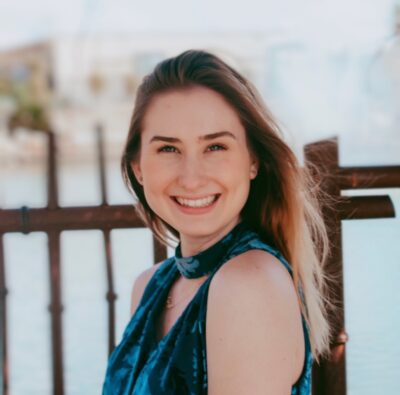
Hannah Shows is a student journalist at American University who works tenaciously to report multimedia stories about people and their brilliant, messy, challenging lives. She recently directed and produced a grant-funded short documentary series about fostering joyful resilience in COVID-19. Hannah has reported for Voice of America, AWOL and The Eagle. As a soon-to-be graduate, Hannah plans to continue multimedia reporting after college.
Stranger than (science) fiction by Nyah Hardmon

Even in imaginary lands, Black people are still not safe.

This article was a finalist and winner of the 2020 DC Student Arts Journalism Competition. Click here to learn more about the competition.

Let’s be honest. When you think of science fiction, it’s likely the same recycled images that come to mind. Aliens from some distant galaxy; scientists perfecting time travel; maybe even mutant robots taking over the world. In fact, it seems as if in the imaginary lands science fiction conjures, there’s room for just about anything – that is, except Black people.

Somehow, in universes where zombies and jedis exist, diverse casts are still a stretch. Only recently have sci-fi creators begun to invite actors of color into their world. Last year’s “Watchmen” rollout on HBO followed by this year’s premiere of “Lovecraft Country” on the same platform contributed to this new, more colorful wave of sci-fi. Both television shows feature Black protagonists at the frontline of their storylines, which is a milestone in itself. For the first time, Black characters are the ones doing the exploring and discovering, reclaiming their place in a genre previously shut off from them, so why does this win feel so off-putting?

The selling point for science fiction is that it is just that- fiction. Stories that put the slightest twist on reality until everything we know becomes strange and unrecognizable but still discernibly untrue. So what happens when the genre blurs this line? When creators take very real historical occurrences and engrain them into sci-fi plots until truth blends with make believe. While this is typically a forgivable offense, it becomes a lot trickier when there are Black characters involved and the truth being distorted is actual Black history.

In “Watchmen,” between meeting floating blue men and wearing elaborate vigilante costumes, Regina King must also battle an underground white supremacy network. This re-envisioned version of Tusla, Oklahoma contains high-tech DNA tracking and men from space; yet, racism is the threat King must face. “Lovecraft Country” does the same thing. When they are not uncovering witchcraft, the show’s stars Journee Smollett and Jonathan Majors find themselves escaping from Sundown towns or getting their homes vandalized by racist white neighbors. Both shows have plenty of fantasy material to build off of but instead, they use the protagonists’ race as a crutch. Hannah Giorgis writes in the Atlantic “the show spends so much time focusing on its white characters’ near-comic monstrousness that it undercuts the development of its Black leads.” Directors and writers refuse to put in the work to expand on minority characters, and instead use their race as a scapegoat.

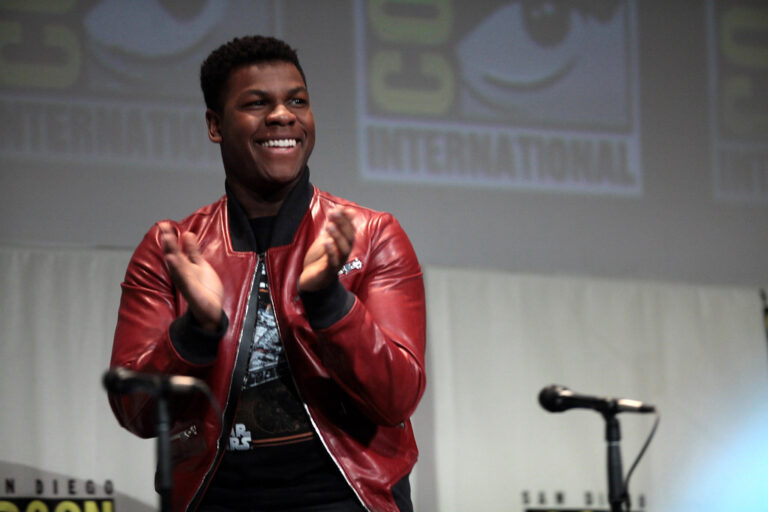
John Boyega, who played Finn in “Star Wars: The Last Jedi,” spoke on this disparity between the complexity of white characters and the shallowness of characters of color: “They gave all the nuance to Adam Driver, all the nuance to Daisy Ridley,” Boyega tells GQ Magazine. Writers of the “Star Wars” reboot lazily developed Boyega and other minority characters just as “Watchmen” and “Lovecraft Country” writers took the easy way out with their Black characters.

For sci-fi veterans like Samuel Jackson, this trend is not a new one. Jackson received nearly the same treatment ten years ago, with the characterization of his role as Mace Windu in the Star Wars franchise. Like Boyega, the detail and attention dedicated to other characters was not afforded to Jackson. Now, Jackson tells Interview magazine that watching shows like “Lovecraft Country” mimic the same plight Black people face in real life reminds him “nothing changed.”

In this interview with Smollet, Jackson tells the young sci-fi actress, “It’s the same conversation that’s been going on for me for 70-some years. It ain’t changed.” As appealing as racial storylines may be, it is nothing Black actors have not seen before. For a genre creative enough to construct entire new universes, sci-fi writers are still unable to transfer this open mindedness onto Black characterization.

This carelessness hints that Black people are still not welcome in science fiction, even if recent efforts suggest otherwise. This sense of not belonging expands to the treatment of Black sci fi actors off the screen as well. Boyega said he experienced a flurry of harassment from racist “Star Wars” fanatics, upset that a Black actor would dare infiltrate their beloved franchise. To Boyega’s attackers, Black people had no place in their fantastical tales, and the film’s half-baked depictions of minority characters like his only supported that misconception. Boyega, like many Black actors, had to battle racism both on set and in daily occurrences off set. Thus, it’s unnecessary to distort fantasy with a monster Black people are already fighting in real life.

By integrating the horrors of racism into science fiction, Black characters are unable to escape trauma within a genre built upon escapism. White characters are allowed the grace of totally imaginative arcs while their Black counterparts are subjected to the same tragedy that has been exploited time and time again. Even in places that do not exist, Black personalities are characterized exclusively by their race instead of being allowed to explore other dimensions.

The melding of Black history and sci-fi could do even more harm by delegitimizing the scale of real events. Suddenly, the authentic trauma experienced from lynchings or racist cops are leveled to the same fear evoked by blood-hungry monsters. When this happens, both occurrences are lumped into the world of make-believe, which clouds over the reality that one of these experiences actually happened.

While the acknowledgement of Black history is essential, Black characters should be defined by more than their racial identity. The world would not end if Black characters executed storylines outside of racial trauma. If white characters can go on escapades without being constantly reminded of their race, why can’t the same be expected for actors of color. It is as if even in the realm of imaginary creatures, Black people must be reminded that they are not still not equal and still not safe.

Nyah Hardmon is a sophomore journalism student at Howard University, where she serves as a student ambassador. While studying in Washington D.C, Nyah found outlets to express her journalistic voice both as a radio personality for the on-campus radio station WHBC and a Creative Content team writer for the on-campus newspaper publication the Hilltop. Nyah also works with the South Florida arts organization Art Prevails Project where she co-hosts the Art Prevails Podcast. Nyah is a National YoungArts Finalist in Writing as well as a Semi-Finalist for the Presidential Scholars in the Arts award.