Home Blog Page 129

The Meaning of Life by Matthew Ratz

Doors locked, we hide the keys

Jeans frayed across the knees

On our backs beneath the stars

Basking in an autumn breeze


She spies Polaris, points out Mars

They’re lightning bugs in fragile jars

I hold my breath; yet quiet’s creased

Incessant drone of distant cars


The scene is calm, an almost peace

Emptiness of sky from west to east

Worlds within worlds forever unknown

Like how dough breathes with a pinch yeast


Aloof I say, “We could go back home.”

These memories drown me like stone

Certain they’d never let me in

A jester laughs at an abandoned throne


She stares at me with her ambivalent grin

Eyes chastise me for an unperformed sin

A fleeting notion for once I might win

She sighs, “That’s how we’ve always been.”
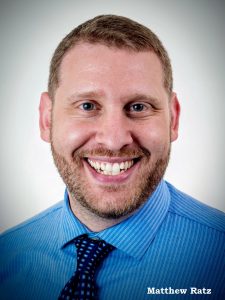
 

Matthew Ratz is a performer, speaker, and writer of poetry and nonfiction. He has performed in musical theater and dramatic productions—most notably playing Anthony Weiner in 2016’s premier of Weiner: the Musical. He is also a regular feature of both music and spoken words at the LaTiDo cabaret in Washington, DC and regularly appears in Montgomery Playhouse productions. Additionally, Matthew has led concurrent sessions at academic conferences locally and nationally on the topics of differentiation, autism, and Millennials. He teaches English composition at Montgomery College and at Howard Community College and previously worked in the fields of Special Education and Developmental Disabilities. His non-fiction writing has been featured in The Kappa Delta Pi Record, The Gaithersburg Town Courier, The Five Towns Jewish Star, Autism Spectrum News, Impact Training Publications, and The Huffington Post; his poetry has been published in the 2003 University of Maryland’s Stylus literary journal, in 2016 on The Huffington Post, and most recently in his chapbook Lightning Bugs in Fragile Jars released in 2017.

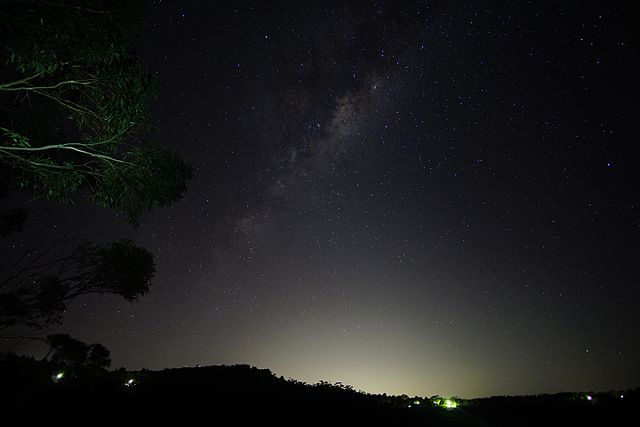
Image by Evonneyu – Own work, CC BY-SA 4.0, https://commons.wikimedia.org/w/index.php?curid=48653039

Three Poems by Danielle Badra

All the silenced, all the neglected, all the invisible

This is not utopia. This is a borderland. This is south of the borderland.

This is not the apocalypse; this is calypso.

This is a joyful dancing rebellion. This is duende. This is a revolution of loose bones.

This is a full-bellied brawl between resilient hips and gravity.

Of those who are overrun, of those who look to the moon for light, of those without

a moon, of those without,

this dance is yours and mine, this dance is irrevocable, this dance is fanning flames,

this dance is eating flames.

Let’s rise to say, “enough is enough.” Let’s rise to say, “I exist.” Let’s rise to say, “Here.”

Let’s rise to say, “I hold the sun between my burnt teeth.”


* Italicized text is translated from Ana Tijoux’s “Somos Sur (featuring Shadia Mansour).” This poem is in response to a video of a belly-dancing routine to the song “Somos Sur” by Gio of Zombie Bazaar Panza Fusion.


Mahmoud

I.

your throne is vacant

was margin is mystic


like Rumi, your voice,

a ruin of rumination


a remnant of Jericho

walls, viscera of olives


hard pit of wind.

The thrown: stone of


one who builds up

blank space takes this

road blocked road won’t

come back empty handed.

II.

How dare the night

you die under Cancer,

the sky deserted, we

avid constellations crowd around

fonts of your celestial,

your sounds like cartography.

This space you held,

you hewed them in

held lungs, your hands

burning. Something like birth

rises like the moon

like your stones. The

way the heavens grow

heavy again with stardust.

* Italicized text is from Philip Metres’ “Marginalia for Mahmoud Darwish.”

A Conversation with The Prophet

I.

Your joy is your sorrow unmasked. And the

selfsame well from which your laughter rises

was oftentimes filled with your tears. And when

my willingness to sit beside your tears

turns into oud strings and a song about

strangers linked by old Cairo and Turkish

coffee, we exchange our names and shake hands

dehydrated by hot sun beams on sand.

Beneath this desert a seabed sleeps un-

abandoned. A kiss on each weak cheek, yes,

my skin is the same shade as yours and you

have lived half longer. Our hearts have slowed some

to a rested rate of moving along

to a tabla drum tapped on a distant

dune to the tune of a new lullaby.

II.

And when you have reached the mountain top, then

you shall begin to climb. And when the earth

shall claim your limbs, then shall you truly dance.

And when the lights go out at night, you will

see millions of attention starved suns dot

the death black sky. And when you sleep outside

in early august, you will watch comets

cut across the stratosphere, a space you

can’t inhabit. And when you try to trans-

late pre-Islamic poetry at twi-

light, unfamiliar words fill in for the

dark. The language of the afterlife is

silt on the surface of an oasis

where you sand dance the dabke alone

in a dead fire’s final glow. And I cry.

* Italicized text is from Khalil Gibran’s The Prophet.


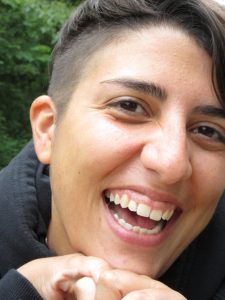
Danielle Badra received her MFA in Poetry at George Mason University. While there, she was the poetry editor of So To Speak, a feminist literary and arts journal, and an intern for Split This Rock. Her poems have appeared in Outlook Springs, 45th Parallel, The California Journal of Poetics, and The Greensboro Review. Dialogue with the Dead (Finishing Line Press, 2015) is her first chapbook, a collection of contrapuntal poems in dialogue with her deceased sister.
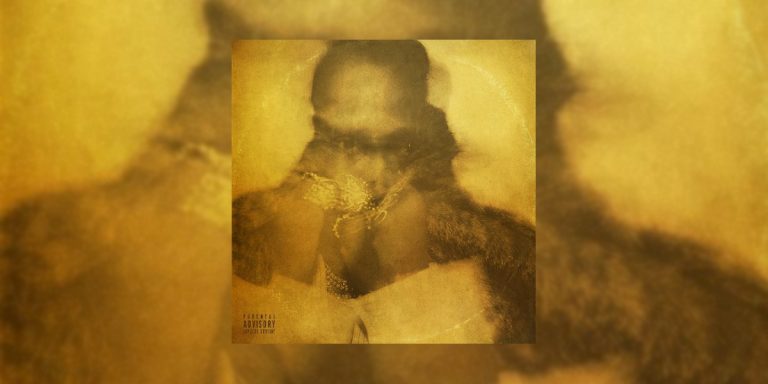
Image by Zeinebtakouti – Own work, CC BY-SA 4.0, https://commons.wikimedia.org/w/index.php?curid=60699186

Competition Finalist: Future Album Review by Noah Hawke

This article was selected as a finalist in the 2017 DC Student Arts Journalism Challenge, an annual competition designed to identify and support talented young arts writers.

Those who listen to Future generally fall into two camps; they either love him or they hate him. Critics cite “mumble rap” and monotony as reasons for their dislike while his faithful fans, myself included, just enjoy the music and can’t get enough. Regardless of your personal opinion, the Atlanta rapper has proven to be one of the most prolific, consistent, and successful rappers of this century. With ten projects released in the past three years, diehard Future fans have never been left craving a new drop. Stylistically, his lyrics constantly contrast the drug-fueled, glorified excess of his trap lifestyle with the painfully self-aware introspection of a hurting man. In terms of production, the collaboration of mainstays like Metro Boomin, Zaytoven, and 808 Mafia ensure listeners get the energetic beats they know and love. With no guest features and a stated desire to return to his roots and fans, the self-titled album, Future, cements his personal brand and legacy by remaining consistent to the styles that drove him to the top.

The project presents a uniform sound, yet still remains very good across the board, adding a collection of hits to the rapper’s massive career portfolio. With 17 tracks, it is easy to grow tired of the very similar sounds but the subtle distinctions and progressions make the project one worth listening to the end. It begins with a battle cry banger in “Rent Money”, which signals an aggressive, rough tone that continues throughout the narrative and develops a more underground feel to the heavily popularized rapper’s bars. “Good Dope” retains the heavy bass from the first track, but repetitive content makes it one to forget off the album. In “Zoom”, Future sounds awake and energetic, a return to standard Future flow, with an entertaining skit throwing gun-sound themed shade at his knockoff, Desiigner, a perfect segue into his upcoming Nobody Safe tour with Migos, Kodak Black, and Tory Lanez this summer.

With Draco, Future mixes his flows and drops some great lines, showing incredible focus and thematic references to Future’s history of womanizing, which has stirred recent drama with women like Ciara and Larsa Pippen, wife of Scottie. This song is interesting and has something special that I just don’t see on any of the other songs on the album. “Super Trapper” misses pretty badly, but “POA” picks it right back up with an all-time trap beat by Southside and Future’s self-aware claims that “[he’s] too consistent.” Just before the middle of the album, we see a nice change of pace in “Mask Off”, with the inclusion of wispy flutes and a slowed tempo, creating a very relaxing turning point and displaying Future’s intent with this album to show his true self to fans, taking his mask off. In an interview with Zane Lowe of Beats 1 radio, Future said, “I want you to hear this and be like, ‘Man he gave us all of him. He let everything out.’”

However, this glance past Future’s rough exterior doesn’t last long as he returns to tales of stunting and flexing because he’s in “High Demand.” Providing immediate contrast in “Outta Time”, “[he] can’t take no vacation, [he] can’t lose”, showing his desire to stay on top and keep rapidly producing music interacting with a sensation of running out of time. “I’m So Groovy” presents a fascinating beat combined with Cudi-esque hums, taking a different look on the power his celebrity grants him, while simultaneously giving us a song that’s just fun to listen to. A return to the self-aware, hurting side of the artist comes in “Might as Well” as Future croons about his past selling crack and “child support getting heavy”, expressing regret over past actions. Keeping with the constant contrast, “Poppin’ Tags” provides an immediate banger in the form of a textbook stunt rap, an alarming addition immediately after drowning in sorrows. The remainder of the tracks are solid, but somewhat forgettable and leave me wondering if this long-winded album would have been better released in a shorter version or as a mixtape. As the project ends on “Feds Did a Sweep”, we see a very dark finale that provides a cap to the dual nature of the album and shifts the balance decidedly in one direction.

Overall, the album is peak Future, While not containing anything as raw and emotional as “Codeine Crazy” from Monster or “Perkys Calling” from Purple Reign, we see glimpses to another side of the artist in “Might as Well” and “When I Was Broke”. Classic flows and flexes permeate the album and create a very entertaining collection of tracks. I can honestly say I liked every single song, but sadly some of the tracks get overshadowed and pushed aside due to the length of the album. True to his intent, with no guest features and a very personal focus, Future makes an honest attempt to present his whole self to fans and created a great project in the process.

Constantly toeing the line between being the name on everyone’s lips and losing his relevancy due to over-saturation, Future has carved out a massive niche in the hip-hop genre that he does not appear ready to lose anytime soon. With rumors of another album release later this week, likely more radio-focused and potentially featuring a collaboration with Chance the Rapper, titled “My Peak”, teased Tuesday on the Chicago artist’s Instagram, we might just see another extremely prolific run of projects. As this most recent release showed, you know what you’re getting from the artist, but you love it every time.

Rating: 8.5/10

Best Song(s): Draco, Might as Well, “I’m So Groovy”

Worst Song (if I had to pick one): Super Trapper

Best Lyrics: “Feds Did a Sweep”

Best Production: “Mask Off”

Noah Hawke is a rising Sophomore student in the McDonough School of Business at Georgetown University. He is a Deputy Editor for The Guide, the arts & culture publication of The Hoya, focusing primarily on hip-hop and rap music. In his free time, Noah likes to play soccer, basketball, and attend as many concerts as possible.
Competition Finalist: The Flaming Lips Oczy Mlody by Peyton Temple

This article was selected as a finalist in the 2017 DC Student Arts Journalism Challenge, an annual competition designed to identify and support talented young arts writers.

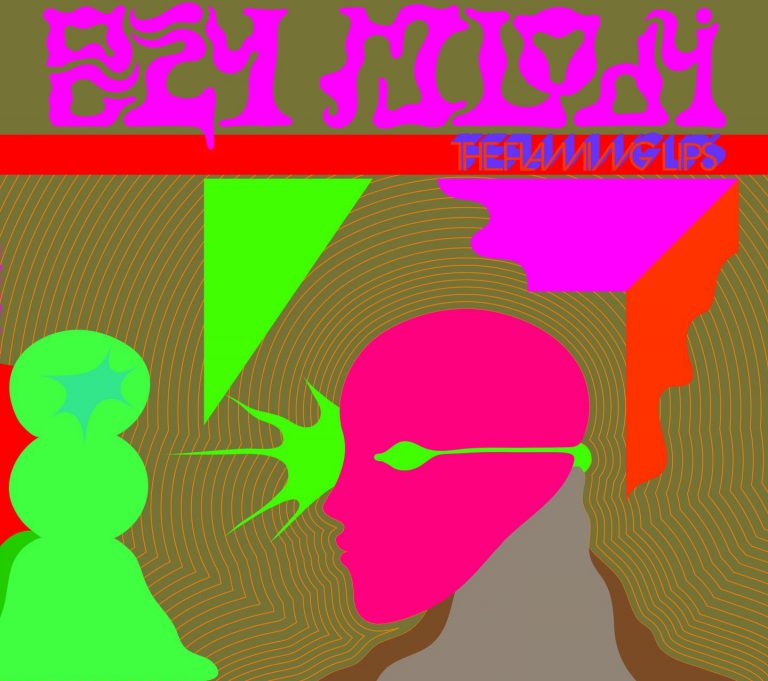
The Flaming Lips have become something of an eccentric American rock staple since 1983, the band has produced more than 25 albums and EPs. Last October, Wayne Coyne, lead guitarist and vocalist, announced that the band was beginning to work on yet another album, which was released this year on January 13. “Oczy Mlody” delivers exactly the kind of psychedelic, dreamy pop-rock expected from the band but not much more.

The Flaming Lips hail from Oklahoma City, Okla., where the band members first met in the early 1980s and continue to record their records. Since the band’s inception, it has garnered attention for its brilliant, over-the-top live performances — and for the impacts the band has had on its hometown, Oklahoma City. Oklahoma City has become an unlikely haven for artists and dreamers, especially since the opening of Coyne’s favorite party venue, the Womb.

Coyne co-started the Womb in the center of Oklahoma City’s bustling and bright Midtown in 2011. Painted and designed to resemble its namesake, the arts complex boasts visits from well-known alternative artists all over the globe, such as Coyne’s friend and collaborator Miley Cyrus. The main murals around the Womb and so-called “womb room” inside are the brainchild of artist Maya Hayuk, another friend of the band. Coyne’s vision of a city of artists and a community in an inflatable dream-space, complete with giant disco balls and life-sized dancing rainbows, has taken root in the city.

“Oczy Mlody” reflects the band’s growing friendship with Cyrus, who is featured in the dense and fairytale-like headlining track, appropriately titled “We a Family.” Cyrus and the band’s relationship has indeed grown to resemble a familial bond. The band toured with her as part of her “Dead Petz” project last year.

In 2014, the musicians collaborated on an updated take on a track from the Beatles’ “Sgt. Pepper’s Lonely Hearts Club Band,” fittingly titled, “With a Little Help from My Fwends.” The reinvention of the 1960s hit featured not only Cyrus and The Flaming Lips but also rock band Dr. Dog, indie-rock duo Foxygen and pop duo Tegan and Sara, among others.

In true Flaming Lips fashion, the album embodies the induced psychedelic sound of classics like “Lucy in the Sky with Diamonds” to the extreme. Cyrus solidified her role as somewhat of a muse for the band, their physical “girl with kaleidoscope eyes,” after “Fwends” was released.

On the homepage of The Flaming Lips website is a video of Wayne Coyne explaining the new title “Oczy Mlody.” He says that the phrase is Polish and translates to “the eyes of the young”.

“The name of our album, as far as I know, is called ‘Oczy Mlody.’ I’ve never heard an actual Polish person say it yet. Perhaps it’s wrong,” Coyne said. He explains that he liked the idea of young eyes and that “Oczy Mlody” sounded like oxycodone, which is why the group picked it.

The clip epitomizes Coyne’s attitude toward the album. It is nostalgic, and it is asking to be more hip and in-line with Cyrus’s era than a 56-year-old Coyne can muster — even if he had all the life-sized plastic bubbles and confetti in the world. In trying to be something it just cannot, The Flaming Lips lose most of that in which the group excels. The band has not really been a rock band since “At War with the Mystics” in 2006. The Flaming Lips rose by mixing rock and whimsy, but “Oczy Mlody” adds perhaps too much whimsy, covering its signature groove with dense electronica.

Tracks “The Castle” and “Sunrise (The Eyes of the Young)” stand out in “Oczy Mlody.” They are  much less cluttered and tangled than the rest of the songs on the nearly hour-ong album. Both reflect bittersweet themes about youth and innocent love. You can almost see Cyrus as Coyne sings, “Her eyes were butterflies / Her smile was a rainbow / Her hair was sunbeam waves.”

The most popular of the album, “We a Famly,” was written with Cyrus separately, over a year before “Oczy Mlody” was even a twinkle in Coyne’s eye. It sounds decidedly separate, a refreshing quality on “Oczy.” Though the chorus echoes old Flaming Lips work, synthesized, endlessly repeated lyrics like “We a family, we a family” are a nod to Cyrus and a slower electronic sound.

“Oczy Mlody” is a testament to, if nothing else, The Flaming Lips’ ability to reinvent and experiment in its work and as artists. It is lyrically sentimental and fundamentally goofy, all reasons why fans of the band keep coming back for more. It is why we return to their concerts in the hundreds and why someone, invariably, wears an orange wig in the front row. Wayne Coyne is nostalgic, but so are we. And “Oczy Mlody” is a perfect manifestation of it.

Peyton Tempel is a native Texan studying at Georgetown University. She began to write with construction paper novels and hasn’t stopped. Peyton now writes for her student newspaper, The Hoya, in the Arts & Entertainment division. This works well for her concert habit, and as an amazingly supportive creative outlet within the community.

Competition Finalist: Updraft America at the Katzen Museum

This article was selected as the winner of the 2017 DC Student Arts Journalism Challenge, an annual competition designed to identify and support talented young arts writers.

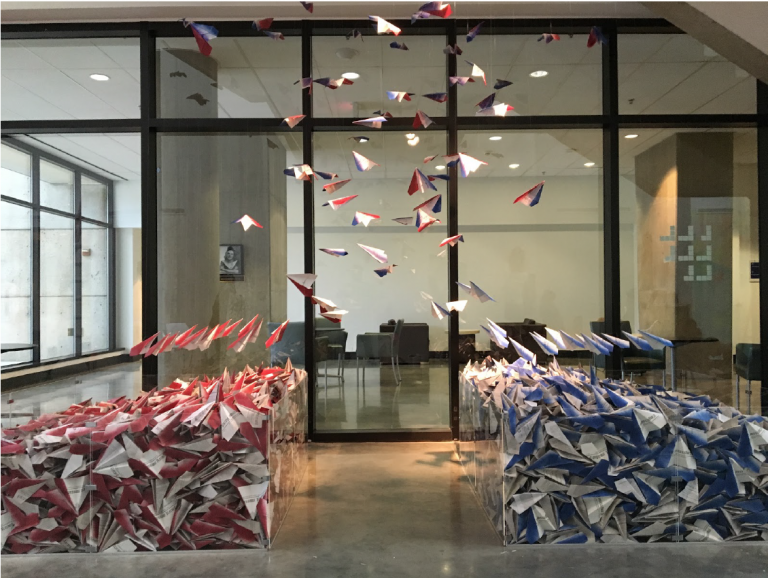
Although the American University Museum at the Katzen Arts Center always seems to have thought-provoking and passionate pieces relating to the contemporary cultural climate, there occasionally comes an exhibit that stops you in your tracks, whether from the sheer ingenuity behind it or the thoughtfulness. “Updraft America”, on exhibit at the Katzen Arts Center from September 6-October 23, 2016, is one of those exhibits. Washington D.C. sculptor and former Senate aide Suzanne Brennan Firstenberg’s frustration with our political climate led her to create Updraft America, an exhibit that uses 10,718 paper airplanes made out of a year of the Congressional Record. There is a clear emphasis on bipartisanship in the the piece — red and blue airplanes congregate together in the middle for a lovely shade of purple, the symbol of unity in politics.

As American University is known for its political activism, the exhibit’s message reflects well in the campus culture. Firstenberg first approached American University’s Museum Director, Jack Rasmussen, a respected figure in the D.C. area art world, in December of 2015 about installing the project. Because American University is a university known for its political activism, the exhibit’s message of bipartisanship reflects well in our campus culture. American University students Cory Flax and Maisha Hoque, who also works at Katzen, encourage fellow students to look into the Updraft America movement. Both have played important roles to how Updraft America reaches AU students.

It is important to mention that though the exhibit of “Updraft America” discusses the importance of intersectional discussion, the movement of Updraft America aims to promote a message of unity in the face of political adversity. It emphasizes that your political affiliation does not matter — what matters is a shared exhaustion over gridlock and the need for our political system to unite for a better nation. Each and every voice matters, which is why you can make your own paper airplane when you visit the exhibit.

Firstenberg’s life has been a series of diverse and challenging experiences, but her job as a Senate aide on Capitol Hill was a turning point. “In the summer of 2015, I was working at my Adams Morgan sculpting studio when I heard a news report of yet another threatened government shutdown,” Firstenberg said about her inspiration behind Updraft America. “That was the day I decided to use art to address political gridlock because words no longer seemed to make a difference.”

Soon after, she came up with the idea of folding each page of a year’s subscription to the Congressional Record into paper airplanes. Firstenberg began to reach out to friends, colleagues, anyone who felt similarly about the lack of union within our political system. “People are angry and frustrated,” she said. “This project takes that frustration and transforms it into something positive, something hopeful.” She set a goal of folding thirty airplanes a day to get to the current 10,718, and started to fold everywhere: doctors’ waiting rooms, stoplights, even airplanes. As her project expanded, more people of all backgrounds started to reach out to her, their frustration echoing her own. Firstenberg began to foster a sense of community among the paper airplane folders, creating a website to encourage others to fold their own paper airplanes. “I formed a bipartisan team. We met with former members of Congress to better understand how people could make the greatest impact,” she said on the inclusion of allowing people to make their own airplanes to further bi-partisanship. “The members told us that people must reach out to the candidates to say that they will only vote for those willing to work across the aisle.”

As the project gained more traction, reaction was universally positive. People were eager to fold their own paper airplane in the name of bipartisanship. However, the movement of Updraft America had a few naysayers whose cynicism was broadcast in the mantra of “this will never work.” To those criticisms, Firstenberg had an answer: “My response to naysayers is that cynicism is a vote for the status quo. Everyone eligible to vote holds responsibility for fixing our political system and possesses the opportunity to create positive change.”

Even the name of Updraft America is incredibly significant to the exhibit; Firstenberg wanted the name to define the concepts behind the art. “Stall Recovery” was a preliminary name, as the definition of “regaining positive control by reducing the angle of attack” correlated well with the project. However, she realized that the name lacked a vital kind of positivity that the exhibit wanted to project. Thus, Updraft America was born, a name that could not only represent the exhibit, but the ongoing political movement.

Firstenberg wants to continue to expand the movement of Updraft America in the future, especially among college students and millennials. “Updraft America’s mission is to give voice and visibility to people who are reasonable in their political stances — people who can loosen their grip on their own ideologies just enough to listen to someone with a differing perspective.”

The “Updraft America” exhibit will be at Katzen until October 23, 2016. You can find more information on the exhibit and movement on their website, updraftamerica.org.

Anying Guo is a rising junior at American University, originally from the small town of Latrobe, Pennsylvania. She is a journalism major with minors in transcultural studies and business administration. She writes for The Rival American, where she holds the position of editor, and recently interned at Voice of America. In her spare time, she enjoys critiquing pop culture, visiting museums for hours at a time, and attempting to enact a feasible budget while living in D.C.

Originally published on amlitmag.com on October 15, 2016.