Toward the New Year, that late December,
we parked the car near the old Sealtest Plant
just off Pennsylvania a block down from
Washington Circle where, since 1860, the
General has sat, always astride his mount,
determined in his slave holding gentility,
as the world spun out and
away from him.
And in that block the world was spinning
away from us as Joe, the proprietor, gruffly
welcomed us with an icy stare as we descended
into the gloom stepping down that small increment
to the One Step Down which was jazz and junky
central in that part of town and, accepted there,
hippie juicers, we sort of fit in without the
peculiarities of those habits related to a
noble musical profession so filled with
prophets and fallibility.
Charles “Yard-Bird” Parker wailed from the jukebox
and we could never figure out where those ancient
45’s came from that never seemed to wear out as
generations of drunks poured in their quarters and
“Strange Fruit” came with a bitter crop defined as
the place peeled back all assumptions.
The secretive white Georgetown addicts filled the bar
stools most nights while the student types, sitting in
the ancient wooden booths along the right wall, got
pitchers of beer for $2.50 or so and nodded sagely to
the always lovely waitresses who sometimes had what
you needed for exams in one of the beer apron front
pockets where those essential study aides, the “black
beauties,” were kept, two or three of those waking
a kid up for a day or two, this joint being known
as sort of a “one stop shop” for this sort of thing.
Philosophers all we raged far into the night till last call
touching the dreams of those real hipsters from the 50’s,
they still an echo that we just caught, some of us skeptical
of the bright colors and vague assumptions of our age,
attracted to the darker hues down here,
just that final step, that last step, those
few steps down that might penetrate
the fog and make the world
clear at last.
And just before the lights came up I sat there
with a brilliant friend, later to succumb to
religion, who for now was as gloomy as a
Russian poet fresh from Gulag, giving me
that old Mandelstam look of doom while
pronouncing life shit as I took issue with
his threats of self-harm based on a violent
passion for a woman far advanced in maturity,
if not years, someone he just could not handle.
In the end Old Baby Jesus saving him,
he settling for that as slowly,
from that night,
we drifted apart.
But for then, in the listless light of the early
hours we ventured out, covered by the
infernal glow of an all-night fire,
braced more for action than for
more words, working out the
dangers as we, ever carefully
calibrated and backlit,
stepped into the city
and continued to
mark our time.
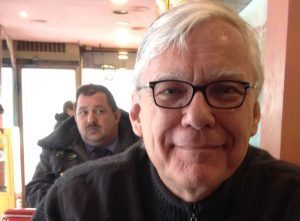 John Huey’s student work of the 60’s-70’s was influenced by teachers in Vermont such as John Irving at Windham College and William Meredith at Bread Loaf. After many years he returned to writing poetry in 2011. Recently he has had poems presented in two issues of Poetry Quarterly and in the Temptation anthology published in London by Lost Tower Publications. Work has also appeared in Leannan Magazine, Sein und Werden, In Between Hangovers, and The Lost River Review. A poem regarding the Trump inauguration will appear shortly in an anthology to be published by Poets For Sanctuary (formerly known as Poets Against Trump). Perfume River Poetry Review will soon feature a piece in an upcoming issue regarding Vietnam. His first full length book, The Moscow Poetry File, has been accepted for publication by Finishing Line Press and it will be out in October 2017. Email jhuey92@yahoo.com
Image by Freimut Bahlo – Own work, Public Domain, https://commons.wikimedia.org/w/index.php?curid=9065073
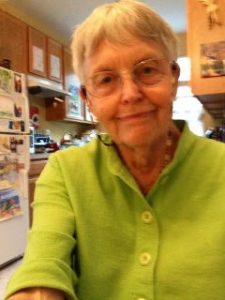 Maryhelen Snyder (Mel) has been writing poetry and prose for over 75 of her 85 years of experiencing the joy and complexity of being alive. She was named the 2016 Poet of the Year by Passager which also published her most recent book, Never the Loss of Wings. Among the poets she carries in her heart is Emily Dickinson who could express the inexpressible in lines such as this one: “A perfect — paralyzing Bliss —//Contented as Despair —”
 Alexander Olesker
 Holly Mason received her MFA in Poetry from George Mason University, where she taught and served as the blog editor for So to Speak: A Feminist Journal of Language and Art. Her poems have appeared in Outlook Springs, Rabbit Catastrophe Review, The Northern Virginia Review, and forthcoming in Foothill Poetry Journal.
 During a Washington-based career in politics, policy and news, Rebecca Leet has been widely published and quoted in newspapers, magazines, and books. She turned her pen to poetry in 2015 after 40 years as a journalist and author. Her first poem was published in Passager in Winter 2017. She lives in Arlington and draws much of her inspiration from nature, whether in her backyard or idling along the Potomac.