Home Blog Page 139

Brain Teaser: Nerd Comedian Dhaya Lakshminarayanan by Amy Char

0

NOTE: This article was selected as a finalist in the 2015 DC Student Arts Journalism Challenge, an annual competition designed to identify and support talented young arts writers.

Theater Comedian Dhaya Lakshminarayanan was once accidentally lodged in former president Bill Clinton’s cleavage.

“I shook his hand and then someone behind me pushed me so I kind of ended up in his man boobs — this was big Bill Clinton — and I got sort of squished in there,”

Lakshminarayanan explains. “I had to wriggle myself out.”

Her refreshing, hilarious outlook on life is clear in this tale, which she chose to share at one of the Moth’s StorySLAM events. Lakshminarayanan responded to the theme of “office” by delving into her neurotic obsession with Clinton and how she never had the chance to connect with him the three times they met. Each encounter was either too awkwardly close for comfort, too brief, or too embarrassing (and was further punctuated by the provocative bachelorette party outfit Lakshminarayanan was wearing).

The Clinton story is only a single aspect of Lakshminarayanan’s impressive résumé, which is generously dotted with storytelling emphasized by human connections, progressive standup comedy, and funny-yet-poignant explorations of the struggles of being a nerd. And yes, her two degrees from MIT and her stints in management consulting and the venture-capital world might have something to do with it as well.

One of Lakshminarayanan’s current projects, a show titled Nerd Nation (its next showing is Friday at Alameda’s Pacific Pinball Museum — an aptly geeky venue), explores the trials and tribulations of being nerdy in a country whose culture values following the Kardashians rather than Neil deGrasse Tyson. “We’re like, ‘I don’t know that dude. Does he have women on his show? Are they hot?'”

Lakshminarayanan described it as “self-imposed anti-intellectualism.”

Nerd Nation, a work in progress, examines what’s happening in nerd culture. First, by highlighting a phenomenon she calls “boobs and boys,” Lakshminarayanan explains how adolescents are bullied for being smart. “It’s really sad because girls stop being interested in math and science either for social reasons or for boy reasons or they’re getting boobs and they feel weird,” she says. “They’re like, ‘Oh, I see pictures of scientists and they look nerdy and stupid,’ and I’m like, ‘No, girl, we can have heels and wear lipstick!'”

At the same time, Lakshminarayanan has noticed how, in spite of the pervasive “anti-nerdism,” people embrace sartorial and tech aspects of nerd culture. “If you look at the Mission, everyone is wearing nerd clothes and hipster glasses,” Lakshminarayanan muses. “I’m like, ‘You don’t have the cred to be a nerd. You didn’t get bullied. You’re not studying some outdated language like German. You’re not a real nerd.'”

Tech-hipster nerds are also shaping culture — for better and worse — like never before. The words “gentrification” and “San Francisco” in the same sentence may sound like a broken record to some people, but Lakshminarayanan spices up the discussion by borrowing the mantra of “diversify your portfolio” from her former investor days. Lakshminarayanan thinks “a diverse portfolio for San Francisco keeps [it] a viable, vibrant, self-sufficient city.”

“You don’t just want tech people,” she says. “You want public policy people, nonprofit people. You want artists.” She emphasizes how important it is to avoid pitting tech nerds against artists.

“I’m kind of both,” she admits. “I’d like people to come together and support each other. Tech nerds, come and watch comedy. Come and have conversations with people of color. Artists, go perform at Twitter. See what it’s like. Make fun of them.”

When Lakshminarayanan makes fun of someone or something in her stand-up act, she avoids profanity, figuring raunchy jokes might make audience members focus on how “a petite, kind of innocent-looking girl [has] a dirty mouth.”

“I almost feel like it forces me to talk about things that are maybe a little bit cerebral or a little bit intellectual or a little bit uncomfortable that women are not supposed to talk about,” she says. “I’m getting guys in the audience to laugh about feminism and I’m getting white people to laugh about immigration.”

Lakshminarayanan has heard far too many comedians punch down at women when they throw the phrase “bitch, please” into their acts for cheap laughs. “What if you took those two words out of your act? Would you still be as strong as a comedian? I would never want someone leaving my show thinking it’s okay to hurt people actively with humor. That’s why I try, as much as possible, to draw light to something and punch up rather than down.”

The Ku Klux Klan once rallied outside of the library in Birmingham, Ala — Lakshminarayanan’s hometown — and she compared this to offensive jokes.

“Sometimes comedians want to do material for the sake of being ‘edgy,'” she says. “Freedom of speech — do it, but what are you creating in society? Are you creating understanding, togetherness, and laughter?”

As for the Klan, Lakshminarayanan wasn’t fazed. “If you make it a big deal and you act afraid of them, you give them power,” she explains. “But think about it. They’re in weird costumes, they can’t really see. I’m surprised that they’re still able to walk in a straight line. If they’re going to impose racism on others, they should at least have their body free. I mean, do some kinesthetics!”

Amy Char is a junior studying government and German at Georgetown University. Originally from San Francisco, she has written for the San Francisco Bay Guardian, one of the city’s alternative weekly newspapers. Her work has also appeared in Georgetown’s newspaper of record, The Hoya, and on WGTB Georgetown Radio’s music blog, The Rotation. She will be studying abroad at the Humboldt University of Berlin next semester.


Flowers, Fruit, and Fatality: Death and Decay is Super Natural by Christine Slobogin

0

NOTE: This article was selected as a finalist in the 2015 DC Student Arts Journalism Challenge, an annual competition designed to identify and support talented young arts writers.

“What is natural?” is the intriguing inquiry surrounding the National Museum of Women in the Arts summer 2015 exhibition, Super Natural. This frustratingly broad question could be answered in a plethora of ways; the works of Rachel Ruysch and Sam Taylor-Johnson—purposefully displayed opposite of one another in the exhibition’s main room—answer this query pessimistically. Ruysch’s seventeenth-century still life painting and Taylor-Johnson’s 2001 video Still Life suggest that decay, death, and the passage of time are the most essential and inevitable processes in our natural environment.

Society has traditionally aligned women with nature because society tends to describe both as pretty, graceful, and demure. Many of the women artists in Super Natural, including Ruysch, challenge these characterizations. Instead, Ruysch and later artists chose to infuse their art with the scientific, strange, and abject elements of nature. Ruysch’s Roses, Convolvulus, Poppies, and Other Flowers in an Urn on a Stone Ledge seems to depict a thriving bouquet of flowers. Upon closer examination the arrangement contains fatal signs of decay.

The composition’s central pink rose wilts, showing the beginning stages of decomposition. Deep purple flowers, half-hidden at the rear of the bouquet, also droop. Their shadowy hue and sagging posture foreshadow the bleak future in store for their upright counterparts. Holes in the bouquet’s large green leaves also suggest impending deterioration. Even the still life’s title reminds viewers that these natural organisms will not last forever. The bouquet stands in an urn, which sits upon a stone ledge—neither setting encourages growth or life. These subtle elements allude to the passage of time and the subsequent demise of the plants.

While Ruysch’s painting subtly refers to decomposition, Taylor-Johnson’s video shines a spotlight on the process. In Still Life, a plate of fruit disintegrates over several weeks. The time-lapse video compresses the natural breakdown to just over three minutes. As the decay progresses, the fruits seem to exhale their final breaths slowly, collapsing into an unrecognizable pile of rot. The lump of the decay contrasts starkly with the pristine ballpoint pen lying next to it, which has remained unchanged throughout the video. Like Ruysch, Taylor-Johnson does not shy away from the foul qualities of natural decay. Unlike Ruysch, Taylor-Johnson has access to modern resources and technology that allow her to depict decomposition over an extended period of time.

Even without Taylor-Johnson’s technology, Ruysch does a masterful job of alluding to the unavoidable fate of her flowers. Both artists imbue their portraits of nature with the most natural life process of all: death. Both artists break the centuries-long stereotype that women artists were only fit to depict the feminine and flowery aspects of nature. These women instead focused on the disgusting, the depressing, and the decaying. The National Museum of Women in the Arts bills Super Natural as an exhibition that inspects female artists’ historical and contemporary connection with nature, but the show ends up exploring a much more universal relationship. Ruysch’s and Taylor-Johnson’s still lifes, as well as the other works by Audrey Niffenegger, Janaina Tschäpe, Maria Sibylla Merian, and Maggie Foskett, examine the ways in which all life—human or otherwise—is destined for the same fate, and each artist in their variant styles gives “death” as the simple yet poignant answer to “What is natural?”

Christine SloboginChristine Slobogin is a senior at Georgetown University majoring in Art History and English. She has previously interned at the National Endowment for the Arts, Exhibits Development Group, and The National Museum of Women in the Arts, where she wrote for the blog Broad Strokes. Christine hopes to pursue a PhD in Art History after graduating Georgetown.

Featured image in this post is detail from “Roses, Convolvulus, Poppies and other flowers in an Urn on a Stone Ledge” by Rachel Ruysch

Inside Out: Mind’s Eye by Mark Lieberman

0

NOTE: This article was selected as a finalist in the 2015 DC Student Arts Journalism Challenge, an annual competition designed to identify and support talented young arts writers.

Some movies go to great lengths to show you how profound they are. Others just assume you’ll pay attention. Inside Out is the latter.

The latest Pixar movie follows an 11 year-old girl named Riley, who moves with her family from her childhood home in Minnesota to a dingy apartment in San Francisco. The move makes Riley sad. She misses her best friend, her hockey team and her childhood innocence. But her parents, despite good intentions, are too busy settling in to notice that Riley is struggling.

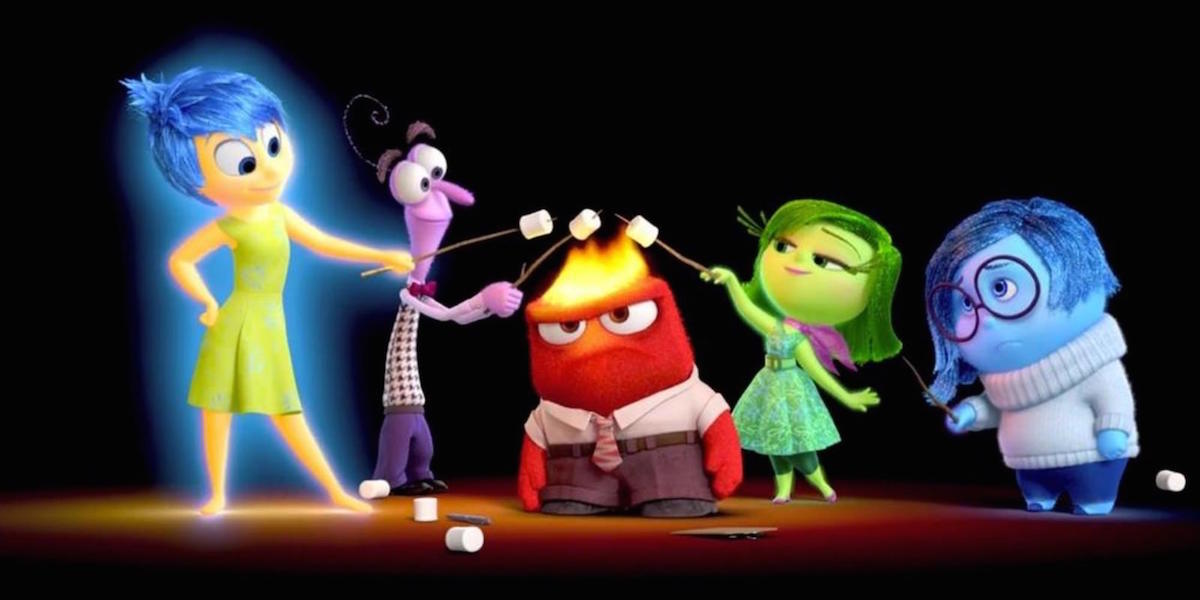
This is a story you’ve seen many times before, more likely in your life than at the movies. That’s because the story doesn’t appear to have much in the way of exterior stakes. And it doesn’t. But Inside Out finds a way to make the interior stakes exterior by zooming in right between Riley’s temples, where emotions Joy (Amy Poehler), Sadness (Phyllis Smith), Fear (Bill Hader), Disgust (Mindy Kaling) and Anger (Lewis Black) take turns influencing Riley’s actions from a sleek control center in her cerebal cortex.

Influencing is the key word. Inside Out wisely avoids drawing a direct link between emotions and actions. It’s correlation, not causation. Dramatizing such abstract relationships would seem near impossible, but director Pete Docter and the team at Pixar have pulled it off with stunning complexity.

A train of thought stops shuttling when Riley drifts off to sleep. Islands of Personality distinguish Riley from others her age, and they break off as she moves away from early childhood. Memories take the shape of spheres, which coalesce in an elaborate shelving system maintained by a team of roving memory managers who toss out the old ones (“Old phone numbers? She has them in her phone!”) and replace them with new ones. When emotions touch memories, they turn the color of that emotion, forever tinged by the association of a particular feeling.

But the movie’s true achievement is its contention that Sadness and Joy are not at odds, and that one ought not exist without a little of the other. As voiced with the righteous positivity of Leslie Knope by Poehler, Joy’s outlook on life is unburdened by setbacks, complications, failure – real life. Happiness has limits. Sadness, meanwhile, starts the movie as Joy’s underling, forced to sit quietly in a corner while Joy keeps Riley humming along. But when Joy and Sadness have to take a journey from the outskirts of Riley’s mind back to the control center, Joy slowly realizes that Sadness has her place.

This dawning realization comes with a little help from Bing Bong (Richard Kind), a dazzling and surreal mixture of elephant, cat, human and dolphin that represents Riley’s imaginary friend, for whom she has little use in her state of burgeoning adolescence. With tinges of melancholy in Kind’s vocal performance, Bing Bong is at once as irrepressibly happy as Joy and as deeply encumbered as Sadness. The movie doesn’t announce it thus, but Bing Bong unites the two emotions, or at least brings them to a place of greater mutual understanding.

There are plenty of serious ideas, and even some darkness, below the shiny surface of Inside Out, but there’s also a bounty of great jokes, visual and verbal. Anger gets his news from a daily copy of “The Mind Reader,” printed in the style of a traditional broadsheet newspaper. Fear sees the danger in even the most mundane task. A foray into abstract thought flattens Joy and Sadness into bundles of two-dimensional shapes, then squiggles, then lines. During the end credits, peeks into the minds of other characters and pets reveal the more basic comedic potential that would have made Inside Out more conventionally enjoyable but less ambitious.

“TRIPLE DENT GUM!”

Oh, right, I should mention the movie’s ceaselessly riotous running gag. Or better yet, you should see it for yourself, if you’re not already experiencing it in your head at this moment.

Inside Out is content to be unusual without telling you as much. No one in the movie bats at an eye at the fact that Riley’s interested in hockey, even though pop culture usually tells us that young girls play with dolls and princesses while their brothers play sports. As Linda Holmes of NPR points out, no one in the movie is overtly villainous or ill-intentioned. In fact, the absence of a malevolent presence makes the sacrifices and transformations in Riley’s head all the more significant, and at times tragic.

Here’s a rare movie about children that respects them as people with thoughts and feelings but doesn’t expect them to embody the character traits of an adult. Riley’s emotions are important, but they’re different from her parents’ emotions: more scattered and tentative, less cohesive and sure-footed. They’re vibrant and energetic and passionate and curious, just like Riley, just like all children.

They’re also subject to change. Inside Out, more than almost any movie I can remember, recognizes childhood as a period of immense internal turmoil and acknowledges that innocence and naivete have their place in a person’s development. The spirit of this movie is generous and kindhearted but far less naive than Joy. It knows, even when Riley doesn’t, that growing up is supposed to be hard, and that becoming a teenager means leaving a part of yourself behind. Happy endings are nice fantasies, but it’s possible to learn something from a more ambiguous conclusion as well.

Inside Out fits neatly into the Pixar tradition of breathing life into objects or creatures that humans sometimes take for granted. Toy Story offers a reminder that possessions carry the weight of our emotional associations. WALL-E posits that a robot can experience emotions just as vividly as we can. Even Cars, considered a throwaway in the studio’s sterling canon, presents automobiles in a nostalgic, reverent light.

With Inside Out, Pixar has forayed for the first time into the realm of the intangible. But the studio’s track record makes its triumph seem not like a miracle, but a logical next step. By now, it’s a well-established meme that this movie has induced tears in many viewers. I count myself among them. But I didn’t tear up because the movie untangles all of my uncertainties about my emotions or anyone else’s. I teared up because the movie dares to ask and provoke questions that would make most movies, or studio executives, run away screaming. It doesn’t have all the answers, and some of its implications about emotional development will have you debating with your friends through teary eyes as you emerge from the theater. But director Pete Docter and his co-writers Josh Cooley and Meg LeFauve have designed a movie that works whether it reflects your worldview or not. Through the eyes of a young girl, we see a sliver of ourselves.

Mark Lieberman graduated from American University in May with a bachelor’s degree in journalism and a minor in cinema studies. He’s a reporter for the Current Newspapers, covering local politics, education, community affairs, business, trends and features for one of D.C.’s premier print publications.  He is passionate about all forms of pop culture from movies and television to music and books, and he believes that thinking about and discussing entertainment is a worthwhile and critically important pastime. His work has been published at USA Today, the Washington Post, American University’s student newspaper The Eagle and his personal blog.
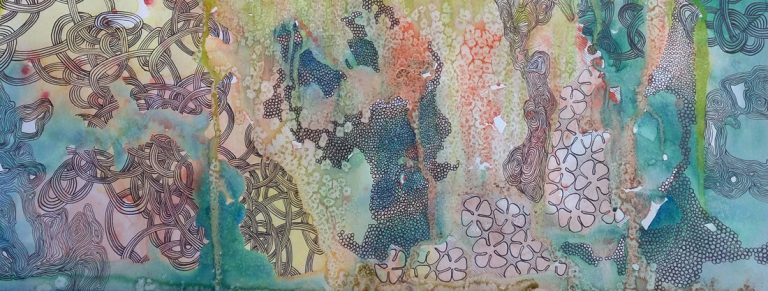
Salted Trickery by Jennifer Pizzillo

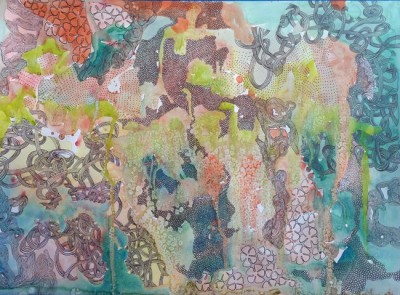
I’m working on a set of drawings that use some trickery with salt. I flood the surface of a really nice thick smooth piece of paper with watercolor until it almost seems too wet, and then put piles of kosher salt on the wet surface. The salt sucks up color and gives the surface a funky lichen effect. Once completely dry I scrape off the salt and start working on the surface with acrylic ink applied by a dip pen.

I love pen and ink for its sublime line making potential, but it is a risky way to work because even a slight bump or sneeze can ruin a whole piece. Oil paintings are pretty easy to fix: you just scrape up the mistake, add a layer, or paint over it, and your flub is fixed. With acrylic ink you really can’t fix the missteps, but with a steady hand and dose of good fortune you can get a slightly raised, slightly shiny, silky line quality that’s really lovely.

Artwork title and media by Jennifer Pizillo (2015)
Salt-aire (2015) by Jennifer Pizzillo 18″ x 24″ watercolor and acrylic ink on paper

I was born in Pittsburgh just as the manufacturing industry there was crumbling. When I was about 10 we moved to a small town in Western Maryland and I don’t know how well I fit in. It was the kind of place where everyone seemed to be distant cousins. No one went to dangerous places like Baltimore, or Washington, and even though I spent 8 years going to school there I still felt like an outsider when I graduated.

I went back to Pittsburgh for a year in college to attend Chatham College. I spent more time with my grandparents and made great friends and got to know the city again. I loved living there. I transferred to Towson to finish my art degree but I still visit Pittsburgh often to see family and friends, and I sort of always wished I never had moved away from there. My husband and I like to travel and even those short trips North help me remember that DC is not really the center of the universe.

I don’t make art for provocation, or to advocate for feminism, or abused victims, or the powerless, or to express political rage, or to tell my sad stories, or to exorcize demons. For me, art is exploration, itch scratching, mental maintenance and creative noodle exercise. I make things and then they pile up and I occasionally show them to other people to make money to buy more stuff so I can keep up with my art itching. Life is complicated; art really isn’t for me.

Jennifer PizilloJennifer Pizzillo is a graduate of Towson University. Her work is concentrated on assembling pleasing color palates and striking pattern in order to produce something visually stimulating. Through the practice of mark making, the effect of mixing textures and media, and the translucence of layering, she aims to create a harmonious patterned aesthetic that incorporates a wide swath of materials, surfaces, and techniques. She lives and works in Montgomery County, Maryland. More information at: https://www.wpadc.org/artist/jennifer-pizzillo

Image at the top of the post is a detail from Salt-aire (2015) by Jennifer Pizzillo.

Jennifer Pizzillo is a featured artist in “Hothouse: imPRINT”, an exhibit that will be open from May 7 – June 20, 2015 at the Capitol Skyline Hotel. This article was produced with the support of the DC Commission on the Arts and Humanities within a partnership between Day Eight and the Washington Project for the Arts.

Windows by Damon Arhos

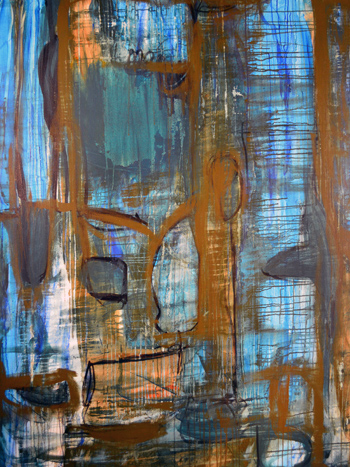
One of my earliest memories is of a dense thunderstorm in my hometown of Austin, Texas. Recalling that memory motivated me to try treating my paints as rain, and my canvases as windowpanes.

For more than a year now I’ve mixed acrylic paint and water and watched – over and over again – as gravity forces the viscous substance down the surface. The process is enlivening for me as it emphasizes the intricacies that exist between background, foreground and everything in-between.

Cyan & Orange #2 by Damon Arhos, 2014
Cyan & Orange 2 by Damon Arhos, 2014

As the paint runs down the canvas it creates puddles of pigment on the tarp I put down to protect the studio floor. I didn’t plan for these series to be an exploration of gravity, surface, and water, but they are. Each piece represents a window with paint caught like rain running down its surface.

I’m currently applying the process to works on wood. Applying both stain and paint these canvases emanate color from the wood fibers and the viscous drips that I apply. I’m also experimenting with holding everyday objects up to the surface, which forces the stain and paint into unusual trajectories down the surface of a canvas.

I’ve been interested in the confluence of the ordinary and the accidental for some time. Back in 1998 I dug through a box of family photos that my mother had collected and selected some as bases for paintings, often choosing to deconstruct figures and objects and occasionally adding in surreal elements. After my mother’s passing in 2010 I shredded documents (from her life) and integrated them into mixed media pieces as a way of exploring the meaning of physical traces. I also used family photos in some of those compositions, photocopying and layering them with paint and sections of metal screen. With those works I transitioned into abstraction – an approach that continues to be the focus of my art practice today.

It was the process of ordinary observation that motivated me to begin creating artwork nearly 20 years ago, and above all else I am grateful for the opportunity to pursue my passion for art each and every day. As time passes and our busy lives continue, how do we direct our attention? We see some things. We ignore others. Many appealing objects exist right before our eyes yet we often don’t see anything.

Damon ArhosA native of Austin, Texas, Damon Arhos is a visual artist and studio art MFA candidate at Maryland Institute College of Art (MICA) in Baltimore. He has shown artwork in exhibits and galleries across the United States and abroad. Exhibition venues have included Strathmore Hall Foundation (Bethesda, Maryland); Foundry Gallery (Washington, DC); City of Austin People’s Gallery (Austin, Texas); East Austin Studio Tour (E.A.S.T. | Austin, Texas); Plano Art Association (Plano, Texas); and the Barrett Art Center (Poughkeepsie, New York), among others. A frequent collaborator on artistic projects, Arhos has affiliated with DC Arts Studios and Washington Printmakers Gallery in Washington, DC, as well as Art Alliance Austin, the Umlauf Sculpture Garden & Museum, and the Pump Project Art Complex in Austin, Texas. Arhos currently lives and works in the Washington, DC metro area. View the artist’s website here.

The image at the top of the post is a detail from the author’s artwork, ‘Cyan & Orange 2’ (2014).

This article was produced with support from the DC Commission on the Arts and Humanities within a partnership between Day Eight and the Washington Project for the Arts.