Home Blog Page 140

Little Girly Worlds by Fallon Chase

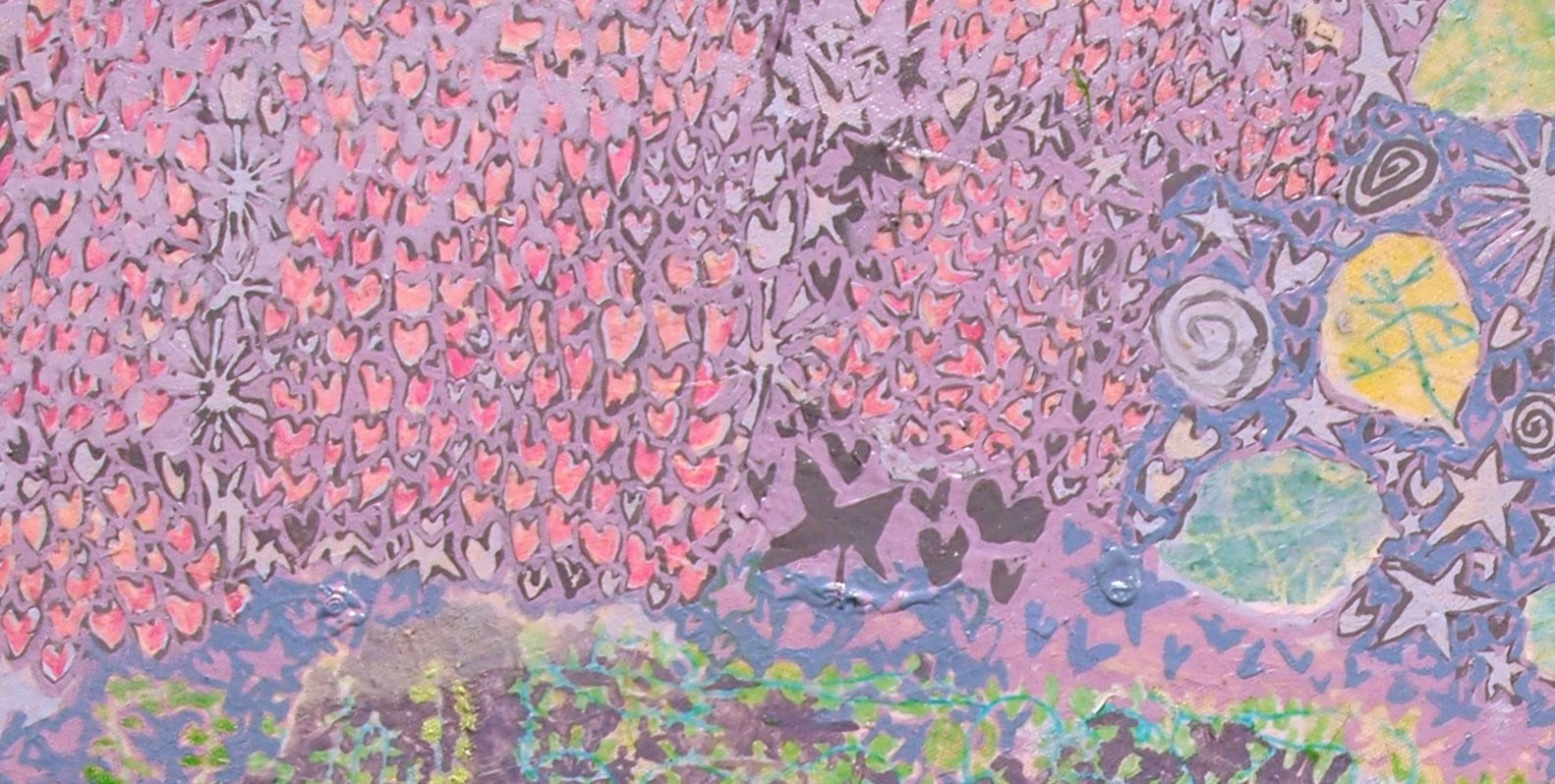
I’m fine admitting that my work most closely resembles the notebook of a middle school girl. The pink, purple and gray could be conglomerations of botanical doodles made with gel pens on seventh grade math homework. I enjoy challenging what is important enough to go into a painting and want to give space to the girly vocabulary and symbolism of hearts, stars, and flowers.

The painting I’m working on now is stretched out flat on my studio floor like a rug. Hearts, stars, and vine clusters obscure a tablet of words. Around my studio are photos cut from fashion magazines and the old cut ­up soda cans I use to hold my painting mixtures. A pile of glitter sits near the canvas.
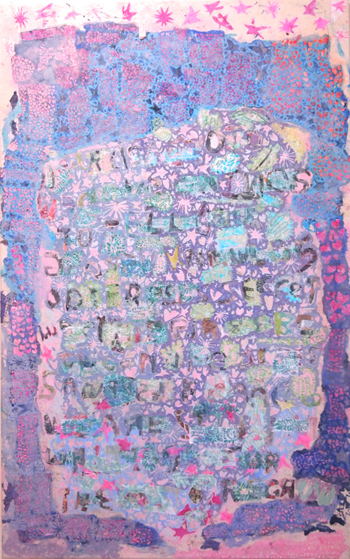
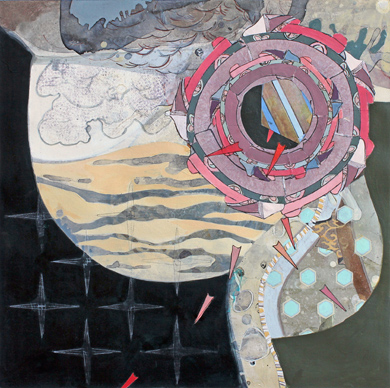
things to tell uou by Chase Fallon 2015 marker and image transfer on canvas
Things to Tell You by Fallon Chase, 2015, oil, marker transfer and image transfer on canvas

My studio is the attic/loft area where I live (in Herndon, Virginia.) Although I grew up in the area I’ve only been in this studio since last May, after finishing my BFA in painting and literature at Maryland Institute College of Art (MICA) in Baltimore. I love watching the sky change color through the two skylights in my studio space. At midday the sun makes bright marks on the floor that slowly crawl up the walls; I wish it could stay the rich ultramarine blue (that comes right before the pink sunrise) all day long.

I live at the end of the metro line and the commute to and from my day job is long. I frequently use the time to draw — grids and arrays of hearts, stars, or flowers. I almost always begin my paintings by working through the patterns I’ve made in transit with marker on paper – often on the white borders of glossy fashion magazines.

In my studio I transfer the patterns onto blank canvas. I always start on un-­stretched raw canvas, bigger than I think I may need, and build up the image with oil paint, collage, and image transfers. The paintings grow slowly and organically as I add bits here and there and the last step is stretching the canvas for display.

I find the patterns I use in the world around me, drawing inspiration from textiles, nature and art history. I’m excited by city trees covered in sugary ice, a patterned blouse glimpsed on a train platform, soggy moss eating up an old gray stone, an exquisite, embroidered couture dress, kid’s art’s and crafts, those little lit up nooks that blur by deep in the metro tunnels… Worlds nestled inside other worlds, places made of the same stuff but dazzling with a disorienting other-­ness. It’s these moments of disappearing from the known that I try to capture in my work, like little hidden pockets of garden.

As I paint the patterns become form, sometimes growing into landscapes, tablets, or tapestries. Stories begin to accidentally make their way into the work. Words too can become a sort of pattern and letters, secret messages, memories, and things I’m reading often make their way in. The paintings are my little worlds, equal parts fiction, memory, and the illogical constructions of patterns seen and imagined.
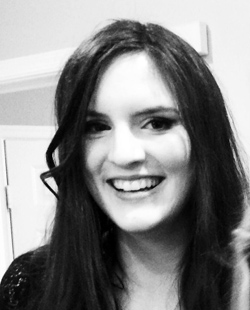
Fallon Chase 2014Fallon Chase, originally from Northern Virginia, graduated in May 2014 with a BFA in painting and a minor in literary studies from MICA (Maryland Institute College of Art) in Baltimore, MD. Her work has been shown throughout Baltimore, DC, and VA. She now lives in the DC area, paints, reads, and works at a museum.

The artist’s work is included in the exhibit “Hothouse: imPRINT” open May 7 – June 20, 2015 at the Capitol Skyline Hotel.

View the artist’s website here – http://fallonchase.com/.

This article was produced with the support of the DC Commission on the Arts and Humanities within a partnership between Day Eight and the Washington Project for the Arts. The image at the top of the post is a detail from the painting “Things to Tell You”, 2015.
White Desert by Maryanne Pollock

My first creations were small and elaborate villages that I made for ants. On the Scottish side of my family I come from a line of creatives, architects and engineers… practically minded people. My Irish grandparents came over during the potato famine and I believe that lineage framed my conviction to stand up for the underdog and helps explain why my current project is important to me.

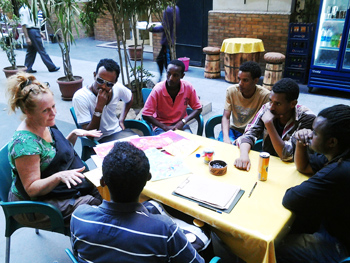
The project is an intergenerational art installation initiated by the University of Maryland and The Barrie School with an elder care facility located near the school called Winter Growth. The Barrie students and the seniors of Winter Growth are working with me to envision what a refuge means, to transform those understandings into drawings, and to print large panels of fabric that will be assembled into a tent structure. Our hope is to build awareness of global refugee-ism due to war, famine, poverty, and climate change, and to bridge some gaps between the “us” of the developed world and “them” in the underdeveloped world. We are all vulnerable in the world today.

The author, artist Maryanne Pollock, with student collaborators in Egypt

Specifically, we are constructing an 8 foot square multi-faceted, printed and painted tent. The tent represents our common human need for shelter, privacy, protection, and safety, as well as beauty and remembrance.  The project will culminate in a community picnic on Barrie’s grounds, and during the picnic attendees can face-time with refugee children (here and abroad), support student-driven fundraising, and enjoy hands-on printmaking demonstrations. Hopefully we will realize an aspect of many childhood dreams, where the tent is a place for the imagination to run free.

I first envisioned a series of illuminated tents almost twenty years ago. I went to Egypt shortly after the end of my professional training, and lived and worked there for six years. Egypt was a crossroads and hotbed for international cultures, and I found a generosity of spirit and lively intellectual discourse. While I was there I travelled in the white desert, 60 miles from Libya, with a group of Bedouins.  I was drawn to their collaborative and nomadic lifestyle, and something about the quieted voices in the night after long hours of feasting, singing, and dancing awakened childhood memories. I had always wanted to live in a hut or a tent somewhere in Africa and there I was actually living my dream. With the current project I’m trying to bring that feeling to Barrie, and Winter Growth.

As a teenager I used to skip school and take the train by myself to University of Pennsylvania in Philadelphia and spend hours studying in the octagonal shaped library there. I later studied at the Pennsylvania Academy of Fine Arts, the oldest art school in America and the Tyler School of Art. As a youngster, every time I went to the Museum of Archaeology and Anthropology at the University of Pennsylvania, I dreamed of being an Egyptologist.

I’ve travelled a lot my whole life and have always had the practice of making small works on paper to capture the light and narratives of my journeys. Some of these studies are inspirations for the panels for the illuminated tent series I’m working on now.

I’ve been a full time abstract painter, printmaker, textile artist and art educator for years. By necessity I’ve made a practice of leaping, and learning to trust that the net would appear — or in this case, the tent.

Maryanne Pollock 350webMaryanne Pollock is a graduate of Tyler School of Art in Philadelphia and Rome, Italy. She received her Bachelor of Fine Arts and continued her studies at the Pennsylvania Academy of Fine Arts, the Corcoran College of Art and Design, and through graduate studies in painting at the American University. Pollock is an international, full-time artist and art educator with many years of teaching experience, including The Phillips Collection, DC Public Libraries, and DC Public Schools. She is represented by the Ralls Collection in Washington, DC; Galerie Mourlot and SkotoGallery in NYC, and Genoma Contemporary in Venice, Italy. The artist has lived and worked in her studio in a historic building in Adams Morgan for more than a decade.
For more information please visit her website: http://www.maryannepollock.com/.

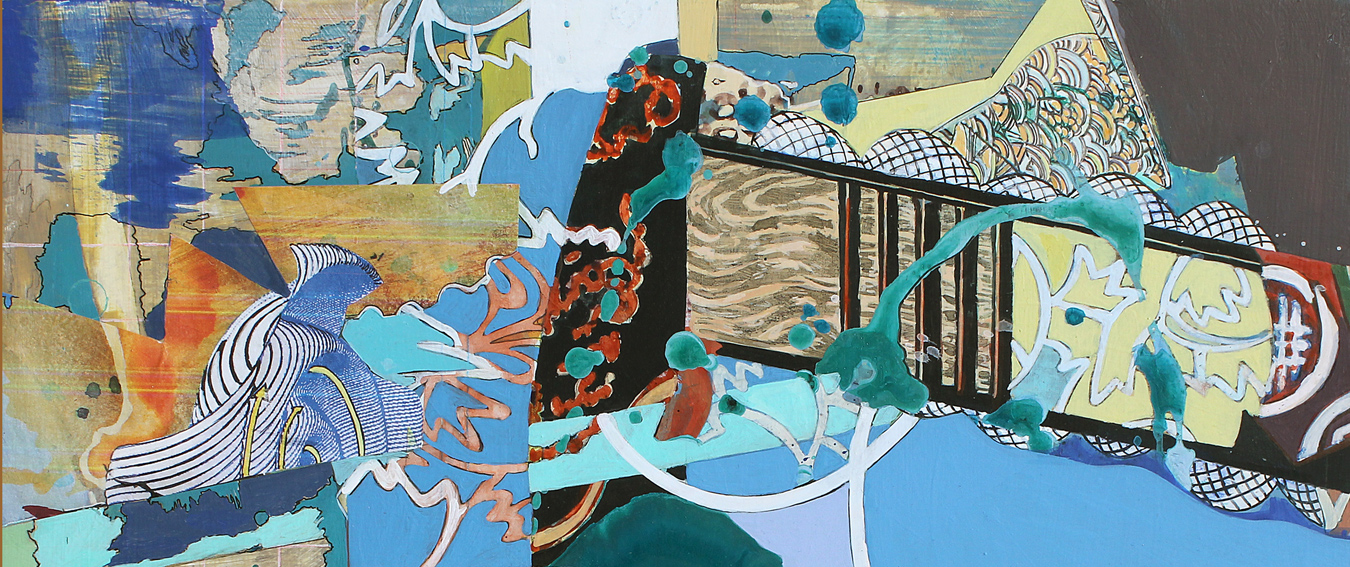
The image at the top of the post is “Crossing Over” by Maryanne Pollock (2012) mixed media on canvas.

This article was produced with the support of the DC Commission on the Arts and Humanities within a partnership between Day Eight and the Washington Project for the Arts.

The Ungrounded Course by Sylvie van Helden

A year ago I quit my job as a full time art teacher to focus more on being an artist. I had been working as a full time art teacher at the high school level for ten years. Prior to that I was an adjunct art professor, and I actually stopped being a professor to take a full-time job with benefits. I was motivated to reverse course and again focus on art making after my brother’s death in September 2013. His death was un-grounding for me, and I’ve been finding recovery in the studio.

I’m the oldest of 3 children, and my brother Pierre was the middle child. Our parents met in graduate school at Columbia University and as children we moved a lot – including from Canada to France and then to the United States – for my father’s job as an engineer and sales director in the automotive industry.

When he was 15 years old my brother was diagnosed with severe ulcerative colitis and an accompanying bile duct disorder called primary sclerosing cholangitis. Five years later there were signs of pre-cancerous cells in his colon and he underwent surgery to have his colon removed. For thirteen years after that he lived a relatively normal life. He managed the remaining cholangitis, worked full-time, and eventually got married and began raising a family.

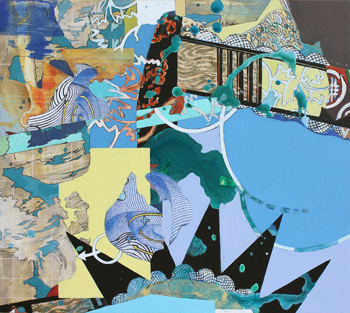
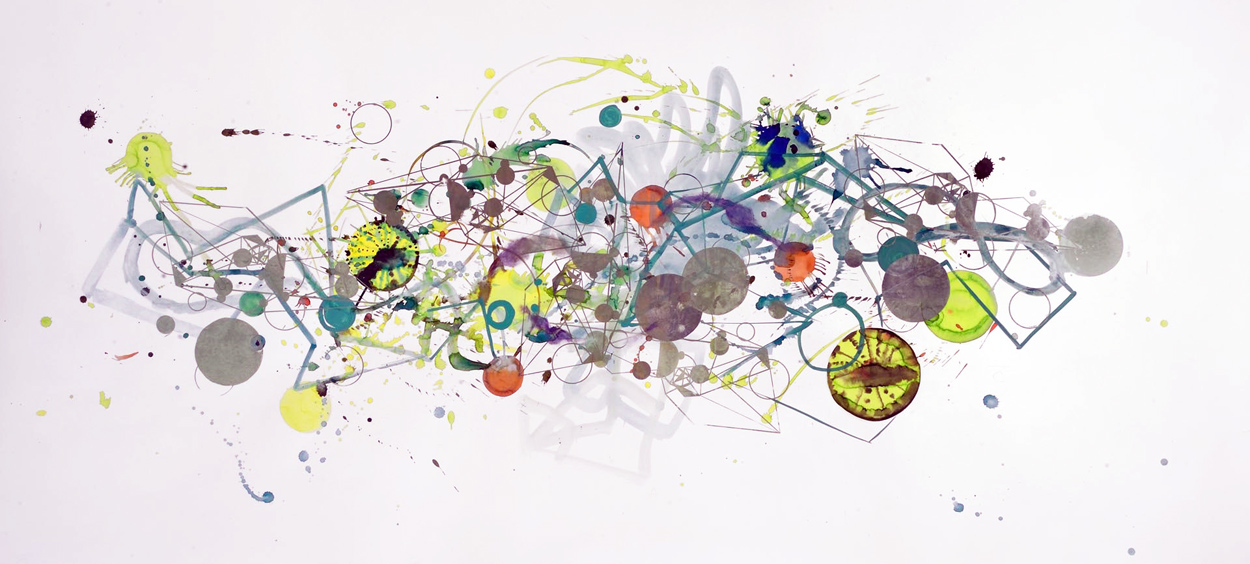
Rotation 7 - Suspension by Silvie van Helden (2015)
Rotation 7 – Suspension by Sylvie van Helden (2015)

Of us three siblings Pierre was the one who could crack a joke and have everyone in the family rolling on the floor with laughter. Though my brother and I were not particularly close as kids, our relationship got closer as adults. In our thirties we had stable jobs and personal lives and were enjoying all that life had to offer.

That feeling of contentment changed when Pierre was diagnosed with bile duct cancer in November of 2011. He fought hard but succumbed in September of 2013, and his passing created a major rift in my life. I found myself turning to my art to balance my feelings of sadness, powerlessness, and uncertainty. Sometime before my brother’s death a yoga teacher told me: the feeling of being “ungrounded” is a state of freedom, with endless possibilities and choices. Since my brother’s death I’ve been meditating on that understanding in my art.

I’m inspired by the Japanese tradition of woodblock prints known as “Ukiyo-e” (which translates to “pictures from a floating world”.) Ukiyo-e prints date to the Edo period of 17-19th century Japan. The prints often depict the leisure activities of the merchant class along with landscapes, flora and fauna. There are many things that attract me to the work of Ukiyo-e masters like Utamaro, Hokusai, and Hiroshige: the flattening of space and simplification of natural forms to their essentials, the color palette, and the abundant patterns are a few that come to mind. In my most recent work I’m drawing influence from the clothing worn by geishas and samurai in Ukiyo-e. The undulating shapes of their wardrobes convey motion and capture some of my feelings of being in flux.

Rotation 4 – Spinoff by Silvie van Helden (2014)
Rotation 4 – Spinoff by Sylvie van Helden (2014)

My newest group of pieces, The Rotation Series, all share circular shapes. The pieces often start with a spontaneous throwing or brushing of paint as I lay a loose groundwork into which I place circular shapes, which act as subjects and focal points. The pieces get more dense as I work in additional ink and paint, building up the layers as I go.

I like pieces with a lot of nuance and layering allows me to produce that. I ‘ve taken layering a step farther in the piece I just completed. Rather than have a clear subject and background, I’ve tried to create an ambiguous sense of space by having shapes recede on some edges and come forward on others and by utilizing colors with a similar saturation and value next to one another.

When I finished my MFA I went to work as an art teacher and only managed to keep making art on an inconsistent basis. Since my brother’s death I’ve spent progressively more time in the studio, and currently maintain a regular 40-hour a week studio practice.  I work out of a spare bedroom at home during the day, which leaves me evenings and weekends for my part-time jobs, household chores, and personal life.

The most important lesson I learned from my brother’s passing is that I have only one go at life. Getting back into a regular studio practice over the last year and a half has been essential to my happiness. I consider myself an artist first and foremost and my dream is to eventually be able to sustain myself off of my work. Five pieces from my Rotation Series are currently in a show at Hillyer Art Space (running from April 3-25, 2015) and you can also see one of the pieces in the upcoming Hothouse: ImPRINT show which will run from May 7 to June 20, 2015 at the Capitol Skyline Hotel.

Sylvie van HeldenSylvie van Helden was born in Montreal, Canada in 1974. After graduating with a Biology degree from the University of Michigan Sylvie moved to Baltimore (in 2000) to attend the Mount Royal Program at the Maryland Institute College of Art (MICA). She graduated MICA in 2002 with her MFA, and taught both at the college and high school levels for 12 years. Her works have been shown in local, regional, and national shows at venues such as Maryland Art Place, The Elizabeth Roberts Gallery, Eastern Michigan University, and the Painting Center in NYC. She was the recipient of a Maryland States Arts Council grant for Painting in 2004. Sylvie lives and works in Baltimore, MD. 

View the artist’s website here. The image at the top of the post is a detail from the author’s artwork, ‘Rotation 7 – Suspension’ (2015). This article was produced with the support of the DC Commission on the Arts and Humanities within a partnership between Day Eight and the Washington Project for the Arts.

Transporting by Gary Rouzer

My new album has just been released and the official release party/celebration will be at the art gallery and performance space Pyramid Atlantic in Silver Spring on May 22. The album, titled Studies and Observations of Domestic Shrubbery, is the product of focus on solo playing and composition.

I’ve been a musician my whole life but didn’t start playing experimental music until relatively recently, about 2007. My early influences were Cream and King Crimson and I played a lot of rock and jazz early in my career. A turning point for me was when I started a Myspace page for my music (on Halloween 2006.) At about the same time I started connecting with local musicians who were also interested in experimental music, and found the scene around the DC Sonic Circuits music festival.

I had always considered myself a bassist who supports a band, but I began looking at myself as a “sound artist”. I started playing fewer notes and listening more. I dug out my copy of the book Silence by John Cage (which I had purchased while working on my music degree in the late 1970’s) and rediscovered alternative ways of conceptualizing my compositions.

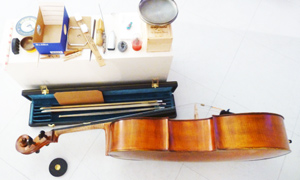
A table of instruments prepared by Gary Rouzer for performance

When I perform (and record) I use acoustic sound sources and also sounds pre-recorded going thru speakers. I play cello and clarinet and use various everyday objects – windup toys, marbles in pan lids, and rope dragged across Styrofoam – for their distinctive sounds. The sound of bowed cardboard, for example, is rich in unpredictable tones and noises. For this latest project I limited myself to only a few sound sources so that I could more fully explore the sonic potential of each ‘instrument’. I decided not to use any of my usual electronics or preparations because I was afraid of repeating myself and just pulling stuff out of my old ‘bag of tricks”. As I began exploring I noticed that the cello, clarinet, and cardboard can each produce sounds that can be mistaken for breathing. I like when the listener can’t tell which instrument is being used, and also like the fact that cardboard seems to not fit with the two traditional instruments. The fact that all three start with the letter C was final proof, in my mind, that I had found the correct instrumentation, and I decided to focus the new album around those three instruments.

The track titles were written after the music was recorded but I wanted to pay homage to important influences and keep them related to the album theme of wood and plants. “Sky Saw” and “Giant Hogweed” come from Brian Eno and Genesis respectively. The albums they appear on, Another Green World and Nursery Crime, are among my favorites. My parent’s home had many boxwood bushes in the yard, hence the title “Boxwood”. The title “Chokeberry Swallow” comes from the Berlin/Hamburg laptop-sax-bass trio HSW. (The laptop player Nicolas Wiese and I are currently working on a duo project.)

Years ago the vision in my head was to be a bassist in a famous band but it didn’t turn out like that. Music for me is about helping people attain a more intense awareness of their own life and to quote John Cage, creating “a music that transports the listener to the moment where he is.”

The album was just released on eh? Records, and label boss Bryan Day did the artwork and cardboard sleeve. I hope you’ll join us on the 22nd for the release party and concert.

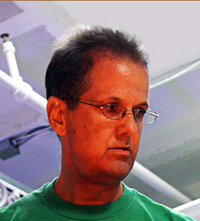
Gary RouzerGary Rouzer was born in Washington DC and works in the area between free improvisation and composition. His focus is on electro-acoustic sounds and the relation between musician and listener within the performance space while exploring noise, silence, texture, and abstract narrative. He is an active member of the DC experimental music scene and has performed at Sonic Circuits, Electric Possible, Fringe Festival, and Artomatic in addition to performances in Baltimore, NYC, Hamburg, and Berlin.
For more information and links to releases, visit https://amptext.wordpress.com/

Modern Music Boxes by Rebecca Silberman

For several years I’ve been making my own kind of music boxes with sculpted miniature puppets and custom made music box works. I’m a professor of photography at James Madison University but over the last decade my interest as an artist has shifted away from the camera made image. In a way, my music boxes aren’t such a change from photography; the camera is a kind of tiny room with a window (lens) that focuses the world down onto a miniature scale.

One of my most cherished possessions is a small, old, glass-domed music box. Inside the box is a captive little ballerina who performs a sleepy dance of jumps and turns to the mechanical tune of the music box, which is concealed under a palm-sized round stage. When I was a child part of the allure of this novelty was that it belonged to my sister. This did not stop me from trying to smash it open by pounding it against the floor when I was three years old. The dome, which is now cloudy with age, also bears the bruises and splits from my later attempts to liberate the delicate and perfect little human serenely trapped inside. Years later my sister allowed me to take possession of our childhood prize and to this day I am fascinated and delighted by it. Many influences have led me to the work I’m creating now, but the uncanny anima of this particular treasure has never faded for me. I hope to create something that will make the viewer wild with the kind of fascination and longing my childhood music box inspired in me. I’m currently on my fifth try, and each box is inspired by a piece of music.

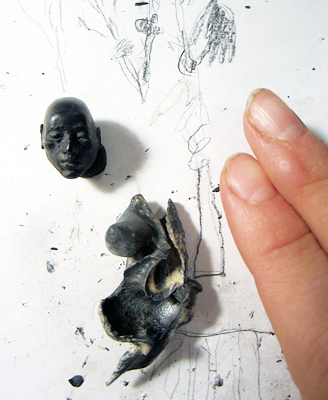
In progress (2015) photo of 'In The Pines', including the artist's daughter's fingers to show scale.
In progress (2015) photo of ‘In The Pines’, including the artist’s daughter’s fingers to show scale.

I’m not a good singer but when my daughter was born I bought a compact disc of traditional lullabies so I could learn to sing to my baby the way my grandmother once sang to me. My current music box is based on one of the songs on that CD, a ballad called In the Pines. Back in 2010 I wrote this passage from the lyrics of In the Pines into my journal: “Black girl, black girl don’t lie to me. Tell me where did you stay last night? In the pines, in the pines, where the sun never shines. And I shivered the whole night through.” My absolute favorite line is, “The very last words you said to me were sing me one more song”, because of the intimacy and finality it conveys and the way it resonates with how miniatures are worlds inside of worlds.

The actual music box works are custom made by a company in Vermont from 18 note musical arrangements. My brother in law, who is a musical director in New York City, did the arrangement for the Pines, and for the past couple of months I’ve been fabricating the miniature puppet. The main character of the song is a sort of shadow and the song’s narrative includes her going missing for some time. The bone that makes up the torso of her figure is possibly the channel from the ear of the same animal skull (likely a possum) I have used for several of my puppets. The shape of this particular fragment of bone allows the figure to wrap around and become the trunk of a pine tree. The sculpting is on an almost micro scale, and it’s slow going. I’ve probably spent about twenty hours so far, and it will likely take another forty to complete just the central figure.

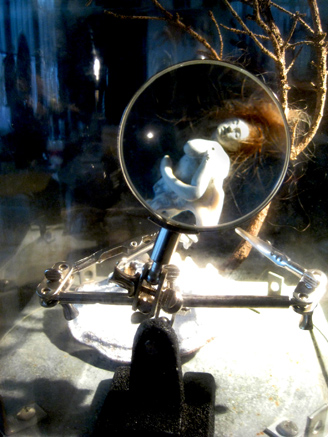
'Trespasser' (2014) by Rebecca Silberman
‘Trespasser’ (2012) by Rebecca Silberman

I’ll use a micro spot to internally light the scene, and I envision this completing as a forced perspective depicting a pine woods stage. The music box works will make the central tree rotate, one full slow rotation corresponding to the heart-breaking phrase of music from In the Pines. The puppet will both be part of and appear to be hidden in the turning tree.

I was born in Washington DC and have lived in Virginia most of my life. The house where I tried to smash open the music box was my grandparent’s house on Mansion Drive in Alexandria, Virginia. My grandmother rescued the box and put it up on a high shelf, mercifully keeping me from destroying it altogether.

In contrast to my maternal grandparent’s house on Mansion Drive, my paternal grandmother was an artist who built her own house in Montgomery County Maryland for a few thousand dollars. It is the quirkiest house with the most incredible handmade details you can possibly imagine: a mosaic wall in one bathroom made from found and melted glass depicting an underwater scene, hand carved art nouveau-esque door trim (a result of wood that cracked while being nailed up: the design conceals the fissure) and several low-relief concrete scenes rendered on interior and exterior walls.

I’m fortunate to have found an equally unusual home and workspace: a formerly abandoned elementary school in Louisa County, Virginia. The entire place is a sort of raw studio but my official studio is the old second grade classroom. My life is full of commitments, including teaching, running a gallery, and as parent of one wonderful daughter. I’m grateful for the time and energy I find to focus into my music boxes, and hope you’ll come see my work in the upcoming Hothouse: imPRINT exhibit.

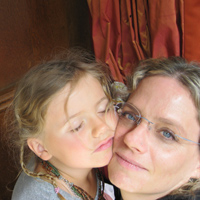
Rebecca-Silberman-and-daughter-in-Paris-200Rebecca Silberman teaches all manner of traditional photography, ranging from 19th Century techniques through large format to instant film transfers and lifts at James Madison University. Her special areas of interest include handmade sensitizers, low-tech adaptations, miniatures, optics and illusions. She is also the director of The New Image Gallery, a photo dedicated exhibition space at James Madison University. She holds an MFA in Graphics (photography, printmaking and drawing) from Bowling Green State University in Ohio.

The image at the top of the post is a detail from the author’s artwork, ‘Trespasser’ (2012).

The “Hothouse: imPRINT” exhibit will be open from May 7 – June 20, 2015 at the Capitol Skyline Hotel.

This article was produced with the support of the DC Commission on the Arts and Humanities within a partnership between Day Eight and the Washington Project for the Arts.