Home Blog Page 143

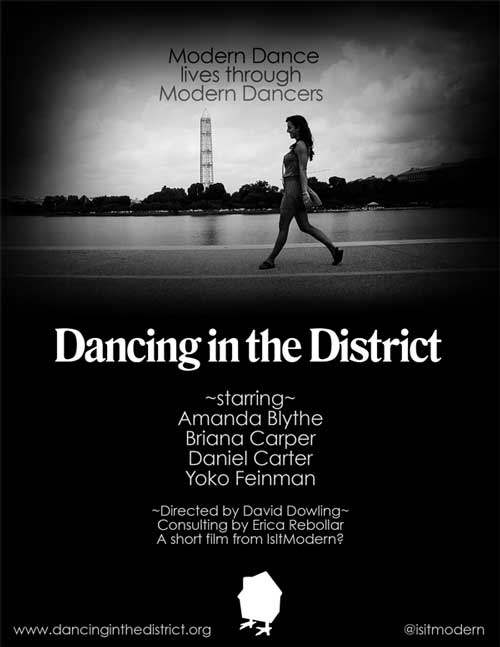
Dancing in the District by David Dowling

I’ve been a multi-media storyteller for more than a decade, and before I became a part of the dance world two and a half years ago I was under the impression that Modern art generally meant, “If the audience understands it, the Artist has failed at their Art.” Now I know that’s not true. Modern art wants to let you arrive at your own conclusions. And that’s the idea behind my current project, Dancing in the District. The Dancing in the District video series allows viewers to meet the dancers performing modern dance locally.

As the resident videographer at Dance Place, I’m a videographer within, and not simply for, the dance community. I regularly document performances, but I wanted this series to be a different kind of stage, a platform for the dancers own personal opinions. Video work is expensive and it’s usually near the end of the list as dance companies budget for the creation of Modern Dance shows. One of the afterthoughts is “now who can we get to film this show?” Video and video projections have become commonplace in today’s Modern Dance, but it remains an area that is expensive and hard to deal with professionally. Often because the videographers and video designers are not dancers, and so don’t share an understanding of the choreographer/creator’s desired vision.

My sister grew up dancing, so I’ve been around dance for a long time. While I was aware of Modern, my passion for dance didn’t really become part of my world until I met several local dance artists. The first artist I met was Erica Rebollar, and she is the person who really brought me into the dance community. I moved to DC and started working at Dance Place shortly after we met, having grown up in Reston. Erica is a beautiful dancer, and choreographer, and also the consultant for my Dancing in the District project.

I filmed the first session of Dancing in the District in April, 2013. At the time, I intended it to be a small series of brief biopics organized around interviews with dancers. The premise was simple: capture the ideas, thoughts and desires of a dancer and edit it alongside them dancing in an interesting or recognizable location in Washington, DC. Briana Carper, the first subject I filmed, had such interesting things to say that I felt the initial idea should be expanded, so the vision grew. Each dancer has their own personality and skills, and all of them were great sports during the shooting. This is a film about the current landscape of Modern Dance against the backdrop of what it is, and what it needs to do, in today’s world.

I’ve been editing on and off since I began shooting. I edit on both PC and Mac, and the editing is a lengthy process. I wrote and performed the musical score for Dancing in the District, and the only role I don’t have for the film is on-screen talent. While the project grew and changed I’ve had other priorities as well. I generally edit at night, while there are few distractions.
DITDpromo1

I am a firm believer that while your art is your baby, once you release it to the public it no longer belongs to you exclusively. When I release Dancing in the District, I will be unapologetic for its flaws. I’m proud that there was no money put into the project. There was no Kickstarter, no fundraising or grant fuel. The project was born and raised on an idea, and the good graces of the dancers. I feel this made the project pure, and beyond that of “give me something, so I can give you something back.”

Dancing in the District is more than a biopic, but less than Modern Art. On the surface, it tells of Modern Dance through the words of the dancers. Beneath their words and in their movements it’s a plea for an art form that is losing ground in a world more often desiring instant gratification packaged neatly within streamlined means of delivery. Modern Dance is competing with 3D films, the internet, So You Think You Can Dance, and other works that are easily accessible. Modern Dance is complex and challenging, and it is the responsibility of the Modern Dance community to make it accessible if Modern Dance is to live, and not merely survive.

It’s true that Modern Dance has a bit of a reputation for being lofty in the eyes of the casual audience goer. Dancing in the District brings Modern Dance back down to Earth by way of communicating through a more familiar language and the people who make it an art form worth seeing. This medium deserves more than a second glance from curious onlookers, and I hope you’ll watch Dancing in the District when it’s released and let me know what you think of it.

David Dowling is a videographer/photographer and founder of IsItModern?, which specializes in Dance Video. He experiments with various design elements and especially enjoys capturing unfolding images in nature. David has published a book of children’s readings, which have appeared on Rachael Maddow’s MSNBC blog. He has composed music and written several short, educational films that have been shown internationally. His Dance films have been featured in Dance Magazine and several dance websites. He enjoys documenting simple and profound architectures in nature. He currently works in Marketing at Dance Place and with Rebollar Dance, maintaining the company’s Internet, promotional and video presence.

Pretty Ugly by Colin Kelly

Pretty much anything audible can be interpreted as music.  Music is one of the most primitive forms of communication there is.  And it’s always been the form of communication that allows me to be my most honest, and profound.  What brought me together with the other three members of the band Young Rapids is that that statement applies to each one of us.  We are not writers.  We are by no means the best speakers.  Everything we have to express, we express most effectively through our music, our sound.

In a day and age in which one could sit for his or her entire lifetime, listen to music, never hear the same song twice and still barely scratch the surface of what is out there, it can be overwhelming to even think about bringing yet more new music to the table.  Does the public really need more music when there already exists a seemingly infinite selection of the yet-to-be discovered artists out there?  Or even more importantly, does the public need our music?

Our relationship with the public has always been a challenge for us.  We’ve always felt that there’s a discrepancy between what we do and what the vast majority want to hear.  Our sound comes naturally to us, and what we play is music that is for ourselves, and that speaks to us as four individuals on a personal and spiritual level.  In making our first album, “Day Light Savings”, we began to ask ourselves: how does the listener fall into that equation?  How are we to succeed if we only take into account our own interests?  Isn’t the whole point of creating music to provide that music to a listener?  “Day Light Savings”, in its fusing of darker and more personal moments–with our slight attempts at a more mainstream pop sound–was a search for answers.  The disconnect we often feel in relation to a vaster majority influences us, and it became a key element of the songwriting in our forthcoming album “Pretty Ugly.”

“…play your own way.  Don’t play what the public wants.  You play what you want and let the public pick up on what you’re doing.. even if it does take them fifteen, twenty years” – Thelonious Monk

Making “Pretty Ugly” has been therapeutic.  We, in the band, are happy people.  We love life, and we love each other, but like all human beings, we have our dark moments.  And those dark moments are what inspire us.  A lot of the sounds we have been experimenting with during our time in the studio are dark, moody; some almost as challenging to listen to, as they are to create.  The love-hate relationship with technology shared by all four members of the band has resulted in some highly electronic, synth-driven songs juxtaposed with lyrics that denounce our population’s over-exposure to technology.  “Pretty Ugly” also touches on corrupt political agenda, the war on drugs and, of course, the challenge of pursuing music in the D.C. area.

We’re privileged to be sharing the stage with some great bands at the 9:30 Club this coming Saturday night (1/25/14.)  We’ll be playing our new material, songs to be released on “Pretty Ugly” this coming spring, and we’re going to have a hell of a time… we’ll see if the listeners do too.

Colin Kelly plays the Drums/Bass/Vocals for Young Rapids, with whom he’s been a band member since 2010. Originally from the area, Colin studied Fine Arts at the University of Delaware, where he played in a bluegrass-rock band before returning to the DMV.

Get your tickets to the show this Saturday on the 9:30 Club website here.

The show this Saturday, organized by DCMusicDownload, is a benefit for Girls Rock DC.

Find the Young Rapids on Facebook and through their website: http://www.youngrapids.com/

Daniel Barbiero on (the) nature (of things) likes to hide

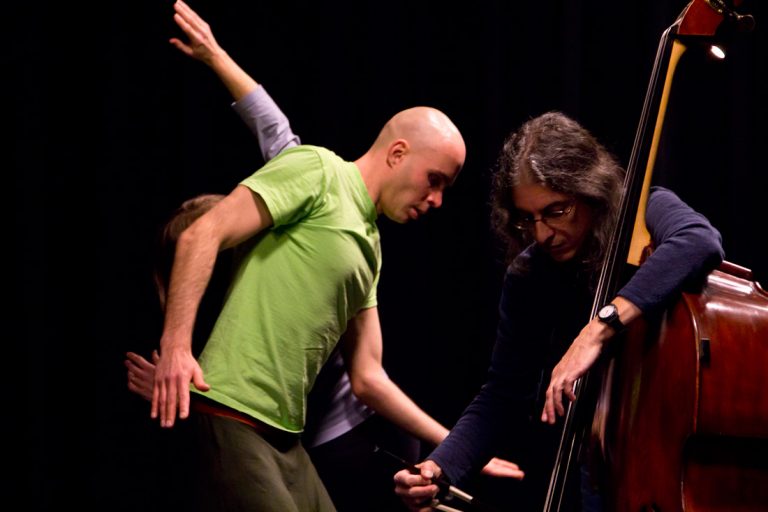
On 1 February 2014 Nancy Havlik’s Dance Performance Group will premier (the) nature (of things) likes to hide, a score for five dancers and five musicians. It will be the culmination of a seemingly unlikely process that began with the 2500 year old words of a Greek philosopher and an idea about using indirect suggestion to mold a musical—and eventually a dance—performance. The piece that would eventually become (the) nature (of things) likes to hide began as Seven Fragments of Herakleitos, a composition for a small semi-improvisational ensemble of musicians. Semi-improvisational, because I conceived the music as being improvised within certain general constraints specified by the score. This meant use of a non-traditional score. As with much of my recent work, Seven Fragments took the form of a verbal score. With their reliance on plain language, verbal scores represent a direct means of conveying information about the actions and processes asked of the performer. And yet they may allow a broad scope of discretion to the performer as well, since they can be restricted to suggesting given creative conditions or processes without specifying a determinate result. In addition, they have a near universal applicability, being equally effective as scores for music, visual art, dance and more. The first two features of verbal notation—its directness and potential indeterminacy—were what inspired me to use it for the new composition. The third feature—its multivalent applicability—is what eventually suggested expanding the composition’s scope to include dance as well as music.

Nancy-Havlik-Dance
Photo by Paul Gillis

The texts I chose were seven fragments quoted from or attributed to the Greek philosopher Herakleitos of Ephesus (fl. 500 B.C.E.). Herakleitos’s writings—or rather the incomplete remains that have come down to us through quotation or paraphrase in various sources–have always carried a deep resonance, not only for me but for many others over the centuries. Above all they are fascinating for the portrait they convey of a mind attuned to the enigmas that dwell in the heart of things—it wasn’t for nothing that Herakleitos was nicknamed “The Obscure.” And yet many of the paradoxes Herakleitos saw were expressed in the concrete terms of motion, change and rest. Given this, I chose the seven specific fragments I did based on their ability to convey suggestions about movement—specifically, the musical movement encoded in changes in pitch, dynamics, timbre or sound density.  Of course the fragments can do so only indirectly; the performer has to interpret how to apply Herakleitos’s general or figurative language to the particular production of any given sound at any given time. Some of the fragments, such as “hidden harmony is preferable to obvious harmony” or “the way upward and downward,” are fairly easy to apply to music; others, such as “approaching” or “(the) nature (of things) likes to hide” require a little more interpretive ingenuity. As did the original texts themselves. There have been many translations, paraphrases and collations of Herakleitos’s writings over the past 2500 years. I relied on the Greek texts presented in the Loeb edition, but based my own translations on several English and Italian editions, as well as on my instincts as filtered through work-specific creative criteria. The title illustrates my process. The original Greek contains the word physis, which can be mean “nature” or “a thing’s nature.” I chose to conserve both meanings by the use of parentheses, which allow the phrase to be read—and acted upon—either way. The score itself is trilingual, setting out the original Greek along with the English and Italian translations. I found that the nuances of the English and Italian versions tend to throw light on each other, and for this as well as for aesthetic reasons, I thought I’d use both. Although I originally intended the score for a music ensemble, it quickly became apparent that it would be appropriate for dance as well. The idea of using it for dance came about by accident, when Nancy Havlik, in whose Dance Performance Group I am music director, expressed an interest in having a text of some sort for a new piece to be developed for the upcoming season. I showed her the score to Seven Fragments, and she thought it was indeed something she could build a dance piece around. Shaping the piece has been a matter of collaboration drawing in all members of the group. Nancy came up with a set of movement phrases for the dancers to use, and choreographed a series of solos, duets, trios and ensemble passages. The dancers chose particular fragments to guide their movement, using the texts exactly as I had envisioned the musicians using the text, as more or less figurative suggestions governing literal actions. In addition, Nancy introduced the idea of integrating the spoken word into the performance by having the dancers speak parts of the text—in the original Greek. She brought in a native Greek speaker, who taught them how to pronounce the words. For the performance, the five musicians—of whom I will be one–will be given the same text score as the dancers. We’ll use it the way it was originally intended, as a suggestive set of directions that can be applied to such musical parameters as pitch, dynamics, phrasing and timbre. How our interpretive choices intersect with the dancers’ choices will be a significant source of the creative drama realized in the performance. Video: Excerpt from Swept Through (Framed), performed by The Subtle Body Transmission Orchestra + Dance Performance Group at the 2013 Sonic Circuits Festival (the) nature (of things) likes to hide will be premiered on 1 February 2014 at the Josephine Butler Parks Center, 2437 Fifteenth St. NW, Washington DC. Daniel Barbiero (1958, New Haven CT) is a double bassist and composer in the Washington DC area. He has performed with Gino Robair on the latter’s I, Norton opera and with Robert Carl on the premier of Carl’s “Changing My Spots;” he has released work under his own name and with Ictus Records percussionist Andrea Centazzo, Blue Note recording artist Greg Osby, and electronic sound artist Steve Hilmy. In addition to his solo work, he is founder and member of The Subtle Body Transmission Orchestra, a member of the free improvisation trio Colla Parte (with saxophonist Perry Conticchio and percussionist Rich O’Meara) and Music Director for the Nancy Havlik Dance Performance Group. Top photo credit: Angel Traveler by Roman Sehling

He Was Beautiful by Ron Moore

1

My name is Anna; I’m just a Baltimore girl who likes to draw. You know my neighborhood the one with the pearl onion steeples on top of the church. East Baltimore has changed but you’d never know it sitting here at Uncle Hank’s party. I’m named after two strong Ukrainian women; my great grandmother Anna and Maya Deren. If my name is my destiny then I have a lot to live up to.

Uncle Hank is 58 today. I faithfully attend family functions when my schedule allows. I believe our ancestor spirits honor us when we honor the elder spirits that walk among us. Lately all anybody wants to talk about with me is my job. Not my art, not even my love life but my job.

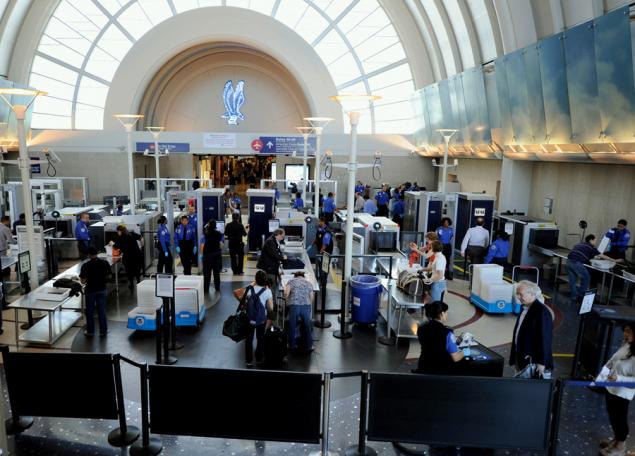
I’m a security screener at the airport. Now they call us Transportation Security Officers. Like they say, if they can’t treat you right or give you a raise they’ll upgrade your title. Like we don’t know what they’re doing. Conversations about being a screener range from ‘the grossest or most embarrassing thing you ever found searching a bag’, to ‘the most exciting story about a gun or weapon’, to grousing about profiling. It’s inescapable. So I politely talk about my job and try to move on to other topics. It rarely works.

A few days ago I was working the checkpoint on D Pier; a late flight. I’m on the night shift so we mostly guard the exit lanes and test the equipment until the early morning shift comes in at 3:30 then we screen early arriving passengers until we go home at 5:30.

I was working the mag or walk thru; I guess the technical term is magnetometer. There’s a lot more to it than just listening for the beep, beep, beep. You’ve got to give passengers the once over to see if anything needs to come off or if they’ve forgotten the set of keys on their hip. Hips are another issue, lots of fake ones, but that story’s for another day.

A young man approached with an older woman. She was his mother and needed to talk to me about him before he walked through. Sometimes folks have special issues or pacemakers and we need to screen them with that in mind. He looked like a ghost. Hair sprouting out of his bandage covered head; arm in a cast and he was wearing a bloodstained t-shirt.

The night before a single car collision cost the life of a young man on I-95. They were two young guys traveling north from Tennessee when something went horribly wrong just outside the city. The young man in front of me was the driver; his friend was dead. His mother had flown up to rescue her son. They were on the last flight out of town and they were dazed.

He had a look in his eye like what they call the ‘thousand yard stare’ you hear about from war veterans. He’s not looking at you, he’s not looking through you, he just looks beyond for something he can’t see.

‘Male assist’ I call out and Ed responds. Holding my hand out one way to prevent anyone from sneaking through I explain the situation to Ed and he brings the young man through to gently get him through this way station and on his flight home to an uncertain and troubled future.

You always hear about the ‘little old lady’ who gets screened. She can’t be a terrorist but the fact is old people beep. They’ve got more hardware inside them than Home Depot and the process applies to everyone. But like this young man, we want to be the human face of the experience and be professional, courteous and kind.

‘I can’t believe it” he said, ‘A whole weekend away’. The car seemed to take on a life of its own as the two young men drove toward a future with them in the driver’s seat. They were young adults now, with adult dreams and what felt like adult responsibilities. But this weekend was about speed and getting to the college to see their girls

All he remembers is the laughter then the darkness. The car blew a tire and the young driver overcompensated sending them careening into the void. His friend didn’t survive; he will never be the same.

When tragedy strikes we become sleuths. We reconstruct events to establish the belief that it should have been us, it could have been us, it was our fault or we caused their death somehow. Each year is a burden as one carries the memory of a life cut short with them.  The days pass into weeks, the weeks years until the memory fades and details dim.

And here at the party, I spot the ‘boys’ (mom still calls her little brothers ‘the boys’ even with the AARP cards in their wallets). They are staring into space after a silent toast. No words can be spoken; there’s nothing to say. Some doors can’t be opened. They know what’s on the other side they’re just not sure who’s crossing the threshold next.

Uncle Hank never talked about Tommy, but I remember once when I was a child hearing him speak of him saying ‘He was beautiful’. Looking through old yearbooks brought the sight of this lost friend into view.  Like a blackout curtain with a pin prick. The curtain does its job; the room is dark and the pin prick is incidental. But you can’t help staring at it.

Hank carried around the burden of Tommy’s death all his life. What else could he do? Each birthday the boys toast Tommy and appreciate another year together. The pain never completely goes away but like that pin prick it appears at unexpected times.

Later that night I started to create a sketch entitled ‘He Was Beautiful’, and I think of that young man at the mag. Hank knows what he feels and what he faces. All I could do is get him through the screening process and on his way. All I can do for Hank is make sure to remember his birthday each year.

We spend maybe thirty seconds with people in good times and bad. Some like that young man — we never forget. That face, that stare haunts me. I’m glad I’m alive but I fear the day tragedy strikes near me, maybe because of me. Nothing prepares you for that journey. You can only hope that those who must guide you through the process are courteous and kind.

Ron Moore is a native of the DC area who currently resides in Statesville, NC. He served as a TSA Officer at BWI Thurgood Marshall International Airport for six years and was the founding president of The American Federation of Government Employee Local 1, the national union representing TSA Officers. He is a freelance writer, and the author of Washington Cats, a collection of poetry, and is writing a book about the early days of the TSA.

Bird Watching by Sherill Anne Gross

I am a cut paper artist. My work is made using only paper, glue, and patience.

Technically I create collages, but I don’t think collage is the right word to describe what I do. I prefer to say that I create cut paper illustrations.

Being a cut paper artist puts me in an awkward place with my contemporaries. This is both a blessing and a curse. A curse because it makes it difficult to categorize what I do and a blessing because the uncommon way I work with paper makes my art unique. I create works that are modern in subject, but traditional in format and medium.

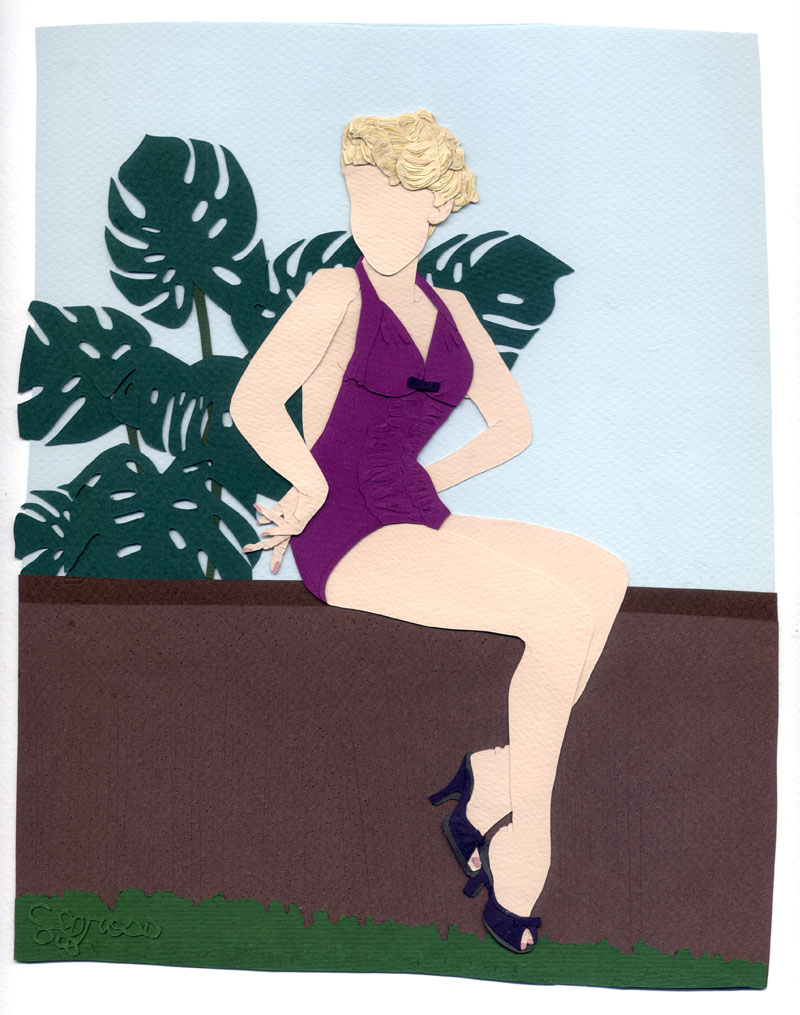
"Darla" by Sherill Anne Gross; image courtesy the artist.
“Darla” by Sherill Anne Gross; image courtesy the artist.

While it may be true for most art, I find my artwork (especially) is appreciated more in person, when the audience can see the cutting details, and the diverse qualities of the paper. While I’m very careful scanning my works so I get good reproductions, the depth of the digital impression can not compare to the hand cut originals.

I’m currently re-evaluating what I want to do (when I grow up). I had originally wanted to be an illustrator and to work primarily on books. I attempted to get illustration jobs, but did not get much traction so that idea went on the back burner. I recently did a workshop with faculty and students in the MFA Illustration program at the Maryland Institute College of Art (MICA) and their energy has made me revisit my earlier aspirations.

One major concern I’m having is with the health of my hand. I’ve had constant hand pain for about 20 years. Doctors wrote me off and told me I was too young to have any real problems. My hand at times locks up, either into a fist or with all my fingers straight out. Five years ago I was in more pain than I could handle, so I pushed a doctor to do more. After tests, he recommended exploratory surgery and we found something. It turns out I have a genetic defect where I have a second thumb muscle in my right hand. This gives me the ability to tighten jars/screws/ bottles/etc with super human strength (in all seriousness, I am not allowed to close 2 liter bottles in my house). The first and second surgeries relieved most of my pain, but in the past few months the pain is starting to resurface, and I am uncertain how it will play out. I hope I do not need more surgery and that the pain is temporary – but we’ll see.

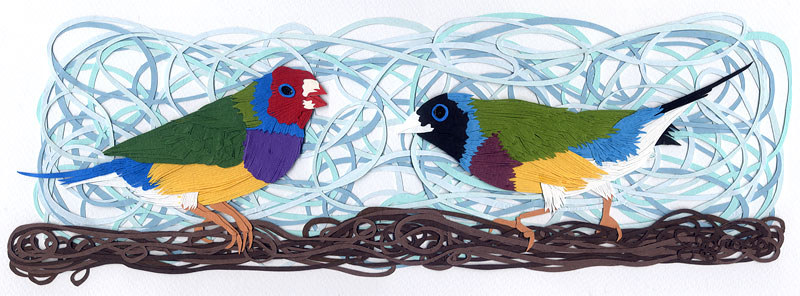
"Gouldian Finch" by Sherill Anne Gross; image courtesy the artist.
“Gouldian Finch” by Sherill Anne Gross; image courtesy the artist.

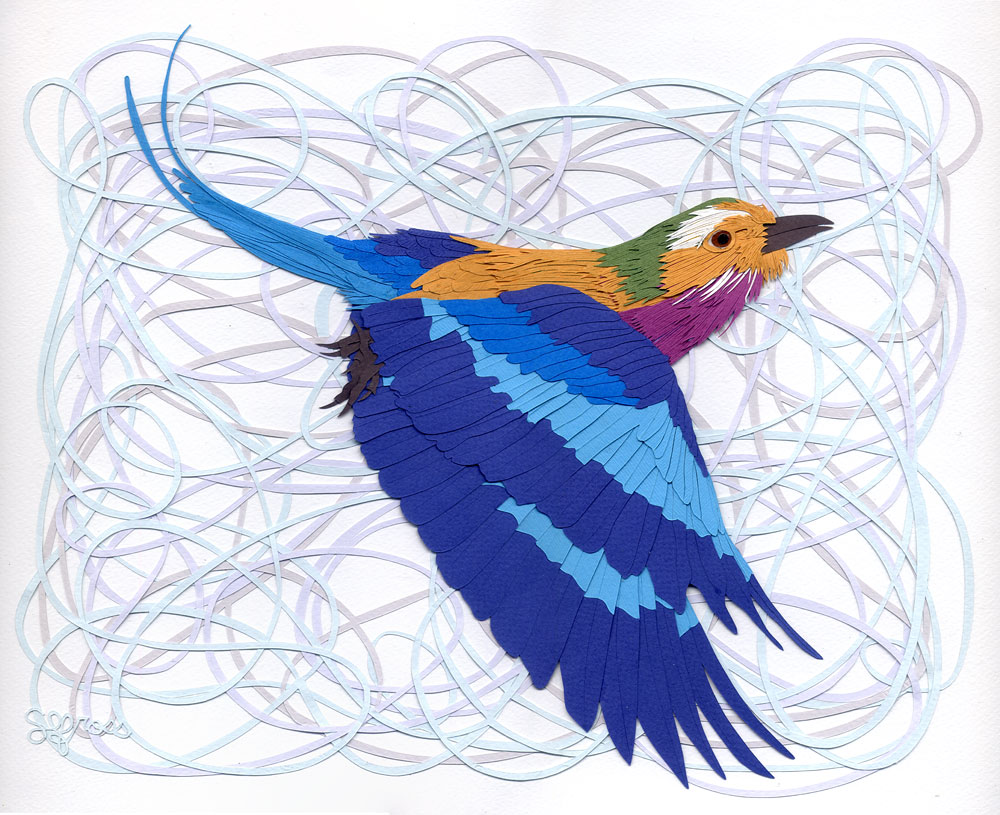
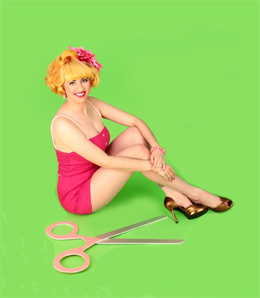
I will keep creating work until my hand no longer works, and I’m currently trying to finish new works for an upcoming show. My plan is for the show, “Bird Watching”, to be on exhibit at some point in 2015. “Bird Watching” will be a combination of fanciful photo-realistic cut paper birds and 1950’s/1960’s pinups (or ”byrds”). Both of these subjects make me happy when I start a new work. I’ve had so many back-to-back shows in the past that it’s very nice to be working without the stress of an imminent deadline looming over me. I have a handful of both themes already done – but I have many more to create before I am ready. Even though I am on my 8th bird I still get giddy when I finish a new one. This makes me laugh since I am slightly afraid of birds in the wild – I was pooped on when I was a little girl and have never quite gotten over it.

Sherill-Anne-GrossSherill Anne Gross was born and raised in central Florida and always had a flair for art and design. While the medium has changed throughout the years from crayons to computer and now to paper, the creativity has never waned. While in college at Florida State, Sherill focused on graphic design but found printmaking to be one of her favorite ways to create art while getting her hands dirty. This work with printmaking helped refine Sherill’s style. In 2000, she received a BFA in Studio Art. It took several years before her work began to resemble Sherill’s current style. The art she creates today is only made with paper and is frequently composed of thousands of small pieces layered onto each other. Sherill’s work has been featured in many group shows as well as several solo shows locally and nationally. Her artwork has also been featured in books and magazines.

The artist’s website: http://sagworks.com/art.html