Home Blog Page 144

Hiding the Bullet by Rosemary Feit Covey

4

“What should I write for this piece?” I asked my friend Kathy Beynette. Kathy is one of my best art friends. An art friend is a good friend but more, because they understand ones work. Kathy will always give an unexpected answer but this time she was practical. “Write something that promotes your exhibition at the Evergreen Museum in Baltimore.”

Kathy was in my studio at the time. I had asked her to comment on a large painting I’m working on that is made up of hundreds of woodcuts. I had become stuck on some compositional elements. After working non-stop for three weeks on this one piece I was not sure I could see it clearly anymore. Kathy suggested I leave one corner light and keep the upper section less defined. I had not thought of this. When finished this will be one of the cornerstones of my retrospective exhibition at the Evergreen.

This particular piece is called “Crossing the Line”, and I had made a smaller version last year. That sold. This one triples the scale and takes the concept much further. At first the viewer is drawn to the highly decorative, bright ginkgo leaves. Looking deeper, the colors reference a personal tragedy. The yellow police line and the blood left on leaves by the door. “Crossing the Line” is made from just five wood engravings, printed many times, with each leaf print cut out and worked together into a large composition. This is a labor intensive piece of work, but labor alone does not amount to a hill of beans if the concept and final work do not come together and resonate emotionally.
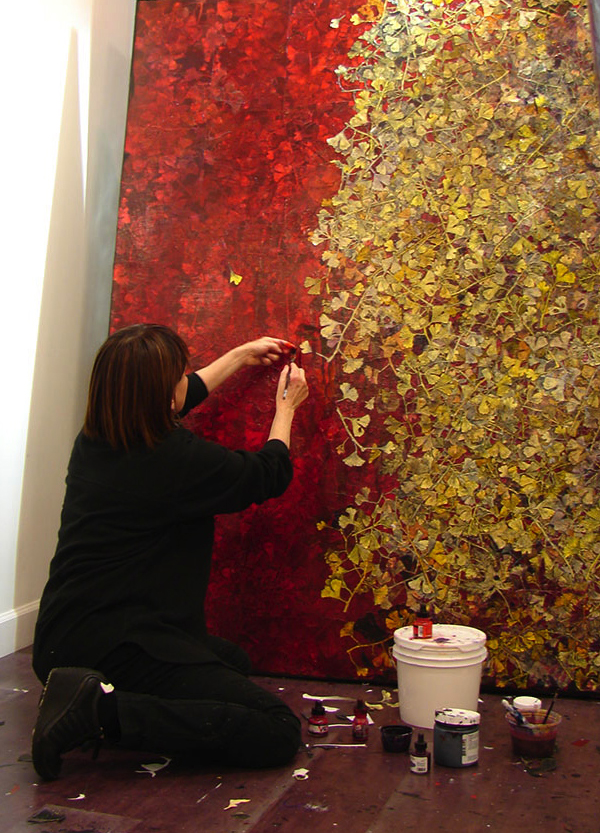
Rosemary Feit Covey with Crossing the Line
Rosemary Feit Covey creating “Crossing the Line”. Image courtesy the artist.

In this composition I’m taking the risk of including a few new elements not tried in the earlier version. Hidden underneath the leaves is the shape of a figure, and a bullet. These elements can only be perceived subliminally as they are covered by leaves on the surface. Even someone owning the artwork may never know what the raised sections of the painting reference, or ever find the bullet. Kathy and I discussed the concept and how far to push it. She understands that I needed those pieces as personal touchstones as I worked (during the weeks I spent printing, painting and cutting parts those elements kept me connected to the meaning of the piece), and why it was important to not make them a compositional focus.

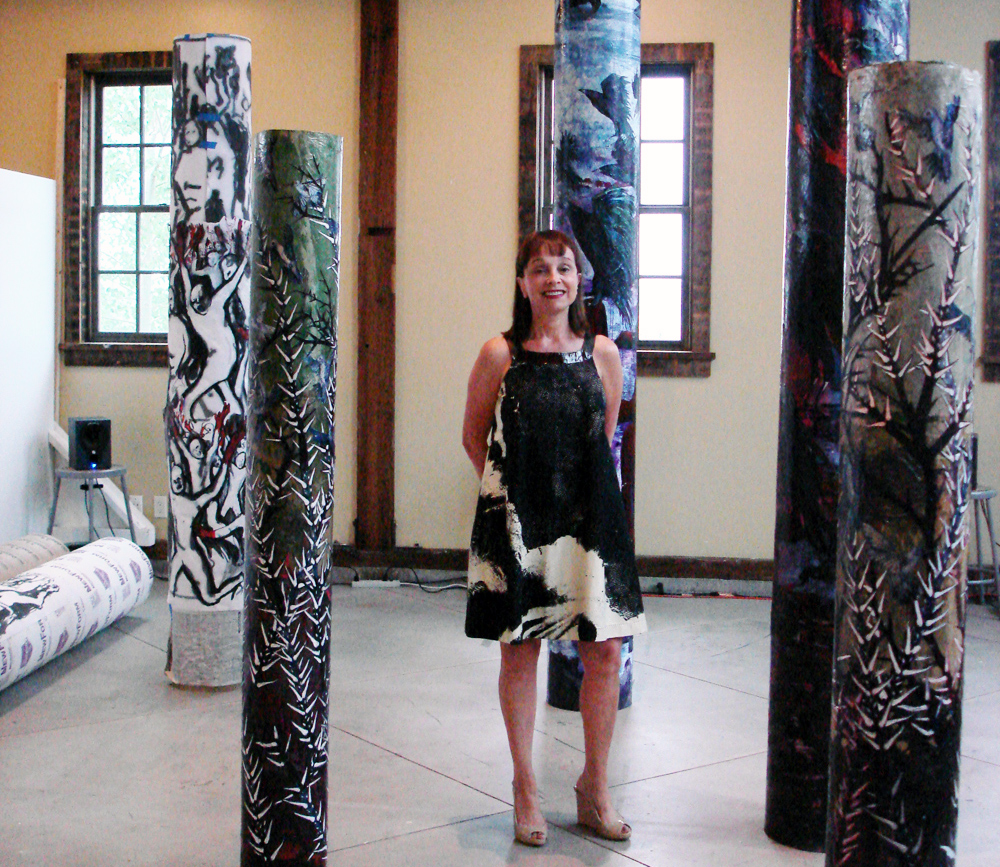
During the same conversation Kathy and I also looked at some large pillars I am creating for the Evergreen exhibition. For this exhibition I am making eight pillars. The pillars measure from six to nine feet tall, and were started during a residency in Park City, Utah. For that residency I drove across the country with my dog Seal, and once I arrived, the trip itself informed my work. The pillars are constructed of drawings and paintings applied to the surface of concrete forms. Working in the round presents new challenges. The work has to be seen (and be exciting) from all angles. The colors of the pillars are changing as I am no longer influenced by the Western United States. Kathy suggested continuing boldly with a yellow color I was unsure of. She often pushes for more- more color- more craziness. A good art friend thinks like this and makes artistic suggestions. It is indispensable. They know your work almost as well as their own. They have watched your progress over time, know your short hand, and limitations, but also push for growth. In a world filled with competition and unkindness this is a real gift.

I’ve noticed that the art friend relationship is not always reciprocal. Sometimes a person I help does not play the same role for me. It works as a chain rather than a direct tit for tat. Another art friend – Margaret Huddy – has for years gone out for lunch with me when either of us have an art win (an exhibition, grant, residency, or publication.) Our work is very different but our career goals mesh and we understand that it is sometimes easier to mourn failures, instead of celebrating when we do receive the small wins that make up an art career.

Kathy and Margaret and I all work at the Torpedo Factory in Alexandria. The Torpedo Factory is an unusual studio space in that the studios are fully visible to the public – with no privacy. This is not easy for me when I am working on multiple pieces and with deadlines. When I concentrate deeply any interruption causes me to react like a grumpy bear. So why work at a place where we are art/zoo animals on display? I make my living by selling my work. If this open studio was taken away from me tomorrow with the prospect of sales still remaining viable, would I go happily? I am not sure. I would miss the regular interactions with Kathy and Margaret, and I would miss the chance to be seen as I struggle.  Kathy knows where the bullet is hidden, and as we share our lives and careers that is worth something.
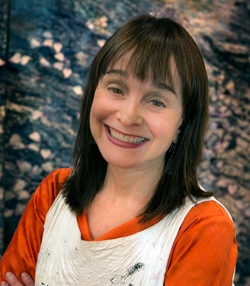
Rosemary-Feit-Covey-headshotRosemary Feit Covey has exhibited both in the United States and internationally, including solo exhibitions in Argentina, Switzerland, the Butler Institute of American Art, as well as other solo and group exhibitions. 

Collections include the Corcoran Gallery of Art; the New York Public Library Collection of Prints and Drawings; the Papyrus Institute, Cairo, Egypt; the National Library of Australia, Canberra; The National Museum of American History; Georgetown University Library Print Collection; Harvard University Library; and Princeton University Library. Georgetown University, Special Collections Library recently acquired 512 of her prints.

Ms. Covey was a 1998 recipient of a Rockefeller Foundation Grant and has been commissioned by The New York Times and The Washington Post and has illustrated many books. Ms. Covey has given lectures at universities in China, Interlochen Center for the Arts, the National Museum of Women in the Arts, the University of Wyoming, the International Monetary Fund, as well as other institutions in this country and abroad.

Born in Johannesburg, South Africa, Rosemary Feit Covey lives in Alexandria, Virginia. Visit her studio in the Torpedo Factory: Rosemary Feit Covey, Studio 224, or her website: http://rosemaryfeitcovey.com. Her work can be seen and purchased at Morton Fine Art in Washington D.C.

The exhibition referenced in this article opens March 9, 2014 at Evergreen Museum:  http://museums.jhu.edu/evergreen.php

Artist Kathy DeZan Beynette referenced in this article: http://pomegranatecom.blogspot.com/2013/09/how-ugly-pair-of-shoes-led-her-to-write.html

Artist Margaret Huddy referenced in this article: http://www.huddy.com/
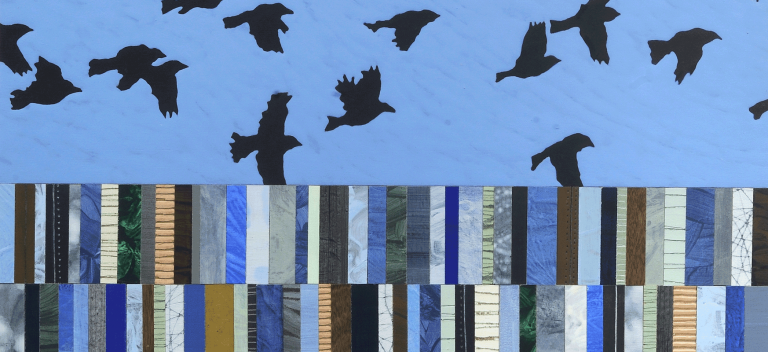
Piecing it Together at the Woodworkers Club by Ellen Hill

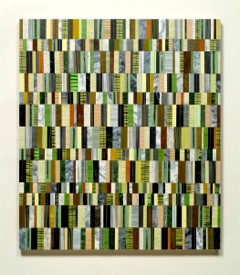
Right now I’m working on two-dimensional paintings that combine panels or multiple pieces of painted and carved wood. The paintings are developed through a technique using lots of repeated mark-making, and multiple glued wood bits. The wood bits can begin to look kind of textile or mosaic-like. This kind of repetition is itself an expressive act for me, expressive of the joy and comfort that I find in repetition, and similar feelings I have about the constancy of natural cycles.

Rock Creek by Ellen Hill; Image courtesy of Steven Scott Gallery, Baltimore

The panels are visibly textural once completed but most of them are built on smooth birch veneer plywood. It has a fairly tight grain, so it doesn’t split easily when I carve it, and it shows the grain when I ink it up. I can etch lines into it and build up the surface with layers of paint. I like the way wood feels and smells; it’s got some substance to it, and I like the inborn tactile energy that it carries with it.

I split my time between my home studio and the Woodworkers Club in Rockville, where I do the sawing and sanding. The drawing, painting, carving, layout and gluing of the artwork takes place in my home studio, so my studio is filled with thousands of little pieces of painted, inked, carved and etched wood. Spending part of my time at the Woodworkers Club is important because it gives me the chance to talk to other people who are working on completely different projects, which helps keep me from going crazy alone in my studio surrounded by little wood rectangles. I learn a lot from the other woodworkers and we chat and bounce ideas of one another. It’s good to mix some fun with work.

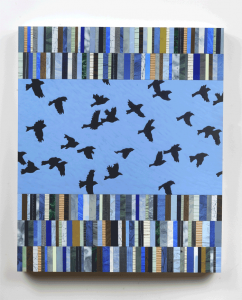
Southbound by Ellen Hill. Image courtesy Steven Scott Gallery
Southbound by Ellen Hill. Image courtesy of Steven Scott Gallery, Baltimore

I’m currently making work for a solo show that will open in April 2014 at the Steven Scott Gallery in Baltimore. I’m painting and etching boards with colorful washes and patterned lines (these boards will be cut up), and making panels with imagery. I tend to use imagery that I’m familiar with—woodsy birds and plants from the Mid-Atlantic region, or patterns that suggest nature.

So far, I’m not sure where these new pieces and panels will go. I’ve got this idea for a “tablecloth” series. I like the idea of something that people gather around at important times, where they share and have a good time. And I love the way that tablecloths tend to lack realistic perspective but can emphasize crazy pattern and energy. I’m hoping that some of the panels I’m working on now will end up in this tablecloth idea. It may or may not work; this is one of those things you have to figure out by doing.

In terms of subject matter, I usually focus my art on things that are affirming for me. I see some artwork that speaks about social issues, and it’s absolutely great and I really admire it. But I have a pretty obsessive personality to begin with, so I have to be careful because I’ve found that when I try to make work about things that make me angry, I just become angrier — and depressed. So I find other ways to address things about the world that bother me. Personal loss and sorrow have inspired some of my work, but even this work tends to celebrate what has been lost, or has been a way to try to keep the faith. It may sound simple-minded, but if someone has my work on a wall, I want it to make them feel good.

Artist Ellen HillEllen Hill‘s artworks have been shown throughout the United States and abroad in Northern Ireland and Vietnam. Her works are in public and private collections including the U.S. State Department; the D.C. Commission for the Arts and Humanities; KPMG-LLP; and Rutgers University. Hill is the recipient of two Individual Artist Awards from the Maryland State Arts Council and a 2011 Grant to Individual Artists from the Arts and Humanities Council of Montgomery County. She has taught art from the elementary school level to the college level, and has served as Artist in Residence at Montgomery College, Takoma Park, MD; Hood College in Frederick, MD; and as resident printmaker at Pyramid Atlantic Art Center in Silver Spring, MD. She received her MFA from the University of North Carolina, Chapel Hill. Ellen is represented by the Steven Scott Gallery, Baltimore, MD. 
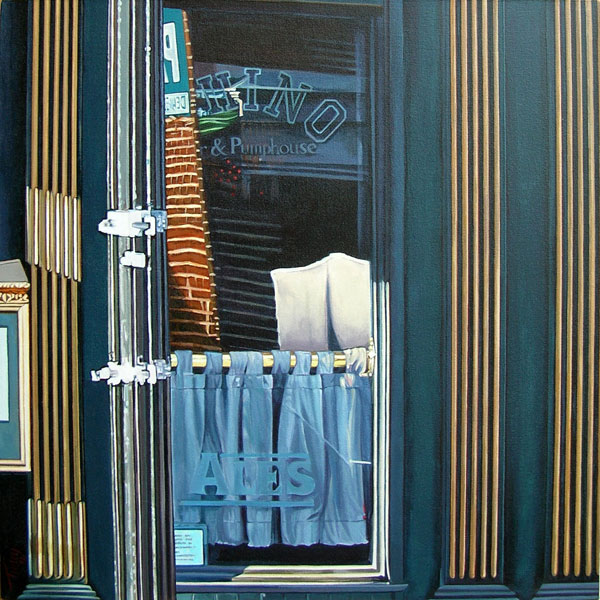
Georgetown Revisited by Teri Hiley

The exhibition that is opening this week at The Arts Club of Washington shows twenty-two of my artworks from a series I painted in response to my first visit to the east coast of America. Born in Australia I, like so many of my countrymen, love to travel. Whilst my husband and I had holidayed in America before, it was usually to ski in Colorado. In 2003 we took a longer vacation, including our first trip to the east coast, which allowed us to see a little of New York, followed by a few days in Washington, before going via Florida to New Mexico to ski. I made the paintings in this exhibit between 2004 and 2007, and at the time I painted them I never dreamed we would end up living and working here. My husband and I moved to the District in September of 2010, sent here by an Australian clean energy company to join their office here.

As a child I had a strong interest in drawing. and elected to study art throughout my secondary school years. After joining the workforce, marrying and having two children, I wanted to express myself by painting, and started with art society classes where we lived. More formal training followed, including six years of tertiary courses which led to a Bachelor of Visual Arts (Fine Arts) from Sydney College of the Arts. After the death of my first husband I used my skills teaching art in high schools for ten years.

Live-Jazz-web copy
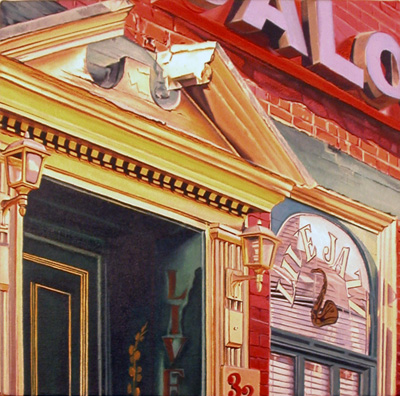
“Live Jazz” by Teri Hiley
Many of my paintings in this exhibition are vignettes of Georgetown scenes and buildings. The area is not what it was the first time I saw it, the way it is in my paintings. It has been gentrified and sanitized. What once inspired me — the creative color schemes of the old buildings along M Street, the “Live Jazz” sign — is no more. The decorative windows and doorway of that bar have been replaced with an aluminum alternative – probably more efficient, but soulless and very brown. I would not paint it today. I am currently working on paintings of Paris scenes as well as a few portraits of family and friends. I tend to work on subjects in hindsight whilst I absorb the place I am living in. I suspect the next Washington series is gestating as I write.

I usually paint for four or five hours a day, five days a week, in natural light, when I am in my home studio in the Blue Mountains outside of Sydney. That is where I painted the scenes of Georgetown — with a view on the Australian bush. I prefer to work at home. Watercolor and acrylics are my preferred mediums. To paint here in Washington I set up in the brightest room in the house making do with a lightweight easel that I can pack away easily when necessary. I have a growing hoard of art materials stashed under beds, in cupboards and in drawers. Unfinished paintings are propped behind furniture and folders of drawings lean discreetly against any spare walls. The longer I am in one place the more my art making spreads over the house. It has taken a little while to begin new projects here. It always does. Picture a cat prowling around its new space, poking and prodding the furniture till it can get comfortable and settle.

I’m honored to be exhibiting alongside talented artists Susanne Eisinger and Ellen Winkler in the upcoming show, and invite you to come enjoy the opening with me, Friday September 6 from 6:30–9 p.m. in the Galleries at The Arts Club of Washington, 2017 I Street, NW, Washington, DC. The exhibit will be on display from September 6 – 28, 2013.

Teri-HileyTeri Hiley is an Australian born artist currently residing in Washington, D.C. She has enjoyed a long career as an award winning artist, and her work is represented in public and private collections in Australia and the United States. Formal studies included the completion of the Art Certificate course at Meadowbank College of TAFE, Sydney and a B.A. (Visual Arts) at Sydney College of the Arts. Teri taught art in various high schools for 10 years before retiring to paint full time. She was accepted as an exhibiting member of The Royal Art Society of New South Wales in 1999 and was elevated to Associate Member in 2006. She joined The Arts Club of Washington in 2012.

Hairy Confrontations: a review of Sonya Clark’s solo show at Contemporary Wing, AHEAD OF HAIR by Roxanne Goldberg

This article was selected as a finalist in the 2013 DC Student Arts Journalism Challenge, an annual competition designed to identify and support talented young arts writers.

Hair. It’s chaotic, it’s ordered. Clean and messy, it is a sense of frustration and joy.

In Sonya Clark’s solo exhibition at Contemporary Wing, AHEAD OF HAIR, Clark uses hair as a medium to represent race, class and culture.

“I’ve been combing hair since I was a child,” said Clark who has been working with hair as a medium in both hairdressing and fine art for over twenty years.

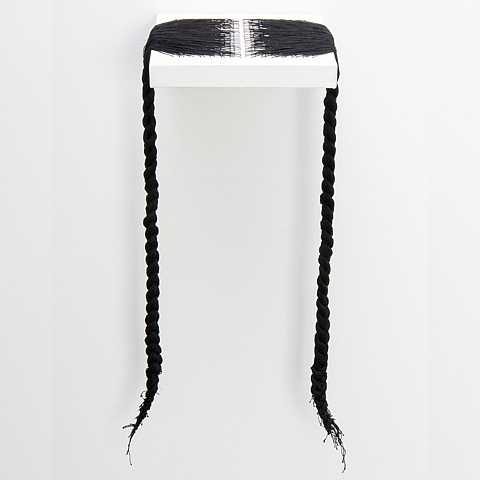
One of Clark’s more recent works, Pigtails, is evocative of youth. Resting on a wall-mounted shelf, a young girl’s braided pigtails are woven from tactile black thread. Though the work suggests innocence, a hairstyle removed from the human head challenges the viewer to consider the means in which a young woman’s hair was taken. When hair is so deeply attached to one’s personal identity, a hairstyle without an owner begins to lose its character, lose its playfulness, and becomes limp and empty. The effect is intensified when the viewer must look down at the work. Mounted at hip-height, the object’s relationship to the viewer shifts from passive to active, as one feels implicated and responsible for subjugating the hair and its anonymous human counterpart.

“Hair is basically a piece of someone’s body. It’s a very intimate experience of selling a piece of someone’s body to someone else,” said Lauren Gentile, Contemporary Wing founder and director.

The emotions evoked by the oldest work in the show, dating from 2003, complement with the powerful notion of stolen youth in Pigtails. Long Hair confronts the viewer with age. The brilliant, life-like digital print of a single dread lock is rich with depth and texture. The viewer cannot help but to yearn to reach out, to touch the hair fibers clearly pulsating with life. Astonishment and disappointment converge when the illusion is realized. 30 feet long, the print work represents the length of a dread grown for 30 years.

“At first, I thought it was strange to use someone’s DNA and then sell it, with the history of selling bodies in this country,” said Clark who is inspired by the infinite hairstyles that became available to black women after the Africa Diaspora.

Unbreakable fashions together black fine-toothed combs branded “Unbreakable” in a composition that is inherently broken. The moderate-sized work demands the viewer to consider the societal and cultural pressures associated with issues of straight hair. Cotton to hair is immediately recognized as an object of relegated beauty—flowers tinged with bronze are forever preserved behind glass. However, the work with antique undertones quickly becomes mystifying and somewhat uneasy, when one considers the implications of merging cotton and African American hair. The ties to slavery are inescapable and uncanny.

Though the subject matter in AHEAD OF HAIR compels the viewer to engage in dialogue, and to contemplate one’s personal notions of race, class and culture, the work would not be as emotive or successful without Clark’s extraordinary craftsmanship and fine attention to detail.

“When you see her work, there is something so elegant and subtle and thoughtful,” said Gentile, “The craftsmanship is always going to be perfect, the concept is always going to be well-thought out.”

To execute Quadroon, Clark revitalized the 1990s art of stitching, by fashioning cornrows into one fourth of a square canvas. The other three quadrants contain a heavy mass of thread, stitched together to resemble dense, straight, hair fibers. The cornrows and straight threads are pulled together at the very center of the work, forming a ponytail that extends and cascades naturally into the viewer’s immediate space.

Quadroon is exemplary of Clark’s extraordinary ability to deeply engage with her subject, while maintaining exceptional hold on her medium and craft. A reference to race classification, Quadroon has roots in an experience traveling through Ghana, where Clark, an African-American, was called “bruni,” the Ghanaian word for a white person. Clark explained that in the context of African culture, because Clark has a white grandparent, she is considered white, whereas in the United States, Clark being three-quarters African American, is considered black.

As Clark said, “I’m the same color in either place but the context is different.”

Albers Study captures this question within an art historical narrative, using Josef Alber’s canonic text on color theory, to take five colors and make them appear as six. Clark achieves her desired effect by wrapping colored thread around the individual teeth of “Unbreakable” combs, creating compositions that resemble Alber’s Homage to the Square. Hanging on the wall opposite the gallery entrance, Albers Study underscores each unique work in Clark’s exhibition. Designed to elevate her signature stitch from craft to fine art, the smallest works in the exhibition validate the artist’s grandest statement: “Hair holds the place where race resides.”

Roxanne-GoldbergRoxanne Goldberg is a rising third-year art history student at The George Washington University, where she is a Curator and the Public Relations Director for the student-led arts gallery, Gallery 102. Roxanne has interned at the Hirshhorn Museum and Sculpture Garden and International Arts & Artists. She currently enjoys her position as a Creative Writer for ArtSeeDC. After graduation, Roxanne aspires to earn a Ph.D. in art history and dreams of one day writing arts criticism for the New York Times.

Is MoMA Putting Artists Back in the Closet? by Mark Stern

This article was selected as a finalist in the 2013 DC Student Arts Journalism Challenge, an annual competition designed to identify and support talented young arts writers.

The Museum of Modern Art currently has on display a wonderful, compact installation titled simply “Johns and Rauschenberg.” Featuring art culled from the museum’s permanent collection, “Johns and Rauschenberg” focuses on works painted by each artist during the mid to late 1950s, using Robert Rauschenberg’s recently acquired Canyon as a centerpiece. The introductory placard describes the two artists as being “in dialogue with one another,” explaining how their works from this period led the way “beyond Abstract Expressionism” and toward Pop Art. At the heart of the installation is the relationship between the two men, an intensely collaborative yet highly competitive connection which pushed each artist toward his own artistic triumph.

It’s a nice narrative, as far as it goes. But it doesn’t go nearly far enough. Rauschenberg and Jasper Johns were lovers during this six-year period of collaboration, and their relationship had a profound impact on their art. For years, the art world ignored this vital component of the Johns/ Rauschenberg story, while the artists themselves kept mum on the matter. But 2010’s exhibition Hide/Seek at the National Portrait Gallery broke the silence, openly exploring the artists’ sexuality as it intersected with their work—the first ever gay-themed exhibition at a major American museum. That was over two years ago. Now, in 2013, MoMA is sending Johns and Rauschenberg back into the closet.

This is puzzling. Were MoMA a publicly funded museum, it might be concerned about offending its state patrons—that concern may sound very 1999, but the censorship issue reared its head again during Hide/Seek’s run, when Congressional Republicans threatened to cut the National Portrait Gallery’s funding over a gay-themed, allegedly “blasphemous” work of art. (The museum quickly removed the offending piece.) MoMA, however, is privately funded, and accepts no government cash. So why the dodge on Johns and Rauschenberg?

Most likely because art museums, even seemingly progressive ones like MoMA, remain more closeted than you might think. Textbooks and survey courses have only recently begun examining this dimension of art history, even though it is a fundamental aspect of movements like Pop Art. And while queer theory has allowed art historians and critics to incorporate artists’ sexuality into interpretation of their works, orientation is rarely noted in museums. (The MoMA’s profile of gay icon Andy Warhol fails to mention that he was gay.)

Sometimes that’s fine—most of Warhol’s work, for instance, does not merit mention of his sexuality (though leaving it out of his bio altogether is a bit much). But in the case of Johns and Rauschenberg, ignoring orientation amounts to curatorial malpractice. As the curator ofHide/ Seek Jonathan Katz explains, Rauschenberg’s guilt and turmoil over their relationship is explored in some of his greatest works, including Canto XIV. Johns’ work In Memory of My Feelings – Frank O’Hara is an obvious eulogy for the relationship. The title is a reference to a poem by O’Hara, who was himself gay, which begins:

My quietness has a man in it, he is transparent
and he carries me quietly, like a gondola, through the streets.
He has several likenesses, like stars and years, like numerals.

The painting contains one of Johns’ famous Americans flags reversed and coated in thick, dark paint, occluding the iconic image with gloomy tones. Johns painted his first American flag soon after meeting Rauschenberg, and completed In Memory during their break-up. Accordingly, the piece is often interpreted as an illustration of a relationship tarnished, smothered, and increasingly obscured by the passage of time.

While those two works are not on display in “Johns and Rauschenberg,” several of the installation’s paintings could be rewardingly subjected to similar analysis. MoMA gives us no such gifts, though, skating over the true nature of the two men’s relationship and, at one point, actively denying it, really, by referring to Johns as Rauschenberg’s “friend.” Issues of offensiveness aside—gay people have fought for decades to have their partners recognized as more than mere “friends”—such bowdlerization is intellectually dissatisfying. Even a brief reference to the artists’ sexuality could clue savvy viewers into keener investigation of these droll, elliptical works—or, even better, complete the installation’s narrative. MoMA tells us that Johns’ and Rauschenberg’s collaboration led them away from abstract expressionism, but it fails to explain how they discovered Pop Art. That genre, birthed by these two artistic giants, was built upon rejection of societal norms including hyper-masculinity and heternormativity. Its gay dimension was present from its genesis, yet a casual visitor to “Johns and Rauschenberg” might think Pop Art merely sprung out of two buddies’ wacky experiments.

In an attempt to justify this re-closing of the artistic closet, MoMA’s press office first informed me that Johns and Rauschenberg “wish to be described” as just friends. (Rauschenberg died in 2008; Johns is 82.) When I asked whether the artists specifically requested such a label, the museum’s representative walked back the claim, instead stating that they “have been referred to that way [as friends, that is] historically,” but the rep would not say whether the artists themselves insisted on the “friends” phrasing. Neither would the Robert Rauschenberg Foundation, which officially had “no reply” to the question, or the Matthew Marks Gallery, Johns’ dealer, which failed to respond to repeated inquiries.

The artists’ preference, whatever it may be, is hardly the only factor to consider here. Museums have a responsibility to acknowledge and consider the sexuality of artists in their collections when it is relevant to the work they are displaying. That’s the real tragedy of “Johns and Rauschenberg”: not that it puts gay artists in the closet, but that it keeps viewers in the dark.

Mark-SternMark Joseph Stern is a graduate of Georgetown University, where he double majored in History and Art History. During his time at Georgetown, Mark was a frequent contributor to Slate Magazine. His work has also appeared in the Wall Street Journal and the Denver Post. Next year, Mark will be attending law school at the Georgetown University Law Center.