Home Blog Page 145

Phyllida Lloyd’s Julius Caesar: Guts, Glory, and Girl Power by Megan Fraedrich

This article was selected as a finalist in the 2013 DC Student Arts Journalism Challenge, an annual competition designed to identify and support talented young arts writers.

There are many excellent reasons for an all-female production of Julius Caesar. For one, the play is among Shakespeare’s most male-dominated, which is saying something; out of roughly forty characters, only two are female. Those two exist to give (ignored) advice to their husbands, and are saddled with lines like “Think you I am not stronger than my sex?” Furthermore, female friendships are often still trivialized in today’s media, while the shifting alliances, betrayals, and dilemmas seen in Julius Caesar are the stuff of literary legend. It would be great to see a more nuanced portrayal of ‘backstabbing’ among women, without the usual high school movie cattiness. Yet for all of the interesting ways Phyllida Lloyd could have explored gender in Julius Caesar, her sold-out production at London’s Donmar Warehouse fell strangely flat.

Not that there wasn’t plenty of excitement to be found. Even before the first lines of dialogue, the creative team made it clear that this was no ordinary Shakespeare production. Audience members who failed to miss the security cameras lining the walk to the auditorium couldn’t ignore the stark interior of the auditorium: never has the Donmar Warehouse looked so much like a warehouse. Designer Bunny Christie replaced the comfy seating with hard plastic chairs and gave the performance space a dingy, industrial look, complete with peeling paint. A strange array of props litter the stage, from a baby doll and a tricycle to a cake and a paper crown.

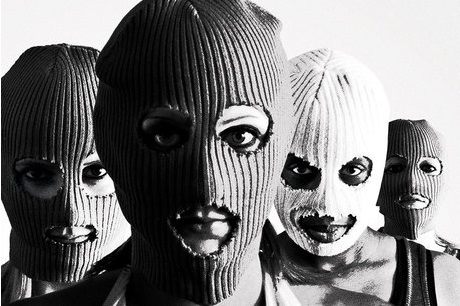
Lloyd’s concept sets the action within a women’s prison, the ‘inmates’ performing the tale of Julius Caesar ala Marat/Sade. The show begins with the framing device of the prison guards unlocking the doors, leading the inmates onto the stage, lining them up, and locking them in. The play itself is filled with loud punk rock music, water guns, and contemporary touches like magazines, doughnuts, and the occasional f-word dropped amid the blank verse—not your grandma’s Shakespeare.  The personalities of the prisoners occasionally intrude through their Roman characters, most notably when the murder scene of Cinna the Poet gets out of hand, injuring an ‘actress’ and sending the cast into a frenzy. But  Lloyd seems to have little to say with this concept, besides giving excellent female actors the chance to speak some of the Bard’s greatest words. Rather than put a feminine spin on the story and characters, the proceedings all seem very gender-neutral, even butch.

Almost every character wears baggy prison polo shirts and sweatpants—except for Brutus’ wife, Portia (Clare Dunne), dressed in a pretty white dress, and appropriately coded as a ‘female character.’ When she doubles as Octavius Caesar, she, too, wears the shapeless uniform. Some moments simply don’t make sense. Why is the Soothsayer portrayed as a naked child? If Caesar is openly dating Antony, who does Calpurnia represent? If Caesar doubles as a prison guard, why does she wear the prison uniform? Does the metaphor of prison emphasize any aspects of the text, or is it just an arbitrary reason for an all-female cast?

The actors handle the text well, despite the clumsy framing device. The only misfire comes from Frances Baker as Caesar, whose boisterous, loud, and crude, mannerisms don’t seem to come naturally to the veteran actress. She brays her words with elongated vowels, as though sucking the juice out of them as she speaks. It is easy to see why Caesar’s friends would want to stab her; not so much to see how she became so respected in the first place. Maybe it’s the doughnuts she brings the inmates.

The excellent Dame Harriet Walter plays Brutus at least as well as the RSC’s greatest men, with a restrained, haggard demeanor. She even swears in a thoughtful manner. Walter’s gaunt face and gravelly-yet-posh delivery give her an androgynous elegance, and she emphasizes the divide between Brutus’ private turmoil and public stoicism. Her performance is most poignant in a scene where, drifting to sleep in her tent, she dreams of dancing with her dead wife. The play’s most haunting scene and one of its simplest, it hits a level of emotional engagement with the audience that much of the play fails to deliver.

For most of the play, Walter shares the stage with Jenny Jules’ volatile Cassius. Jules spits angry words through her teeth, resembling a rattlesnake as her body shakes with rage. Her Cassius is an exhausting person to watch, both for the audience and for Brutus: Walter seems to grow ten years older when interacting with her. Brutus’ exasperation plays well off of Cassius’ petulance, but Jules lacks the manipulation that Cassius requires. Lean and hungry she certainly is, but subtle, she is not. Clare Dunne’s Portia emphasizes her shared traits with Cassius—she gives herself a ‘voluntary wound’ to prove her bravery to her husband, a moment that takes on greater significance when Cassius attempts to do the same after Portia’s death, and Brutus hastily prevents her. Yet Dunne’s Octavius Caesar seems dull-witted, lacking the spark that make her Portia so interesting.

Cush Jumbo gives Mark Antony nuance from the start, her large dark eyes simultaneously calculating and soft. As Caesar’s toy-girl, she raises the energy whenever she takes the stage, filled with that “quick spirit” that Brutus mocks, but Jumbo moves with a contained grace. Her anger is much quieter than Jules’, and the more threatening for it. Even her acting, though, cannot justify Lloyd’s decision to have her deliver her ‘Friends, Romans, countrymen’ speech lying down.

Other standouts in the cast include Charlotte Josephine as Brutus’ mischievous young servant Lucius and Ishia Bennison’s sarcastic and cackling Casca. This adaptation manages to convey the full story with only fifteen actors, a mean feat for a play with so many characters, and though it is occasionally difficult to tell who was who, the plot itself remains crystal-clear. A battle scene cunningly uses lighting, rock music, and stylized movement to represent Cassius’ decimated ranks: standing on a moving platform, Cassius watches in despair as her soldiers disappear. The assassination scene fills the stage with well-choreographed chaos, forcing Caesar into a chair in the audience (at this performance, mine—I was brought up onto the stage by an actress and placed in the middle of the madness) and shoving bleach down her throat. Rarely, however, does the action attain the electricity that the setting demands. Performed in one act without intermission, using the guards’ interference following the ‘Cinna the poet’ mob to transition across the skip in timeline, the play drags despite the abridged script.

Though this noisy production says little about gender besides showcasing female talent—and Harriet Walter seems ready to conquer Rome, following an enchanting stint as Cleopatra opposite Patrick Stuart—it sparked enough controversy to convert any skeptic to feminism. Cranky critics mocked the idea of an all-female cast more they did any directorial weakness, and droned relentlessly about Shakespeare ‘spinning in his grave’ at the thought of (gasp) female actors! The original text of Julius Caesar is packed with anachronism (characters talk about clocks and doublets, both definitely not Roman, and use Elizabethan slang liberally) yet modernizing Shakespeare’s already-modernized retelling happens surprisingly rarely. Lloyd’s Caesar could have used a bit more substance to back its considerable style, but it certainly injected some fresh spirit—and estrogen—into one of the starchier plays in the literary canon.
Megan-FraedrichMegan Fraedrich is a rising senior Literature major at American University, focusing on early modern drama. She is an avid participant in the campus Shakespeare troupe, the AU Rude Mechanicals, and hopes to direct her own production of Julius Caesar next year. Megan enjoyed a semester abroad in London this past fall, where she got to stand on both the Donmar Warehouse and Globe Theatre stages.


Growing pains become pleasures in Chobsky’s Perks by Mary Borowiec

This article was selected as a finalist in the 2013 DC Student Arts Journalism Challenge, an annual competition designed to identify and support talented young arts writers.

The transition from book to the big screen is one widely feared by authors and audiences, as movies almost universally fail to live up to their printed predecessors. Proving the exception to this rule, The Perks of Being a Wallflower shines in the film adaptation of this coming-of-age tale, bringing heart and a star-studded cast together to capture the emotional roller coaster that is growing up.

The successful adaptation of Perks is due in large part to the atypical position of Stephen Chobsky, who served as director, screenplay writer, and author, as well as inspiration for the story’s central character, Charlie. In a question-and-answer session about the film, Chobsky explained the decision to direct his own work. “It was so personal, I couldn’t just sell it to Hollywood.”

Though Chobsky’s connection to the story could have crippled the adaptation, his ability to distance himself from the story in the 10 years he took between writing the novel and the screenplay came together seamlessly in this production, which he described as “the greatest artist experience of [his] life.”

Fiercely personal but universal in its depiction of growing up, Perks captures its audience with Charlie’s moving but winsome tale of fitting in and finding himself during his first year of high school. Framed through a series of letters to an unnamed but supportive source, who is addressed simply as “Dear friend,” Perks maintains a strong first-person narrative, impressively staying true to the book’s perspective.

Perks begins as Charlie (Logan Lerman) enters his freshman year, both trying to move beyond a bad place and to survive the 1,800 days of high school. Identifying as a “wallflower” because he watches life from the sidelines, Charlie soon falls in with a group of outliers, led by step-siblings, Sam (Emma Watson) and Patrick (Ezra Miller). Together they draw him out from his precarious position witnessing life go by and into their inner ring, where he learns to “participate,” even if that means trying everything from pot brownies to performing in the “Rocky Horror Picture Show.” This theme, which carries throughout the movie, leads to one of the most warming scenes of the film, where standing on the outskirts of the gym at

homecoming, Charlie head bops his way to the center of the dance floor to join Sam and Patrick as they comically perform a dance routine to “Come on Eileen.”

As Charlie is quickly subsumed into this group of misfits, led by the beautiful but troubled Sam, who doesn’t think she deserves to be loved, and class-clown Patrick, who struggles with a boyfriend who won’t admit his sexuality, Perks might seem on par with an ABC Family original movie overflowing with every adolescent issue imaginable—an opinion only compounded by Charlie’s ultimate revelation of being sexually abused.

Yet, in overcoming this propensity for melodrama, Lerman, Watson, and Miller astound with incredible performances that bring both innocence and intensity to their characters in a way that makes their every struggle and triumph come alive. As a result, this trifecta of actors undoubtedly succeeds in recalling the singular struggle that is growing up while simultaneously making the audience root for their every success.

An honest role that encompasses the entire high school experience from the mundane to the extraordinary, Lerman’s portrayal of Charlie impresses not only for its candidness but also for its range as Charlie navigates school dances, parties, an LSD trip, his first kiss—with a girl and boy—all culminating in a sweeping breakdown that lands him in a mental hospital. Alongside Watson and Miller’s leading roles, an eclectic cast of minor characters, from Charlie’s parents (Dylan McDermott and Kate Walsh), to his sister’s boyfriend, Ponytail Derek (Nicholas Braun), to his English teacher (Paul Rudd) make Perks a collection of comical but identifiable lifetime moments.

A stellar soundtrack brings these scenes to life as Chobsky succeeds in capturing “a timeless nostalgia,” which is, for him, what makes this coming of age story stand the test of time. This feeling is best captured in bookend scenes where first Sam, and then Charlie stand in the back of Patrick’s pickup truck as he speeds through the tunnel at night, the city lights sparkling around them. It is this instance, as Charlie explains in his last letter, “This one moment when you know you are not a sad story. You are alive. And you stand up and see the lights on the buildings and everything that makes you wonder and you are listening to that one song on that drive with the people you love most in the world and in this moment, I swear, we are infinite.”

Mary-BorowiecMary Borowiec hails from Summit, New Jersey. As a senior at Georgetown University, she is studying History and Spanish–she is currently studying at the university in Sevilla, Spain. She has worked for Georgetown’s weekly news magazine, The Voice, since freshman year and last year served as the editor of the Arts and Leisure section. At Georgetown, she has also been involved in undergraduate research and a literacy and mentoring program for local youth.

Why Artists Should Stop Playing Their Seminal Albums Live By Paula Mejia

This article was selected as a finalist in the 2013 DC Student Arts Journalism Challenge, an annual competition designed to identify and support talented young arts writers.

On a wispy evening last October, my housemate and I went to see GZA perform his magnum opus Liquid Swords in full at D.C.’s swanky Howard Theater. I wasn’t the only one with high expectations. The crowd’s hunger escalated with Killer Mike slaying his opening set, pulling out perfectly punctuated showstopper moves, pouncing directly into the crowd, taking drags from a carrot-sized blunt and passing it around for all to inhale. He closed out by simply dropping the mic and disappearing behind scarlet curtains before you could even say “damn”.

That said, I couldn’t imagine what sort of antics GZA would pull during his set. The gun was cocked. But then… GZA never pulled the trigger. He strolled onstage blank-faced, an expression that didn’t change for the 40 or so minutes he performed. He immediately jumped down into the crowd, as Killer Mike had, for Liquid Swords’ opener and title track “Liquid Swords.” He immediately handed the microphone off to an anonymous member of the crowd. It was cool at first, even appropriate seeing people duke it out for “Duel of the Iron Mic.” But instead of slinging rhymes, a stone-faced GZA handed off the mic consistently, barely muttering.

When he did take it back, he kept reminding everyone to “YouTube this shit” and Instagram the moments he brandished a mic in everyone’s face. With 40 iPhones all blinking at once, it felt like performance art and a publicity stunt combined. Was Wu-Tang’s purist in there somewhere, the one I had come to see perform? Where had the prowling Genius gone?

I thought about the value of performing “seminal” albums in full, as opposed to performing newer material, long after the curtains drew to a close. Are tours to perform albums in their entirety misguided — fans own the albums anyway — and more of a PR stunt to enliven an artists who may have hit a lull? Or are the full album tours giving in adoring fans’ demands?

My freshman year of college, Pixies sold out two consecutive nights to perform Doolittle at D.C.’s colossal D.A.R. Constitution Hall. I didn’t go — tickets clocked in at a steep $60, and at the time I was attending every campus club event I could find in search of a free meal. Why pay that much to hear an album performed when I own a vinyl copy, and could just listen to that? Ticket prices for full album tours often rake it handsome profits, but are exorbitantly expensive for audiences.

If I were going to experience Doolittle live, the moment would have probably been as a college student in the late ’80s and early ’90s. Sure, I was born too late to see Pixies in their heyday, but I’m pretty sure “Gouge Away” wasn’t meant to be performed in front of a seated audience of 3,700 people. If Pixies were to get back together now, I’d say there’s more value in what an older, stranger Black Francis has to say at this point in his life than him cranking out “Debaser” yet again.

As years pass, musicians’ sensibilities and mindsets inevitably shift. Growing out of songs isn’t uncommon. Much of the brilliance of bands’ piece de resistance albums, from Doolittle to Damaged is due to the perfect (albeit unpredictable) marriage of timing and place. The divine unsettlement of Liquid Swords too stems from GZA spitting about what was immediate and important to him in 1995. In his case, gritty street tales of hustling and growing up in inner city Brooklyn.

When GZA sleepwalked through Liquid Swords he not only sounded disinterested, but also plain spent. The grueling tour circuit inevitably wears on artists, especially when they’re performing from the same album that propelled them to glory. And at this point, he’s probably performed “I Gotcha Back” tens of thousands of times.

Nick Cave is currently touring to promote the latest Push The Sky Away, along with his band The Bad Seeds (it hits NYC”s Beacon Theatre next Thurs. and Fri.). On the tour circuit, the Bad Seeds have hit SXSW, something older and well-established bands don’t do too often unless they’re insane (here’s looking at you, Wayne Coyne). I could harp on the demise of The Birthday Party, disbanded in 1973. But there’s more room for an audience to be floored if Cave performs from his latest, more a testament to his band’s growth than if he were to perform, say, 1985’s From Her To Eternity in its entirety.

The magic of seeing a band live lies in the spontaneity we can’t pick up on our home speakers, amplifying the love for those formative albums. I can’t listen to Dummy without it still resounding with the bittersweetness of an old friend’s footsteps walking away, or Exile On Main Street without thinking of how it sometimes hurts to breathe in so much sky when driving through my home state of Texas. Instead of performing Dummy, an album I can hum by heart, I’d find it far more compelling to see Portishead work to craft a careful set list. Maybe they’ll pull favorites like “Sour Times” as well as b-sides, or even a cover in between to both engage and inspire audiences.

Right now, we’re at a pivotal point where the industry has to rapidly adjust to increasing interconnectivity and the ability for anyone to make music. Bands have a choice: they can either dust off decades-old albums. Or they can use their artistry to continuously revamp their live performances, continuously finding alternative ways to win the hearts and minds of audiences.

Paula-MejiaPaula Mejia is a student at George Washington University, where she is currently enrolled in a 5-year BA/MA program in English and Creative Writing. She is currently an Editorial Intern at SPIN Magazine in New York, where she also writes. In her spare time, she freelances for various arts and culture publications, both in print and online, including The Village Voice, Consequence of Sound, Time, Washington City Paper, FILTER and others. She is interested in bridging further connections between music, identity and technology in today’s ever-shifting media landscapes. 

We Come Out of the World as Leaves From a Tree by Michele de la Menardiere

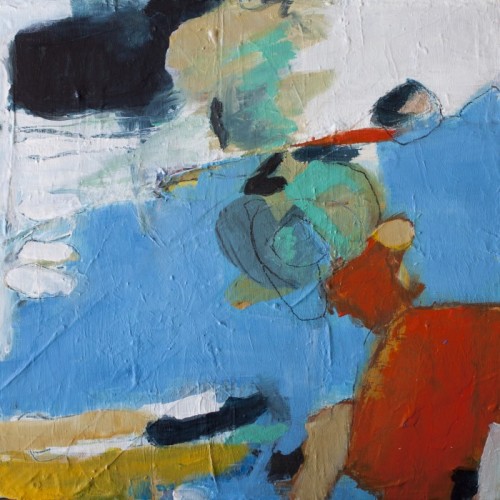
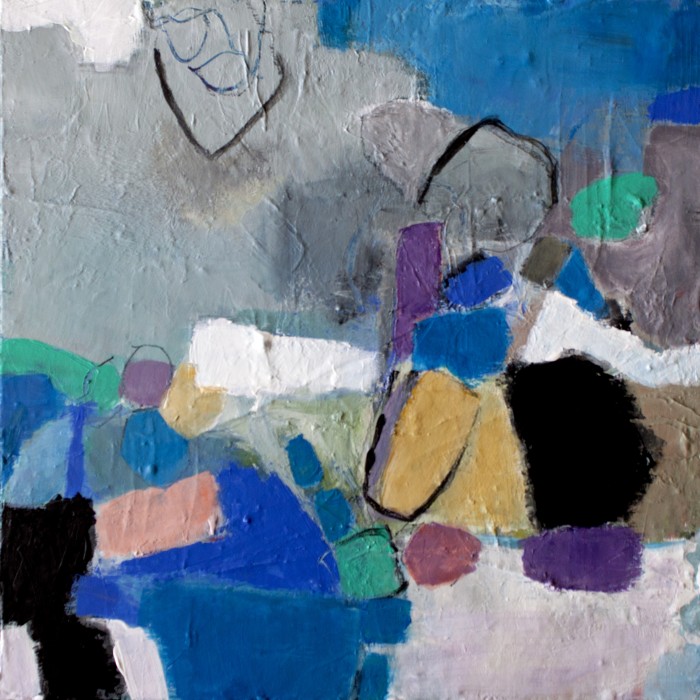
My latest series of small square paintings is called Saudade. This is a Brazilian Portuguese word that has no English translation. Saudade describes an emotional state of nostalgia or longing for an absent something or someone. I first heard this word while traveling through Brazil, the birthplace of Bossa Nova, a musical style that, for me, has the melancholic Saudade sweetness.

So much of our culture sends us the message to buck up, get on with things, and forget about the “bad”, but we have no ceremonies or ways of processing loss and sadness. We pretend it does not happen and try to not make it a big deal. But it does happen. It is truth. And it should be honored. I found that Brazilians express their passions, loves, losses, and defeats openly and honestly. It is a wonderful thing to see.

Saudade is the inescapable sad yet beautiful reality of the human condition. We are here for this transitory blink of an eye. Life brings us great joy and wonder, but eventually all fades away. All love stories come to an end. There will always be goodbyes. This is not something to run away from. It simply just is and it makes our experiences even more precious.

I’ve always appreciated this Alan Watts quote:

“We do not “come into” this world; we come out of it, as leaves from a tree. As the ocean “waves,” the universe “peoples.” Every individual is an expression of the whole realm of nature, a unique action of the total universe.”

And so it is with the art. I do not feel I am creating something from nothing. I feel I am allowing something essential to come through the materials. As I allow my mind to quiet and my ego to soften, my ability to express opens up.

A painting from the Saudade series by Michele de la Menardiere

I am no longer stuck in my “self” and my set ideas. Now, I let the materials lead. There is a sense of endless possibilities. Chaos transforms into visual order and back again. This is the magic. Here is my on-going dialogue with the universe.

I start with a blank canvas and layer on, paint, destroy, layer again, break down, erase, coat, draw, scribble, and wash away.  The work is very much about the process: movement, form, color, and shape just happening in the unplanned, present moment. When I start, I have no idea what will happen. I just wait and see what will emerge from these materials, the music I listen to, and the emotions I feel. I paint for hours, white out the whole thing, and start over. I leave a painting for weeks, come back, and suddenly see something very simple I need to do. Ta da! It is done in a few minutes.

I think, unintentionally, my art has become my own ceremony—a way to send a prayer to the awe-inspiring, thrilling, destructive, brilliant, vital, and primordial forces of nature. Through the practice of painting in the here and now with no set agenda, I am able to get in touch with something significantly more sublime inside me. I feel my most authentic and alive. This brings me inner strength and bliss, and I hope some of those feelings live on in the work.

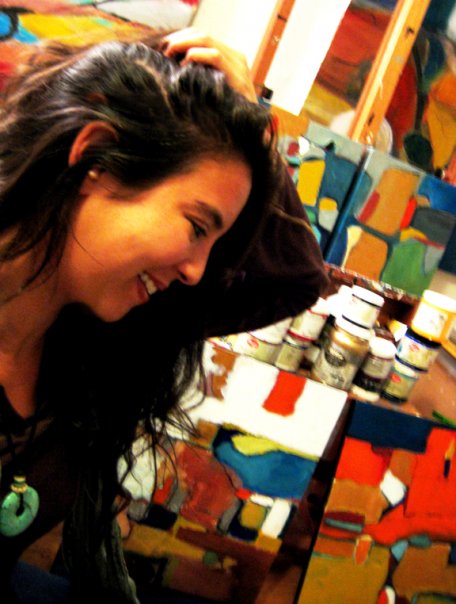
meandartMichele de la Menardiere is a professional fine artist based in San Francisco, California. Born and raised in the Washington, D.C. area, she credits the city’s vibrant energy, international feel, and beauty with significantly contributing to her artistic vision. Always a seeker of new adventures, Michele travels extensively. She spent 6 years studying art in Paris and London and moved out to San Francisco in 2008 to experience life on the West Coast.  Michele has exhibited her art at prestigious galleries across the country and abroad. Her work is part of the U.S. State Department’s Art in Embassies Program and was exhibited at the U.S. Embassies in Algeria and Kosovo. Her paintings are part of the permanent collection at the U.S. Embassy in Burkina Faso. Michele’s work was selected for three public art commissions in the Washington, DC area–Emerge, a large-scale art installation on the exterior wall of the Hyatt Regency Hotel in Crystal City, Virginia, Nascent Flight, a public artwalk in downtown D.C., and Art Underground, a large-scale art installation in the Crystal City Metro. Her work has been purchased by numerous public and private corporations, including the D.C. Commission for the Arts and Humanities, Archstone Properties, and Westin Hotels. She has also done corporate commissions for Stone and Youngberg and The Association of Metropolitan Water Agencies. Her paintings were featured in the Home section of The Washington Post in November, 2009. Michele is also a highly accomplished graphic designer and has received eleven awards for her design work. Her art and design were exhibited together in For Love or Money? at the Brea Art Gallery, Brea, California, in 2009.

My Saudade series, along with other larger works, will be featured in the summer show at The Grand Hand Gallery in Napa, California along with the phenomenal sculptural work of John Petrey. Feature Show: Painter Michele de la Menardiere and Sculptor John Petrey at The Grand Hand Gallery, Napa, California, August-September, 2013.

I am also in the summer group show at Slate Contemporary. This show features fresh work by artists including: Carol Inez Charney, Michele de la Menardiere, Joanne Fox, Carol Lefkowitz, Diane Rosenblum, Michelle Sakai, Victor Cohen Stuart, Talita Suassuna, and Patricia Thomas. Summer Collection,  Slate Contemporary Galley, Oakland, California June 15-Aug 17, 2013.

Stargazing by Angella Foster

With the premiere of my newest work, Stargazing, rapidly approaching, I’ve been spending a lot of my time attending to all the minutiae of the production at hand. It is always this way. Right when I am at that crucial point in the creative process where I am piecing a work together, my focus gets pulled in a myriad of directions–production meetings, costume fittings, publicity e-blasts, postcards, emails and more emails. All those things are an exciting part of the process of bringing a work to the audience where it will really live for the first time, but they can also be distracting, fragmenting my vision and sapping my creativity. Sometimes the only thing to do at this point is to stay up late enough that the rest of the world slips away, and I’m too tired enough to stop crossing things off my to-do list. Up that late, I can let my mind wonder, question, consider and daydream. And, it is exactly that experience that inspired my current project, Stargazing.

I live in a second floor condo with lots of windows, so I live at eye level with the trees and all their inhabitants. There’s even a window above our bath tub. When I’m up late, I like to take a night shower with a starry view, if the sky is clear. Although it isn’t the most spectacular stargazing experience I’ve ever had, there is something about the dailiness of this small moment of wonder that energizes me. About a year ago, my nightly sky searching sparked the exploration that has led to the creation of my current work, Stargazing. I started the process of creating the piece with an interest in the sense of wonder I experienced scanning the night sky.

As part of my inquiry process, I chatted with a friend of mine who works as an astrophysicist at NASA Goddard in Greenbelt, Maryland where I live. Her passion and enthusiasm for her work resonated with me. She is working with incredible equipment like the new James Webb telescope and applying the knowledge she’s gained over years of schooling, but, fundamentally, she is stargazing; she is engaged in an act of wondering, questioning and discovering. Just like me, in my humble shower time searches for Orion’s belt. And, like her, my work requires me to ask questions, remain open to new possibilities and keep searching for meaning through a process of experimentation, failure and revision. This is how I work in the studio to make dances, and it was delightful to discover that someone engaged in such a different inquiry was working through a similar process.

Maggie Picard Photography
Photo by Maggie Picard Photography

Over the past year of working on Stargazing, the project has shifted and changed many times, and it has taken a form very different from what I first envisioned. That’s pretty typical of my choreographic process. I started out imaging the work as a fable about wonder with the night sky as more of a backdrop to the narrative, but my research and curiosity slowly shifted the focus of the work until diverse stories of the night sky took center stage. There are so many stories–ancient myths, childhood wonders, new scientific discoveries, personal moment of revelation–that cast the night sky, specifically the stars, as a main character in a drama of sorts. From the spectacular death of a star to the wonders visible in our backyards, the starry night plays a pivotal role in the human experience. In the rehearsal process, I used these different perspectives to inform our movement explorations.

We work collaboratively with everyone, myself included, creating material based on the concept at hand. We videotape everything, and, over time, I curate the process of choosing the phrases, gestures and moments that will ultimately have a life in front of an audience. By this point in the process, we have a collection that resembles a gallery exhibit in the sense that diverse pieces of expression are presented together, united by an underlying conceptual framework that lends meaning to the elements in relationship to each other. In Stargazing, our explorations have yielded a sort of triptych in time and space with the work unfolding in three sections that tell a different story–one mythical, another informed by scientific concepts and a third crafted from the personal experiences of the performers. These different stories are presented in succession without attempt to make them fit with each other. They simply co-exist in the same way that our experience of something as ever-present as the night sky is at once so complex, multifaceted and unconscious.

With just a few weeks left to work on Stargazing, I’m still searching for an ending, a closing moment that feels right. And, tonight I’m up late again listening to the soft murmurs of the night world and trying to capture this feeling in hopes of evoking it in the final moments of the piece. With another rehearsal in a couple days, I’m looking for the right images and words to bring into the process in hopes of bringing the work to some satisfying closure. Even if the solution doesn’t present itself to me tonight, it will be worth it to have had this quiet time and, even on a mostly cloudy night, I can still look out my window and see a few stars peeking through the darkness which reminds me why I embarked on this path to begin with, so many months ago. Wherever it lands, living with Stargazing constantly in my thoughts for the past year has helped renew my sense of wonder in the mundane beauty of the natural world that borders the increasingly engineered landscapes in which we live. And, I hope that the audiences that see Stargazing later this month will walk out of the dark theater into a starry night and find themselves stopping to look up and take a moment to appreciate all the stories being spoken through those distant glimmers of light.

Angella Foster is the founding artistic director and resident choreographer of alight dance theater. She trained at the Merce Cunningham Dance Studio and earned her MFA in Dance Choreography at the University of Maryland, College Park. Her choreography has been performed in New York City, Washington D.C., Houston, Atlanta, and Moscow, Russia. Her evening-length work Speechless was commissioned by the Kennedy Center Local Dance Commissioning Project and supported by the Prince George’s Arts Council and Community Foundation for the National Capital Region. Angella has performed the works of Steve Rooks, Clay Taliaferro, Ed Tyler, Joe Poulson, Nejla Yatkin and Colleen Thomas. She danced with Ad Deum Dance Company in Houston, Texas. She has taught at Towson University and University of Maryland-College Park and currently serves as the Director of Studio Dance at Greenbelt Community Center.

Stargazing premieres at Dance Place in Washington, D.C. on Saturday, June 29 at 8pm and Sunday, June 30 at 7pm. Click here to visit the Dance Place website and purchase tickets.