Home Blog Page 149

Art is a Story by Megan Coyle

2

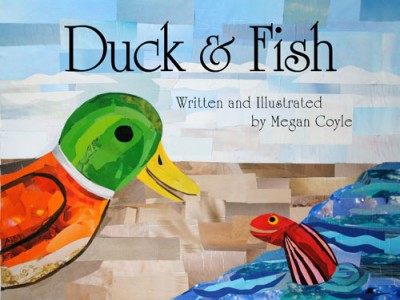
As a collage artist, I’m drawn to storytelling with images and words. I decided to pursue a career as a visual artist after majoring in creative writing and painting in college. Since graduation, the majority of my time has been dedicated to honing my collage technique – which I call ‘painting with paper’ – where I use a palette of magazine strips to create compositions that resemble paintings. Earlier this year, I combined my visual art and my interest in storytelling and wrote my first children’s book, Duck & Fish.

Duck & Fish began as a series of sketches on note cards. I spread the note cards out on the ground so I could visualize and play with the narrative as a whole, and then wrote the story to accompany the images. When it came to revising the book, I went back to my illustrations (that I previously thought were finished) and edited and reworked them several times. The writing itself underwent numerous revisions as it was passed around a small circle of friends for edits and insight. Finally, after a great deal of bouncing back and forth, from editing text to seeing if it properly described my colorful collage illustrations, I finished the book.
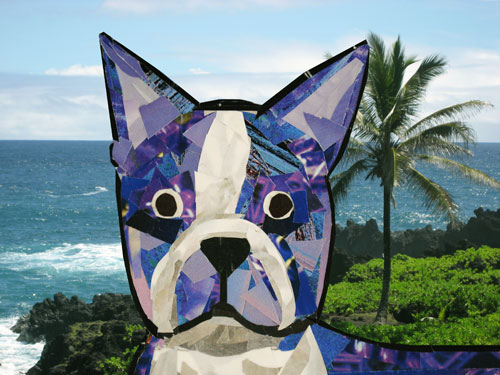
The storytelling process for Duck & Fish has really influenced my current projects, which include a series called “The Adventures of Bosty”, and a collaborative collage animation. With The Adventures of Bosty I’m Photoshopping a collaged Boston terrier into photographs taken from various trips around the country and world, and I write about Bosty’s adventures next to the images. At the top of this article is a recent picture of Bosty  and the text that goes with this one is: “It was getting cold in DC – so Bosty boarded a plane and flew to Hawaii for the week. He sent plenty of pictures of all the fun he was having. Here he is enjoying the bright blue skies while posing next to a palm tree.”

Moving back and forth with drafting and revising illustrations for my first children’s book has influenced my art-making process. With my current series of collages I find myself revisiting the piece to refine and edit the narrative of each subject. Creating my own written story, for Duck & Fish, I was forced to think more about conveying a very specific storyline instead of just focusing on a general idea. Representational art is like a story in many ways. Scenes and sitters can convey different ideas for a work of art. Since I depict familiar scenes, animals, and a variety of sitters, viewers can look at a collage and think about what might be happening in a given image. It encourages them to tie the work to their own memories and experiences. I’m looking forward to continuing to develop new books, as well as fine art projects, and I feel like the two are reinforcing each other.

Megan Coyle is a Washington, DC area artist who makes collages using a technique she calls “painting with paper.” Her children’s book Duck & Fish is illustrated with paper collages and tells the story of a duck and fish that switch places for a day to explore new wondrous worlds of ocean and sky. She is currently working on a new body of work of animal collages for a solo exhibition next year in the Alexandria City Galleries.
Asanas After Troy by Jean-Jacques Gabriel

0

Anger. Tears. and a fleeting desire for violence
disrupt a dreamer’s dream
of race-less love in world without lynching.

certain moments stoke outrage-fueled flames,
exciting anger – our sense of self’s immune sytem.
certain moments remind me that we fine folk
are born with holes in hearts, yearning for forever.

forever seems most pleased by a reflection ever-changing
so, some ill-aim with silly ideas
that more matter alone will quench cosmic thirst.
some pillage earth, rape women, slaughter men,
kill feral folk and fauna, and disown many other beauties.

in moments like this,
i overlook spirit’s possible possession of us.
i overlook what futures beautiful histories allude to.
i overlook the dreamer’s dream
of race-less love in world without lynching

but the ritualized returning of awareness to intention,
feeds and revives my well-aligned aim.
With this focus, i stoke the burning fire within,
sparking multiple mini-armageddons, cleansing me,
cleansing us, of enshrined criminality, foul histories, unlove,
and silly ways, becoming better within, and without.

well postured for living the dreamer’s dream
of race-less love in world without lynching.

————————–
Published in The Poetry of Yoga (Vol. 1) Book Anthology
————————–
On November 11, 2011 (11.11.11), The Poetry Of Yoga, a contemporary anthology compiled and edited by yogi and spoken word poet HawaH released. This anticipated first volume distills 333 pages of heart-wrenching poetry from over 1,500 pages of submissions originating from 16 countries. The Poetry Of Yoga is kick-starting a modern day renaissance of Hafiz, Mirabai, and Rumi. It is an important platform for a new body of work that serves to expand the literary tradition of yoga to include the cultural perspective of the 21st century. This pioneering anthology brings together living poetic voices to share their existential expressions and the shifting landscape of human consciousness. Featured writers include: Rod Stryker, Lilias Folan, Krishna Das, Sharon Gannon, Joseph Goldstein, Sianna Sherman, Judith Lasater, Aadil Palkhivala, Douglas Brooks, Chuck Miller, Shiva Rea, Erich Schiffman, Swami Ramananda, Doug Swenson, Leza Lowitz, Michael Stone, Tias Little, and more.

For more information please visit: www.ThePoetryOfYoga.com

Silence as Varied as Snow by Nancy Havlik

0

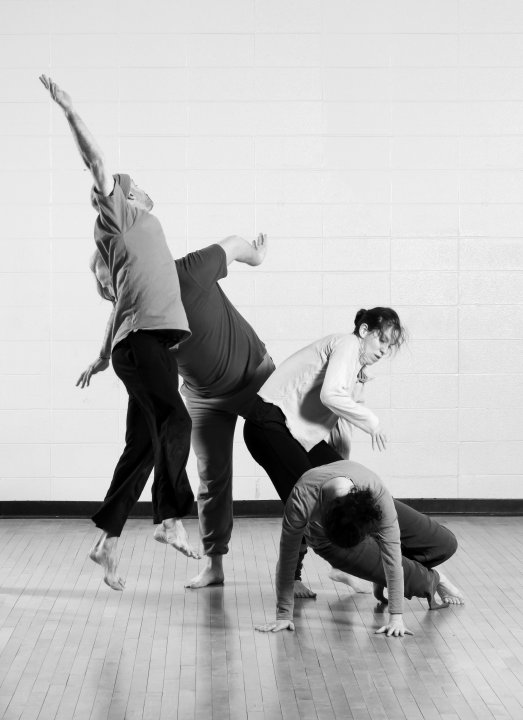
I began thinking about the new dance/theater I’m making while recovering from a double knee replacement surgery in July, 2011. I had to spend a lot of time recovering in stillness, “not doing” stuff”, and the work is entitled “Silence is as varied as snow.”

I was interested in starting the composition from that place of quiet – with lack of expectation or preconceived idea of where we were going. When I began meeting with my company members (musicians and dancers) after the four month break (because of the surgery) we talked about silence/sound and stillness/motion.

Of course the musicians had thought a great deal about silence so they had a lot to say right of the bat. We looked at the writing of John Cage:

“Our intention is to affirm this life, not to bring order out of a chaos or to suggest improvements in creation, but simply to wake up to the very life we’re living, which is so excellent once one gets one’s mind and one’s desires out of its way and lets it act of its own accord.”

I felt this rule of thumb from Cage was a very good beginning for our new collaboration. Dancer Ken Manheimer suggested an improvisation in which the dancers moved to the sound inherent in silence and that was how we began rehearsing. I was determined to stick with letting the dance flow from what was happening in the moment and not try to “pre-conceive and pre arrange.” I follow the observations of scientist Michael S. Gazzaniga who wrote, “You’re just trying whatever it is you’re trying; you don’t know what’s going to happen, and then whoosh! —the thing pours right out there and generates the next questions, questions you never would have thought of before.”

At one point the dancers were doing something and the musicians started to pack up their instruments to leave and whispered together upstage of the dancers as they left. I loved the whispering, knowing it said something about sound and silence in an unexpected way, and we’ve kept “whispering groups” as a part of the choreography. There are sections of ideas about sound/silence, movement/stillness.

Since my surgery, I’ve been able to move more and more freely. It has been a wonderful feeling after years of increasing physical limitation. I can plie, jog, move quickly and even jump a little. Several people have assumed that I would perform again but I’ve not been driven to perform in recent years; I’m much more a director of dancers. I love to see the moving body. Can’t get enough of it. It’s an addiction. The most satisfying experiences I’ve had as a performer have been doing solos of someone else’s choreography, someone who can coach me to look good. The last solo I performed was Andy Torres’ “sparrow”. The great part of being in Andy’s work was to just follow his direction and trust him. It’s a marvelous feeling for someone who is usually the director. I try to bring my dancer’s sensibility to my choreography.

I hope you’ll come enjoy the first performances of this piece next weekend at Woolly Mammoth Theater as part of the Jane Franklin Company’s 24-Hour Dance Project.

Nancy Havlik has directed and choreographed for the past 25 years. She formed Dance Performance Group (a non profit 501c3 corporation) in 1989 as a vehicle to explore her own choreographic ideas with a small group of dancers and musicians. Through the Company her choreography has been performed extensively in the Washington, DC area at venues including Dance Place, Joy of Motion, Montgomery College, Jewish Community Center, Joe’s Movement Emporium, Mt. Vernon College and the Kennedy Center Millennium Stage. Her work has been shown in New York City at Joyce Soho, WAX and the Construction Company and in in Eastern Europe. (Czech Republic and Slovakia). She has directed site work performances all over the Washington, DC area in places as varied as C& O Canal, the Building Museum, Barnes and Noble Bookstore, Josephine Butler Center and the Torpedo Factory Arts Center. She participated in the Capital Fringe Festival for 3 years and recently has presented performances at Flashpoint Mead Theatre and at Woolly Mammoth Melton Rehearsal Hall. She has received grants from Maryland State Arts Council, the Montgomery County Arts Council and the DC Commission on the Arts and Humanities. Nancy teaches creative movement and intergenerational workshops for older adults through Arts for the Aging (AFTA). Her AFTA program “Moving Art” has received a 2011 Met Life grant to present a series of workshops for older adults in collaboration with Donna McKay combing visual art and creative movement. Nancy also directs Quicksilver, an improvisational performance company of dancers over 60 years of age under the auspices of AFTA.

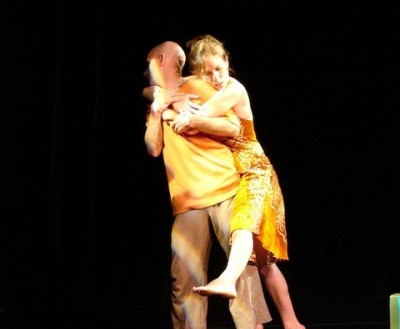
Image with dark background of Ken Manheimer and Micah Trapp credit Roman Sehling.
Image with light background of multiple dancers credit Nancy Havlik.

Sun Boxes by Craig Colorruso

0

In November of 2008 my good friend David Sanchez Burr called me up and said, “Yo! Make something solar. We’re going to the desert.” Then he hung up. In June of 2009 Dave and I went to Ryholite Nevada with Richard Vosseller. We had a residency at The Goldwell Open Air Museum and created Off The Grid. The idea was to make art using sustainable energy. Sun Boxes was my contribution. Although I cite Dave as the main catalyst, the truth is I’ve been thinking about this for a long time.

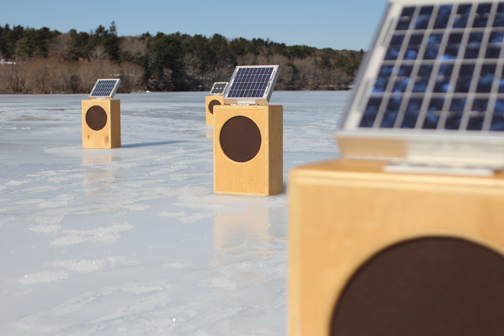
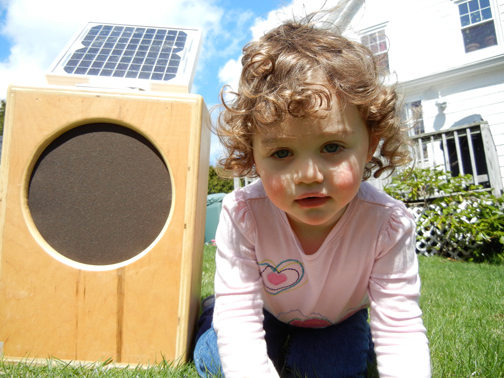
When on tour with China Pig back in 1995, I remember looking out the window and I saw a field of fireflies. It was pretty beautiful, but what was so memorable, was being able to get a sense of the depth of the field. Some of the fireflies were closer than others and I got a sense of a chunk of space. In a way Sun Boxes is a sonic version of that field of fireflies. Sun Boxes is a solar powered sound installation. It’s comprised of twenty speakers operating independently, each powered by the sun via solar panels. Inside each Sun Box is a PC board that has a recorded guitar note loaded and programmed to play continuously in a loop. These guitar notes collectively make a Bb chord. Because the loops are different in length, once the piece begins they continually overlap and the piece slowly evolves over time.

I played in a lot of bands and have spent a lot of time playing on stage. Although it was all great, I really wanted to make something people could feel like they were part of physically. There is no stage with Sun Boxes, once you see it or hear you’re in it, you decide how far in to go. One of my favorite details about Sun Boxes is to be surrounded by the piece.

The piece creates space; it’s an environment for one to enter and exit. The footprint this environment occupies is similar to that of a city. A metropolis. It’s a burst of technology in the middle of nature. Unlike most cities I have been to, it does not just take over the space. Rather Sun Boxes interfaces with the environment and collaborates with nature. It is the perfect combination of technology and nature that create art, an environment, and a metropolis.

There are no batteries involved, so Sun Boxes are reliant on the sun. When the sun sets the music stops and doesn’t start until the sun rises. The piece changes as the length of the day changes. Since the amount of sunlight varies from day to day so does the composition of Sun Boxes. Participants are encouraged to walk amongst the speakers, and surround themselves with the piece. Certain speakers will be closer and, therefore, louder so the piece will sound different to different people in different positions throughout the array. Allowing the audience to move around the piece will create a unique experience for everyone. Participants are encouraged to wander through the speakers, which will alter the composition as they move. Given the option two people will take different paths through the array and hear the composition differently. Sun Boxes is not just one composition, but, many. Sun Boxes is a system that really interacts with its environment.

We are all reliant on the sun. I think it is refreshing to be reminded of this. I live on the South Shore of Boston in a town called Hingham. I live with a wife and two cats. We are one mile from the ocean. Our lives have filled up with technology. But we still need the sun and so does Sun Boxes. Karlheinze Stockhausen once said “using Short-wave radios in pieces was like improvising with the world.” Similarly The Sun Boxes are collaborating with the planet and it’s relation to the sun.

So far Sun Boxes has been In Nevada, Massachusetts, Indiana, Connecticut, Ohio, New Hampshire, Vermont, and Maine. More importantly, Sun Boxes has been in the desert, on a frozen pond, grassy plains, a parking lot, the beach, in the snow and on a mountain. I have an informal goal to bring Sun Boxes to every state, and a more formal goal to seek out different locations.

Craig Colorusso sometimes makes stuff you can hear, and sometimes makes stuff you can see. You can visit a website for Sun Boxes here.

U-Turn by Naomi Thiers

I can’t turn around, I can’t go back.
I’ve worn a rut in all my years of love
and worry; my life never takes me off.
I request to be reborn as a skipped rock.
I stop the car by the Bay Bridge and watch the sun—
more generous than humans are inclined to be—
cast diamonds in dirty water. That was once
my dream—to give everything I owned away.
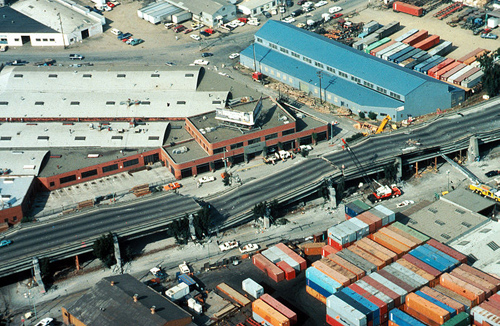
I think of the woman driving Cypress Street Viaduct
in the ’89 quake who heard God hiss: go back.
Sharp U-turn: With horn and chutzpah, she made it off
seconds before the upper deck collapsed.
I’ve told my friends that story, and I’ve dreamed
of it, the way her wheel jerked in the sun.

During the 1989 Loma Prieta earthquake in San Francisco, the two-level Cypress Street Viaduct collapsed so that cars driving on the bottom level were crushed.

U-Turn by Naomi Thiers (c) Copyright Naomi Thiers; printed by permission of the author.