Home Blog Page 148

The Golden Dance Experiment by Lindsey Golden

2

As an artist I am constantly striving for new ways to express the vast array of swirling emotions within my being, and living in Baltimore has inspired the dance piece I am currently finishing: “Baltimore…the Dirty-B.” The piece explores the contrast I see among the resident hobo, downtown lawyer, wealthy socialite, and gang leader in Baltimore, and plays with the way different worlds co-exist. This is a concept that reaches far beyond my backdoor, to cities throughout America. But Baltimore has developed in a way that intensifies this harsh contrast, with dangerous back-allies and “blue-light districts” (the blue lights indicate heavy crime areas) interwoven among high-rent skyscrapers and fine-dining restaurants.  The movement in the dance is introspective and dark, with a little narrative quality. The composition is split into four sections, with a combination repeating in the beginning, middle, and end of each section, demonstrating that section’s theme. Each section is dedicated to a different worldview in Baltimore. The first three are: the wealthy couple shopping for wares, the desperate homeless family struggling to be seen, and the drug dealer on the street corner hiding beneath a cold stare. The last section combines the pieces together.

Choreographer Lindsey Golden

I’m making the “..the Dirty-B” for my new dance company, The Golden Dance Experiment, a professional contemporary ensemble with a focus on modern dance and contemporary ballet.  All of the dance performed by The Golden Dance Experiment will feature music by the company’s resident composer, Seth Milder. Seth is trained in classical and electric guitar, electric bass, and electronic music composition. Last year I formed The University of Baltimore Contemporary Dance Company as an arts education program for University of Baltimore students interested in dance. The company is a little piece of my soul — I make all costumes, choreograph all pieces, teach all technique classes, create all marketing materials, and organize all photo shoots. It’s a labor of love for me, and I am very proud of the students who participated in it this year. “Linked in Motion,” is a piece I originally composed for The University of Baltimore Contemporary Dance Company based on a poem I wrote. For that piece, Seth and I combined his classical guitar with my vocal recording of the poem, adding in electronic waves of sound to intensify the auditory experience. We performed the piece at the Baltimore Theater Project’s recent ‘Open Marley Night,’ and based on positive feedback I am working to add a second section to the piece for The Golden Dance Experiment. For the second part of “Linked in Motion”, my plan is to incorporate my flute playing along with new guitar work. The choreography is a modern trio with airy and soft movement. I hope that the connection between the dancers and the poetry create an understanding of the way our closest relationships are like trickling rivers, climbing up and down a mountain and dripping slowly into a still pond.
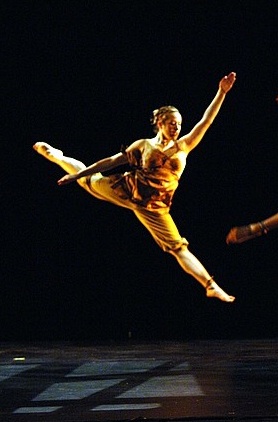
I frequently start my choreographic process by transferring my ideas into drawings I make in a visual journal.  From these images I develop movement concepts and a structure for the choreography.  This process helps me take my ideas to new places I would never see by working from dance improvisation alone. I’m regularly inspired by dance artists I have worked with in the past, visual art, live African drumming, classical ballet and choreographers and companies including Paul Taylor, Jose Limon, Merce Cunningham, and the American Ballet Theater. Ballet was my life while growing up, but as a student of the James Madison University Theater and Dance program, I began to make the switch from ballerina to contemporary dance artist.  In 2009 I graduated and began to dance professionally, with AriDen Dance Company and DanceAntonini, and both companies have influenced my work as a dancer, teacher, and choreographer.

Last month I was asked to lead a lecture-demonstration for a local elementary school hip-hop dance event.  I jumped at the idea, and at the Hip-Hop Dance Party at Stoneleigh Elementary School, 100+ boys and their mothers were entertained with a hip-hop duet I choreographed and performed with The University of Baltimore Contemporary Dance Company member Sue Wu. We rocked the crowd by combining hip-hop, break-dance, and contemporary partnering. The performance was followed by a thirty-minute lesson where I taught the students a section of the hip-hop duet, and led the students in a dance improvisation exercise. Dance is my joy, my passion, and my way of life, and I hope you’ll check out The Lindsey Golden Project website, which includes a detailed calendar of events, as well as original poetry, dance blogs, video of past performances, and photo galleries.

Lindsey Golden graduated from James Madison University with a B.A. in Justice Studies and a minor in Dance. During her training she performed with the Fairfax Ballet, as well as JMU contemporary dance companies The Associate Dance Ensemble, Contemporary Dance Ensemble and the Virginia Repertory Dance Company. Lindsey performed at the American College Dance Festival twice, and was honored to perform in the Gala Concert in 2008. Ms. Golden began her professional career performing with modern dance companies based in the Washington D.C. area: DanceAntonini and AriDen Dance Company. In 2011, Lindsey began to focus her attention on choreography and arts education by forming the University of Baltimore Contemporary Dance Company.  The company was featured in “The Open Marley Night” at the Baltimore Theater Project. In 2012, Lindsey became a member of Dance Baltimore, and branched off to direct and perform with the professional contemporary ballet and modern company, The Golden Dance Experiment.  The Lindsey Golden Project website reflects all of Ms. Golden’s artistic works including poetry, music compositions, and dance choreography, as well as news articles and blogs regarding upcoming events: http://lindseygolden.com.

Why I Struggle to Make Photographs by Andrew Zimmermann

1

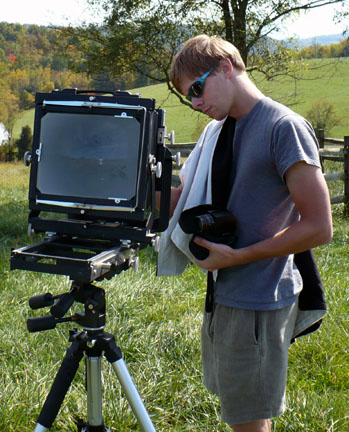
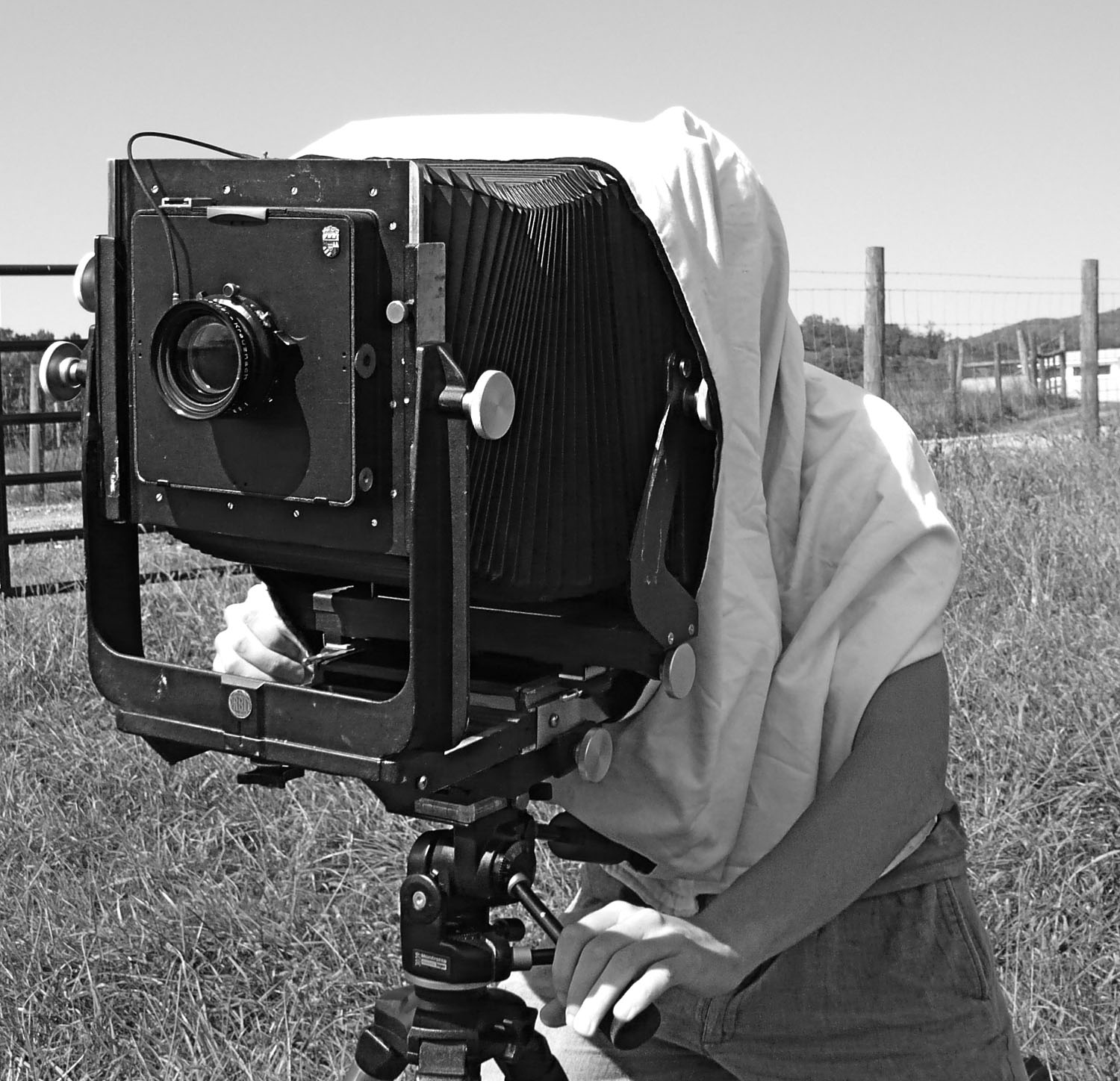
I work with a large format camera, a heavy steel contraption that is older than I am, which puts images onto 8×10 inch sheets of film. With my tripod attached, the camera weighs about 40 pounds, and people often ask me why I bother using this sort of camera. To keep things simple, I often tell them that I love the sharpness and dense tonality of the prints that are ultimately produced from such big negatives, but honestly, this is only about half the truth, and not the half that really matters. The real truth is that the most essential thing I get from my enormous camera is focus—not in the sense of lenses and light but in terms of my own attention. The large camera helps me focus, and see.

For me to produce an image, I carry my 40-pound camera—which I prop over my shoulder, like an old musket—through the landscape until I find something that seems relevant to me. I then set up the camera, and focus it with a dark cloth over my head. I calculate an exposure based on the available light, and then shoot, exposing a single sheet of film, which I eventually develop by hand in trays of chemicals in my darkroom. After the negative is produced, it has to be printed, which involves several hours in the darkroom. I also perform several campaigns of hand-work on each print, first with a solution of reducer (or “bleach”) applied with watercolor brushes in order to lighten areas of the print, and then with neutral watercolor to add tone and texture to areas of the image that I still feel need adjustment. Creating a single print involves at least 8 hours of my time, and sometimes considerably more. This whole lengthy process is always in my mind as I look for my next photograph, and it forces me to make choices, to decide what I think is really important and what is really worth capturing.

In this day and age, when one can take a photograph with an iPhone and moments later post it to an online album or print it out on a desktop inkjet, spending 8 hours to create a photographic image may seem like an absurd difficulty. But I feel that this difficulty adds something fundamental to my work. Things that have been labored over for a long time express the care and attention given them, even if not always in an overt manner.

An image from Zimmermann's "Ways to Lexington" series.

It’s less a question of perfection than of character— think of a chair handmade by a woodworker, or a bowl hand-thrown by a ceramist. In many ways these objects are less perfect, less seamless, than plastic chairs or bowls cast at a factory in China and sold by the millions at Wal-Mart, and yet they are so much more alive! I choose the big camera and the long process because for me, the difficulty of working with this equipment and these materials parallels the difficulty of struggling to truly see—and truly appreciate—the world around me.

I recently completed a series called “Ways to Lexington”, which is a group of landscapes of the Shenandoah Valley made more or less in response to the recent decline and death of my grandparents, who lived in Lexington, VA since before I was born. I had initially intended the work to portray my bright recollections of the landscape around my grandparents’ old farmhouse, but the events taking place in my life at the time ended up seeping into the work and coloring it in somewhat darker tones.

I am engaged in the physical and technical photographic process because through it I am able to share a part of myself that really sees with whoever cares to look. Every series is different, but they are bound together by an attempt to look at the landscape and find something in it that is both particular to me and engaging to others.

Andrew Zimmermann is an Arlington, Virgina based photographer who works with large format cameras. His work has been widely exhibited around the Washington, DC area and in numerous venues throughout the United States. He recently received a Professional Fellowship from the Virginia Museum of Fine Arts for his body of work “Common Place”, which documents the landscape within one mile of his suburban home in Arlington.

To see more of the artist’s work, check out his website: www.andrewzphotographs.com

[POEM] Maybe It’s A Tin Ear by Tim Butterworth

0

Maybe it’s a tin ear for poetry.

“Do unto others” didn’t balance like a see-saw when you heard it?
You were playing with fire while others sang about whose land this is?

Sunday mornings the others gaped at visions of camels and needles, but no image came to you? Sad.

In history class you forgot Eleanor’s 4 freedoms, but spurred on the 4 horsemen, knowing they would never ride up your gated street. You heard “pursuit of happiness,” but missed “created equal”? Heard Reagan’s siren voice and quoted “Greed is good” on dates? How’d that work for you?

Oh God. Not really? You shrugged along with a pedantic Ayn Rand, but couldn’t see the stars sparkling over the heads of two guys floating down a river? Others might be wherever there’s a fight so hungry people can eat, but you headed for the cafeteria, right?

Even that old man who’s heart was breaking for those poor wretches in the storm? You felt no pelting rain, no pity, no poetry?

Oh yeah, you heard the workers throwing off their chains all right. The clank scared you to death, didn’t it? But you never hummed the Marseillaise, how does it go, “Allons enfants de la da dah dhadedah?”

Your favorite was those Valkyries riding with a whiff of napalm? Of course it was.

Art museums. Ever stare in shock and awe at that big painting of a small town in Spain? At Whole Foods, Millet’s stoop labor never comes between you and the arugula?

You stay involved, do you? You cheer choleric campaigns in October, but even by January miss . . . what? You think out there somewhere there’s a green light on the end of a dock beckoning you and the rest of America? That’s because you never felt the force of some half-naked Indian’s truth and love. You never woke up to dreams of justice rolling down like a blue river from purple mountains.

I guess that’s it, a deaf ear for poetry.

Tim Butterworth, an Institute for Policy Studies associate fellow, is a former teacher, union negotiator and New Hampshire state representative. His life revolves around family, politics, arts, literature and writing, gardening, timber harvest and making maple syrup. This year he is immersed in the political-cultural mash-up in DC – www.ips-dc.org

Image from Gotham Gazette

[POEM] Drinking Weather by Gregory Luce

0

Sky perfect dull gray
intermittent spits of rain
not cold or warm
and just enough wind
to get inside a jacket
and I have nothing to do
and all the time in the world
to do it. A good day
to go home early
turn out all the lights
open the bottle
and look through the window
at the sky until everything
goes dark.

Gregory Luce is the author of the chapbooks Signs of Small Grace (Pudding House Publications) and Drinking Weather (Finishing Line Press). His poems have appeared in numerous print and online journals, including Kansas Quarterly, Cimarron Review, Innisfree Poetry Review, If, Northern Virginia Review, Juke Jar, Praxilla, Buffalo Creek Review, and in the anthology Living in Storms (Eastern Washington University Press). He lives in Washington, D.C. where he works as Production Specialist for the National Geographic Society.

Drinking Weather by Gregory Luce (c) Copyright Gregory Luce; printed by permission of the author. Photo also courtesy of Gregory Luce.

Lament for Bob Dylan by Anne Becker

0

. . . as if he were holding the sea in his black hands,
as if, after giving him all that power, she now could give
him pity and consolation . . .
from “The Same Moon Above Us” by Gerald Stern

Lament, lament for Hibbing, for Duluth,
lament for Marquette, for Munising, for the Sault;
Let me lament the raw earth, its skin scraped off;
Lament for the grass pulled up by the roots;
Lament, lament for the pure child, the pure dirt;
Let me lament the sheer rain of words–each pure
note harnessed to the right word;
Let me lament, let me lament, let me lament for the electrician’s
son with the sizzling hair; song searing the mouth, cracking
the lips, lament caught in the throat;
Let me lament the swirl of ash on the tongue, the charred word;
Let me lament the eagle’s beak rotten with poison, lament blowing
through the nose, wind in a ruin:
blistered tear, smooth cheek—let me lament the downy hair on the young neck,
the suspicious eyes, the walking debt;
Let me lament the dumb repetition of hunger, faithful generations
of want;
Lament, lament for the gate open and shut;
Lament, lament for the locked box of luck;
Lament for the money borrowed and stunned;
For the rank cruelty and unintended harm;
For the useless car and the wailing fire truck–
for the phony false alarm
Lament for the stiff mask strayed from the shelf; and for
the electric son plugged in, playing himself;
For the risky kitchen where you freeze, where you bake–
weep for real pain–the phantom ache–
Lament for the authorities, for the agents, for the brakeman,
for the promoters, lament for the undertaker, the agitators,
commissioners and free-loaders;
Lament for the pillar of salt corroding in the sun, he thought he had
everything, he never looked back–he didn’t know what he’d done;
And for wise incorruptible love–gone like ice–gone like air–lament
for the quivering bridge;
Lament, lament for the angel visions of Johanna–were they hers?
Were they his? Were they mine? Were they yours?
For the harm done unto you, the harm you did;
For the love done wrong, time mislaid, scratched face at the window,
rain tracks on the pane;
Wolf moans at the blue door–jowl sagging, smoldering eye–his one
song, his sole idea of order;
And Woe sing the wholly free, released from the strings of the body;
Let me lament the busted windows of the sea;
And for the ship stalled at the shore, deranged harpoon, impostor
cabin boy, manic crew;
For the delusional captain adrift in the dunes–his fevered
pocket, his drunken shoe–
Fire thirsts, unquenchable, guzzling the parched air,
tomorrow’s long past, the hours rust–
And the little boy lost in the blinding snow, bitter cold–fire,
the fire full of holes;
Lament for the north country, jumping off place, end of the
world, mines closed, the borderlines blur;
For the bootless weatherman, the aimless wind–and for
the ghost of electricity whistling its scorched hymn;
Lament, lament for the ground, insects that play there, delicate
snake in the weeds, the purposeful ants, lizards, turtles,
everything that breathes;
Lament for the National Guard guarding the wrong door, for the
bored slave, escape artist, cold Joker–traitor kiss;
For the homeless, the ruthless, the witless, the clueless,
the deathless, the reckless, the eyeless, the foolish;
Lament for the feckless nickel, the friendless dime;
Let me lament the strangled voice cut off of the vine, lament for
the words that have shriveled and died;
Let me note the little red hen’s lament, and the evil step-sister’s lament,
and the great ape and the little elves dancing their lament;
Lament, lament for this old man, his house full of knick-knacks, his single
thumb, his dog Bingo, his nameless furious wife;
Lament, lament for the mutilated mice, the triumphant cheese, lone-
some cornbread, juicy frog, the innocent knife;
Let me lament, let me lament, let me lament for the hoodlum persuaders
of song–scattered dust–desolate carnival boys, their wild high-
wire rhymes, their sisters’ speechless science;
Lament, lament the low ringing of the law;
Lament for the tambourine giant, the silver saxophones and the flutes;
Lament for Jack-a-Diamonds, for Gypsy Davy, for Mr. Jones “Don’t-
Know-What’s-Happening-Do-You,” for the cocky punks, the plucky
scoundrels, the scorned lovers, the jealous monks;
Lament for the city of truth spoken in song;
Pity the shadow of the laughter of youth–burned–gone–
their god knocked
down–the icon broken–rattlebag of bones and a polka dot rag–already
the prophets mourn–the robin falls mute–and the dove–and the raven–
black fire flailing her unfeathered wings–their illegible scrawl–soft white
underbelly of the brain–tick of the heart hung in its sack, roiling, swollen–
golden bead of sweat;
And the windowsill and the tattered ceiling–
And the cowboy angel astride his cloud-horse, twirling his lariat candle;
And the renegade physicist fiddler, fiddling in anger;
Naked emperor at the edge, howling for his lost dominion, his soldier-
clowns stuck in their coffin phone booth;
And his junkyard bed, its skeleton mattress, his black tooth;
And Maggie’s farm, what she grew there, her lunatic ma, her raging pa,
her cerebral servant, her well-scrubbed floor;
And Rita, and Annie, and Mona, and Louise, all the saints in the penitentiary;
Let me lament for the 18, for the 30, for the 50 years’ wait;
For the price you paid–what you had to say–what you were offered, what
you didn’t get straight;
Let me note every lament, and lament each note:
Let me lament
the choked wind, the dry rain
the shattered hand and the wall
a shell,       a shard,            salt                   sand
unmanned man    the endless highway’s end
lion’s breath           footsteps silent                   abandoned name

letmelament, letmelament, letmelament

Ah mama, can this really . . .
the golden bead of sweat

letmelament, letmelament, letmelament

The former poet laureate of Takoma Park, MD, Anne Becker is beginning her tenure as poet in residence at Pyramid Atlantic, a print-making and book arts studio and gallery in downtown Silver Spring, MD. She received an MA from the Writing Seminars, Johns Hopkins University, teaches at the Writer’s Center in Bethesda, MD and offers tutorials for poets putting books together. Her books include The Transmutation Notebooks: Poems in the Voices of Charles and Emma Darwin and The Good Body (chapbook). Since 2001 she has led a special poetry workshop, Writing the Body, for those who have experienced life-threatening or chronic illness as patient, caregiver or family member.

Lament for Bob Dylan by Anne Becker (c) Copyright Anne Becker; printed by permission of the author.