Home Blog Page 151

Turner to Cezanne by Annalisa Quinn

“Turner to Cezanne” is a finalist in the 2011 DC Student Arts Journalism Challenge.

On loan from the National Museum of Wales, “Turner to Cezanne: Masterpieces from the Davies Collection” features the donated collection of two Welsh sisters. The exhibit largely consists of European Impressionist, pre-Impressionist and post-Impressionist paintings. But the charming thing about this exhibit is its slight inconsistencies, its surprises. The fact that these paintings come from the collection of two amateur collectors means that the exhibit is unexpectedly personal, full of the tastes and whims of two very particular people.

The first room features Turner’s tumultuous and ethereal seascapes. Ghostly ships linger on the horizon and ocean skies are awash with violent oranges and purples. These luminous and sky-filled water paintings of his are, for me, the apotheosis of 19th century British painting. One of the best, “Charing Cross Bridge,” shows the Houses of Parliament just visible in silhouette through the heavy hanging mist of the Thames. Hints of dawn — rose and orange — suffuse the painting, with everything else a gentle blue-grey. These misty paintings, pre-Impressionist, are almost atmospheric studies.

The room that follows is highly varied — dim and lovely Daumiers, a Manet and even some Renoirs. Daumier is especially well-represented, with everything from his caricature sketches to his more famous oil paintings. Renoir’s “La Parisienne,” a painting of a tall, beautiful woman dressed all in royal blue, is a highlight. The painting — of a Parisian actress — was shocking when it was first painted because of the subject’s direct gaze and loosely tied hair. Though she is covered neck to toe, it’s not hard to see that provocation even now due to her arresting bright blue dress and strong face.

One of the lovely, unexpected surprises is James Whistler’s “Nocturne: Blue and Gold — St. Mark’s, Venice.” St. Mark’s Cathedral looms through night mist — somehow both exquisitely detailed and murky at the same time. The cathedral itself is not idealized — it’s a little dirty with a hint of scaffolding through the fog — but somehow more striking for that (perhaps because Whistler knows that those dark and dismal Venetian winter nights are really the best ones — the quietest and the loveliest). In fact, the Davies sisters apparently shared a great love of Venice, visiting many times together and collecting paintings of the city, several of which are featured in this exhibit.

Another apparent favorite of the sisters is Maurice de Vlaminck’s fiercely colored and skewed landscape paintings. One of the minor Fauvist painters, de Vlaminck was inspired by the color experiments of the Impressionists.

Mysteriously, though, and strange in light of the title of the exhibit, Cezanne only has two paintings in this collection — one, a fairly standard landscape: purple mountains, blocks of green and brown in the foreground. The other, “Provençal Landscape,” is lovely and dynamic — a tumult of color, twisting purple trees set against the pink earth.

Visitors end the exhibit with two of Carrière’s Maternity paintings — “Maternity” and “Maternity (Suffering).” These two paintings of a mother and child are brown and pink canvases, misty and lovely, though not, like many other paintings of this exhibit, imprecise. Rather, Carrière paints light on skin with such exquisite care that the paintings are exacting even though indistinct. These two sensual, subtle and graceful paintings are the perfect end to an exhibit filled with quiet surprises.

What other exhibit would juxtapose solidly Academic paintings and Cezanne? The collection is lovely — feminine, almost — and entirely unexpected. You may see any number of Impressionist exhibits, Academic exhibits, Fauve exhibits or Post-Impressionist exhibits — this is unusual because of the charming scramble. There is the familiar — Monet’s water lilies — together with the unexpected, the overlooked and the quietly gorgeous.

Annalisa Quinn is a junior at Georgetown University. She is a double major in English in Classics, with a focus on Ancient Greek. A native of Washington, DC, Annalisa has a lifelong interest in the DC arts scene and hopes that it will play a part in her future career. After college, she plans to pursue graduate studies in Ancient Greek Literature or English.

<
Turn on, Tune in, and Drop by the National Gallery by Clare Donnelly

We all know what it feels like to be the black sheep – and we can all recall a time when that’s all we wanted to be.

Think back to your rebellious phase – that time in your life when you felt like Big Brother was out to get you and your parents just didn’t understand (Will Smith knew it best). Mine was the product of a discovery of old-school punk rock bands like the Clash combined with an eye-opening reading of Ken Kesey’s One Flew Over the Cuckoo’s Nest in my sophomore year English class. Regardless of whether your own period of defiance was spurred by leather-wearing anarchists or peyote-smoking hippies, though, the latest photography exhibition at the National Gallery of Art speaks to the nonconformist in all of us.

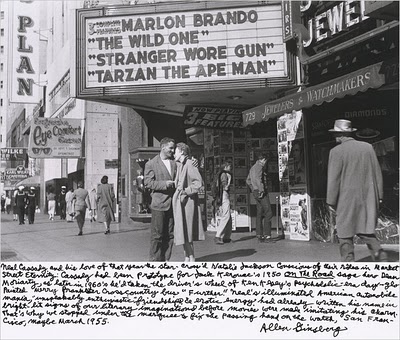
The exhibit, Beat Memories: the Photographs of Allen Ginsberg, is a wild and exciting look into the world of the Beat Generation, a group of writers including Jack Kerouac, William S. Borroughs, and Ginsberg himself that became prominent in the 1950s – a time of extreme materialism, fear and conformity in America brought on by the Cold War and the anti-Communist sentiments of Senator Joe McCarthy during the Second Red Scare. Kerouac’s On the Road, Borroughs’ The Naked Lunch, and Ginsberg’s Howl were the major defining works of this generation, one which rejected these modern societal norms and turned instead to experimentation with drugs, alternative forms of sexuality, and Eastern religion. They preached lives of spontaneity, simplicity, and self-discovery, all the while expressing their contempt for the conformist culture in which they lived. Ginsberg’s “Sunflower Sutra” is a prime example of the prominent influence of Eastern thought and philosophy on the Beat writers, who often incorporated the fundamental ideas of Buddhism, Hinduism, and other Eastern religions into their writing as a means of conveying the problems they saw in their contemporary American society.

The photos themselves – which constitute the first-ever scholarly exhibition of Ginsberg’s photography – create a fascinating ride through the unorthodox lives of these countercultural icons as seen by the poet himself. For the most part, they are candid portraits of Borroughs, Kerouac, and others, accompanied by a poetic, stream-of-conscious description of the images’ contexts written in Ginsberg’s sloppy scrawl. Together, the photo and the text work like Dick van Dyke’s magical sidewalk chalk drawings in Mary Poppins, allowing the viewer the opportunity to leap right into the scene at hand and be transported directly into the wild world of the Beats.

Upon entering the exhibit, you learn that Ginsberg picked up photography after purchasing a thirteen-dollar Kodak camera at a pawn shop in 1953 (with which many of the early prints were taken). That fact alone speaks to Ginsberg’s style, both as a poet and a photographer; he is at once spontaneous and romantic, aware that the quality of his work comes not from the quality of the materials with which he works, but from his own unique observations of the world around him – and, as one can see after viewing these first few images, he did not need a fancy camera to capture this unique perspective.

Ginsberg once said that “the only thing that can save the world is the reclaiming of the awareness of the world. That’s what poetry does” – and it would appear that that’s what photography does as well. His photographs are simultaneously iconographic and intimate, strange and personal. They capture the Beat Generation’s philosophy of living in the moment while maintaining awareness of the beauty which surrounded them. They serve as instantaneous glimpses into the lives of a group of people who were both disheartened by the society in which they lived, one guided by convention and fear, and enchanted by the world that existed beyond these confines of conformity. They are the graphic version of Ginsberg’s poetry – spontaneous, personal, unconventional, imperfect, and shamelessly honest. They are portraits of iconic, countercultural voices as seen through the eyes (and lens) of another. One of the marks of a successful portrait is its ability to capture the unique spirit and persona of the sitter, and, though he is by no means considered one of the great American photographers, he certainly achieved success in this regard. Through his photography, Ginsberg captured not only the carefree personalities of his close friends, but also the greater spirit of an entire generation of like-minded writers, artists, and thinkers who dared to be different.

So, the next time you’re feeling like just another sheep in the flock, take my advice: abandon the flock. Get off campus, hop on the Metro, and head down to the National Gallery to take a ride on the Beat bus for yourself. This exhibit is sure to inspire as well as entertain and, if nothing else, to remind you to embrace your own individuality.

Clare Donnelly is a junior at Georgetown University studying Art History. A proud native of the Ocean State, she quickly fell in love with D.C. and its vibrant arts scene upon moving to the city for her freshman year at Georgetown. It was not until this past semester, however, that she made her foray into arts journalism, serving as a columnist for The Guide (the weekly magazine for The Hoya, Georgetown’s student newspaper of record). When not busy eating, sleeping, and breathing the arts, Clare also takes part in Georgetown’s New Student Orientation, Relay for Life, and student theater. She is currently studying abroad in Brussels, Belgium.

“Turn on, Tune in..” is one of the five finalists in the 2011 DC Student Arts Journalism Challenge.

Campaigning in Poetry by Thomas Seay

0

“You campaign in poetry. You govern in prose.”
– Mario Cuomo

But here’s a secret: the halls of Congress
burst with would-be poets, those marble-faced men
in dark gray ties who strive each day
to govern in sonnets or even haiku,

but inspiration – so radiant in their minds –
dies before it hits the pencil’s tip,
and what survives is just the sour prose of law.

It isn’t only poets. Among these columns
are painters and sculptors too, their fingers
numbed by icy governing, and
opera singers filibustered into permanent silence.

Saddest of all is the junior senator from Kansas,
the gymnast who campaigned in flips and twirls,
aloft in winds of promise, who now moves
only to commit, defer, adjourn,
his sashays clicking, clacking
in a soldier’s rhythmic march.

Thomas Seay passes his days in the halls of Congress, which very rarely inspire poetry. His fiction has appeared in Boys’ Life, Realms of Fantasy, Fantastic Stories, and other publications. He holds an M.F.A. in creative writing from the University of Kansas, and he is an administrator at the Alpha SF/F/H Workshop for Young Writers, held each summer in Pittsburgh.

Campaigning in Poetry by Thomas Seay (c) Copyright Thomas Seay; printed by permission of the author. Photo courtesy of the Library of Congress.

Love and Death at the NIH by Michele Banks

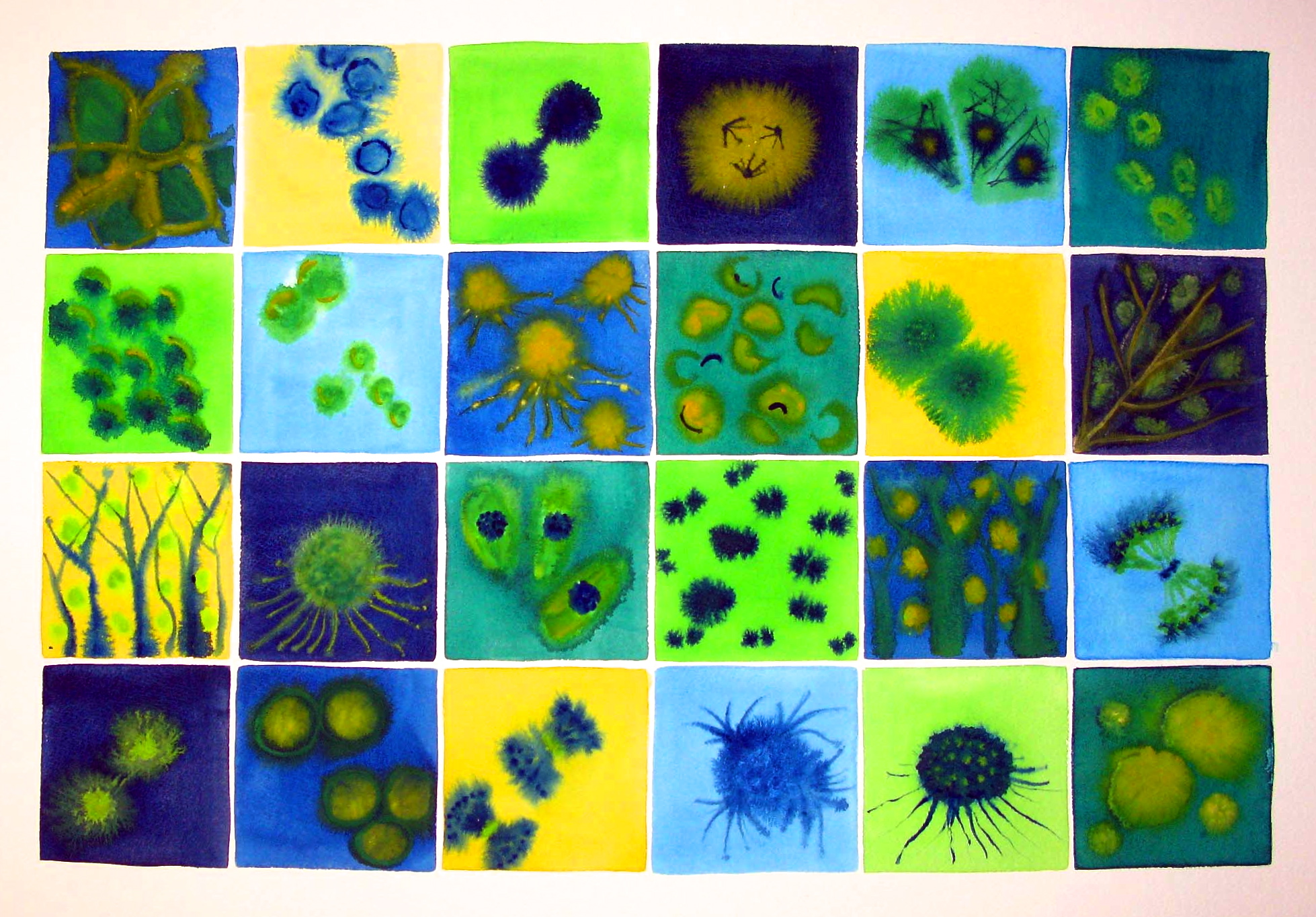
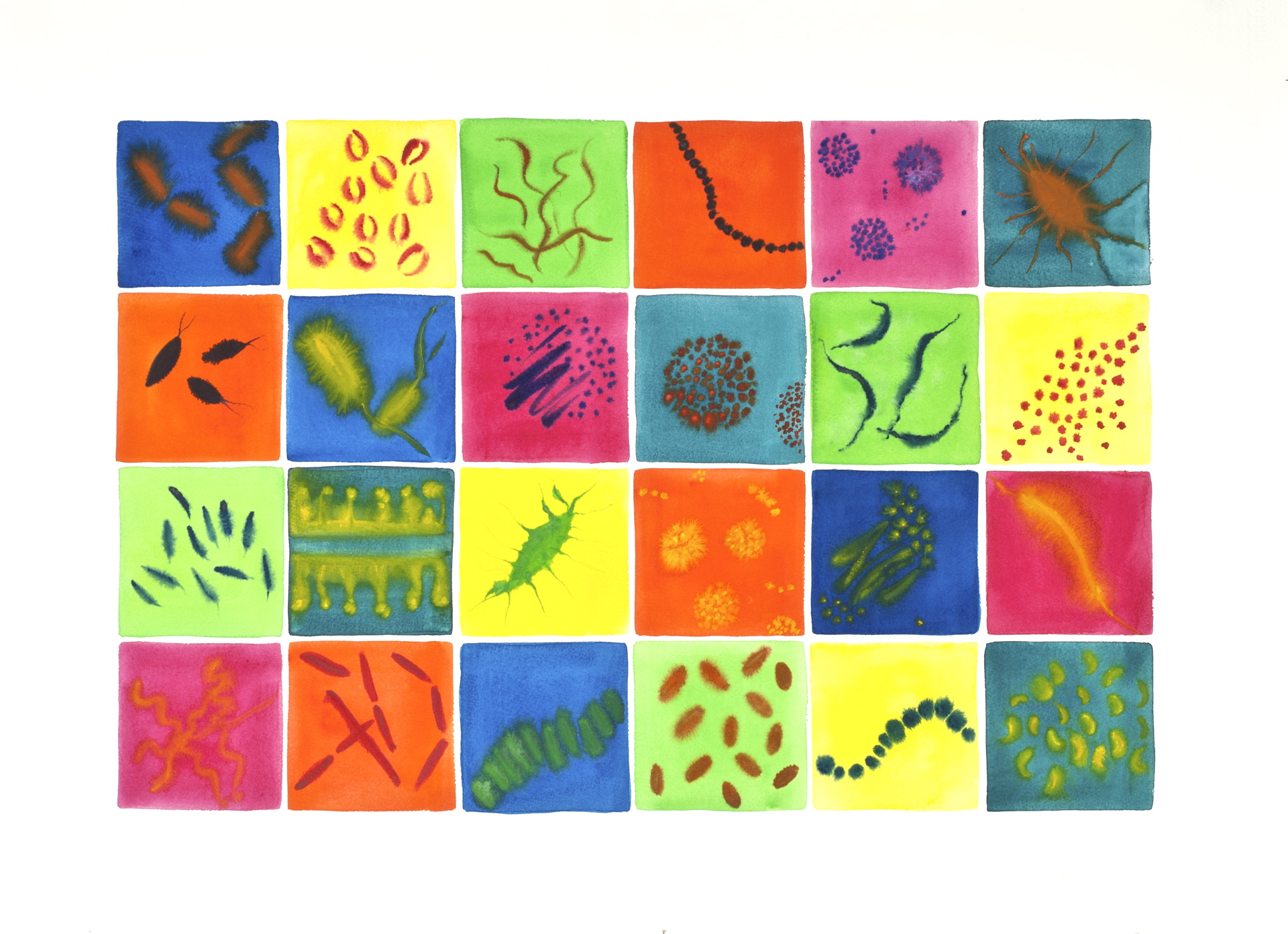
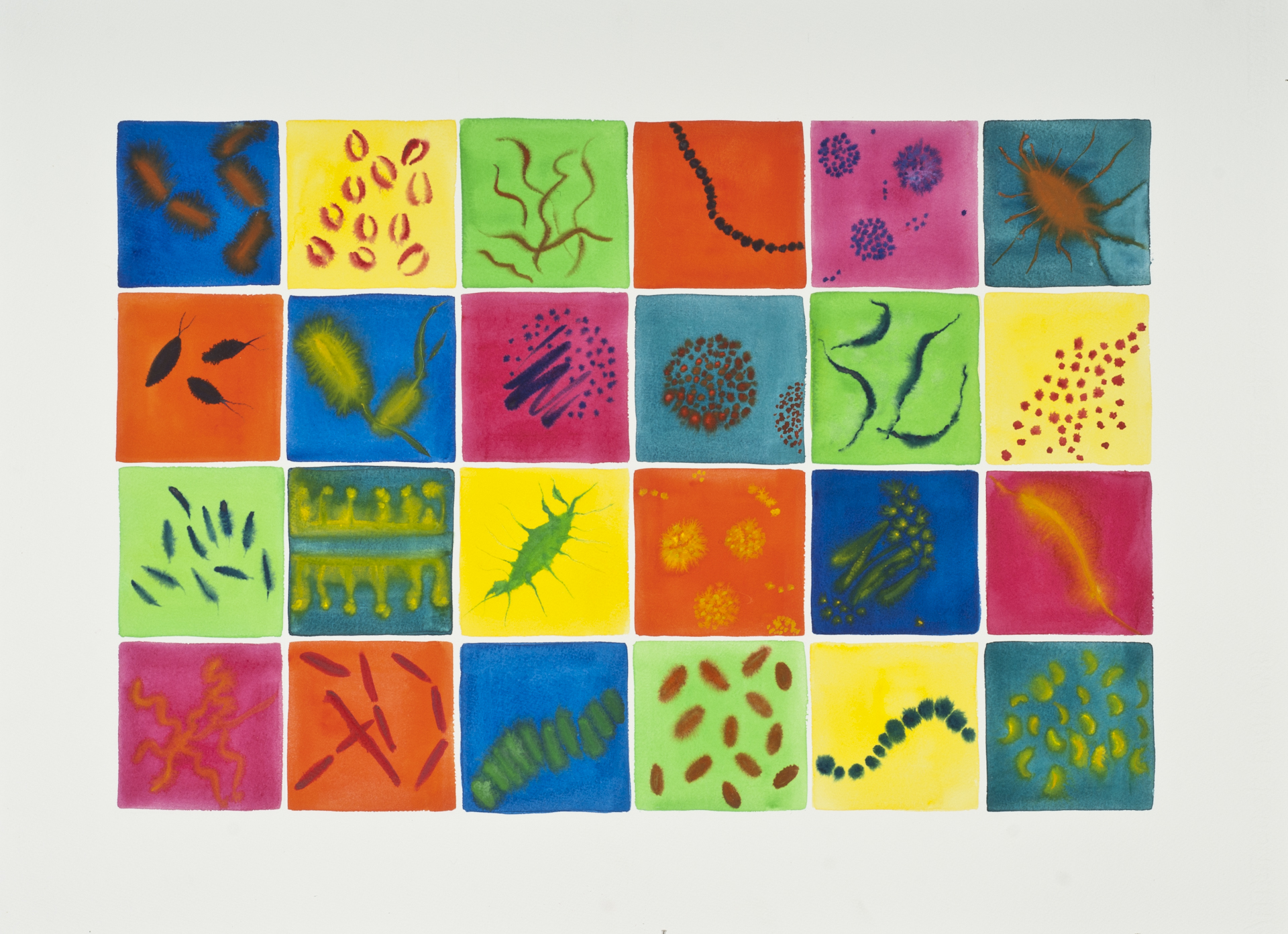
I first started experimenting with watercolor about 10 years ago, and from the beginning got into “wet in wet technique.”  To paint “wet in wet” you paint a base color and then add other colors to it while it’s still wet.  This allows the different colors to bleed into each other, making interesting patterns. People who saw my wet-in-wet work at shows kept mentioning how much it looked like cells under a microscope, so I found some images of cells in mitosis, or cell division, and discovered that they did indeed look a lot like what I was doing.  After looking at the images I began actually trying to paint cells, but I guess I’ve been painting them for about a decade.

Last winter, when DC was buried under several feet of snow, I decided to finally make a move into online art sales, opening up a shop on Makers Market, a juried online marketplace with a scientific bent.  The cell pieces were instantly my most popular, so I’ve been making more and more cell images.  I’ve been showing my work, mainly at art festivals around DC, for about 10 years.  Selling online connected me to a whole new audience and provided a creative shot in the arm. A bunch of biologists bought my work, and some of them suggested new subjects, like bacteria or blood cells.  One buyer pointed me toward “brainbows” – a series of images of mouse brain cells dyed in bright colors.  I loved them, and the images inspired me to begin painting brain cells.

I was talking about this new work with an artist friend, Sean Hennessey, who mentioned that he was having a show of his work at the National Institutes of Health (NIH) and suggested that my cell paintings would be a good fit. The curator at NIH agreed, so I started to conceptualize this show. I decided that a whole show of mitosis paintings would be a little boring, and I wanted the exhibit to have a stronger theme.

bigbacp

I got to thinking about how activity at the cellular level underlies major upheavals in our lives, like falling in love, giving birth and dying.  I decided to divide my paintings into two groups – love and death.  It’s a kind of ridiculously grandiose theme, but I’m a lover of opera and Russian literature, and heck, go big or go home, right?

I learned a whole lot of anatomy and biology while painting these pictures.  I looked up microscopic photographs in books and on the web and did many practice paintings, trying to get the balance right between accuracy and artistry.  The “love” paintings focus on the cells that are involved in attraction and desire – the skin, eyes, and ears, the brain and the circulatory system.  I’m very proud of my blood vessels, especially my abdominal aorta.  (That’s not technically a cell, but ok, too bad.)

For the “death” paintings, I depicted three microscopic killers – bacteria, viruses and cancer.  The cancer piece really hit home, because I lost both my parents to pancreatic cancer over the last decade, and I had never really approached it in my art before.  And I included two mitosis paintings, because cell division underlies the whole process of life and death.

I’m really happy with the work I’ve put together for this exhibit, and I feel like it’s opened new doors for me creatively. The exhibit opens January 14th and will be up through March 5, 2011 at the NIH Clinical Center West Gallery (10 Center Drive, Bethesda MD 20892.) For more info about getting to NIH, see: http://www.nih.gov/about/visitor/index.htm

Michele Banks is a self-taught artist based in Washington, DC.   She stayed in school for 20 years, picking up degrees in non-art-related subjects from GW and Harvard.  Michele then set out for Europe, spending five years as a management consultant in the UK and Russia.  After getting married, moving to Bermuda, and having a baby, she came back to DC and started to paint.  Michele has been showing her work locally since 2001 at galleries and festivals in the DC area.  She has served on the steering committee and the board of Artomatic, and her work is in the DC government’s Wilson Building Collection and the permanent collection of Children’s National Medical Center.  Michele lives and paints in an apartment in DC that she shares with her husband, daughter and cat. She sells her work online at artologica.etsy.com.  You can follow her on Twitter @Artologica.

In the Kitchen Chopping Vegetables by Jenny C. Lares

0

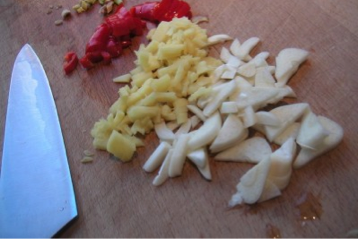
She’s chopping carrots
on the bamboo cutting board
the knife slicing,
permanently and irrevocably.
She asks me when I came home last night
in the beat to the blade
rocking on the board.
She leaves no time for pauses
and continues on a motherly tirade
each stroke closer to my tongue
escaping out my mouth
and the inevitable slap across my face.
Ladies don’t come home at 2am.
Her words reverberate,
resounding off the board
and only the scraping of steel on bamboo
occupies the space between us.

In our fury, blood, spit and
a million misunderstandings
spill over with one misstep.
Our words are curt and sharp
as that knife and we battle
endlessly as we’ve been taught.
Neither one backing down
because pride is all we got
in common, and a struggle
I articulate in my college rhetoric.
When really all she wants to know
is if she raised a good child,
a good daughter.
Her personhood founded on
being a good mother.

As she starts to mince onions,
my silence stings with each passing second.
I want to tell her:
I am good.
Just not in the way she wants.

Jenny C. Lares is a poet and the Founding Co-Director of Sulu DC, an underground network and home for Asian American and/or Pacific Islander (AAPI) multidisciplinary artists in the D.C. area. On the 3rd Saturday of every month, she curates a showcase of emerging and established AAPI artists from local and national scenes. Ms. Lares also hosts the 4th Tuesday Open Mic Night at Busboys and Poets (14th & V). She has featured at Busboys and Poets, Artomatic, and Mothertongue, and has performed at the APIA Spoken Word & Poetry Summit(s), the Bowery Poetry Club in NYC, and the Asian Arts Initiative in Philadelphia. Her work was recently published in the anthology, Walang Hiya: literature taking risks toward liberatory practice, published by Carayan Press.

In the Kitchen Chopping Vegetables by Jenny C. Lares (c) Copyright Jenny C. Lares; printed by permission of the author. Photo courtesy of Wikimedia Commons (cyclonebill).