Home Blog Page 153

Endurance/Suspension by Jenny Walton

0

Recently, I have worked largely in monotypes – one-of-a-kind prints that are painterly in execution and in effect. A residency at Pyramid Atlantic in Silver Spring gave me access to the best printmaking equipment and time to experiment. My work involves the suspension of faith in science and organized belief systems; I question commonly -held “truths” through my personal experience in the process of making art and the physical destruction and reconstruction of the body. By dealing with the beautiful, horrific, and sublime nature of the human body, I work toward an evolving sense of the spirituality and physicality of being human.

In much of the work, I envisioned the rib cage as a structural and metaphorical stabilizer within each composition. It offers protection, structure, and containment, much like organized religion. The often abstracted and wildly expressive landscapes outside of the ribcage allude to a constantly changing realm of scientific discovery that challenges established belief systems. These monotypes were created by painting and drawing into ink on YUPO polypropylene sheeting the size of the full press bed. Using this material as the printing matrix emphasizes fluidity and spontaneity.

I worked in suites of prints, building upon or destroying parts of the previous composition to further ideas and elements in the next. At the beginning of each suite, I would utilize imagery from anatomy books, x-rays of my own body, and photography to create the initial composition. As I worked further into the suite, those representational images would either be obliterated or emphasized, depending on the response to my physical awareness of previous injuries to my body. As my own physical stamina decreased in the course of long printing sessions, so too did the representation of human anatomy in the work.

Physical endurance during my artistic practice has become a key factor in my work. As I reached for larger ranges of motion and pushed the limits of my physical ability and mark-making, the pieces reflect my response to thoughts of spirituality, mortality, and the metaphors of human life and its evolving relationships to the world.

Recently my work has taken some new directions that are also inspired by the limitations of the physical body. Shortly after my residency, I had a serious fall that required a long healing process on multiple limbs. My studio practice has suffered significantly. It felt like being on a speeding freight train, then coming to a sudden halt without notice. It hasn’t been easy to work in the last year; it feels stilted, rusty, and painful. But the key is, I continue to try. The physicality of the work that I was enjoying in the residency, using my whole body to work on increasingly larger images, is no longer accessible. I had to try to figure out how to translate the marks, ideas, and methods that I discovered at Pyramid Atlantic into something more manageable from the sitting or reclining positions that I can maintain.

My best friend, who understands my frustrations, dared me to try working with my left hand while the right arm heals, and I took the dare. Training my left hand to respond to my brain’s directions takes great concentration. It requires doing the opposite of what comes naturally.

Using my left hand, I have been working very small. It’s strange to me how a 5” x 7” piece of watercolor paper can become intimidating, when just last year, 60” x 30” inches seemed too small. With each piece, both my body and ability gets better. While at this moment I’m concentrating more on regaining my skills, I can’t keep the content from emerging. The small intimate pieces have become meditations on healing. While my work in the last several years has addressed the healing process, it has never been quite so important that the work also BE the healing process.

Jenny Walton was born in Spokane, Washington. She received her MFA from American University, which included a year in Italy. Walton has received the Joanne Crisp Ellert Award of Excellence and two Mellon Research Grants. She has shown work at Daneyal Mahmood Gallery in New York, Pierre Menard Gallery in Cambridge, Pyramid Studio in Rome, and is included in the American University Watkins Collection and the District of Columbia Art Bank. Residencies include the Chautauqua School of Art and Pyramid Atlantic Art Center. She currently lives and works in the Washington, D.C. metro area.

Edited by Ellyn Weiss
In My Father’s Image by Camille Mosley-Pasley

My father was a phenomenal photographer. He took his camera everywhere and documented the ordinary. He took photos of relatives, neighbors, door-to-door salesmen and anyone else that crossed his path or entered our home. He had a way of drawing people out and making photographs that revealed their personality, quirks and all. I used to look at his photos in magazines and newspapers and his boxes and albums of photos over and over, the way a child does with a favorite storybook. Everyone that came to our home did the same thing. They would pick up an album and reminisce about the people and places they knew and ask for the story behind those they didn’t know.

When I was 14, I asked to use my father’s camera so I could make my own photo albums full of the people, places and stories that meant something to me. He wasn’t partial to me handling his equipment, so he bought a camera for me and taught me how to expose, compose, develop film and print. I’ve been documenting the ordinary ever since.

I’m drawn to the sights, ideas and experiences that most people readily dismiss as insignificant. Things that are so common or second nature that they are not noticed. In my mind, these are the things that define a person, place and time and tell a story. These are the nuances of life that fade and disappear with the passing of time. These are the things I want to remember with photographs.

In my late teens and early twenties, I thought I needed to document exotic places and exciting events. The resulting photographs rarely interested me unless people were in them doing something very ordinary. The scenic postcard type of photo does not resonate with me. I need human or animal interaction to hold my interest. I need to tell a story.

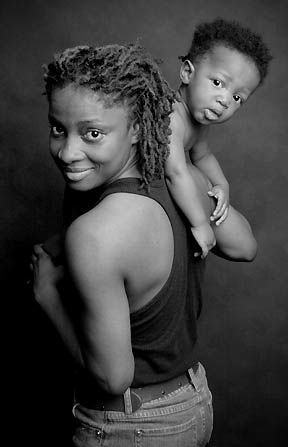
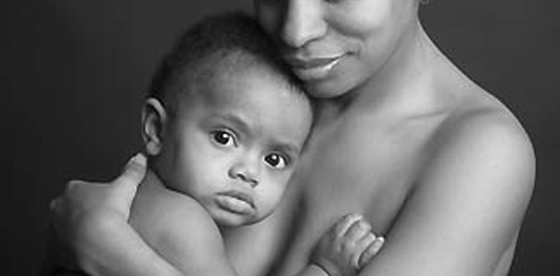
The best way for me to tell a story is in a series. I usually work on two or three concurrently, with one on the front burner and the others simmering in back. Elements from one series segue into the next. The “Mama Love” series is currently on the front burner. It’s an offshoot of a pregnancy series that began several years ago. As a thank you gift, I invited the women to return to my studio for portraits after they had their babies. During the photo sessions, the new mothers expressed amazement at the magnitude of the feelings they experienced after giving birth. I felt that their casual, seemingly insignificant expressions and the resulting images were far more moving and powerful than the series of pregnancy photographs I was working on, so I switched gears and began inviting women to the studio to be photographed with their infants and to comment on their feelings about motherhood. This series aspires to give the viewer a glimpse into the special bond between mothers and their children. The women are not portrayed as madonnas or mother goddesses to be idolized. They are fully human, expressing the complexities of parenthood.

While photographing women for “Mama Love” the related series “Nurture” emerged. Many crying babies were bottle and breastfed during the photo sessions. This was a great relief to me since a happy baby resulted. Most of the breastfeeding moms gave permission to continue photographing while they fed. The images reveal an even deeper connection between mother and child. The calm contentment of both mother and child is heartwarming and powerful. Several of the breastfeeding images have been used by national and international health organizations to raise awareness of the health, psychological and financial benefits of breastfeeding. As health care becomes less available and affordable, breastfeeding is one way to give a child a healthy advantage. “Nurture” will be used to advocate breastfeeding, particularly in low-income communities with high rates of formula fed babies.

Further development and promotion of the “Nurture” series is on the back burner for now along with the pregnancy series. “Mama Love” will be self published in book form in the near future. What pleases me most is that the book has the same effect effect on me as my father’s photo albums. I look at the images over and over, remembering the ordinary stories and conversations with extraordinary people.

Camille Mosley-Pasley studied Commercial Photography at Penn Career Center, a vocational high school in Washington, DC and earned a BFA in Fine Art from the Corcoran College of Art & Design with an emphasis on sculpture and photography. For many years she served as director for two DC area galleries. Currently, she owns and operates a photography studio, serves as chair of Market 5 Gallery, a non-profit alternative arts organization, is an art consultant and independent curator. Through her ongoing documentary series Transcendence and Mama Love, she preserves the small, often ignored details of daily life that define her culture.

Edited by Ellyn Weiss

Tricycle Trip in the Mesilla Valley by John Russell Monagle

0

When mother went to sleep
in the afternoon I pedaled
my tricycle by yards and houses
behind chain linked fences,
along paths beside dry ditches,
through a vacant lot,
across the sidewalk
before tracking on solid
yellow lines parting asphalt streets.

I pedaled toward the mesa,
cars rushed from ahead and behind.
Unconcerned about my danger,
I rode through the slow hours
before a mother left her son in the yard
and ran to stop my tricycle
on the yellow lines, straddling
her legs on the big wheel.
She carried me into her house
and fed me ice cream before calling
the police who arrived a short time after
and took me home in their cruiser.

Through the back window,
I tracked the sun’s descent
through the final hours
to its splashdown. It sank
too quickly for me to join
others who went every day
to the evening party where
mothers put the sun to its sleep
while twilight children danced
on the tightrope of the horizon.

John Monagle was born in Claymont, Delaware and raised in Las Cruces, New Mexico. A graduate of New Mexico State University, he is a resident of Rockville, Maryland and works at the Library of Congress. He has been twice selected as a Jenny McKean Moore fellow at The George Washington University and has been previously published in Minimus and Wordwrights poetry journals.

Tricycle Trip in the Mesilla Valley by John Russell Monagle (c) Copyright John Russell Monagle; printed by permission of the author.

Photo courtesy of Wikimedia Commons (Thegreenj)

Daniel Barbiero on Musical Space and Texture

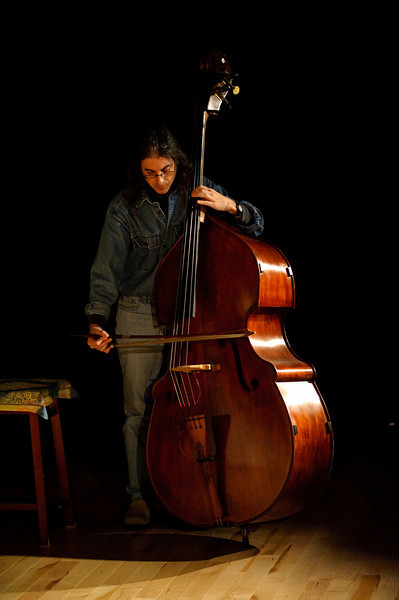
While we might think of pitch, melody, and harmony as traditionally musical elements, non-musical elements and objects also have a place in contemporary improvised music. I play the double bass, and experiment with space, or musical silences filled by ambient sound, and texture, the particular quality or color that gives each sound its defining character. With both of these elements, I hope to focus the listener’s perception not only on the improvisation as it unfolds, but on the act of perception itself.

Space

Many of my improvisations include stretches of silence in which I and/or my collaborators do not play. These silent spaces function as a means of ordering the sound events, both separating and connecting them within the overall architecture of the improvisation. They also allow the listener to gather in the improvisation as a whole, and to become aware of the act of listening itself. (When we find ourselves listening to silence, we are in effect listening to listening.)

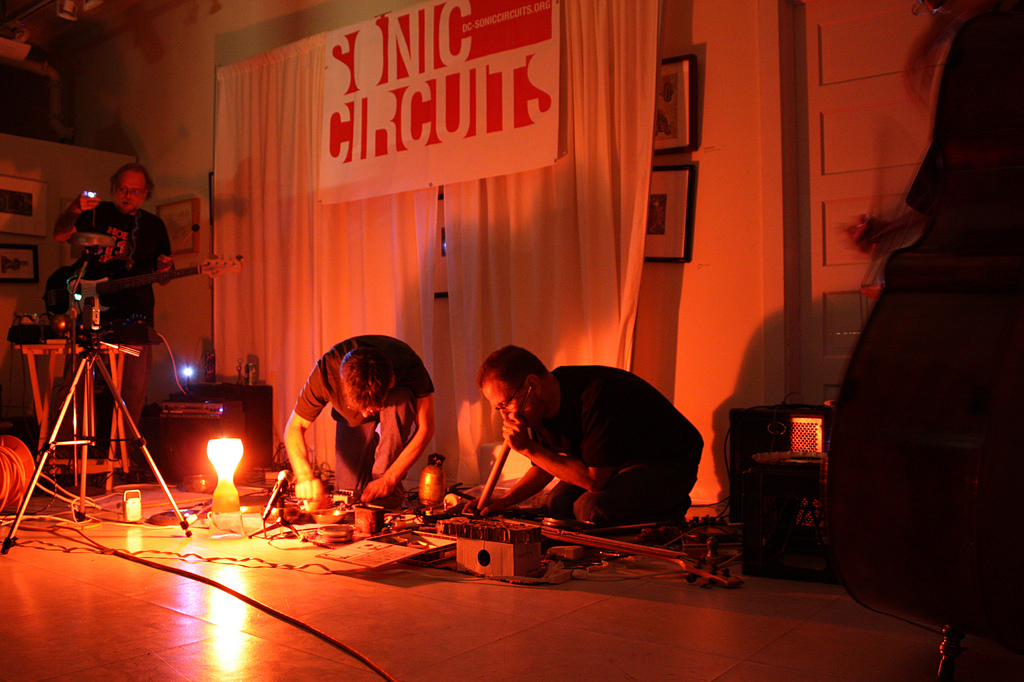
When I play with improvisational groups, such as Liquid Friction Assemblage, nine_strings, or Mercury Fools the Alchemist, my collaborators and I listen to the open spaces we create around each other. One of us might fill in a silence left by another, or we may simply leave the silences to stand by themselves. We do this more or less spontaneously, as we create unplanned but mutually agreed-upon lacunae with which we can balance and bind the sounds we create with our instruments.

Texture

On the double bass, I can alter the texture of my sound by bowing or plucking, or at a more subtle level, by varying the pressure or placement of the bow, its speed across the string, or by bowing across or below the bridge. These textures dramatize the colors that are an integral part of the sound envelope of the musical note, and which impart essential information about the note, such as what kind of instrument—e.g., string, wind, or percussion—produced it. To add another layer of texture to the sound, I can prepare the bass by introducing non-musical objects into it, such as chopsticks or pieces of cardboard threaded between the strings, or binder clips attached to the bridge.

My collaborators may contribute to the foregrounding of texture by creating sounds from a variety of non-musical objects—for example, running a violin bow across metal, amplifying rolling marbles in a box rigged with contact microphones, or scraping and rubbing surfaces of everyday objects such as springs and kitchen implements. Although produced by non-musical objects, these textures serve to highlight the color nuances of the more conventional musical sounds we create, underscoring the fact that there is a timbral element to pitch and focusing the listener’s attention to this sometimes neglected, sometimes taken-for-granted dimension of pitch production.

When we move back and forth between pure textures and more conventional instruments, and between musical events and open silences, we allow the music to recontextualize the sometimes mundane, sometimes startling sounds surrounding it, and offer the listener an opportunity to heighten his or her awareness of silence and texture as essential elements of the sound environment we all inhabit, whether listening to a musical performance or going about our daily lives.

A native of New Haven, CT, Daniel Barbiero has been active in improvised and experimental music in the Baltimore-Washington area for several years as a performer, composer, and ensemble leader. His music reflects his long-standing engagement with scalar and free improvisation, aleatory composition, and alternative methods of scoring for mixed ensembles. His creative activities have included leading and composing for the ensembles Shape Memory Alloy and Third Object Orchestra; he has collaborated with pianist Nobu Stowe and electronic sound sculptor Lee Pembleton, and backed Ictus Records percussionist Andrea Centazzo and Blue Note recording artist Greg Osby. In addition to his work with the Nancy Havlik Dance Performance Group, he currently plays in nine_strings, Liquid Friction Assemblage, and in the ambient/surrealist/improvisational trio Mercury Fools the Alchemist.

Edited by Jessica Wilde

Photo of Daniel Barbiero (c) 2010 Colin Hovde/Artists Bloc

My Ritual of Snaphot by Kathryn Boland

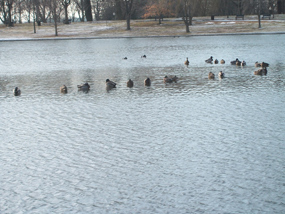
While some artists are known for maintaining rituals in their creative processes, many are known for the opposite – making art when the muses move them. I made a creative ritual for myself this past spring, putting me in the former category. Every Saturday morning I walked down to the pond between the Lincoln and Washington monuments and snapped photographs. I would shoot runners, the adorable ducks living in the pond, trees and their shadows – anything that caught my eye. With its meeting of the natural and man-made, the location is full of intriguing photographic possibility. I only hoped that I could do all that possibility justice; I only have a little bit of independent experience with photography, having never taken a class or worked in a darkroom.

Photographic images have always interested me, however. Even in dance, the art form that I’ve devoted far more attention and energy towards, I love to dance and choreographic still images, poses, and geometric shapes. Photography has even helped me to enhance this interest. When I would walk down to that pond and shoot, I could see how pictures capture one moment in the continuous cycle of energy that is life. I could then apply this new understanding to dancing and choreographing. My dancing and choreography began to let that continuous energy flow through it more than it ever had before, while still in my habitual still-image mode. My movement became more natural, easy, and aesthetically pleasing as a result. Many artists similarly recognize how engaging in separate art forms can complement one’s abilities with one or both of those forms.

My Saturday morning ritual also became catharsis for me, as creating art can often be. The walk was meditative and peaceful, with few people up and outside that early on the weekend. I would mouth a quick “hi” to the occasional passing runner, and be glad that I didn’t have to deal with shoulder-to-shoulder crowds. Beyond that even, my weekly ritual was a comforting constant in an otherwise consistently changing life. Rehearsals and performances always change, as do approaches towards and scheduling of academic work. That being said, I wouldn’t have it any other way. I think that a completely regular schedule, without a break in the monotony, would drive me insane.

Torrential rain or snow would occasionally make me have to re-schedule, or an early rehearsal would mean that I would have to cut my walk short. For the most part, though, I could depend on being able to take my walk/shoot every weekend. All I needed was myself, good walking shoes, and my camera – and, oh yes, the essential tumbler full of coffee (it was early). I could simply enjoy being creative and physically active – out of bed, off of my computer, and out of the library. No one to judge me but myself. No one to please or rubric criteria to meet. No phrase of choreography that I just can’t seem to get. No slow internet connections or malfunctioning printers. Just me, the ducks, the trees, the water, and my camera. Click. Swoosh. Quack. Not a bad way to start the weekend, I say.

Kathryn Boland is a rising Senior at the George Washington University, majoring in Dance. She is also minoring in Art History, Theater, and English. Originally from Newport, Rhode Island, she is fascinated with anything and everything artistic. A former intern, she is currently an editorial assistant for Bourgeon.