
Home Blog Page 161

White Do-Gooderism in DC’s Dance Education Scene by Jonathan Carrington

I don’t write this to be critical of Caucasians, or persons who identify as Caucasian. I write this to bring awareness and attention to a few of the administrators of arts education programming, specifically dance educators in predominately African-American and/or Latino neighborhoods in the District of Columbia.

As I think about this issue, I am reminded of the 1995 movie Dangerous Minds. Starring Michelle Pfeiffer as LouAnne Johnson, a White ex-marine who finds a job teaching English in an inner-city high school, Dangerous Minds is based-on-a-true-story. The 2007 movie Freedom Writers (starring Hilary Swank as Vera Drake) hews to a similar boilerplate account of a White crusader ministering to the under-served, predominately African-American and Latinos. The theme that these two movies share reinforces my understanding of dance education programs in the District: the White female heroine archetypes “doing all that they can” inside and outside the classroom to “save the children” from themselves.

Janine Jones, an African-American philosopher, has written about White efforts to empathize with the difficulties of non-white people, and labels characters like LouAnne and Vera as “goodwill Whites”. She describes such people as praiseworthy for the concern they have for others, but asserts that these people usually don’t realize that their efforts are about helping others become more like themselves. Jones writes that unconsciously, “goodwill Whites” believe their customs and beliefs are the “best” customs and beliefs. According to Jones, “goodwill Whites” offer their assistance from a condescending position, because they don’t see themselves as White and thus don’t comprehend how that has come to deeply inform who and what they are. When I think about her analysis and the state of dance education programming in the nation’s capitol, it raises the question: “Should teaching dance in predominately African-American and Latino neighborhoods be left to hippy, free-spirited White women wearing chunky jewelry with their touchy-feely, scientifically-tested, New Age classroom games?”

Dance education programming in predominately African-American and Latino neighborhoods deserves to be investigated. The “white do-gooders”, or “goodwill Whites” who administer these programs express confidently to the outside world that they expose their students to a world that is entirely “better.” In fact, it is just markedly White. As the movies I cited show, the world outside of a ghetto offered to these students is a world full of people who don’t have “dangerous minds”; people who are much “better” than those filling the seats in under-funded, poverty-stricken, racially oppressed inner-city classrooms.

Again, this article is not intended to bash anyone based on skin color. But I have a message to all of the White do-gooders and goodwill Whites out there: We are not a scientific experiment. Your New Age-inspired teaching methods and principles do not work on us. Your job is to educate, inspire, and mentor, not condescend, analyze, normalize, and save us from our-selves. We are powerful beyond measure, despite your blindness to our real potential. Are we just meant to gain exposure to the field of dance? If you have come to help us, you are wasting your time. However, if you have come because your liberation is bound up with ours, then let’s work together.
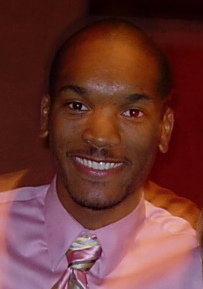
JonathonJonathon Carrington currently works with Dissonance Dance Theatre, a contemporary dance company in Washington, DC. He has worked with Dissonance as a General Manager for three years; and as an arts manager in the District for seven years. His current professional interests deal mostly with writing about dance-related issues in DC, mentoring, professional development, and arts leadership. You can check out some of his latest blog entries at http://www.ddtmedia.com.

Creating ‘Postcards’ by Alec Simpson

A number of months ago I went to a conference and exhibition at the World Bank called: “AFRICA NOW! Emerging talents from a continent on the move.” Although the conference and exhibition were impressive on many levels, I was really moved by two female African artists who in their slide shows emblazoned the tag of “Artist Entrepreneur” under their name. Apparently, in their culture, being an artist is the provenance of men and, as females, they were completely shunned and un-supported by the community. In a nutshell, these artists had to learn their craft on their own, manage their day-to-day survival, and also learn how to push their craft before the public and into the marketplace. Hence, they had to take on the dual role of artist and entrepreneur in a serious way.

Although I do not face their exact challenges, I face my own challenges that are large enough. After I saw how they proudly presented themselves as artist entrepreneurs, a strong sense of connection to that notion took over. Now, when asked the question about what I am working on, I answer unequivocally that I am working on owning and becoming comfortable with the notion of being an “Artist Entrepreneur” and all that that means.

What exactly has that meant for me? It has meant that I had to stop acting as if I were asleep at the wheel and start to awaken to the opportunities that were already coming my way. One is not an artist entrepreneur unless one gets his or her work out there. My sister does websites, and has been begging me for several years to create my website. I finally woke up to this opportunity when she recently offered to do my website as a birthday present. My website is currently under construction at www.alecsimpson.com

On the Artist side of the equation, I have been working hard on closing the time gap between the germination of an art idea and its actual execution. I make myself do some kind of artwork each day. And if I get a new idea about an art technique, art materials, or art process that I would like to “play with,” then I try my best not to wait another month or two to try it out. I just make myself go in there and do it. I have not been a hundred percent successful in this, but I have made real strides in this direction.

Postcard-14-for-web-littleThe opportunity for a one-person show came my way. This put fire under my feet to begin working in earnest on a series that I had started during a recent trip to Berlin. I needed something new to show and those works would be perfect; I now had a reason to commit to getting them done. The name of the series is: “Postcards from Berlin: Rising from the Ashes.” The works in this series are composed of materials I literally picked up off the streets, and from the gutters, of Berlin; announcement postcards from many different performance and exhibition venues, chotchkies from the colorful Turkish bazaar in the Kreuzberg section, maps, beads and colored sand from arts and crafts stores, and many other items. Some items were burned to create ashes that were mounted on Berlin post cards or card stock, and then painted with various acrylic media.

For me, the works have a universal message. We all face times in our life when we need to rise from the metaphorical ashes of whatever challenge we are facing. I am facing just such a time in my own life … taking ownership of being an artist entrepreneur, and coming to terms with what that means for me regarding making a living. For others, I would imagine that “rising from the ashes” could and would have so many meanings. Whatever the meaning, it is my hope that these works act as symbols of empowerment, courage and overcoming to face each day as a new day with potential for hope and joy, no matter the challenge being faced. The show, “Flash-back/Fast-forward: An Exhibition of Artwork Past and Present,” opens on October 10, 2009 and runs to November1, 2009 at the Corner Store Gallery, 900 South Carolina Avenue, SE in the Capitol Hill Area of the District (www.cornerstorearts.org).

As the show gets closer, I am getting photos of my work done, updating my artist bio and statement, and thinking more about the pricing of my work. I am confronting what it means to really take care of business regarding my artwork. Being an Artist Entrepreneur means managing a balancing act. That said, now that I know the name of the game I am in, I am better able to learn the rules, play well and win. This is what I am working on.

Bio:
Color, energy, music – these are the elements I think of as I create artwork. My approach is akin to jazz improvisation. Once I have my “sub-text and back-story,” then process and flow become very important. For me, this means allowing materials that want to work with me the opportunity to express freely within loosely set parameters. Therefore, most of what I produce shows up as abstract mixed-media works. I hold a Bachelor’s degree in Music, an art history and aesthetics M.F.A. in Comparative Arts, and an M.B.A. in General Management. For more information, please feel free to contact me at: info@alecsimpson.com.

Salvador Casco on the Emergence of Expression

Recently, I was invited to participate in a Career Day event hosted by Northern Virginia Family Services. The event brought together professionals from various fields; a videographer, a reporter, an event promoter, a financial analyst, a policeman and myself – a contemporary artist. The event was hosted to inform youth, at risk of becoming involved in gang activities, of career opportunities. I took with me a selection of paintings, which were placed around the room. I gave a brief history of my artistic life, and talked about key points of my creative process and techniques. Later I had a chance to meet with the students and answer their questions. I’m hoping that the participants were able to get something from my words, and my paintings, and that I might have influenced them to make a turn for the better.

I grew up in a small town where electricity was a luxury. In pitch-dark nights, my mom took me outside to contemplate the stars, and I would make fanciful configurations with the constellations. She has told me that she knew then that I was an artist; that she was aware of my sense of wonder and curiosity at nature and the universe. My view in the morning was equally inspiring. I woke to un-obstructed panoramic views of glorious sun rises, with their ever changing warm color compositions. The morning and the evening both guided me to the path of creativity, and made me appreciative of the transformative powers of the elements. To this day, nature is a springboard for my imagination. The morphing of the clouds in a semi-clear blue sky, and the scribbles left on the beach by thousand of tiny snails after a receding tide, are inspirations for the inexhaustible nature that I reference in my work.

Pictures-of-S-Casco-1-2007-038

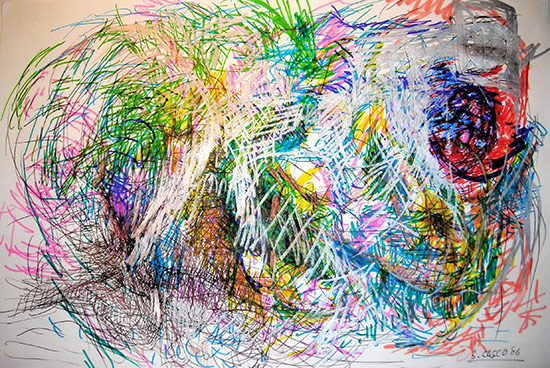
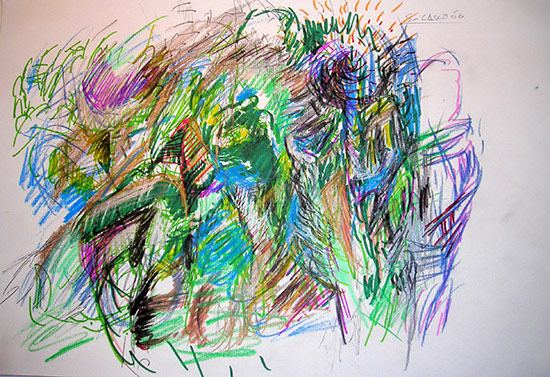
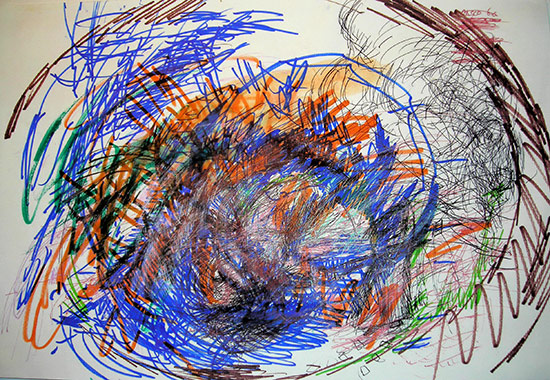
Drawing has been a critical part of my artistic development. During my elementary school years, I drew not just for the simple pleasure of it, but for my teachers. My teachers would request my assistance in executing all kinds of drawings on black boards. There were many times when my lessons were interrupted by a teacher walking into the classroom, asking for my assistance in another room. Drawing then was about depicting what I saw; now my work is solely about expression. I aim for non-objectivity as much as possible, hoping that my state of mind will surface in the work. I enable this transparency by working with scribbles – indistinct markings that generate a collective energy, motion, and image. Sometimes figures find their way into the final product. I’m not sure if the scribbles are gravitating to or away from figures, or a literal representation. My drawings are warm ups for my paintings. I am likely to carry some of the gestures on into my paintings.

Texture is an overriding trait in most of my paintings. I get a lot of satisfaction at not being able to tell for certain the surface of a painting. I use all kinds of paints mixed with spices and coffee grounds to achieve a somewhat gritty and sandy texture. In the past, I’ve used cinnamon, ginger, turmeric – which have distinctive scents. I enjoy that the outcome of those works are a gift for the sense of sight, and also a gift to the sense of smell.

Currently I spend much of my time working in my studio in Columbia Heights, in Northwest, Washington, DC. I’m working with inks, dyes, acrylics and oils on a variety of surfaces. My desire is to communicate with the viewer my deep and profound appreciation of the exuberance of the human experience. I believe that the emergence of expression is a central element of my humanity. My artistic process is an essential part of my emergence as a human; I hope that my work inspires the emergence of others. It is satisfying for me as an artist to engage with that intent as I create. Works can be seen at my studio by appointment and at my web site.

Growing up in El Salvador, attending Art School at Bucknell University, and living in the United States for thirty years, are integral factors that have contributed to my artistic development and my ability to communicate. I have shown at Moore College of Art and Design, The Drawing Center and Columbia University. More recently, I participated in Artomatic 2009 and contributed paintings for Art Without Frontiers, a show held at The Mexican Cultural Institute. To view some of my works go to www.cascoart.com, or contact me at chamba321@aol.com

Pictures-of-S-Casco-1-2007-034

Cindy Coldiron on Creating Cast Recycled Glass Public Art

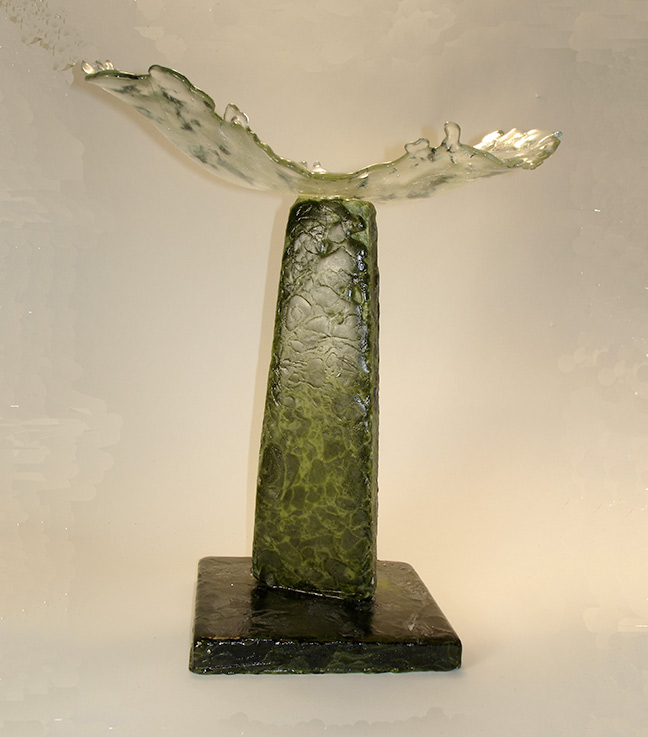
I was recently awarded an Arlington County Public Art grant to create a group of kiln-cast recycled glass sculptural works. I’ll be creating the works over the next few months, and they will be installed in a county park next spring.

From the time I was a child I was always fascinated with how various decorative objects were made. My grandmother had collected affordable art glass and ceramics, and I became a collector myself in my teens. Beginning in the mid 1990’s, I started taking art classes through the Arlington County recreation program. I took classes in pottery, cloth weaving, basket weaving, and painting. But the class that really created an intense continuing interest was a stained glass class taught by the artist Jimmy Powers (who is now a resident artist at the Lorton Arts Center). During one class, Jimmy brought in a small kiln and mentioned fusing glass. I was instantly drawn to kiln-cast glass sculpture – it combined my love of 3-D sculpture with glass.

Ten years ago next month I won two grand championships at the Arlington County Fair – including for a glass vessel called “Pond Life”. After my initial wins, I was so enthused with art competitions that I began to enter professional level juried art shows – starting with the Torpedo factory and the former Wilson Center gallery in Washington DC. I decided to set up my own art glass business in late 2000. I worked for years creating vessels from a glass purchased for fusing, but the rising costs of the glass prohibited me from working on a larger and thicker scale.

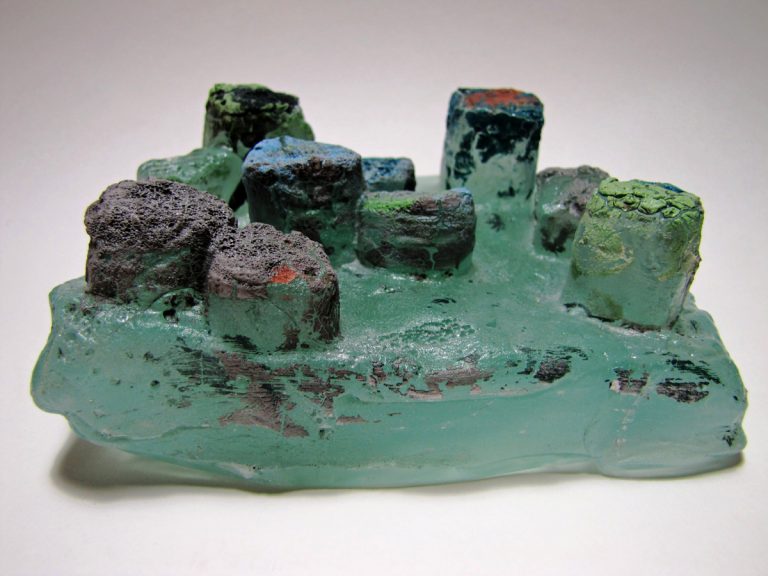
Glass-w-extra-space-littleThree years ago I began experimenting with making sculpture from recycled glass (including bottles, window glass, and table top glass.) Creating work from recycled glass has forced me to learn a whole new set of technical skills. Each type of glass reacts differently when you work with it, depending on a number of factors. Glass expands and contracts upon heating and cooling and it does so at different rates depending on its coefficients of expansion (COE.) If the COE of all the glass in a piece is not the same – or near the same – the piece will crack upon cooling.

The glass used to create most art glass comes from sheets pre-tested for fusing compatibility. Recycled glass, in contrast, has various unknown COE’s. Window and bottle glass (also known as “float glass”) are an inexpensive source of glass, but the COE’s can range greatly from bottle to bottle, even for the exact same product. Until three years ago I had always used glass from the same large sheets for my kiln-cast sculptures. To create my new work, I have done compatibility tests and found a few types of bottle glass that do tend to work with each other.

Recycled glass is also different in that it has to be fired at higher temperatures to get it to melt in a kiln. When you create glass pieces you frequently fire the work multiple times. I’ve found that with recycled glass I get about three attempts to fire and re-fire the same piece of glass (at temperatures over 1600 degrees) before the glass stiffens up and does not want to flow. Between firings, the cooled piece is cold worked with various sanders, dremel tools, tile saws, etc. in order to remove the mold casting materials, kiln wash and rough edges.

I am hopeful that people will appreciate my artwork when it goes up, and also that the work will bring increased attention to the uses of recycled glass. Glass comprises a large amount – by both volume and weight – of the post-consumer waste stream. I hope my work will inspire others to explore new uses for recycled materials, including glass.

This is a permanent installation piece where all the pieces work together to give a cohesive theme/message. What the viewer will see is a series of cast recycled glass dragonflies (18 inches or so each) all on a huge round mound flying towards a blue glass “pond” vessel. The theme is destination, and the sculpture conveys activity, a goal. I’m very proud to have received this commission, and hope you’ll follow my ongoing work on the public art project by looking at http://myartgrant.blogspot.com.

In the years since becoming a professional artist, my work has been exhibited at numerous juried shows and exhibitions, including the former Wilson Center Gallery in NW Washington, DC, the Art League (Torpedo Factory) in Alexandria, Virginia; the Washington Square Sculpture shows; corporate exhibitions; and “Art Anonymous” at the Corcoran College of Art and Design. I have won numerous awards including a recent public art grant from Arlington County. I have studied art through Arlington County classes, the Millennium Arts Center (predecessor to the Washington Glass School); the Art League at the Torpedo factory and at the Lorton Wokrhouse Arts Center. My artist website is at http://artist-cindyann.tripod.com.

Cem Catbas on Creating Scheherazade for the Baltimore Ballet

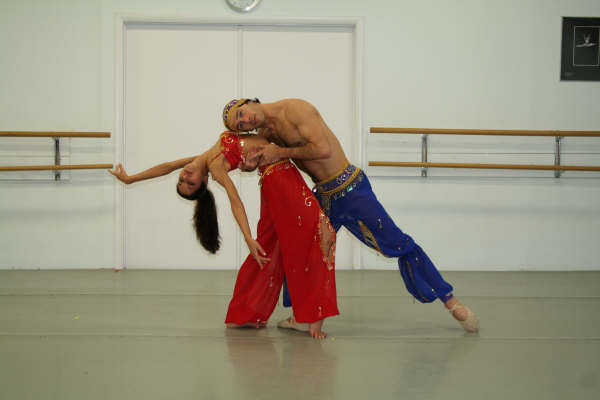
Every now and then I find myself sitting at the kitchen table, or at a restaurant, trying to decide what I want to do for the next year. It is never an easy decision, because you have to assess your resources. You always have limited money, time, and support, but unlimited passion. I decided last year that it was time for me to introduce “Scheherazade” to Baltimore. A gem of the Ballet Russes choreographed almost a century ago, the dancing is exotic and classical, and the music (by Rimsky-Korsakov) is flavorful and touching. I realized that I would have to restage the ballet for a smaller and more tentative cast than the original production, and began the creative process for my company and myself by studying various existing productions.

I started rehearsing the lead role with my partner in early March. Our pas de deux (dance for two) is 10 minutes long, demanding memory and stamina, yet does not contain particularly strenuous lifts. After the first half hour, it became obvious to both of us that all we needed was rehearsal time. We danced together in “Les Sylphides” recently, and have comfort dancing together.

I also started rehearsing the roles of The Persian King and his brother in March. Their interaction in the first and the third scenes is important in understanding the whole plot. I approached their choreography as if it was a new choreography. We began with the bare minimum cued to the music (we called it “the skeleton.”) By introducing subplots, I made them think and learn from each other. In coaching the development of their performances, I believe that “Less is more” only when you are comparing two different qualities. Any other time less is less, and more is more.

I started corps rehearsals with the Three Odalisques, a beautiful trio executing belly-dance-like movements. Since I was born in Turkey where belly dancing is a way of life, I retained the choreography, but added my own interpretation (which in my humble opinion makes it better.) I brought a DVD of a recent performance for the dancers to watch at the first rehearsal. Although this may seem like cheating, it’s actually a fairly common rehearsal practice. Dancers are frequently so busy with their own corrections during the rehearsal time that they can fail to capture the whole picture which for an artistic director, must remain the most important thing. Helping the dancers to see themselves within the whole picture speeds up the preparation period and makes the artistic director job easier.

I could not start working with the full corps de ballet till the following week (end of March), because I needed to be sure who was able to commit. By that time I had divided the ballet into three scenes, making it easier to schedule separate rehearsals for everyone. When working in a semi-professional situation, it is particularly difficult to be able to rehearse with the whole cast all the time. Someone is always either sick, having personal problems, or is injured. I read that Balanchine had similar problems in his early years in NY, and that is why he choreographed Serenade with different number of girls in each scene. Trying to mount a professional production under these circumstances can take a toll on you because you strive for perfection that at every step is unattainable. Much great choreography that we like today had been revised and re-staged with a different cast countless times. They are not a product of a single creator but a collaboration of many talented artists over time.

Now one week before the performance date, I finally see my dancers transforming into artists. In any live performance, the beginning is what grabs the Goucher College Performance spaceaudiences’ attention, and the ending is what they will always remember. If what happens in between is good, you will have a great performance. When my dancers do well in the studio, I always say: ‘Good.’ If they can do it that way with the makeup, costumes, lights, sets and a little bit of stage magic in the presence of an audience, it will be “Great.”

Our performance is on Sunday, May 17th, 2009 from 5:00-7:45pm at Goucher College’s Kraushaar Auditorium. To purchase tickets for this performance please call (410) 667-7974, or email directors@baltimoreballet.com.

Cem Catbas, Artistic Director of Baltimore Ballet School, and co-founder and Director of Baltimore Ballet Company, danced principal roles with Pittsburgh Ballet Theatre, the Istanbul State Opera and Ballet, the Istanbul Contemporary Ballet, and the Koblenz Ballet in Germany. Awards he has won include the 2006 and 2002 Individual Artist Award for excellence in solo dance performance from the Maryland State Arts Council, 1st prize in the 1st International Seleznyov Ballet Competition in 1991, and the Most Promising Dancer award from the city of Istanbul. He has a B.F.A. with honors from the Istanbul University State Conservatory where he studied with Ramazan Bapov, Nikolai Morozov, and Ludmilla Morkovina. He has worked with Ben Stevenson (Houston Ballet), Patricia Wilde (NYC Ballet), Marianna Tcherkassky and Terrence Orr (ABT), Richard Glasstone (Istanbul Ballet), and Kent Stowell (Pacific Northwest Ballet), among others. He has choreographed “The Nutcracker”, “Pictures at an Exhibition”, “A Gershwin Rhapsody”, “Carnival of the Animals”, excerpts from “Petrouschka” and “Scheherezade”, and staged “Les Sylphides,” the 2nd act of “Giselle”, “Swan Lake” and “La Bayadere” for Baltimore Ballet. He has been a judge for several competitions including the Frederick Arts Council. His students have gone on to dance professionally, have won numerous awards including 1st Prize at the regional Youth America Grand Prix Competition, and have been accepted into the most prestigious summer programs with full scholarships (including NYC Ballet’s School of American Ballet). He has been interviewed on WMAR-TV, WJZ-TV, and Comcast Local Edition. He has given Master Classes in the US, Canada, and Europe.