Home Blog Page 141

Due Process by Michael Fischerkeller

Taking from others has a bad reputation, but I believe in appropriation, and use it as a central element in building my compositions. Appropriating art historical images within my compositions allows me to use juxtaposition and context in a way I find particularly satisfying. I resonate with the statement by filmmaker Jean-Luc Godard, “It’s not where you take things from – it’s where you take them to.”

I look to create dialogue between history and cultural iconography through the appropriations, and through the dialogue, contemporary meaning.
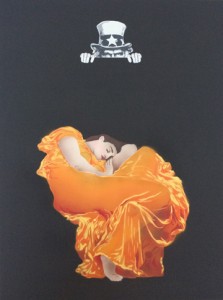
False Sense of Security (PATRIOT Act I) by Michael Fischerkeller (2014)

I’m in the midst of producing a 5-painting series commenting on the PATRIOT Act. An appropriated female (in a vulnerable state) is the centerpiece of the first completed painting in the series. Flaming June, from Sir Frederic Leighton’s 1895 artwork of that name, is a figure sleeping in a near-fetal position, dressed in a semi-transparent gown.  In my work, Uncle Sam peers over a wall at June.

In case you’re not familiar with the PATRIOT Act, Section 215 (of 170 sections totaling 342 pages) enables vastly expanded government surveillance powers. The Act challenges our rights to privacy and due process, and in various ways I’m expressing my concerns through this series.

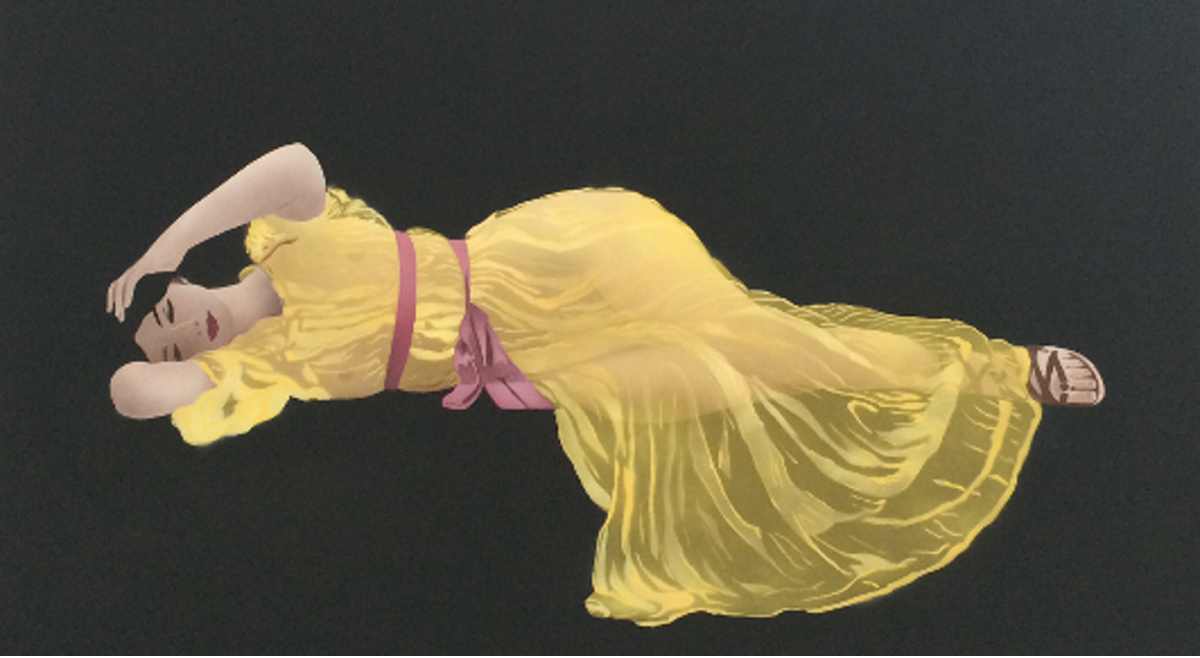
I really like the transparency effect from Flaming June’s gown, and I’ve been playing with carrying that transparency on the figure through all of the paintings in this series.  Last month I created “False Sense of Privacy” using a figure from John William Godward’s 1903 painting “Girl in Yellow Drapery”.  The figure’s pose and the color palette of her dress hint at intimacy and I’m using her to make a statement about how it is in our most intimate moments that we are most vulnerable to invasions of privacy.

Aspects of legal due process (obscured by the PATRIOT Act) are inspiring the piece I’m creating now, which I’m calling, “False Belief in Due Process”. I’m searching for the right art historical images to base the work on, and have been playing with options. I mostly use Google for my image research. I generally work in the evenings and on weekends after other responsibilities have been tended to, i.e., family time, to-do lists, and so on. I work in my house, finding the images, putting together and cutting stencils in one room and spray painting in my garage. I hope you’ll come to the upcoming Hothouse: imPRINT exhibit opening and let me know what you think of the work.

Michael Fischerkeller was born in Pittsburgh, PA in 1961. He received his Ph.D. in Political Science from the Ohio State University in 1996.  After purchasing a piece of street art in the Summer of 2014 he was inspired to create, to try and elucidate through art what have become increasingly complex political, social and economic issues.  Fischerkeller has exhibited across the United States, including within exhibits that focus on art’s role in highlighting contemporary social issues. Locally his work has been shown at the Art League Gallery in Alexandria, VA, Touchstone Gallery and Hill Center Gallery in Washington, DC, Gateway Arts Center in Brentwood, MD and Washington ArtWorks Gallery in Rockville, MD.  He lives and works in Upper Marlboro, MD. View his artist website here

This article was produced with the support of the DC Commission on the Arts and Humanities within a partnership between Day Eight and the Washington Project for the Arts.

The “Hothouse: imPRINT” exhibit will be open from May 7 – June 20, 2015 at the Capitol Skyline Hotel.

The image at the top of the post is a detail from the author’s artwork, “False Sense of Privacy (Patriot Act II).
The Sloth Ensemble: how far can you stretch sound before it breaks? by JS Adams

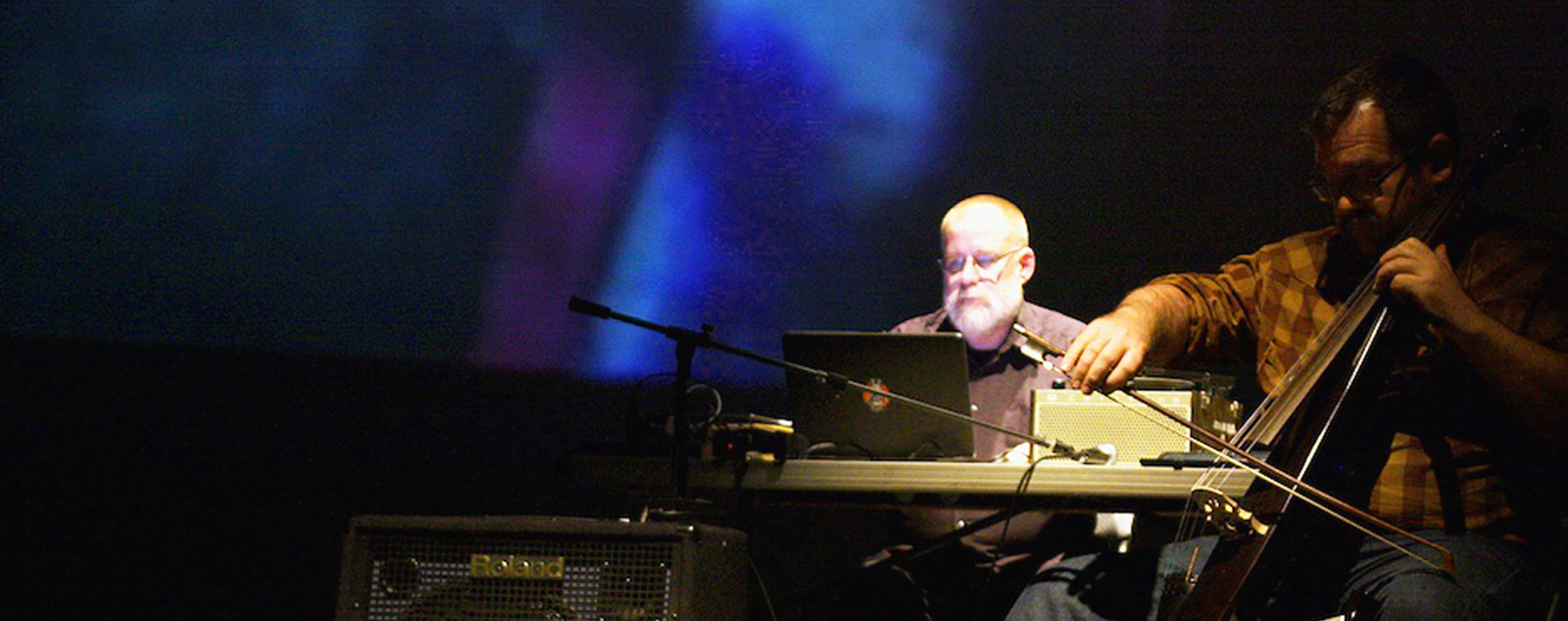
A few months ago experimental musician Chris Videll approached Daniel Barbiero and me to provide new works for a drone night that Chris is curating for music promoter Sonic Circuits. We three then began an on-line conversation about pushing drone, monotonic music to its near-breaking point extreme as fully-static sound, and we’ll be performing the product of those discussions on Saturday, March 7, 2015 at Pyramid Atlantic in Silver Spring, Maryland.

Daniel Barbiero has pulled together a small acoustic ensemble LET X ≠ X to perform as a prelude to my ensemble piece. In Daniel’s LET X ≠ X, performers are instructed to play a concert D while continuously changing timbres. (For the variable “X” substitute “concert D;” through shifts in instrumental color D ≠ D.)

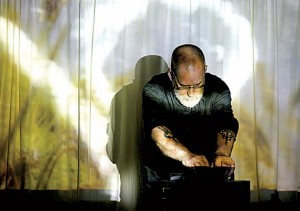
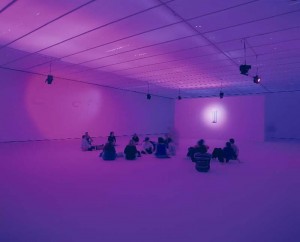
An image from an installation/performance of La Monte Young’s “Dream House”

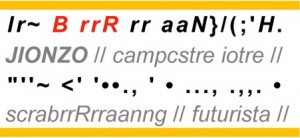
My piece, “A T N I G H T L Y I N G I N B E D S H E R E R E A D S T H E L E T T E R F R O M H E R G U N N E R A T T H E F R O N T”, is conceived as a glacial dirge (something akin to La Monte Young’s “Dream House”) and is based on the poetry of F.T. Marinetti. I’m realizing the concept by applying digital malfeasance (purposeful glitches) and communications decay to the poetry. I translated Marinetti’s poem to Morse code, and then ran the graphic poem through OCR (optical character recognition) software. OCR is the mechanical or electronic conversion of images of typewritten or printed text into machine-encoded text. While OCR is a common method of digitizing printed texts, the morse code printing of Marinetti’s poem scanned as a gibberish of punctuation and random letters — which we’re using as a score (see below).

The work is composed for cello, guitars, electronics, optical character recognition, voice, Morse code, text-to-voice programming, static visuals, prepared vinyl, and vintage Califone turntables. Wherein earlier works Morse code was MIDI-transcribed to piano, this piece uses the unaltered audio of the dots and dashes in the mix. Prepared vinyl for the piece will be two vinyl stereo-test pitch recordings with the center holes of the records chiseled out to wobble the playback, and creating wave interference. The opening section of the piece will be near-static waves of sound that finalize as a contrasting staccato of Futurist sound poetry and L’arte dei Rumori: How far can you stretch sound before it breaks?

sloth-score
A selection from The Sloth Ensemble score shows alternating instrumental (black and red text created through OCR of Marinetti’s poem) and vocal (grey text) stanzas.

I’ve been interested in sound and sound manipulations since I was a child. I was that artsy neighborhood kid, and luckily I early on found willing, like-minded collaborators. We were inspired by vinyl albums we purchased from the Import bins at downtown Chicago music store Rose Records and were encouraged to find that it was in our grasp to create similar sounds. We even borrowed the audio-tone generators from our school science lab.

We were not trained musicians and didn’t imagine ourselves to be “making music.” We felt that we were visual artists expressing our creativity through sound. One early experiment included my cousin’s electric guitar mixed with primitive percussion. Another involved tape loops on a hulking Bell & Howell analog reel-to-reel tape recorder. For another I pulled small lead weights from my father’s workbench and recorded them bouncing against the tone arm of record players.

My early college introductions to the music of John Cage and David Tudor, Cornelius Cardew, Mauricio Kagel, and Iannis Xenakis, reinforced my sense of conceptual composition and visual scores. I consider my backing tracks and compositions as audio collage, or performance constructions, and I continue to be grateful for the generosity of the like-minded artists joining me and adding their talents to my trajectory.

You can experience The Sloth Ensemble, Let X ≠ X, Anduin, Dave Vosh, M.O.S., Tag Cloud at the Sonic Circuits event Saturday, March 7, 2015, 7:30 p.m. – 11:00 p.m at Pyramid Atlantic, 8230 Georgia Avenue, Silver Spring MD. Scheduled to perform as Sloth Ensemble are Jeff Barsky on guitar, Guillermo Pizarro on guitar + turntable, Doug Poplin, digital contributor, PD Sexton, digital contributor, Sarah O’Halloran on voice + electronics, Pat Gillis on electronics, and myself with loops + turntable.

J S AdamsJS Adams is a Washington DC-based visual + sound artist. His main musical projects are the modern classical/dark ambient group BLK w/BEAR, the BLK TAG collaboration with Chris Videll (Tag Cloud), and STYLUS vintage turntable ensemble. Rather than attending his senior high school prom in 1972, Jim – fueled by teenage exposure to the Deutsche Grammophon Avantgarde Series, Silver Apples, Freak Out, and Ummagumma – opted to see Pink Floyd perform in Chicago.
To read more about Sonic Circuits, click here.
To read more about JS Adams, click here.

The Last Text of Augusto Boal

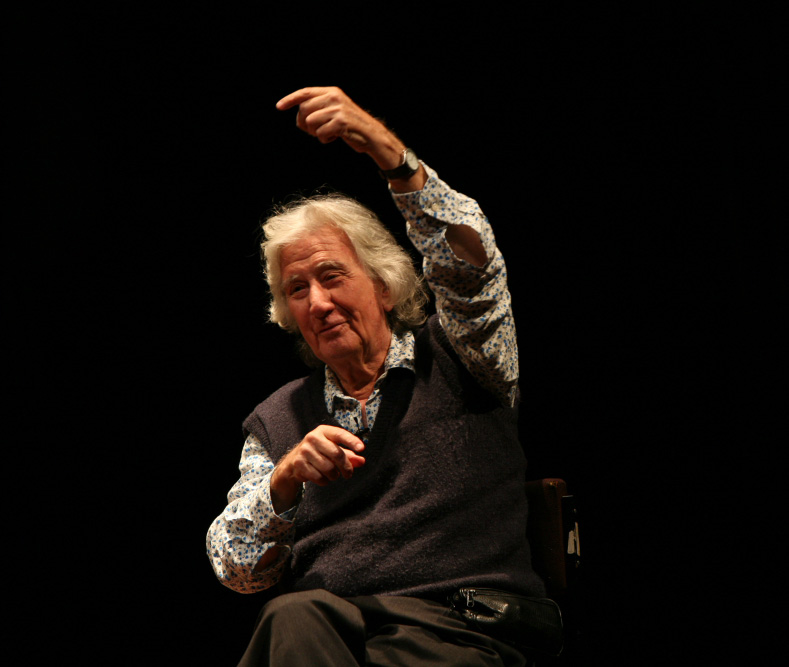
Brazilian theater director and political activist Augusto Boal was internationally known as the founder of The Theatre of the Oppressed (TO). Oppression, according to him, happens when one person is dominated by the monologue of another and has no opportunities to reply, dialogue, or interfere in the change of an event. Boal’s life was devoted to giving those who are in powerless positions ways to express themselves and become agents of change. He mainly did that through theater. In his efforts to transform theater from the “monologue” of traditional performance into a “dialogue” between audience and stage performers, he experimented with many kinds of interactive approaches to theater, which resulted in methods that weaved theater and therapy, as in The Rainbow of Desire (1995), a text that aimed to raise individuals’ awareness about internal oppressions and how they can separate the individual from society, or in the Legislative Theatre (1998), when he used performance as a means to make politics. Together with The Theater of the Oppressed (1985), his signature work, they form a legacy of artistic political activism against the continued dominance of a privileged few.

In his first theatrical experiments, audience members were empowered to stop a performance and suggest alternative actions for the character(s) experiencing oppression. In response, the actor(s) would change his (their) behavior and transform the situation. But during one performance, a woman in the audience, outraged because the actor was not able to express her suggestion, went up to the stage and performed what she meant. The event became the source for Boal’s concept of spect-actor, someone who perceives and acts accordingly, and his theatre was transformed: he discovered that through direct participation members of the audience became motivated to actually experience the change they wanted, were able to reflect collectively on the transformation, and felt empowered to generate social changes in everyday life.

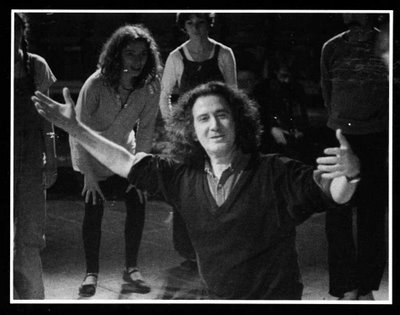
Augusto Boal (1931-2009) passed away on May 2. A week before, in an emotional exchange of emails, when we were saying goodbye to each other, he sent me this text, which had been sent to UNESCO, on the occasion of International Theater Day. To celebrate his life, his struggle for “peace without passivity”, and the creativity of his work, and aiming for its continuity, I share his last thoughts with you.

Regina Miranda
Chair of the Board & Acting CEO
Laban/Bartenieff Institute of Movement Studies, LIMS®

color-band

All human societies are “spectacular*” in their daily life and produce “spectacles” at special moments. They are “spectacular” as a form of social organization and produce “spectacles” like the one you have come to see.

Even if one is unaware of it, human relationships are structured in a theatrical way. The use of space, body language, choice of words and voice modulation, the confrontation of ideas and passions, everything that we demonstrate on the stage, we live in our lives. We are theatre!

Weddings and funerals are “spectacles”, but so, also, are daily rituals so familiar that we are not conscious of this. Occasions of pomp and circumstance, but also the morning coffee, the exchanged good-mornings, timid love and storms of passion, a senate session or a diplomatic meeting – all is theatre.

One of the main functions of our art is to make people sensitive to the “spectacles” of daily life in which the actors are their own spectators, performances in which the stage and the stalls coincide. We are all artists. By doing theatre, we learn to see what is obvious but what we usually can’t see because we are only used to looking at it. What is familiar to us becomes unseen: doing theatre throws light on the stage of daily life.

boal-black-back-squareLast September, we were surprised by a theatrical revelation: we, who thought that we were living in a safe world, despite wars, genocide, slaughter and torture which certainly exist, but far from us in remote and wild places. We, who were living in security with our money invested in some respectable bank or in some honest trader’s hands in the stock exchange were told that this money did not exist, that it was virtual, a fictitious invention by some economists who were not fictitious at all and neither reliable nor respectable. Everything was just bad theatre, a dark plot in which a few people won a lot and many people lost all. Some politicians from rich countries held secret meetings in which they found some magic solutions. And we, the victims of their decisions, have remained spectators in the last row of the balcony.

Twenty years ago, I staged Racine’s Phèdre in Rio de Janeiro. The stage setting was poor: cow skins on the ground, bamboos around. Before each presentation, I used to say to my actors: “The fiction we created day by day is over. When you cross those bamboos, none of you will have the right to lie. Theatre is the Hidden Truth”.

When we look beyond appearances, we see oppressors and oppressed people, in all societies, ethnic groups, genders, social classes and casts; we see an unfair and cruel world. We have to create another world because we know it is possible. But it is up to us to build this other world with our hands and by acting on the stage and in our own life.

Participate in the “spectacle” which is about to begin and once you are back home, with your friends act your own plays and look at what you were never able to see: that which is obvious. Theatre is not just an event; it is a way of life!

We are all actors: being a citizen is not living in society, it is changing it.

Augusto Boal


Originally published Bourgeon (c) May 2009

“Her”: Future Awe by Mark Lieberman

0

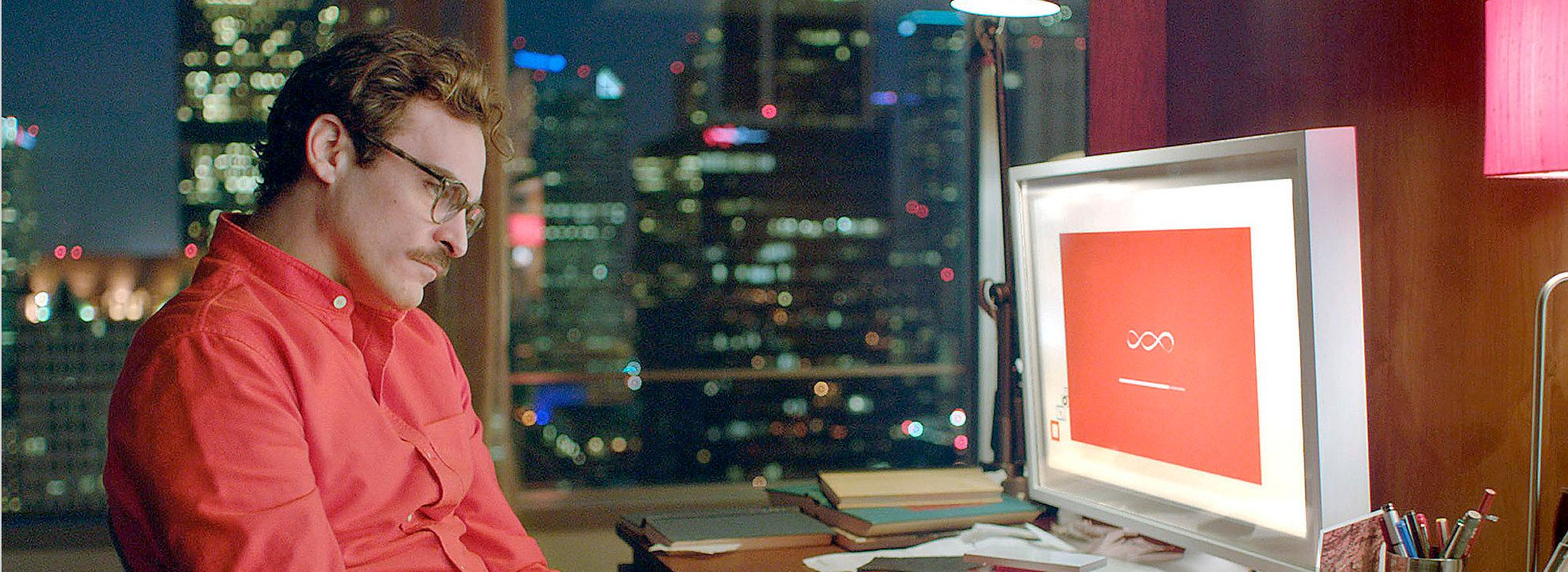
In writer-director Spike Jonze’s Her, Joaquin Phoenix plays the man some of us might turn out to be in twenty or thirty years. Burdened by the constant bombardment of “connection” and “engagement,” Theodore Twombley is perpetually alone, at least in his own mind. Even though he knows his life is stuck in neutral, he feels too threatened by his own sorrows to make any meaningful strides in the right direction. But technology hasn’t hollowed him out. In fact, Theodore radiates empathy and compassion, even when he doesn’t know where or how to direct it.

That’s the contradiction at the heart of this marvelous film, a richly imagined exploration of the nature of relationships and a study in the futility of rejecting technological progress. Her offers a vision of the future that’s both radically different from our world and very much the same. Theodore’s central quandary – is my relationship with an artificially intelligent operating system “real”? – is just a logical extension of our own uncertainty about knowing and connecting with others. As we place our trust in manmade machines that take on lives of their own, we’re simply transferring the central questions of human existence into a more palatable outlet. In the not-so-distant future of Her, those central questions remain the same, even though they’ve evolved on the surface.

Her takes place sometime in the future. It’s not clear how much time has elapsed since 2013, but technology seems to be only a few decades removed from our own. High-waisted pants and brightly colored shirts are the fashions du jour. Everything looks a little sleeker than it does right now, but Theodore lives in a world that is recognizably our own, and his love interest of choice bears a superficial response to our friend, the eternally wise Siri.

Theodore is a dweeby man who mumbles a lot but speaks eloquently, never more so than when he’s composing affectionate declarations of love for his clients at BeautifulHandwrittenLetters.com. Phoenix’s performance is delicate and tender, so that Theodore is always a little removed from his surroundings even when he’s talking to other people. No wonder, then, that he takes a liking for his new operating system Samantha (voiced by Scarlett Johansson). She accepts his fractured soul because that’s what she’s programmed to do, but the relationship is built on a solid, if unconventional, foundation.

Samantha arrives at an ideal time. Theodore’s marriage has dissolved, his dating life stagnated. He’s lost the ability to offer himself completely to another human being, a necessary component of any long-lasting relationship. He’s grown distant from his estranged wife (Rooney Mara) and finds himself unable to even follow through on a one-night stand (with the gorgeous Olivia Wilde, no less). Samantha offers a tangible taste of another person’s soul without the difficulties of interacting with another human being. It also helps that Samantha is growing into herself as she’s growing closer to Theodore. Johansson’s performance is remarkable – with only her supple voice, she captures Samanatha’s inherent anonymity and unbridled curiosity so convincingly that her physical form, an earpiece and an iPhone-shaped console device, is as compelling as an actual human being might have been. Johansson doesn’t simply read the lines – she translates them into delicate expressions of burgeoning self-actualization.

Her is more than a fascinating premise. Jonze’s perceptive script weaves through each facet of Theodore and Samantha’s relationship both gracefully and thoughtfully, rarely settling for the obvious outcomes. A lesser movie might have hinged on others disapproving of Theodore’s unconventional relationship. Indeed, several characters express that skepticism, but they’re not frowned upon for doing so. The movie questions not only the ethical and logistical issues surrounding this relationship, but also the complications that ensue when it comes to sympathizing with a creature fundamentally different from yourself. Jonze oscillates effortlessly between judging Theodore for his faults and praising him for his unabashed sentimentality. The relationship isn’t inherently winning or troubling – it’s complex, tentative, rapturous and destructive all at once. When Theodore and Samantha “have sex” for the first time, Jonze lingers on Theodore’s face before tenderly cutting to black. Never mind the logistics. This situation is an oddity, and the movie never pretends it’s anything but.

Her is constructed so purposefully that the quality of the details is almost beside the point. In a throwaway scene, Theodore visits his friend Amy (Amy Adams), who shows him a rough cut of her new documentary. It’s a still shot of a middle-aged woman sleeping in her bed. Theodore asks if there’s more to it. “No, that’s it,” she replies. Amy’s husband (Matt Letscher) suggests talking heads or reenactments to articulate Amy’s intended theme. Amy refuses – it wouldn’t be real anymore. Try to explain this movie’s premise to someone who’s never heard of it. You’ll feel like Amy pitching her documentary or Theodore condensing his relationship with Samantha into a single sentence. Her contains multitudes. Its point is that relationships do too.

Mark Lieberman is a rising junior majoring in journalism and minoring in cinema studies at American University. He is the Managing Editor of The Scene at The Eagle, covering arts and entertainment, music and lifestyle around campus and across DC. He is currently interning at USA Today, where he has written articles for the Life section and USA Weekend Magazine, in addition to managing the web site and social media accounts for USA Weekend. He is passionate about all forms of pop culture from movies and television to music and books, and he believes that thinking about and discussing entertainment is a worthwhile and critically important pastime. You can read his work on The American University EagleUSA Today, and his blog: liebermannolie.wordpress.com.

This article was selected as a finalist in the 2014 DC Student Arts Journalism Challenge, an annual competition designed to identify and support talented young arts writers.

Jodorowsky’s Dune Brings Epic Back by Emilia Brahm

0

“Deep in the human unconscious is a pervasive need for a logical universe that makes sense. But the real universe is always one step beyond logic.” Frank Herbert’s seminal science fiction novel Dune asserts an unattainable reality, a universe represented by the innovators who see one step beyond the expected and the logical.

If assessed by his oeuvre of absurd, surrealist films, Chilean director Alejandro Jodorowsky is either many steps ahead or totally befuddled. Based on his bizarre 1970 hit El Topo and the more erratic The Holy Mountain (1973), Jodorowsky seems the latter—the films are enticing for their outlandishness but present no digestible philosophy.

After the wild cult success of his mystic and surreal early films, Jodorowsky decided to take on a new project: turning Herbert’s Dune into a film. Jodorowsky’s Dune, directed by Frank Pavich, chronicles the attempt and failure to realize this project in fascinating detail, doubling the audience’s regret that Dune was never made.

But, rewind: the year was 1974 and the time was right. Jodo, as he is known by his former colleagues interviewed in the documentary, was popular in art circles, he had the funding, the vision, and more than enough energy, and soon began amassing a team of, in his words, “prophets…and warriors to change the world.”

Jodorowsky’s Dune interviews these said-warriors, showcases their work, and highlights how magical the process ofDune’s pre-production was. They—notably all men—are nerdy, awkward oddballs, and very talented in their own realm. It was Jodorowsky’s impassioned encouragement that brought their life’s best work out, as many of them acknowledge.

Beyond the stories of the participants in this three-year attempt at making Dune, the film shows a world begging to be put to film. The illustrator Moebius’ intricate storyboards and the planet of the evil Harkonnens, designed by the undeniably eldritch H.R. Giger, stand out. In combining story and imagery and music, Jodorowsky’s Dune succeeds on many levels.

In fact, it’s an adept piece of documentary filmmaking. The music is tight, the imagery smooth, the cinematography clean – only once is it slightly out of focus as it zooms out to capture Jodorowsky spontaneously picking up his cat to tickle him.

And yet—it was too perfect. What a criticism—too perfect? But for a story about the creation of Dune—a story of a secret meeting with Dalí in the St. Regis hotel bar in NYC under the 8-by-30 foot Maxwell Parrish painting of King Cole farting, a story of chasing a retired, huffing-and-puffing obese Orson Welles around the bistros of Paris and hiring him with payment of unlimited ambrosial catering from his favorite bistro (the gourmand swallowed the bribe like a draught of expensive wine with his coq au vin)—the presentation was too divorced from reality, technically flawless, and boring.

I wanted messy, strange, quixotic, like Jodo’s story. I wanted young Jodorwsky, wild haired, throwing himself into new characters and around the city with strange friends.

But just like the vast phantasmagoria that was—and would have been—Dune, the movie, this version of Jodo was not sustainable. After the failure of Dune, Jodorowsky formulated psychomagic, a practice based in Tarot cards and zen buddhism. Psychomagic asserts that a symbolic act, like hypnotism or even more active, risible spectacles, can be taken as fact by an unconscious mind, and therefore heal internal conflict.

Dune as Jodorowsky planned it never came together (David Lynch made an embarrassingly mediocre version in 1984—not good enough to deserve praise, not bad enough to become a cult film). And yet, the symbolic act of the two-year compilation: planning, sketching, modeling, has been taken as fact by Jodo’s unconscious (and conscious mind, too).

Jodorowsky has moved beyond the wave that peaked at Dune, and this documentary does too. Perhaps the clean editing and sharp image are the zen version of maturity, adulthood, where we can enjoy and learn from the wildness of youth from a safe distance, like looking through the scrubbed-clean glass window of Jodo’s Paris apartment at the street below, where Jodo once ran, wild-haired, with Mick Jagger and Salvador Dalí, shouting about madness and art as loud as he could.

Emilia Brahm headshotEmilia Brahm is a writer of journalism, criticism, and fiction. She currently studies at Georgetown University, where her academic focus is Gender Studies and Urban Agriculture, as well as Polish and Arabic Language and Literature . Her work can be found at http://emiliabrahm.wordpress.com/ and in the Georgetown Voice.

This article was selected as a finalist in the 2014 DC Student Arts Journalism Challenge, an annual competition designed to identify and support talented young arts writers.