Home Blog Page 170

What Every Dancer Needs To Know by Rob Bettmann

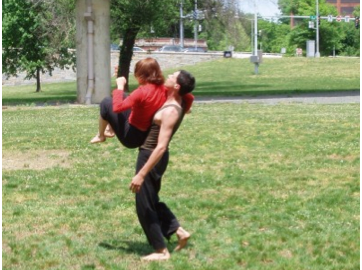
Below is the only performance that Jen Stimmel and I had of ‘What Every Dancer Needs to Know’.

I made the dance thinking about teaching… it seems that most teachers tell you what you need to know. That’s part of the role: they set the curriculum. But do we all need the same thing? Sure, you are more marketable with certain strengths. Do we all have the same best road toward those strengths?

I’m not certain that I was able to actually capture what I was after. I think I did, but really: this is a three minute dance. Only so much you can really look for in three minutes.

I really enjoyed working with Jen, and am pleased with the dance we were able to create. Thank you to Joy of Motion for including me in their Choreographer’s Showcase.

Here is the first draft, which we shot to submit for another showcase. (we didn’t get in.)

This is an itty-bitty little dance. I was mindful of trying to not make it be too much. I am also mindful of its high level of abstraction. Since I created it, I have done some editing. We took out all of the downward facing dogs. I felt like they were illuminating a lack of movement invention on my part. Some other changes to make it more fluid… Would love to hear thoughts or suggestions on this. Have final rehearsal next week.

Roudolf Kharatian on Ballet

The roots of classical ballet go back many millennia, for dance and humankind are the same age. In ancient Greece, the physical exercises practiced by the military were called “dance”. In pre-Christian Armenia, a group of seven priests would perform a circle dance around a fire, replicating the movements of the planets. The ancients understood that the human body is the greatest instrument for directing and focusing the consciousness and used dance rituals to achieve spiritual awakening and enlightenment. The dance movements we find in use today are the result of many millennia of evolution and development. Around the world there exist schools which unconsciously have maintained the ritual movements inherited from ancient times and continued to develop them, although in most cases their meanings have been lost.

Ballet, as we know it, began developing in Italy. It then moved to France, Russia, again to Europe, and America. When we speak today of “Russian ballet”, or “American ballet”, we do ballet a great disservice. Although ballet was enriched by its peregrinations, it is neither Russian, nor Italian, nor American, but universal, and determines for itself where it will continue to be developed and reside.

In classical ballet, no movement is coincidental. Every movement has a very definite purpose and significance, and reflects the structure of the universe. The greatest phenomenon of classical ballet, its DNA as it were, is ‘fifth position’ which represents the spiral. Every movement has three intrinsic meanings: physical, emotional, and philosophical. Today, the philosophical meaning has been lost, with more importance being given to esthetic and emotional concerns. What I teach in my class is the reconstruction of the meanings of the main movements as I have come to discover them through work and study.
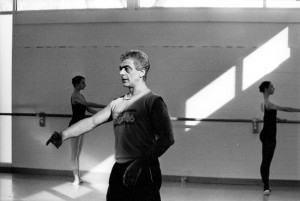
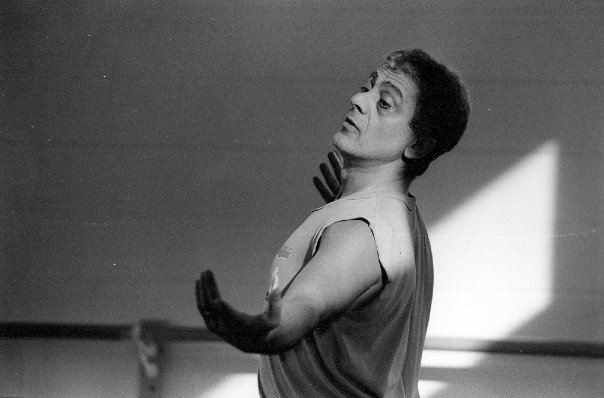
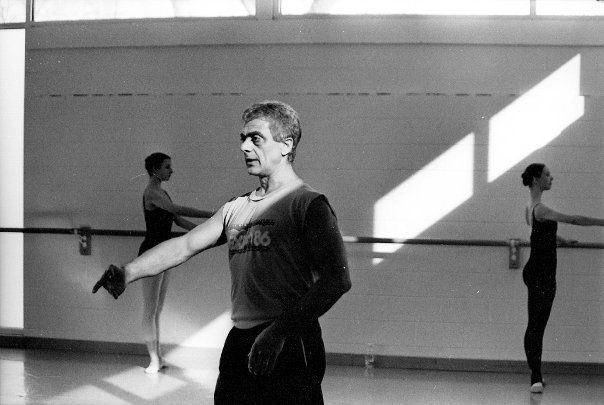
Roudolf Kharatian teaching In contrast to much of American modern dance, classical ballet training takes many long years of very meticulous work and discipline in order to achieve the minimum required level of proficiency. Unfortunately, today much of the meticulous attention to detail in ballet movement seems to be disregarded.

When I’m working with dancers in class, I try to make them see how important it is that each movement be as clean – as near perfect – as possible. Not only does it facilitate the dancers’ work, but it ensures that each movement actually realizes its intrinsic purpose. Let’s not forget that the purpose of classical ballet exercises is to create beauty, harmony and balance in the world.

Originally published May 5th, 2005 in Bourgeon Vol. 1 #1

The DC Improvisation Festival Present, and Past by Maida Withers

The DC Improvisation Festival celebrated it’s 13th season September
 27-30, 2007 on the streets of the Penn Quarter in downtown Washington,
 DC. The performances occurred on G Street between 7th and 12th streets. There were 23 participating
 groups including Jane Franklin Dance, Dan Burkholder/The Playground,
 AVA Dance, Kathryn Williamson, Contradiction Dance, Tony Olivares, Maida
Withers/GWU, The Liz Lerman Dance Exchange, and others. For a complete list of artists 
please visit: http://www.improvfestival.com.

This is a video I put together from some of the performances of the recent DC Improv Festival:

 
I founded the DC International Performance Plus + Festival, which is now the Improvisation Festival.  I later co-curated with Jim Levy, Daniel Burkholder, Cyrus Khambatta, and Sharon Mansur.  A little over a year ago I turned the reigns of the festival over to my colleagues in the Metro/dc area. This year’s festival 
was coordinated by Amanda Abrams, with an excellent curatorial board.  
I’m so happy that the festival continues, am proud that it was one of the first such festivals nationally 
and/or internationally.

The DC International Improvisation Festival introduces audiences to 
diverse approaches to improvisation as a performing art and provides
 artists with opportunities for networking and exchange. Over the last 
thirteen years the DC International Improvisation Festival has 
successfully presented improvisational performances in theatres and for
site-specific venues throughout the Washington, DC area.
 

Michael Bjerknes

“Michael Bjerknes, a former Washington Ballet dancer and ballet master and co-founder of the American Dance Institute in Rockville, died April 14 of colon cancer at the Washington Home and Community Hospice. He was 51.

Mr. Bjerknes, a Bethesda resident, also was a soloist with the Houston Ballet and a principal dancer with the Joffrey Ballet, as well as a guest artist with the Royal Winnipeg Ballet in Canada and the Northern Ballet Theatre of England. Agnes de Mille, Robert Joffrey and Choo-San Goh choreographed original roles for him.

After Mr. Bjerknes stopped dancing, he became a teacher and ballet master at the Washington Ballet and the Universal Ballet in Seoul. He was an influential creative force in the Washington area for the past two decades.

In 2000, he and wife Pamela Bjerknes, a former member of American Ballet Theatre, founded the American Dance Institute, a thriving school and performance space. The institute came about at an opportune time, the couple told The Washington Post shortly after its opening. Pamela Bjerknes, then 46, was looking to expand her private teaching career, while her husband, then 43, was not eager to be a peripatetic artistic director, his next logical career step. Their three children also were in school.

“I have a limited ability to become a bohemian again,” Mr. Bjerknes told The Post.

Click here to read the rest of the Washington Post article.

To read more discussion on Michael, visit the board on Ballet Talk; click here.

Why are there no Black Ballerinas?

I was reading ArtsJournal.com just now and saw this from the Guardian (Uk):

“Neither the Royal Ballet nor the English National Ballet currently employs a single black ballerina. The path to ballet stardom is generally easier for black men than women: black men are considered well built for lifts and pas de deux work. Just 10 dancers in the Royal Ballet’s 98-strong company are not white – of those, only four are black, and all of them, like Acosta, are male. At ENB, just eight out of 71 dancers are not white. Only one is black, and he is also male.”

You can see the whole article here.


It reminded me of the Bourgeon article looking at the difference between the treatment of men and women as choreographers. You can see that here

-Rob