Home Blog Page 177

Introduction Focus Section “The State of Dance” by Dr. Naima Prevots

Read…Question… Challenge…Think…Ponder… Share…What is the State of the Art? What is the State of the Art in Washington? At your next rehearsal, meeting, coffee break, share the thoughts of these eight Washington based artists, teachers, educators, administrators, choreographers with colleagues and friends, and see if you agree, disagree, have more questions and thoughts.

Robert Bettmann, visionary creator of Bourgeon, asked a variety of people to pick a topic dear to their hearts, and to comment. Open ended, the result is here for you the reader to take this as a jumping off point for your own thoughts. As editor of this “focus” section, my job has been to make suggestions to the writers for clarifying their thoughts but not intruding, and for finally finding a way to group them conceptually. As a member of the Washington dance community since 1963, I found these responses to be provocative, informative, and important. Reflection on who we are and existing problems will lead to increased dialogue amongst us, and even possible solutions. Contributors were asked to limit their comments to roughly two pages.

The first two essays deal with the issue of what we call now World Dance: the wide range of forms that emerge from the vast heritage of dance all over the world. The accepted understanding is that these are forms that have developed from a variety of ethnic traditions, and that are embedded in communities both western and non-western. The term world dance has been used to identify forms that do not have the traditions or vocabularies of modern dance or ballet. This term covers a wide range of dance forms that stem from the lives and cultures of people and have been practiced in communities for many generations. Some of these forms have always required significant specific training and have been based on high levels of technical performance, such as the many Indian classical forms. Some of these forms have always been identified as dances that are related to specific rituals and festivities and are performed by all segments of a community. Dance scholarship currently is heavily involved in study of these dances, in terms of the way they have evolved and changed over the generations, the nature of their performance and their complex identities. Many contemporary choreographers who have grown up in these various world dance traditions are now seeking to integrate them with current dance trends and within the artistic frameworks of both modern dance and ballet. There are also artists and scholars who are seeking to preserve the various traditions as they have existed, and to understand what that preservation means. There is now a vast literature on this subject, and two recommendations for current publications are: Theresa Jill Buckland, Dancing from Past to Present: Nation, Culture and Identities ( University of Wisconsin Press, 2006); Dance Research Journal: Re-presenting Indian Dance (Winter, 2004).

Christel Stevens writes about the vast number of ethnic communities in Washington and the dance groups that represent them. The Washingtonian recently had an issue devoted to the demographic changes in Washington, in terms of the large number of immigrants from many countries who have settled here over the last years. Christel writes about the need for greater understanding and acceptance of these companies and artists, and some of the problems they face in communicating with the modern and ballet dancers who pre-date them, when Washington was a different city. She notes that some of these companies are trying to cross the boundaries by integrating their traditions with contemporary dance in all its many guises.

Lori Clark writes about the large Middle Eastern dance community, and the dangers of commercialism and amateurism within these groups. She focuses on the potential for Middle Eastern dance to assume a strong role in the artistic life of the community, but also points to the lack of awareness of the many studios in terms of their professional obligations to present and teach at a high level. These two essays were put first, for two reasons. It is important for all of us to be aware of the exciting dance traditions that exist in this city, and that we might not encounter in our usual round of activities. It is also important for us to have a discussion as to how we can be more inclusive and aware of the rich heritage that these dances embody, and how we can all work together for higher standards and better funding for all.

Helanius Wilkins and Elizabeth Johnson focus concerns on their lives as artists in Washington, and issues of survival, standards, and communication. They talk about the contradictions: the numerous groups that exist and the tendency for each to remain separate and isolated; and the other tendency of bringing people together through Dance/Metro D.C. and the Dance Awards, and various collaborations happening throughout the city. These are very personal statements, but they resonate in broad ways. They ask important questions about quality, training, and funding, and also reflect an excitement about the State of the Art in D.C.

Gesel Mason and Helen Hayes are concerned with how we educate people in dance, and the challenges faced by those who teach in different environments. Gesel talks about her own experiences in college, both as student and teacher. She notes that often fear becomes a dominant factor in the training and learning process, as opposed to developing confidence and creativity, and she also questions what and how dancers are trained in college dance programs. Helen writes about her work with youth at Joy of Motion, and how space challenges resulted in a more open approach to working with young people of varied ages and abilities. She notes the surprising success resulting from the challenge, and how the coming together was instructive and exciting for all.

Robert Bettmann and Nejla Yatkin wrote essays that dealt with broad concerns, and provided a fitting conclusion to this focus section. Robert places his concerns about sex and sexuality in “the District” but in fact gender issues exist in all of contemporary dance and in all forms. What is feminine, and what is masculine? Do we deal in stereotypes, or do we dig beneath the surface? What do we say about ourselves with our bodies, and do we create boundaries or go beyond these? Nejla explores the conflicts between taking risk and getting money, between conforming to what is expected and daring to step into the unknown. She wants to see a national conversation on dance that would reach into all segments of the dance community and beyond.

Read… Question… Challenge, Think.. Ponder.. Share.. What is the Sate of the Art? What is the State of the Art in Washington? I hope these articles will provide much food for thought and a rich agenda for discussion. They certainly provoked and challenged me, and I am delighted that Robert asked me to “edit” this section.

Naima Prevots, Professor Emerita, American University, has been a performer, choreographer, educator, administrator, critic, and dance historian. In 2005 she was awarded the Metro DC Dance Award for “Outstanding Achievement in Dance Education.” She has written 3 books, several monographs, numerous articles, has been awarded Fulbright and NEH Fellowships, and has consulted for The Washington Ballet and currently for the D.C. Collaborative. She writes reviews for www.danceviewtimes.org. She has contributed to the forthcoming book The Returns of Alwin Nikolais: Bodies, Boundaries and the Dance Canon. published by Wesleyan University Press this coming June.
Sharing Balance in Contact Improvisation by Ken Manheimer

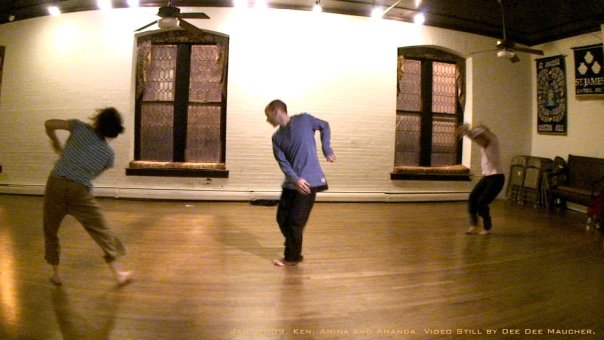
I love what can happen in Contact Improvisation (CI) dances – especially a kind of exquisite cooperation. Finding that cooperation is not inherently hard, but it can be elusive. It’s often not obvious how the dances are created, even to the dancers, themselves. Descriptions and observations that focus on the dancer’s overt actions and skills can be confusing. Perhaps the key is understanding cooperation. I suggest that cooperation emerges from the partner’s shared focus. A route toward understanding that cooperation is to understand the following:

Contact Improvisation is an exploration of the question, “How can we share balance through change, playing with what happens along the way and allowing that to influence how we continue?”

In the basic CI recipe, dancers follow shared points of contact to discover their dance. By mutually following and investing their balance in shared points of contact, dancers yield independent control of the dance, committing to mutual choices and responses in the moment. This balance sharing is an avenue to vital cooperation in the moment, enabled by the willingness and craft of the partners.

Balance is one of the most pervasive, viscerally compelling ways that we’re involved with the world. Our sense of well-being is legitimately coupled with it, and sensing, processing, and responding to it has an overriding priority in our moment-to-moment awareness. In CI dances, sharing the processes of balance while moving, or even while mostly still, is an opportunity to engage with another person in something that is inherently immediate, and compelling.

By “balance”, I’m referring to all of the senses by which we are aware of and navigate our situation in space. Rather than static equilibrium, it is the process of responding to and playing with the changing conditions of equilibrium while moving together. It’s not staying on-center, but rather continuing to engage with a shared center as the situation develops, however near or far from equilibrium the shared center goes.

Shared changing balance can entail shared paths through space, falling together, lifts and leaps into the air, fluidly shifting responsibilities for (fluidly shifting) shared weight, and much more. It need not include any outwardly overt activity, as well – all of the shared balance can be happening in subtle inter-responsiveness of the partners, in barely noticeable movement. The immediacy of this connection, whether physically in contact or not, fosters a shared sense of presence and liveliness, a process of doing something together as an organism.

In a CI dance (and probably most collaborative improvisation) the relationship between dancers is a dynamic, evolving thing. To maintain integrity in their movement – and their immediate well-being – each partner must distinguish what the commitment means for them in the moment, balancing their independence from and inter-dependence with their partner(s).

Shared, shifting balance is by no means unique to contact improvisation – it’s a fundamental element of most partner dance. Waltzing, for example, fosters elegant connection through this dynamic, in a very clearly delineated form. Many other practices involve it, including not only other forms of dance but also sports, martial arts, and even some meditative arts. Exploration of balance-sharing dynamics is more directly the focus of CI than in most practices, however, over a more open range of activity.

CI dancers are constantly negotiating balance not just of their physical selves, but also of their independence from and inter-dependence with their partners. Paradoxically, development of solo ability is as important as partnering to development of cooperation. Independence vs inter-dependence with your partner is a dynamic balance. At any moment you can overshoot in either direction. Relinquishing too much of your solo sacrifices a dimension of your personal involvement, and presents your partner with too little of your personal substance to engage with. Holding on too tightly to your solo, on the other hand, can preclude responsiveness to your partner, also limiting connection.

In general, developing solo presence and appetite – the ability to find movement that suits you with conviction in the moment – broadens and tunes your options for navigating each dance. You’re freer to develop each connection to the degree that suits you, avoiding the need to force connection in order to sustain your personal momentum. That ability also helps in navigating a Contact Improv jam – a freewheeling event where people explore CI dances. The more options that the participants have for dancing – including dancing solo and in larger ensembles, as well as the more common duets – the more chance that the jam can become a vibrant event.

There is an essential connection between surprise and discovery in any creative endeavor. As Isaac Asimov puts it: “The most exciting phrase to hear in science, the one that heralds new discoveries, is not ‘Eureka!’ but ‘That’s funny…’” In collaborative art, partners depend on common ground to base their mutuality. They need not stay in the familiar, but are most vitally engaged when they grow the new out of the familiar, together. Our sense of well-being is coupled with our sense of balance, for legitimate reasons. In CI we yield control of our balance (in many ways) to share it with another.

In this realm, the consequences of many choices are shared. This adds another dimension of balancing: each partner, individually, negotiates an internal frontier between new and familiar ability. Staying too much with what’s familiar limits discovery, while abandoning discretion can overreach beyond what is tenable. Somewhere in the balance is the frontier of discovery for each person.

It is not for one partner to dictate where the other’s frontier is, and vice-versa. The partners engage best by leaving room for one another’s discretion, exploring together the combination of their choices. This is a kind of etiquette of necessity, so that the intuition and judgment of each can be fully realized in the collaboration. It is how safety is maintained and mutually supported, while exploring frontiers. Like other commitments in this practice, it is a continually fluid balance, reassessed and renegotiated moment to moment by the partners, within themselves and between them.

One type of response that limits ones ability to maintain a fluid balance is “clenching.” Drunks and infants tend to be less injured by catastrophic falls than other people. Due to obliviousness, they are less likely to present themselves as rigid and, therefore, brittle on impact. They are less likely to clench. Clenching is not only a physical response – it is an unwillingness to handle surprise. Responding by clenching often reduces effectiveness by refusing to engage the situation. It also reduces familiarity that would be gained, for next time, through active involvement. In this way, it becomes a self-fulfilling prophecy of ineffectiveness. I believe that measured, deliberate engagement is where the real benefit of training lies. Even in martial arts, the raw experience gained in mock confrontation is probably more important than the particular techniques being explored.

CI is often taught with specific techniques: physical exercises and skills that indicate essential ingredients of the practice. Many interesting questions arise in this approach. For instance, is some particular range of skills necessary to dance CI? Do skills help foster dances, or can they get in the way of some kinds of connections by which the dances cohere? What skills are and what skills are not crucial? I believe that these questions, in themselves, are illuminating, and that the proper response is not cut and dried.

For example: I happen to be partial to falling as an element of dancing. Falling together is an extreme case of sharing dynamic balance, and is exciting and engaging. And yet, some of my most memorable, viscerally involving experiences dancing have involved hardly any movement. It was the level of shared focus and connection that made those dances so memorable – I don’t know what role technique played in them. It was as much not-doing as doing that enabled them to be so deeply realized. Where exactly is the supporting technique? Sometimes it is clear, and sometimes not.

There may not be quick or easy answers to these questions, and I certainly don’t have them. They are revealing, however, of the framing of the practice – some things we take for granted, and some things we can question. My ultimate concern is with what helps me connect and find dances that work. Skills can help lead the way to connection, and help to develop and navigate the dynamics – yet it is the dynamics of cooperating, and ultimately the connection itself, on which the dance thrives.

I’ve found it valuable, in my practice and teaching, to recognize that finding my way into a dance is as central to the art as exploration of the connection once I get there. Personal presence in the moment is a rich and inexhaustible endeavor. The process of finding one’s way there with another, and the process of exploring that terrain together, are each engaging and challenging in themselves. It helps me to recognize this because I can wind up spending as much or more time searching for connection as I do playing in connection. It’s tempting to try to avoid the gaps of the search by instead depending on technique and/or routines that have worked before. Using previous actions this way is trying to “play the same way twice”, foregoing the opportunities of the pursuit of surprise and discovery. Conversely, recognizing and exploring the art of the search is part of discovering presence in the moment, and can inform and support one’s ability to dance as much as anything else.

Embodying presence in the moment and proportionately trusting to share it, learning to non-verbally communicate and connect with immediacy and clarity, navigating and balancing the dynamics of collaboration and commitment in all their intricacy, all these are rich realms explored in Contact Improvisation, and all are enlightening in their discovery.

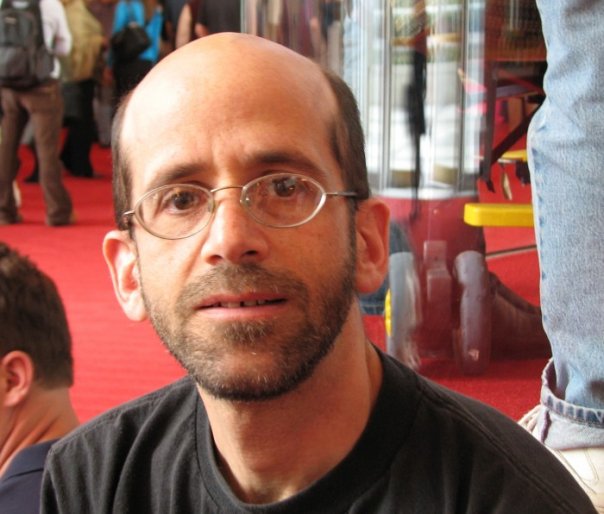
n755716802_591607_9890Ken Manheimer is curious. A software developer by trade, he loves to explore, invent, and move, and enjoys contact improv as a rare combination of these things, and an antidote to the static of everyday life. He has been a member of the D.C. Contact Jam for 20 years. This piece is extracted from writings on Ken’s website, www.myridicity.net.

Dance, Awareness, and The Feldenkrais Method® by Daniel Burkholder

0

In 2001, after studying, teaching and creating dance for 20-odd years I was ready to find a new direction for my exploration of movement. I was suffering from chronic injuries, dissatisfaction with traditional technique classes, and I wanted to expand my understanding of how the body organized for movement. I was interested in how the brain and the nervous system coordinated the muscles to operate in a systematic and efficient manner. I was intrigued by how different people coordinate in ways that organize the body for more or less efficient movement. I began to explore numerous somatic modalities, including The Alexander Technique, Body Mind Centering and Laban Movement Analysis. But, one day while I was lying on a mat, doing the articulate movements of The Feldenkrais Method®, I found the technique that I needed to explore. Through its subtle and powerful movements I found relief from discomfort, a dynamic way to expand my movement skills and tangible, practical information on the functional organization of the body.

Developed by Dr. Moshe Feldenkrais, the method, unlike traditional movement techniques, doesn’t teach specific movements to learn and master. Instead, it offers dancers a method for increasing their awareness and efficiency while moving. Most dancers have habitual tendencies when moving – it may be unconsciously lifting the chin, unnecessarily contracting muscles, or tucking the pelvis. For example, I had a tendency to clench my jaw which led to chronic discomfort in my neck and shoulders. Through The Feldenkrais Method®’s approach I explored the different movements of the jaw, head and neck and I found ways to re-pattern my movement. As a result, I no longer get neck and shoulder pain and have more freedom in my upper torso. Developing increased awareness led me to understand how I was organizing movement and then allow new movement patterns to emerge. As Dr. Feldenkrais stated, “You can’t do what you want to do until you know what you are doing.”

Increasing awareness is also a key to improving and expanding a dancer’s technical facility. As the dancer becomes more aware of how she is organizing her body she is able to accomplish technical feats with more ease and control. For example, a dancer may wish to increase her proficiency in turning – to turn more times, or more consistently, but she always shortens her left side as she lifts her right leg into passé. This unevenness in the torso throws her off balance and she is stuck only doing one or two turns through brute force. Her teacher can tell her over and over again to lengthen her left side, but if she can’t feel it, it won’t change. If the dancer had more precise awareness of herself, she would be conscious of her imbalance and easily lengthen the left side. By working with The Feldenkrais Method®, dancers develop more awareness so that they can approach and practice movement with more clarity.

By practicing The Feldenkrais Method® dancers will also find that they suffer from less frequent and less severe injuries. Much of the pain that dancers live with comes from ineffective technical habits repeated over and over for many years. Dancers who are suffering from these ongoing discomforts often assume that “that’s just the way it is”. But, once these habits are recognized,  more efficient patters become available for the dancer, and their discomfort easily fades away.

To study The Feldenkrais Method® the dancer has two choices; to study one-on-one with a practitioner or, to study in a group class setting. Which way the dancer approaches the method depends on his personality, needs and opportunities. Ideally, to get the best results, students should study in both the individual and group settings.

Dr. Feldenkrais first developed one-on-one sessions, Functional Integration®, in which a practitioner meets privately with a student to design lessons that address the individual’s goals. The Feldenkrais® practitioner will work with the student, who is often lying on a low padded table, by gently touching and guiding him through movement. The practitioner will help the student increase his range of motion, release unnecessary tension, as well as integrating the different parts of the body into an efficient whole. Through this process The Feldenkrais Method® reorganizes the body so that unnecessary movements disappear. The practitioner will work with the student lying on his back, as well as on his side, in sitting and in standing. Changing the student’s position assists the student in finding clarity in his organization. Functional Integration® is ideal for those individuals who have specific issues or discomfort that they would like to examine.

Out of his work with individuals, Dr. Feldenkrais created Awareness Through Movement® lessons that are taught in group sessions. These classes are lead by a teacher who verbally guides students through a sequence of gentle movements that are unique and easy to learn. By doing unusual movement patterns in class students can discover their unique movement habits and simultaneously find more efficient ways of moving. Dr. Feldenkrais designed over 1,000 lessons to address every joint, muscle and function of the body. The 30-60 minute lessons take place in an open room with carpet or on soft mats. Often the classes are taught in a series that address specific topics, such as posture or walking, areas of the body, such as the spine or hip joints, or populations, such as dancers or seniors.

The Feldenkrais Method offers dancers the opportunity to fine-tune their bodies, heighten consciousness and awareness by eliminating unnecessary habitual patterns before they become major problems. The method allows dancers to avoid common repetitive types of injuries, recover from traumatic injuries, expand their technical proficiency, and find greater ease in their movement. The method has been invaluable to me as a dancer and my body feels better now, at 38, than it did 10 years ago. While it doesn’t replace taking dance class or working out, it does make all of these activities easier, more beneficial and more enjoyable.


Daniel Burkholder is the Director of The PlayGround, Co-Director of Improv Arts and is a Guild Certified Feldenkrais Practitioner(cm). For further information about his dancing projects go to http://improvarts.alkem.org, and for further information about his Feldenkrais practice go to www.integrated-body.com.

originally published in the Focus Section “Technique” – Bourgeon Vol. 2 #3

The Horton Technique by Diana Dinerman

Modern Dance innovator Lester Horton (1906-1953) pioneered dance in Los Angeles from 1928-1953.  Today, Horton’s technique is taught in varying versions at numerous institutions in the United States and Overseas. By the 1950s, the Horton technique had evolved through several phases into a massive body of movement vocabulary that included exercises for every part of the body, even the eyes and tongue. Horton was at the height of his creativity in the early 50s when he re-codified his dance technique (after 15 years of collaboration with Bella Lewitzky). He used the students and their diverse physiologies, rather than his own, to develop a technique that works to broaden a dancer’s range of movement and expression, not define or limit it.  “The technique strengthens and increases the expressive range of every body, not just classically proportioned ones,” said Milton Myers, Director of the Modern Program at Jacob’s Pillow. Lester Horton’s aim was to endow dancers with strength, extension, lyricism, fluidity and, most importantly, versatility.

The Horton technique can be separated into six movement categories. For each category Horton developed detailed exercises, that he called “studies.” Projections are studies that deal with varied and specific qualities of movement, for example, ‘Leg Slices’ and ‘Hip Pushes’. Locomotions are traveling steps (walking, running, leaping, jumping, gliding, skipping, etc.), for example, ‘Accented Runs’ and ‘Arch Springs.’ Preludes are short phrases of movement designed to quickly stimulate and tone the psycho-physical instrument. Rhythms are music dance patterns, rhythms of work and play, plus emotional manifestations of rhythmic consequences. Improvisations are used to awaken the students own movement sensibilities. Fortifications are long combinations of phrases designed to ensure protection and maximum efficiency of the body’s capabilities, for example the Hinge and Balance Studies.

The fortifications are considered the core of Horton technique. They establish a framework of movement mechanics, of muscular development and coordination, elasticity and range, rhythm and timing of phrasing, and movement quality. Horton’s intent was to make the whole body dance so he developed a system of facility, not a style.  “A well trained dancer shouldn’t look trained,” said Kristina Berger, Horton instructor at Marymount Manhattan College. Horton wanted to see the dance, not the effort behind it. As a result, many of the studies, when put in combination present like etudes full of dynamic contrasts and broad, sweeping movements, such as Spiral Falls, where a dancer moves from standing to the floor in one fluid spiraling motion. The technique is not separate from the act of dancing.  In order to execute the technique properly, you must dance it. Therefore, his technique addresses every possible movement that a choreographer might want a dancer to perform.

What most people have not experienced about the Horton Technique is the circular, lyric and fluid motions it insists on. Everything stays connected unless it’s meant to be percussive or staccato, such as the ‘Percussive Stroke Studies.’ Regardless of how we view the Horton technique today, it is neither a geometry class nor a series of poses and positions. It is a force of communication where the body is the sole medium of articulation.
The Horton technique should never be studied just for its strengthening or limbering effects. To truly embrace its inventions, a dancer must use each exercise to explore its expressive qualities. For Horton, learning to dance was not about the execution of a step but how the step spoke. This idea also manifests itself clearly in the naming devices of the Horton Studies, such as ‘Torso Language’ and ‘Deep Floor Vocabulary.’

The Horton Technique is a figurative and literal oak of organic growth and exposition that stems directly from the mighty trunk of Dimensional Tonus (yawn stretch.) This study begins with intake of breath, then proceeds to reach for every dimension and possibility of bodily extension. Its movements constantly balance freedom and control.  Horton’s inclusion of Native American forms such as the ‘Figure Four’ and ‘Smiling Figure’, as well as Caribbean, Balinese, Javanese, African, and Afro-Brazilian influences create a massive range of movement vocabulary. His ‘Isolations’, in particular, from the percussive to the sensual, include many of the dynamics that we encounter today in the study of traditional ethnic dances.

Horton’s technique, like the ballet barre, moves from simple to more complex exercises – it is progressive.  “It begins with roll downs and flat backs. It culminates with fortification studies, many of which teach students to transition from the floor to knees to standing,” said Ana Marie Forsythe, Horton Director at the Fordham Ailey Dance Program.  One of the most recognized aspects of Horton training, Flat backs, are meant to engage and warm up the abdominals and hamstrings at the beginning of class.  They are not meant to be used as strengthening exercises before the body is even warm.  “Horton Technique is the literal opposite of those who insist on technique as an end, those who subscribe to the acrobatics rather than the spirit of dance,” said Frank Eng, Horton’s long-time business partner.  “Lester Horton’s lifelong and career-long exposition and development of a dancer’s alpha and omega… of the possibilities of the human skeletal musculature body as an instrument of movement in space and time transcends mere technique, and, as such, very much embodies the very essence of “art” itself.”  It is this alpha and omega of expression that Horton was looking for and created his technique to help us find.

Diana Dinerman is a D.C. based dance scholar, and the Director of The Horton Summit.

Dear Ludwig, by Diana Dinerman

Please permit me to enter into this conversation unannounced.  I agree with you completely. Form is not outside of ideology.  And this is not a new thought.  Walter Benjamin told us this in 1936, “The Work of Art in the Age of Mechanical Reproduction.”  There is ideological content in form. I think Rob is making a case that because form is an abstraction, it is neutral.  Unfortunately, he is wrong.

Ballet is the most collectively oppressive form of art as it maps compulsory heterosexuality and whiteness, and uses the body as its sole instrument for this message.

While dancers of ‘other’ (other meaning non-white, non-hetero) genders or races may experience a thrust of personal agency because he appears on stage and may express himself, he is making himself a spectacle for someone else’s pleasure.  And even if that exchange is pleasureable to him, which is not wrong in itself, (one does choose to perform, after all, one is not forced) he is still catering to a dominant ideology.  Even happy dancers have felt like chattle or prostitutes at least once in their performing career.  Spectacle is objectification, we can’t get around that.  As long as art remains commodity and operates with in the consumer market, this is a dynamic we must accept and, I hope, whose power we can redeploy.

It should be said that Ballet is not the only genre of dance that is oppressive.  Many forms of dance do the same thing and through various means. Commercialized Hip Hop stages a live auction/brothel for us every time we turn on the television-bling and bootie around every corner.  It is also the prime example of capitalism’s excesses.  Even Common, a hip hop artist I used to enjoy, has succumbed: “Peace, Love and Gap,” he raps in his most recent commercials.  Is he crazy?!  I’ll state the obvious in case we’ve lost site: Social Justice and Slim Fit Stone-washed are not synonymous.  But back to the subject…

The most difficult part of the ideological debate over Ballet for me is that it undermines the hard work of so many people.  Their talents and sacrifices get swept under the rug when I dismiss Ballet as oppressive. Ballet is part of the dance community and the people it employs are our fellow artists who deserve our respect and our love.  It is with deep contemplation and a little regret that I express to them that their practice, the reason for living to some, is wholly useless and destructive as a contemporary mode of expression.  I have not been able to reconcile these conflicting feelings as I respect the creativity and spirit with which dance is made and performed.  I’d like to think I do this in all its genres, but maybe I can’t.

I know that some people are thinking, “What’s wrong with appreciating beauty, can’t I just take pleasure in prettiness, why do we have to ruin it by getting deep?”  First, there is no such thing as ‘just beauty.’ Beauty is not outside the discourse of oppression or ideology.  And no, we can’t stop getting deep.  Getting deep is the only thing we’ve got going for us.  Furthermore, thinking does not render something un-beautiful.  Thinking does not destroy art or artfulness.  In order for creativity to survive, it must be cultivated.  Cultivation requires critical, by that I mean ‘deep,’ thought.  So it is not a good idea to stop ‘getting deep.’

Form is ideology, ideology is culturally embedded.  Ideology guides and constructs the means by which we express. The means can not be separate from the ends in this instance.

When means are separate from ends we run into a new conflict:  We don’t recognize what we see and because we don’t recognize it, we do not assign the same cultural value to it.  Ed Tyler’s work is the perfect example of what happens when an artist refuses to participate in the oppressive discourse that is classical Ballet. Audience’s expectations of dance are uprooted so thoroughly that they don’t know what they are looking at.  Part of the reason Ed’s work received so many different and confused responses, is because he uproots our expectations of concert dance at almost every level: costume, narrative, movement vocabulary, partnering, casting.  He does this in favor of imagining an alternative way of being in the world, an inclusive space, which nurtures some unknown, and therefore, frightening, possibilities of human experience. As a community, we simultaneously court and tame this kind of innovation.  We want things to be new and different, but not so different that it disrupts our value system.  This is where we need to stop and think about what we need/desire most for our art.  Do we want to move forward or do we want to live in 18th Century Europe?

I’ve never seen Ballet that doesn’t racialize, engender, classify and stratify. The kind of cultural work Ballet does is bad for us.  But to conclude more diplomatically, I do not know the solution to these problems.  I want to continue discussing it because I think the ideological/form issue is one of many that maintains concert dance as a marginalized art form.

Diana Dinerman is a Washington, DC-based writer and Founder of the Horton Summit.  For more information on the Lester Horton Dance Theater Foundation, Inc., please visit www.hortonsummit.org

originally published in the Focus Section “Technique” – Bourgeon Vol. 2 #3