Home Blog Page 163

Safety Release Technique by Camerin Allgood McKinnon

I will be teaching a free ‘Introduction to Safety Release Technique’ workshop on Thursday mornings in May (7th, 14th, 21st, and 28th) at Dance Place’s annex studio H (3225 8th St. NE, Washington DC 20017 – very close to Brookland Metro.) The class is open to experienced movers not just dancers, anyone that has a clear sense of their own body and how it moves through space. Please contact me if you’re interested: allgoodesigns@gmail.com.

BJ Sullivan developed Safety Release Technique through integration of her understanding of Release Technique and other Somatic practices. I had the pleasure of studying with BJ for several years while working toward my BFA at UNC Greensboro, and am very excited to introduce this work to the DC area. Most modern dance classes are a compilation of everything that an individual artist has studied; it is rare to find a codified modern movement technique class. I am looking forward to further developing my own teaching of the technique, which is why I am offering the workshop for free, and continuing to study this movement with other artists.

Personally, I was not so much drawn to Safety Release Technique as pulled to it with an undeniable force. As a bright-eyed high school senior I visited the University of North Carolina at Greensboro to check out the campus, and the dance department. One of the classes that my mom and I observed was BJ Sullivan’s advanced level technique class. I remember thinking to myself: They’re all rolling around on the floor. I want to roll around on the floor just like that. I remember feeling the movement very strongly in my own body just watching the class.

One of the most powerful things about Safety Release, watching class and later practicing it myself, is the intimate relationship with the floor. The technique asks the dancer to initiate movement from the centeredness of the core using breath, weight and momentum instead of through muscular force, and to further develop the movement from that place. Floor work is an integral part of the technique.
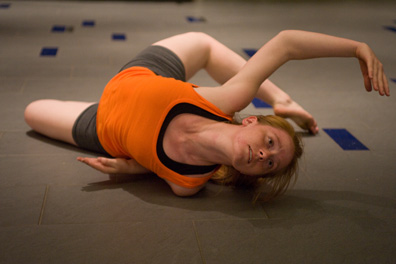
camerin-by-enoch-chanWhen you dance standing up, there is often a linear quality – similar to standing or walking. I love the connectivity and freedom to be found when dancing without the concern of balance/falling off your feet. Movement on the floor can be done with eyes closed and full internal attention to what is occurring within the body. With some practice, freedom found on the floor can be transferred to standing. It is the ease allowed by dancing on the floor, the repetition of movement, and the fluidity of Safety Release that permits inner investigation of movement as opposed to external visual focus.

The technique is focused on personal discovery. BJ likes to say that when she can do it “right” she will quit dancing. Each class offers a new opportunity to explore the movements through your own body. I find the continued opportunity to discover more, to further develop even the most basic movement sequences, very inspiring. Also, Safety Release has helped me to redefine success. Success is discovering something new each time you walk into the studio, and the work to maintain that focus. Studying Safety Release Technique taught me a process for being a dancer. There’s a connection with the metaphysical through the physical movement.

Safety Release Technique has a visceral circularity. I immediately related to this connectivity as my personal movement aesthetic is closely tied to fluidity and enjoying the pathway from one movement to the next. In understanding the movement vocabulary students are encouraged to focus on metaphor and create a story for themselves within the movement. This story or metaphysic understanding allows the mind to fully connect with the work of the body.

So that we are comfortable being really open together in listening to our bodies, I begin each class with a short community building activity. I try to encourage the class to the sense that we are more than a bunch of individuals sharing a space – we are a community sharing a common experience. It’s important that we are comfortable discussing our bodies and personal understanding of their capabilities in this specific movement vocabulary, and what is and isn’t working.

The movement is codified and taught in order very much like a ballet class. You will always do side hooked arm leg swings in a Safety Release class, just as in a ballet class you will always do tendue. Once you understand the mechanics of a side hooked arm leg swing each class offers moments to more fully explore that movement individually. Each movement flows directly into the next.

If you have any questions, thoughts or comments about the technique I’d be happy to respond to your comment here. I have benefited enormously from studying Safety Release Technique, and hope that you’ll join me for my workshop at Dance Place annex studio H on Thursday mornings in May.
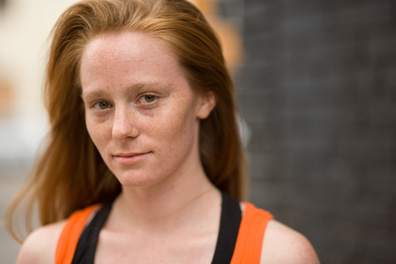
camerin-horizon-head-by-enoch-chanCamerin Allgood McKinnon, a Georgia Peach from Atlanta, developed a love for dance as part of Metro Dance Company in Decatur. She received her BFA Degree in performance and choreography from University of North Carolina at Greensboro in May of 2007. After graduation Camerin moved to Washington DC as an intern at Dance Place where she has since transitioned into staff. She also works with Mason/Rhynes Productions. Camerin has done performed locally in projects with Kayla Hamilton, Reggie Glass, Heather Doyle and Coyaba Dance Theater. She is currently apprenticing in Gesel Mason Performance Projects Women Sex and Desire: Sometimes you feel like a ho, sometimes you don’t. Camerin also teaches, working with all ages. She has been particularly inspired by her work with students with disabilities.

Images of Camerin are by Enoch Chan. Copyright (c) Enoch Chan, 2009

David Koteen on Caught Falling

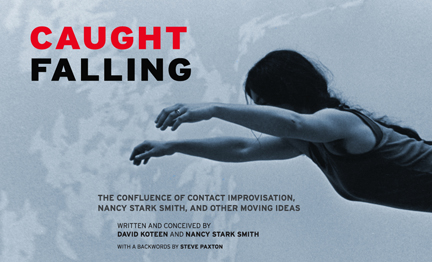
Hi. David Koteen here. Recently I completed a book with and about Nancy Stark Smith, entitled Caught Falling. Many of you will know Nancy as an experienced performer and teacher of the dance form Contact Improvisation.

In Contact Improvisation there’s no leader, no follower. No hierarchy. Contact Improvisation is democratic by its nature. Just bring your best game to the floor, make a point of contact, and begin. Follow and lead. Stay connected.

Our experience participating in the development of Contact has occurred in moment after moment. Creating Falling with Nancy, we realized that there was no way to summarize years of experience. Our book contains selected episodes from our experiences together with Contact Improvisation.

Because we are both such dedicated Contacters, every step in creating this book encouraged another step. Caught Falling is our dance, 14 years in the making and hardly breathing hard.

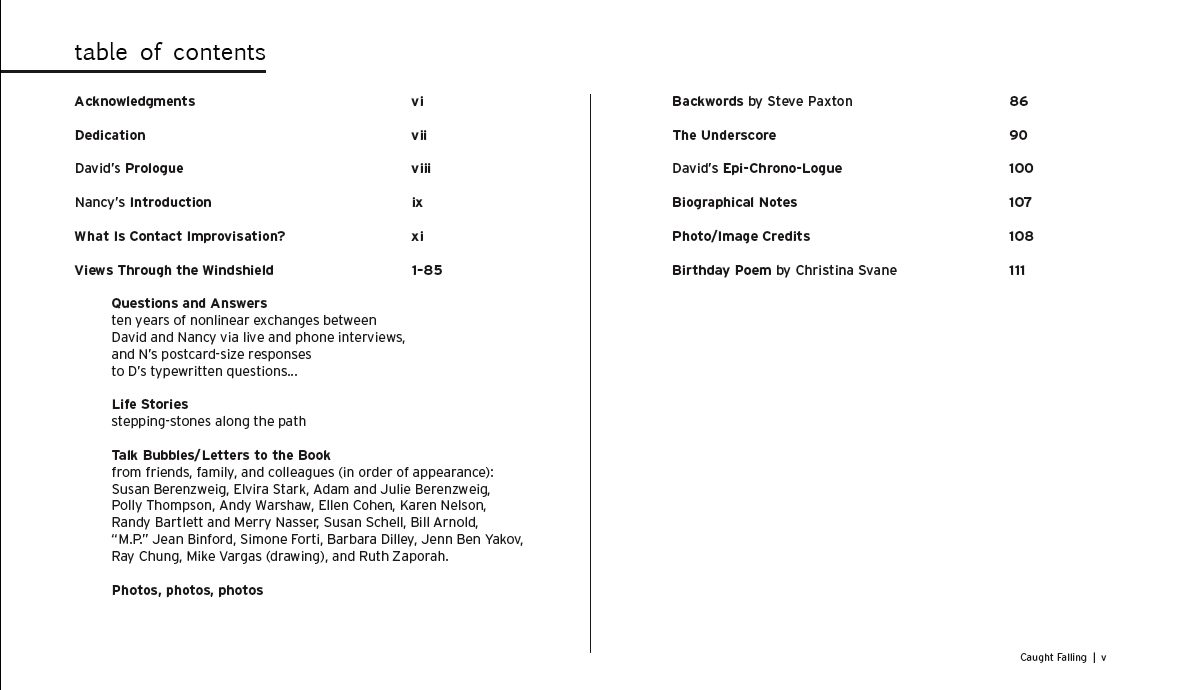
Following is the Table of Contents with a taste or two from each section.

David Koteen 5/4/09

Table of Contents

Prologue

Nancy and I have been working on this book, Caught Falling, on and off, in fits and starts, since 1994. It has truly been an engagement of two Aquarian, writer-type, Contact Improvisers. Fun, research, and exploration; very challenging, always moving. A slow long-distance dance.

Caught Falling is about Nancy’s life, about Contact Improvisation, about our mutual devotion to this endlessly delightful art-sport. We’ve generated volumes of material, edited and reedited, replaced, sought counsel, laughed at our complicated musings. How like a river the book caught us up in its current. Who knew where it would take us? What it would be?

Since the beginning of the project, my intention with Caught was to further disseminate information about CI, with Nancy as the medium: How she has unhesitatingly taken on major roles as Contact archivist, continuous editor of Contact Quarterly, initiator of CI25, and on and on. How she has wandered the globe like some peripatetic diva, embodying the spirit of Contact in her teaching, writing, performing, workshops, dance—life.

Take a look at Caught Falling; make contact with it; jam awhile…enjoy the ride!

From: What Is Contact Improvisation

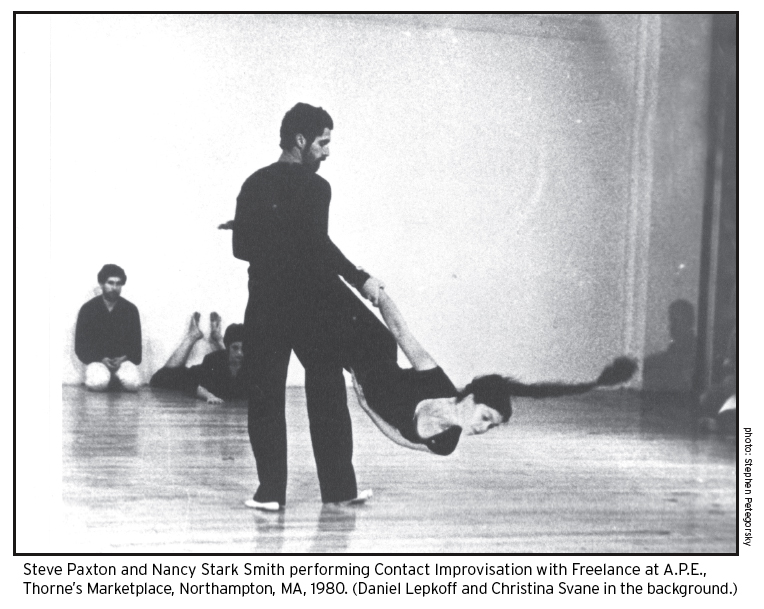
Contact Improvisation (CI) is, at its root, a duet dance form based on the dialogue of weight, balance, reflex, and impulse between two moving bodies that are in physical contact. The form was first presented during a series of performances that took place in New York City in June 1972 at the John Weber Gallery, conceived and directed by American choreographer Steve Paxton.

It is a free play with balance, self-correcting the wrong moves and reinforcing the right ones, bringing forth a physical/emotional truth about a shared moment of movement that leaves the participants informed, centered, and enlivened.

When I asked Steve recently what he thought the “core proposition” of Contact Improvisation was, at first he said he didn’t know, but on further reflection he offered this: “Do under others as you would have them do under you.”

steve_nancy

From: Epi-chrono-logue

From 1985 to 1990, prior to Raku and the falling rose incident, I had more observed Nancy from afar: teaching, laughing, singing, skipping – being best friends with her body – running backwards (eyes closed, standing by river in red beret) headstand with braid swishing like panther’s tail. Seamlessly fearless. We shared an occasional dance, lunch, happenstance, flash dialogue, random meeting. In Nancy I found a sophisticated sororal ally. An amphibious monkey creature, who like me, luxuriated in movement, romance, service and freedom.

My self had become rededicated to the principle of self-liberation through assistance to others on their respective paths…and here she was, Nancy, embracing her own karma, being her own gravity.

We shared a craving for precise language, art/icu/lation. Giving things their proper names. I suggested an interview, or intra-view, or VIEWS: our first working title.

I had been published on and off by The Sun Magazine and wrote editor Sy Safransky, January 1994, about interviewing NSS on CI for The Sun…..

From: He Made Me Do It

Caught Falling is a book for you to enter anywhere, follow along with, skip around in, imagine your own answers to the questions, be amused, be informed, enjoy in your own time. Follow the faces and the passage of time through a life; a family; an extended family of relatives, colleagues and friends. Imagine your life in it.

I have benefited beyond calculation from the profound teachings and enlivening practice of Contact Improvisation. Thank you Contact, thank you Steve, thank you David, thank you Contacters all over the world. May the benefit of our work and our pleasure in the dancing continue to multiply.

photogram Nancy Stark Smith 2008

Simone Forti’s Talk Bubble

Color is light, and Nancy has an eye for color. Delicate
and precise. Deep red, pale yellow, purple black, sky
blue. A touch of juniper. I’ve often wondered what
other animals must think of us, always changing
clothes, changing colors, so they can’t say of
us “the one that hangs out by the creek; the gray
one with white marking on its breast.” But of Nancy
they can always say, “The one that gives off light,
like wild flowers clustered in a clearing.”

From: Questions and Answers

David: I often describe Contact Improvisation as an American martial art but with no defense. Comment?

Nancy: And no offense? Defense and offense are communications that probably occur in CI too. But in CI, the intention of the activity is not to fight or prevail over the other or to neutralize their aggression, but to dance together. Perhaps in CI you could call it action and reaction. Yes, like martial arts: always being in the ready state. Maybe it’s closest to tai chi “push hands” practice, where you’re testing each others readiness to respond.

David: Currently for me, intimacy is the new road, the work, the way. Intimacy and touch go hand in hand. And contrary-wise, non-intimacy and non-touch lead to abuse and bayonets. As Karen Nelson so aptly stated: “Contact is the “touch revolution.”

Nancy: In Contact Improvisation, you need to be able to harmonize with your partner physically and energetically to dance with abandon safely. To read and be read through the surface of the skin takes patience and speed. It requires being aware of yourself and the other at the same time, often sharing a common center of balance – synchronizing weight, rhythm, and timing enough to proceed. This does tend to reinforce cooperation rather than aggression. In Contact, initiative can replace aggression.

From: Steve Paxton’s Backwords

As Contact Improvisation has enlarged geographically, it has become more inclusive socially. Ballet dancers, modern dancers, postmodern dancers, folks with disabilities, and just plain folks have ventured into the swirl of it. Apparently, a new common dance has emerged.

It is difficult for me to imagine the developments of the past quarter century without feeling gratitude for the keys Nancy has provided, the doors she has opened. She has made it possible for us to know ourselves and maintained a forum for our words, which will give future dancers an idea of this period.

bill_nancyFrom: Life Stories

Quitting smoking

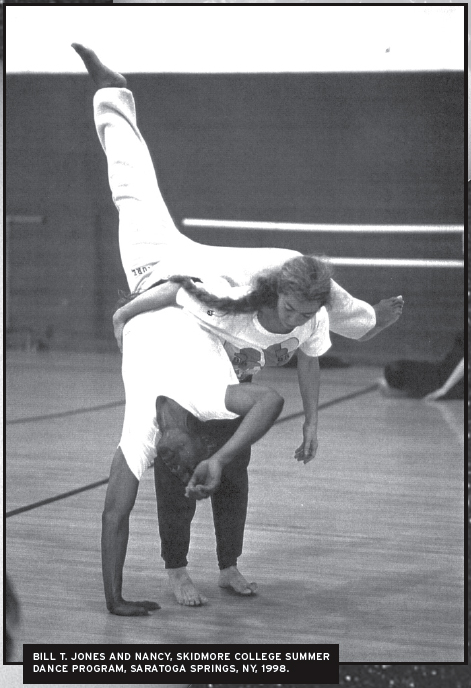
Thanks to Bill’s support, I quit smoking on January 28, 1986, which turned out to be the day that I was interviewing Bonnie Cohen and also the day the space shuttle Challenger blew up. Quitting smoking opened up a deep, raw emotional flow that I hadn’t realize was constricted; it introduced me to sadness I didn’t know I had and taught me how to tolerate my own tears. It was tremendously empowering to be able to give up a pleasurable but enslaving addiction.

From: The Underscore

What it is

The Underscore is a framework for practicing and researching dance improvisation that I’ve been developing since the early 1990’s. It is a score that guides dancers through a series of “changing states,” from solo deepening/releasing and sensitizing to gravity and support; through group circulation and interaction, Contact Improvisation (CI) engagements, opening out to full group improvisation with compositional awareness, and back to rest and reflection.

The Underscore can be seen as a vehicle for incorporating Contact Improvisation into a broader arena of improvisational practice; for creating greater ease for dancing in spherical space – alone and with others; and for integrating kinesthetic and compositional concerns while improvising. The Underscore is also being used in the CI community worldwide as a way to focus and concentrate Contact jams.

Dedications

This book is dedicated to probing life’s mysteries through movement, and to the people whose work that is.
NSS

To self-liberation & simultaneous liberation of others, which is both sides of Contact Improv.
DK

cover_final_smallsize

Caught Falling is distributed by:
Contact Editions
P.O. Box 603
Northampton, MA 01061

What Do We Need From Our Teachers by Cem Catbas

Every now and then an exceptionally talented dancer appears and revolutionizes the art form. They create new steps, and by pushing the boundaries of technique, they set higher standards for everyone to achieve. Unfortunately, sometimes even the talented dancer himself does not quite know how he is doing it, or does not have time to share the knowledge with others. It is the teacher’s responsibility to understand, and to pass on the understanding to aspiring dancers.

The expectation of becoming very strong and very flexible is contradictory. Without proper guidance, it is easy to make mistakes. In ballet, the teacher tries to simplify a movement that is so complicated by naming it, and relying on the visual learning capability of the student. There are no details in the art of ballet; it is a fine detail as a whole. But because the movements are very complex, the student begins to learn without capturing the details. He is asked to show it in the future the way ‘his teacher said so’. To teach the movement the teacher must also help the student develop skill in visual learning. One mistake that a teacher can make is to assume that if the student does not get it he is not intelligent. Even the most talented pupils need time and training: technique.

ce-in-airWe start teaching with slower movements and music because we know that students of a young age are incapable of executing movements fast and correctly. Many teachers, realizing the difficulty of their task, prefer to teach the students with similar body types to their own, hoping to get faster results by relying on their own experience. But not only ‘perfect body types’ become good dancers, and many bodies that look similar on the outside actually function very differently from one another. Talent has many faces and comes in many different shapes and forms.

Aches, pains, and injuries are common in ballet training. But pain will create doubt in the mind, forcing the student to distance herself from the training. Students deserve a method that reduces injury, and encourages healing. This is the miracle that makes a teaching method work. Imagine we broke an arm, and a surgeon operates on us. If the body did not heal, we would now have to deal with a broken arm and the injuries from the operation. Getting injured before gaining total understanding of a method is a common disruption to learning, and to learning how to teach. A correct system is very important to classical ballet training, to overcome and prevent injuries.

Artists are made by performing. A syllabus (and by that I mean the entire dance program for students at a school) should contain the repertoire of the affiliated company and plenty of performance opportunities for the young and talented students. In the navy, there is a very selective and elite group of soldiers that are called “Seals”. The idea is that nobody really becomes a navy seal, but through a vigorous and long test, the instructors (who also had to go through the test and completed it successfully) and the candidates find out the ones who were born with it. Talent has to be discovered, and ballet students need more than technique class to find their talent.

Despite the fact that it is very hard and sometimes painful, watching ourselves dance is one of the best ways to learn how to correct our mistakes. Let us face it; we are our own worst critic. Seeing ourselves the way the others do is another way to learn how to improve. It also helps to create a bond and trust with the teacher, because in seeing ourselves dance we learn to assess the corrections we have received and compare their results.

Part of the artistry – going beyond technique – is to make it look easy and effortless. We are often disappointed to realize that we are faced with teachers who as students and professionals were so busy trying to survive the system they never learned how to teach. Teachers must possess the qualities that they expect to teach their students.

cem-sona-1Cem Catbas, Artistic Director of Baltimore Ballet School, and co-founder and Director of Baltimore Ballet Company, danced principal roles with Pittsburgh Ballet Theatre, the Istanbul State Opera and Ballet, the Istanbul Contemporary Ballet, and the Koblenz Ballet in Germany. Awards he has won include the 2006 and 2002 Individual Artist Award for excellence in solo dance performance from the Maryland State Arts Council, 1st prize in the 1st International Seleznyov Ballet Competition in 1991, and the Most Promising Dancer award from the city of Istanbul. He has a B.F.A. with honors from the Istanbul University State Conservatory where he studied with Ramazan Bapov, Nikolai Morozov, and Ludmilla Morkovina. He has worked with Ben Stevenson (Houston Ballet), Patricia Wilde (NYC Ballet), Marianna Tcherkassky and Terrence Orr (ABT), Richard Glasstone (Istanbul Ballet), and Kent Stowell (Pacific Northwest Ballet), among others. He has choreographed “The Nutcracker”, “Pictures at an Exhibition”, “A Gershwin Rhapsody”, “Carnival of the Animals”, excerpts from “Petrouschka” and “Scheherezade”, and staged “Les Sylphides,” the 2nd act of “Giselle”, “Swan Lake” and “La Bayadere” for Baltimore Ballet. He has been a judge for several competitions including the Frederick Arts Council. His students have gone on to dance professionally, have won numerous awards including 1st Prize at the regional Youth America Grand Prix Competition, and have been accepted into the most prestigious summer programs with full scholarships (including NYC Ballet’s School of American Ballet). He has been interviewed on WMAR-TV, WJZ-TV, and Comcast Local Edition. He has given Master Classes in the US, Canada, and Europe.

A Guide to Participating in Artomatic by Tammy Vitale

2009 promises to be one of the best Artomatics yet. Each time I participate, I learn a little bit more about how to work this huge event to support my art and increase my network of artist friends.

For the un-initiated: Artomatic is a D.C. original, a massive, volunteer-organized, un-juried art show that features hundreds of visual artists, musicians, and performers of all types. Artomatic 2009 will occur May 29th to July 5th at 55 M Street, S.E., a new – but unoccupied – 275,000 square feet office building developed by Monument Realty. The building is located atop the Navy Yard Metro stop and within a block of Nationals Park, home to the Nationals baseball team.

Artomatic events occur regularly, but not on a set schedule. There are two good ways to stay up with what’s happening with Artomatic. First: be subscribed to the Artomatic website (http://www.Artomatic.org), and second: belong to artdc.org (http://www.artdc.org), where many of the Artomatic regulars go to chat between shows. There’s a special Artomatic topic there, but participating in any of the calls for shows is more than likely to put you in the same rooms as other Artomatic artists. Makes for a great grapevine!

Once I know Artomatic is going to happen, I start planning postcards, business cards, brochures and signage. Most of these can be self-designed and printed through VistaPrint on line for not much more than $15 total (really – they are an artist’s best friend.)

tammy-one-piece-hungNext comes the wait for registration day. Each year more and more folks have registered and this year, visual artist slots filled quickly. I sit with my computer so that I can register early. This merits an early site selection slot and a large range of volunteer slots to choose from. This year so many of us tried to register at noon opening, that we crashed the site. I finally made it in around 2:30. Alas, my new part time jobs (thank you economy) severely limited the times I could volunteer and I found many of the slots I had hoped to get already taken. Undaunted, I nevertheless found 3 workable slots and could relax for the day.

After registration is site selection. The volunteers who put the sites together – label and layout, and these last two years build the partitions and install electic – are amazing. They give untold hours of their time because they believe in this event. Each year everyone learns a bit more about how to deal with this many people (and don’t you know working with artists is like herding cats) effectively and efficiently. There are different strategies for making a site selection, but I’d say almost all are based around: how do I get my art where there will be lots of traffic and I can show to my art’s best advantage? Last year I tried for the top floor only to have several more floors above me open after I had already done site selection. This year we will be on the 2nd floor, which also has cabaret and a bar – not too close to the bar, but within shouting distance.

Now the fun begins. Some artists live in town and can be on site easily and regularly from the time they open the site up until opening. I, on the other hand, live almost 2 hours away. So I plan one trip (planning being harder this year not only because of my part-time job – now down to one – but also because this time we (Artomatic) are across from the Nationals’ Stadium and game days seem to be non-stop. Parking in the building this year is a “bit” more than in past years. One must suffer for one’s art. There is almost a month to complete your site prep and hanging, and a month to load out, on either side of the month-long show itself.

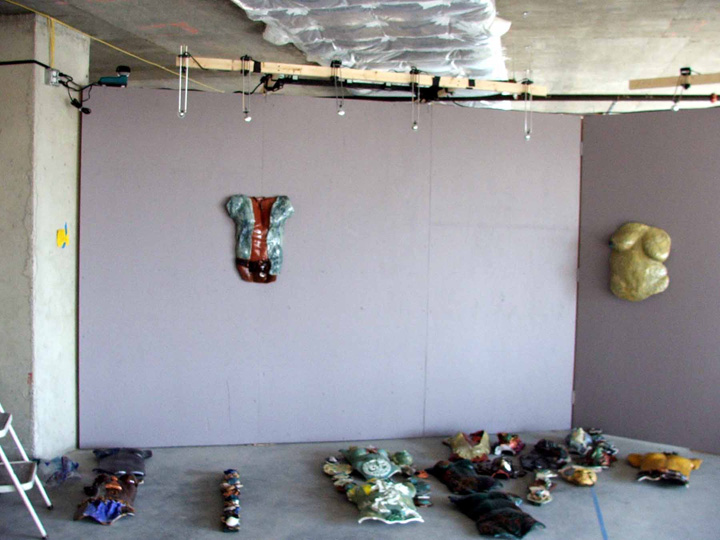
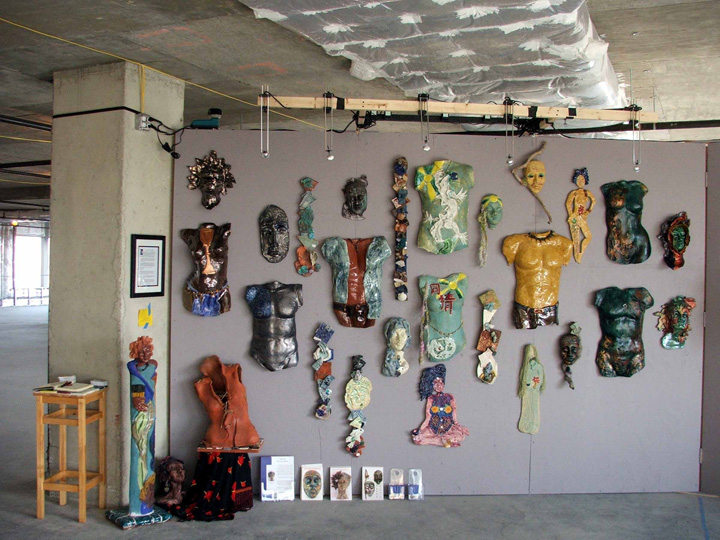
Because I have sold retail for about 5 years now, I always have a lot of work hanging around waiting to be “out there” but I still use Artomatic to push my own envelope a bit, trying to see what direction new work might take. This year, in addition to masks, several torsos and some tile work, I will be showing my new efforts at glass work (slumping), along with some abstracted clay work that I am, as I type, still trying to figure how best to mount for hanging. I love going to Artomatic to see how other artists display their work. There is so much innovation in presentation (which happens to be perhaps my weakest skill) that it becomes like taking a class in how to show art.

tammys-art-hungI make a list of things that need to come with me to install my work. Anything forgotten can put a real glitch in the plans. It all has to fit in my car (with the back seat out) including my marvelous handtruck which changes into a flatbed and can carry the world and make it feel like a feather. Having done this for other shows, including the Philadelphia Buyer’s Market, I’m getting pretty good at knowing what needs to come, and even better at stashing things afterward in self-contained groupings that make gathering it back together for a show like taking things off the shelf. For several years I have managed to plan my ArtOmatic load-in to occur with several of my volunteer dates so I go early, stay late, and get two things done (one trip: paint and then do shiftwork, one trip hang and then do shiftwork). This year that wasn’t workable, so I’ll just take a full day to paint and hang all at once (on a non-game day when hopefully the garage won’t be charging premium price).

My first two Artomatics were labors of love. I sold nothing. But the last two I’ve done very well. And, it is still a labor of love for me and I’m still always delighted when someone finds something they can’t live without (last year I had two return buyers from the year before – collectors!)

As a way to get to know other artists, and because I blog, I wander through Artomatic several times during the show, taking photos and making notes. Often I contact the artists and many have been kind enough to do interviews via email with me. This has led to getting to know other artists better. Originally my hope was to become more active in the DC art world, but my own inclination not to travel there regularly put an end to that. Now I do it to honor the artists whose work I enjoy and as a way to get to know more people at Artomatic.

I’ll admit that during the hard work of set up I often wonder if it’s all worth it. I think my returning again and again is its own answer!

[Editor’s not: you can read more of Tammy’s writing (including about preparing for Artomatic) and see more of her work on her blog and website. The blog is at http://www.tammyvitale.com, and her website is at http://www.Sacred-TammyVitale.com.]

Tammy Vitale is a clay and glass artist who also dabbles in the 2D arts. She is currently represented on the Atlantic Coast by A Step Above in Berlin, MD, Herons Way Gallery and Leonardtown Galleria, both in Leonardtown, MD, Sea Scapes in North Beach, MD, Sandy Bay Gallery in Hatteras, NC and Island Artworks in Ocracoake, NC, Ravenwood Curio Shoppe in New Hampshire, Sara Jessica Fine Arts in Provincetown MA and Atlantic Artisans in Atlantic Highlands, New Jersey. Her smaller work can be found at The Bead Boutique and Body in Balance in Prince Frederick, MD. The magazine, Artful Blogging, features one of her drawings in its May/June/July issue (page 35). In February 2009, she taught her ceramic torso class to 2 students (see http://www.heatherbartlettart.com/2009/03/tile-making-workshop-by-parran-collery/ for a review of that class) and in March she was interviewed by MMCA Marketplace, an on-line gathering place for artists. [http://mmcamarketplace.typepad.com/mmca_marketplace/2009/03/tammy-vitale-of-lusby-marylandis-no-stranger-when-it-comes-to-mixed-media-anda-long-list-of-accomplishments-that-inc.html]. She has been accepted for the show, PINK, hosted by Coury Gallery in Savage Mill, MD (April 2009), and will participate in the upcoming 12 x 12 show (May 16) with ArtDC.org’s new space in Hyattsville, MD. In 2008, joining with Heather Bartlett of Charles Cty, MD, Vitale created interactive chalkboard torsos for the installation art piece Body Politics (http://bodypolitics.allzah.com/)

Vitale started her full-time career as a clay sculptor in May 2002 as resident artist at Carmen’s Gallery in Solomons, Md, for one month, and went on to found the Wylde Women Gallery (10/2004), open to and encouraging all artists, which was closed a year later (10/2005) due to censorship. Vitale also founded the non-profit Arts Alive! which sought to bring diverse art and artists to Southern Maryland, including the delightful Annie King Phillips who presented a lecture and workshop on collage in conjunction with the Calvert County Library. Vitale was co-curator of “Independent Visions,” an art show at Vision Gallery in Georgetown (DC) July 9 – 30, 2005. She has participated in the last four ArtOMatic shows, in DC in 2002 and 2004, Crystal City in 2007, and MOCA DC 2008. She teaches classes in clay in her home studio – tiles, architectural tilework, fish and torsos – and has taught tile-making and fish at Southern Pines in conjunction with the Calvert Artists Guild. Her current obsession is making lampworked beads, beadwork and jewelry design and she still occasionally dabbles in painting for relaxation.

Jessica Williams: What is Dance?

0

What is Dance, you ask? Dance is ephemeral. You have to be there.
Picture is attached.

During precious free time, Jessica Williams has had the pleasure of presenting choreography in various venues throughout NYC including Dance New Amsterdam, Triskelion Arts and the DUMBO Dance Festival. Jessica derives her artistic influences from contemporary ballet and Merce Cunningham’s chance elements. Randomly assigned isolations of the body initiate a chain-reaction of fluid momentum. By coinciding chance with pre-determined repetition, her work illustrates the dialectics of free will versus destiny.


[editor’s note: The last sentence might not have been part of the intended answer. Regardless – there was no photo attached, and the answer is especially clever with the last sentence.]