Home Blog Page 174

Local Work (or not so local) by Jessica Hirst

After choreographing, teaching, dancing and performing in the DC area for six years I came to live in Managua, Nicaragua at the invitation of my partner, Otto Castillo.

Talk about a different working environment. My first several months we kept running out of water. We had to choose between taking a shower or washing the dishes. Now we have an alternating schedule of blackouts, one week no juice from 2pm to 7pm, next week dark from 5pm to 11pm. Most dance and aerobics classes take place on concrete or uneven, unfinished, untouched-since-the-revolution-when-the government-cared-about-culture wood floors. Then there are the mosquitos, the upset stomachs, the piropos (catcalls), the horrendous roads, the corrupt traffic police (they took my Maryland license because I wouldn’t pay up), the corrupt ex-revolutionaries, and, of course, the intense heat, uninterrupted by air-conditioning. My friends and family in the states can’t understand why I want to be here. Let me explain.

Nicaragua has become my space to try anything. I am free of whatever pressure I felt in Washington to succeed, to fit in, to not fit in, to be liked by the right powerful people, to show up on time. I have been discovering that I am less a choreographer-dancer and more a multidisciplinary artist who likes to move her body. I am still performing, more with images and actions than choreographed movement. My fascination with site-specific choreography has morphed into Nicaragua-specific art.

Garbage?

There is no such thing as garbage here. Anything with metal in it – old broken car parts, household appliances, teeth – can be resold. I started making earrings out of bottle caps, corks, keys, and wooden clothespins. While recycled fashion is chic in the US, here it is shocking to see a chela (white girl) with garbage hanging from her ears. Lately more people have been asking where they can get their own, which I take as a good sign.

Violation

The amount of child sexual abuse here is staggering, as is the Sandinistas’ crass decision to curry favor with the Church by outlawing all abortions, even when the pregnancy is the result of rape or the mother’s life is in danger. I kept imagining pregnant little girl dresses hanging on a clothesline. I made a performative installation that incorporates the dresses and macho futbol (soccer) slang for sex. The National Network of Women Against Violence invited me to show it in front of the Supreme Court and at National Women’s Day. The companion piece, which I have performed in Costa Rica and Tijuana, is an homage to Yoko Ono’s Cut Piece, in which she invited the audience to cut her dress off of her. In my piece I wear a little girl-style dress and recite a litany of cases, statistics, and commentary on child sexual abuse while people cut my dress. The air gets very charged, and the piece takes on a ritual quality. For some people, including abuse survivors, it is therapeutic, for others it is disturbing to be confronted with this part of their reality.

Ritual Sex

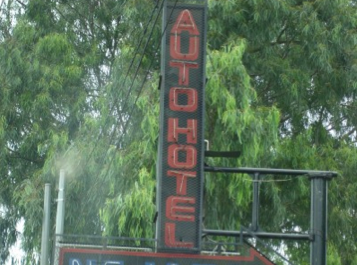
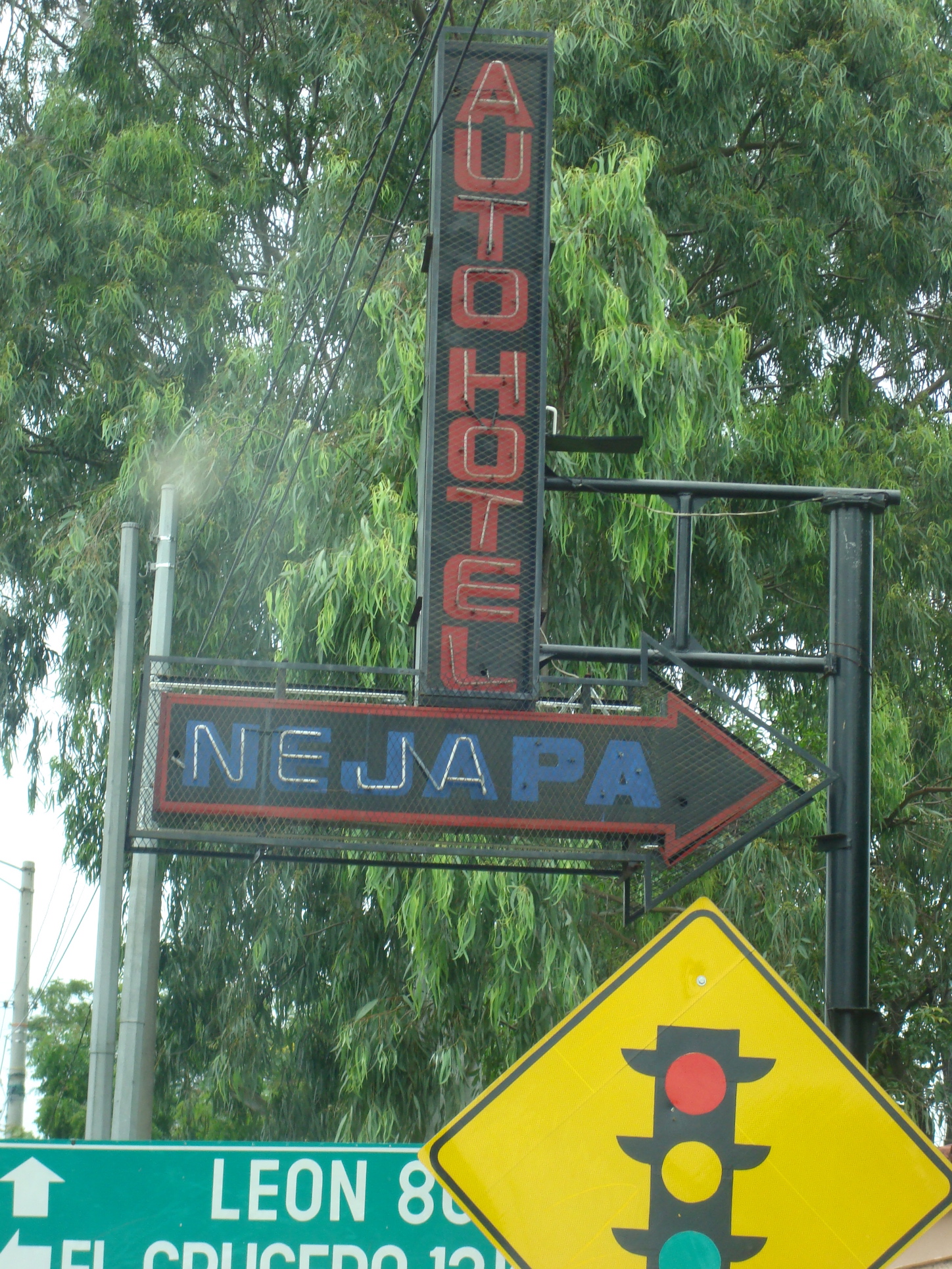
One of my least favorite cultural institutions here is the Auto Hotel. Auto Hotels are designed expressly for covert sexual encounters, and they’re everywhere. When you drive into an auto-hotel an attendant waves you toward a very tight enclosed parking space. He closes a huge curtain behind your car. Inside you find a bed, condoms, a TV that only shows bad porn, a wooden suggestion box, a bathroom, and towels embroidered with the hotel’s name. In one place we saw playground/workout/torture equipment for more exotic sex. We stole the helpfully framed cartoon instructions for ‘the many positions you can enjoy’ on this jungle gym, in addition to the towels and the suggestion box. One last bit of brilliance on the anonymity front: you interact with the hotel staff through a wooden box in the wall, so they never see you. We ordered rum and soda and they delivered it through the box.
I made a performance piece in which I engage the audience as a gringa archaeologist studying the sexual behavior of Nicaragua in the 21st century. The audience seemed to find it hilarious, especially since it featured a bumbling, self-deprecating North American.

There was one genuine suggestion in the box when we took it from the Auto Hotel, and I asked the audience to submit their own guesses as to what the suggestion was. The correct answer was not titillating on the surface, but look beneath and you will find implications of a dark and dangerous world: ‘Please remove the outdoor lighting on the entry from the street’.

I doubt I will return to pure choreography, and that´s OK. I was always supremely frustrated alone in a studio trying to make movement.

Jessica Hirst is a multidisciplinary artist who lives in Managua, Nicaragua, and Washington, DC. In Managua she lives with her partner, artist and psychologist Otto Castillo, and her dog, Benedicto the 17th.autohotel-compressed
Musings on Tundra by Mare Hieronimus

The story of my newest project, Tundra, is part of an ongoing story about how I am trying to make sense out of the intersection of literature/narrative and dance. In the creation of Tundra, I started with a series of questions. What is it to be a woman in the world, alone? What is it to choose solitude? Does solitude turn into an exile from self, shadow self, or other? What does it mean to face ones shadow.

I turned to writing – as I often do – as a way to sort through these questions. The writing for Tundra grew, and started to take on the form of a story written in an old- English inspired prose. Simultaneously, I was working in the studio with movement.

I have always found writing and dance very difficult to integrate. Dance can be nonlinear, overlapping, and multi-dimensional. Dance can create a whole picture and experience without adhering to a linear sense of time. Beginnings and endings can mysteriously happen in reverse, and make perfect sense. Traditional written language is linear in nature.

tundra_mare-hieronimus_photo-by-yi-chun-wu_1_25mbI found myself struggling with merging the world that I had on paper, a half finished story about a sort of visitation of the shadow, with the world that was happening in the studio, in our bodies. I was very apprehensive about laying a narrative on top of the dance. Working across disciplines calls for a delicate balance, the right arrangement where one medium enhances the other, without overshadowing it. At this point in my process, the parts remained very separate, and I continued to think of the writing as a hazy backdrop that the audience might never see.

I made an initial draft of the dance Tundra in January 2007. I was utterly confused by it. Frustrated by my own inability to integrate and merge my ideas in a cohesive way, I wanted it out of my life. And luckily – life gave me a diversion; I was whisked away by Maida Withers to tour Russia.

Strangely enough, Maida took me to a personal tundra while we toured Moscow, and the physical tundra of Siberia. While in Russia I had a deepening of my own experience of solitude and land. I also found myself pushed to a limit, facing things that terrified me, and living in a sort of a barren and beautiful terrain (a terrain that I had psychically imagined as the world of my work at the time.) I couldn’t really escape. I suppose we never really can escape our thoughts. Through this journey, something shifted.

When I returned to the States I came back ready to finish my written story, and ready to take a different step with the performance, though I still wasn’t sure what that step would be. Shortly after returning to New York, in May of 2007, I was asked to perform informally at a Salon showing. I had no original sound score. So I decided to merge the written prose with the movement, and to allow the prose to be an integral part of the sound score for the dance. I created a score through the text and other found sound. For whatever reason, this was terrifying for me. I think I was scared to reveal too much, to move too close to narrative, and to lose the sense of mystery that I often try to cultivate in my work. Response to the performance was very positive though, and instead of losing its mysterious quality, people told me that it gained a whole new level of intrigue, that they were able to enter into the world in a more complete way.

Through the summer and now into the fall, I have been working to complete my dance/story. Using the story as the score, I am moving along creating it, part by part. I don’t know what it will be in the end, of course. But I am thrilled by this dive into the literary aspect of my work, and by the prospect of fusing these media together in a more cohesive way. It has also given me new fuel for other projects, new ideas about how I can incorporate story and narrative into my world of dance.

Maré Hieronimus is a Brooklyn-based interdisciplinary dance artist, performer and teacher. Often working as a solo performer, Maré creates abstract and psychic landscapes, using the body in motion as the primary impulse. Her choreographic and improvisational performance experiments have been presented in gallery and site specific settings, including in NYC at Dixon Place, The Flea Theatre, Monkeytown, The 92nd St. Y, Solar One Powered Dance Festival, and Les Petit Versailles Gardens. Tundra can be seen this fall at White Wave Rising Festival October 31st, November 2nd, November 3rd, November 4th

www.marehdance.com
www.whitewavedance.com

originally published in Bourgeon Volume 3 #2 as: Finding the Dance Story: Musings on My Process With Tundra
by Mare Hieronimus

Chino Latino by Dana Tai Soon Burgess

0

On October 12, 2007, I will premiere a new company work at the Kennedy Center’s Terrace Theater entitled, Chino Latino. This suite of dances references my teenage years in New Mexico. I grew up in Santa Fe attending Spanish and English bilingual schools. Although I am Korean-American, my nickname at school was “Chino”.

By night I would go salsa dancing at the Cactus Club, a questionable establishment located on the outskirts of town. My high school accounting teacher was the bouncer/doorman. When I entered those doors, I saw the shadowy outlines of people who I longed to know, and wished I could dance like. I wondered who they were and how they had built their nightlife personas.

This season, I entered the studio to build a movement vocabulary from the life that I was engrossed in when I was in New Mexico. In addition to my social dance experiences, I religiously took martial arts and modern dance classes as a teenager. All of these images and experiences went into Chino Latino. The vocabulary we have been developing is a synthesis of martial arts, salsa, meringue and modern dance. For a sound score, I chose Spanish music that evokes the presence of Asians in Latin and South America from the 1920s to the 1970s.

My company has toured extensively through South America over the past decade, and at each stop I have met artists of Asian ancestry, many from families that immigrated in the 1800s. We have spoken of shared experiences growing up Asian in a Latin culture. I have enjoyed encountering the multi-faceted visions that emerge from our common cultural intersection. There is a particular synergy in Asian and Latin cultures that combines to develop a distinct voice. I like to call this an ‘Asian-Americas Aesthetic’.

I am finding that tapping this history provides me with a great source of inspiration for dance-making. Global exchanges and new visions for art are all around us. They begin on the simplest personal level, such as a social dance, and manifest as public art. All those late nights in the smoke-filled Cactus Club have left me with wonderful memories, and better yet, choreographic inspiration.

Dana Tai Soon Burgess is the Artistic Director of Dana Tai Soon Burgess and Company. His choreography has been presented and commissioned by The Smithsonian Institution, The Asia Society, The Kennedy Center, Lincoln Center, La Mama, and the United Nations. He received the District’s Mayor’s Arts Award in 1994 and 2004. He is on faculty at The George Washington University.

Editor’s Note:

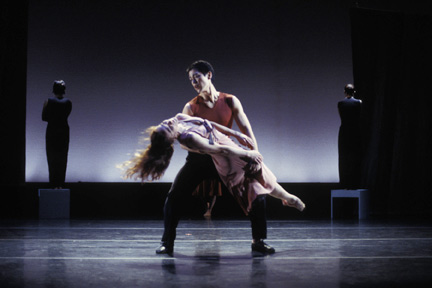
Here is some video of a piece made by Dana Tai Soon Burgess. The images illustrating this article come from this piece.

Letter from the Editor – Bourgeon Vol. 3 #2

0

It is hard for audience members to learn about what we do. In an article entitled “Ballet for your Children”, George Balanchine wrote, “many of us are more easily entertained if we have in advance some information about an art that happens to be strange to us.” As someone who came to dance later in life, I can relate to his sentiment. Sometimes what we do seems awful strange.

In Bourgeon Volume 2 #1, Suzanne Carbonneau spoke about the importance of art encouraging its own discovery. Carbonneau – who is a critic – wrote of how Merce Cunnigham’s work encouraged her to understand the world in a new way, so that she could understand the work. With that understanding I am forced to question whether or not writing about dance is valuable. Perhaps to build audience, and understanding, all we need is better work.

In this issue Dr. Judith Hanna asserts that being a stripper is like being an acress. Jessica Hirst asserts a connection between the culture of sports and sexual abuse. Lisa Traiger asserts the centrality of a plural identity in Liz Lerman’s work.

I don’t know that I agree with all of these assertions, but I enjoy learning what these artists are thinking about, and find my own thoughts clarified by reading their words. If you appreciate the dance writing in this magazine, please visit www.dayeight.org, make a donation, or purchase a subscription.

Sincerely,

Robert Bettmann

The Shallows by Jody Bolz

0

Oh for a life of sensations over thoughts!
-Keats

We passed into the shallows–
limbs slow wings–

the great world of days
something separable, irrelevant,

and minded only surface stars,
the dreaming elements.

So the stream held us: sensation fell
like water from our fingers,

shaped for an instant,
then returned–

and all we would attend to there
was summer sunlight, summer air.


Jody Bolz is the author of A Lesson in Narrative Time (Gihon Books). Her poems and essays have appeared widely in such journals as The American Scholar, Crab Orchard Review, Indiana Review, and Ploughshares–and in many literary anthologies. She is an editor of Poet Lore, America’s oldest poetry magazine, founded in 1889.